Results by title
460 books match the query 'Law and legislation' and 20 start with m
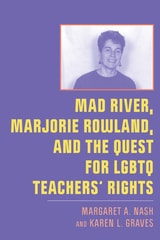
Mad River, Marjorie Rowland, and the Quest for LGBTQ Teachers’ Rights
Margaret A. Nash
Rutgers University Press, 2022
In the first in-depth treatment of this foundational legal case, authors Margaret A. Nash and Karen L. Graves tell the story of that case and of Marjorie Rowland, the pioneer who fought for employment rights for LGBTQ educators and who paid a heavy price for that fight. It brings the story of LGBTQ educators’ rights to the present, including commentary on Bostock v Clayton County, the 2020 Supreme Court case that struck down employment discrimination against LGBT workers.

Making Fathers Pay
The Enforcement of Child SupportDavid L. Chambers
University of Chicago Press, 1979
Making Fathers Pay is David L. Chambers's study of the child-support collection process in Michigan, the state most successful in inducing fathers to pay. He begins by reporting the perilous financial problems of divorced mothers with children, problems faced even by mothers who work full time and receive child support. The study then examines the characteristics of fathers who do and do not pay support and the characteristics of collections systems that work.
Chambers's findings are based largely on records of fathers' support payments in twenty-eight Michigan counties, some of which jail hundreds of men for nonpayment every year. Chambers finds that in places well organized to collect support, jailing nonpayers seems to produce higher payments from men jailed and from men not jailed, but only at a high social cost. He also raises grave doubts about the fairness of the judicial process that leads to jail. While Chambers's total sample includes 12,000 men, he interweaves through his text moving interviews with members of one family caught in the painful predicaments that men, women, and children face upon separation.
To increase support for children at lower social costs, Chambers advocates a national system of compulsory deductions from the wages of non-custodial parents who earn more than enough for their own subsistence.
Making Rights Real
Activists, Bureaucrats, and the Creation of the Legalistic StateCharles R. Epp
University of Chicago Press, 2009
It’s a common complaint: the United States is overrun by rules and procedures that shackle professional judgment, have no valid purpose, and serve only to appease courts and lawyers. Charles R. Epp argues, however, that few Americans would want to return to an era without these legalistic policies, which in the 1970s helped bring recalcitrant bureaucracies into line with a growing national commitment to civil rights and individual dignity.
Focusing on three disparate policy areas—workplace sexual harassment, playground safety, and police brutality in both the United States and the United Kingdom—Epp explains how activists and professionals used legal liability, lawsuit-generated publicity, and innovative managerial ideas to pursue the implementation of new rights. Together, these strategies resulted in frameworks designed to make institutions accountable through intricate rules, employee training, and managerial oversight. Explaining how these practices became ubiquitous across bureaucratic organizations, Epp casts today’s legalistic state in an entirely new light.
Managing Data for Patron Privacy
Comprehensive Strategies for LibrariesKristin Briney and Becky Yoose
American Library Association, 2022
- succinct summaries of major U.S. laws and other regulations and standards governing patron data management;
- information security practices to protect patrons and libraries from common threats;
- how to navigate barriers in organizational culture when implementing data privacy measures;
- sources for publicly available, customizable privacy training material for library workers;
- the data life cycle from planning and collecting to disposal;
- how to conduct a data inventory;
- understanding the associated privacy risks of different types of library data;
- why the current popular model of library assessment can become a huge privacy invasion;
- addressing key topics while keeping your privacy policy clear and understandable to patrons; and
- data privacy and security provisions to look for in vendor contracts.
Managing Land Use Conflicts
Case Studies in Special Area ManagementDavid J. Brower and Daniel S. Carol, eds.
Duke University Press, 1987
Marriage and Divorce in the Jewish State
Israel's Civil WarSusan M. Weiss and Netty C. Gross-Horowitz
Brandeis University Press, 2012
Mastering the Law
Slavery and Freedom in the Legal Ecology of the Spanish EmpireRicardo Raúl Salazar Rey
University of Alabama Press, 2020
Atlantic slavery can be overwhelming in its immensity and brutality, as it involved more than 15 million souls forcibly displaced by European imperialism and consumed in building the global economy. Mastering the Law: Slavery and Freedom in the Legal Ecology of the Spanish Empire lays out the deep history of Iberian slavery, explores its role in the Spanish Indies, and shows how Africans and their descendants used and shaped the legal system as they established their place in Iberoamerican society during the seventeenth century.
Ricardo Raúl Salazar Rey places the institution of slavery and the people involved with it at the center of the creation story of Latin America. Iberoamerican customs and laws and the institutions that enforced them provided a common language and a forum to resolve disputes for Spanish subjects, including enslaved and freedpeople. The rules through which Iberian conquerors, settlers, and administrators incorporated Africans into the expanding Empire were developed out of the need of a distant crown to find an enforceable consensus. Africans and their mestizo descendants, in turn, used and therefore molded Spanish institutions to serve their interests.Salazar Rey mined extensively the archives of secular and religious courts, which are full of complex disputes, unexpected subversions, and tactical alliances among enslaved people, freedpeople, and the crown.
The narrative unfolds around vignettes that show Afroiberians building their lives while facing exploitation and inequality enforced through violence. Salazar Rey deals mostly with cases originating from Cartagena de Indias, a major Atlantic port city that supported the conquest and rule of the Indies. His work recovers the voices and indomitable ingenuity that enslaved people and their descendants displayed when engaging with the Spanish legal ecology. The social relationships animating the case studies represent the broader African experience in the Americas during the sixteenth and seventeenth centuries.
Media Localism
The Policies of PlaceChristopher Ali
University of Illinois Press, 2017
Medical Monopoly
Intellectual Property Rights and the Origins of the Modern Pharmaceutical IndustryJoseph M. Gabriel
University of Chicago Press, 2014
Drawing on a wealth of previously unused archival material, Medical Monopoly combines legal, medical, and business history to offer a sweeping new interpretation of the origins of the complex and often troubling relationship between the pharmaceutical industry and medical practice today. Joseph M. Gabriel provides the first detailed history of patent and trademark law as it relates to the nineteenth-century pharmaceutical industry as well as a unique interpretation of medical ethics, therapeutic reform, and the efforts to regulate the market in pharmaceuticals before World War I. His book will be of interest not only to historians of medicine and science and intellectual property scholars but also to anyone following contemporary debates about the pharmaceutical industry, the patenting of scientific discoveries, and the role of advertising in the marketplace.
Mental Disorder, Work Disability, and the Law
Edited by Richard J. Bonnie and John Monahan
University of Chicago Press, 1996
This book will be of great value to scholars in law and the mental health professions and to policy makers and the administrators of disability programs.
Mexico's Indigenous Communities
Their Lands and Histories, 1500-2010Ethelia Ruiz Medrano
University Press of Colorado, 2010
Ethelia Ruiz Medrano focuses on a series of individual cases, falling within successive historical epochs, that illustrate how the practice of drawing up and preserving historical documents-in particular, maps, oral accounts, and painted manuscripts-has been a determining factor in the history of Mexico's Indian communities for a variety of purposes, including the significant issue of land and its rightful ownership. Since the sixteenth century, numerous Indian pueblos have presented colonial and national courts with historical evidence that defends their landholdings.
Because of its sweeping scope, groundbreaking research, and the author's intimate knowledge of specific communities, Mexico's Indigenous Communities is a unique and exceptional contribution to Mexican history. It will appeal to students and specialists of history, indigenous studies, ethnohistory, and anthropology of Latin America and Mexico
Monongah
The Tragic Story of the 1907 Monongah Mine DisasterDAVITT MCATEER
West Virginia University Press, 2014
New paperback edition with an introduction by Robert B. Reich
Monongah: The Tragic Story of the 1907 Monongah Mine Disaster documents the events and conditions that led to the worst industrial accident in the history of the United States. This mining accident claimed hundreds of lives on the morning of December 6, 1907 and McAteer, an expert on mine and workplace health and safety, delves deeply into the economic forces and social-political landscape of the mining communities of north central West Virginia to expose the truth behind this tragedy. After nearly thirty years of exhaustive research, McAteer determines that close to 500 men and boys—many of them immigrants—lost their lives that day, leaving hundreds of women widowed and more than one thousand children orphaned.
The tragedy at Monongah led to a greater awareness of industrial working conditions, and ultimately to the Federal Coal Mine Health and Safety Act of 1969, which McAteer helped to enact. This new paperback edition includes an introduction by Robert B. Reich, Chancellor’s Professor of Public Policy at the University of California at Berkeley and Secretary of Labor during the Clinton administration.
More Guns, Less Crime
Understanding Crime and Gun Control Laws, Second EditionJohn R. Lott, Jr.
University of Chicago Press, 2000
"Lott's pro-gun argument has to be examined on the merits, and its chief merit is lots of data. . . . If you still disagree with Lott, at least you will know what will be required to rebut a case that looks pretty near bulletproof."—Peter Coy, Business Week
"By providing strong empirical evidence that yet another liberal policy is a cause of the very evil it purports to cure, he has permanently changed the terms of debate on gun control. . . . Lott's book could hardly be more timely. . . . A model of the meticulous application of economics and statistics to law and policy."—John O. McGinnis, National Review
"His empirical analysis sets a standard that will be difficult to match. . . . This has got to be the most extensive empirical study of crime deterrence that has been done to date."—Public Choice
"For anyone with an open mind on either side of this subject this book will provide a thorough grounding. It is also likely to be the standard reference on the subject for years to come."—Stan Liebowitz, Dallas Morning News
"A compelling book with enough hard evidence that even politicians may have to stop and pay attention. More Guns, Less Crime is an exhaustive analysis of the effect of gun possession on crime rates."—James Bovard, Wall Street Journal
"John Lott documents how far 'politically correct' vested interests are willing to go to denigrate anyone who dares disagree with them. Lott has done us all a service by his thorough, thoughtful, scholarly approach to a highly controversial issue."—Milton Friedman
More Guns, Less Crime
Understanding Crime and Gun Control Laws, Third EditionJohn R. Lott, Jr.
University of Chicago Press, 2010
On its initial publication in 1998, John R. Lott’s More Guns, Less Crime drew both lavish praise and heated criticism. More than a decade later, it continues to play a key role in ongoing arguments over gun-control laws: despite all the attacks by gun-control advocates, no one has ever been able to refute Lott’s simple, startling conclusion that more guns mean less crime. Relying on the most rigorously comprehensive data analysis ever conducted on crime statistics and right-to-carry laws, the book directly challenges common perceptions about the relationship of guns, crime, and violence. For this third edition, Lott draws on an additional ten years of data—including provocative analysis of the effects of gun bans in Chicago and Washington, D.C—that brings the book fully up to date and further bolsters its central contention.
More Speech, Not Less
Communications Law in the Information AgeMark Sableman. Foreword by Paul Simon
Southern Illinois University Press, 1997
On a daily basis we are confronted with "more speech, not less"—more news reports, more television channels, more publications, more electronic communications. Communications laws have expanded in response to the proliferation of communications, and these laws affect everyone.
Communications lawyer Mark Sableman uses recent case studies, practical examples, and plain language to describe and analyze the broad spectrum of modern communications laws and policies. In these essays, Sableman helps communications professionals as well as informed citizens understand the law.
The constitutional foundation for the information age is settled: radical solutions on either side have been rejected. Neither First Amendment absolutism nor untrammeled content-based censorship will rule in America. But within the remaining middle area, many key policy choices are being made by courts and policy makers. Intricate webs of legal do’s and don’ts, practical pitfalls, and effective safe harbors are being developed across the broad spectrum of communications law.
In this guide to existing law, developing trends, and critical policy determinations, Sableman discusses privacy, Internet communications and policy, censorship, libel and slander, copyright and intellectual property, advertising, broadcasting, and journalistic confidentiality. Through actual cases and practical examples, he examines and explains both the existing rules for communications professionals and the developing policies that deserve the attention and scrutiny of informed citizens. Sableman approaches these subjects as a practicing lawyer experienced in both business and media communications.
The phrase "more speech, not less" describes not only the growing cacophony of the information age, but also one approach to legal policy—Justice Louis D. Brandeis’s preference for "more speech, not enforced silence" in all but the most extreme situations. Drawing from his strong advocacy of free speech, Sableman hopes to stimulate informed debate among all who are concerned about the power of information and the magic of words and images.

More Than Science and Sputnik
The National Defense Education Act of 1958Wayne J. Urban
University of Alabama Press, 2010
Sparked by dramatic Soviet achievements, particularly in nuclear technology and the development of the Sputnik space orbiter, the United States responded in the late 1950s with an extraordinary federal investment in education. Designed to overcome a perceived national failure to produce enough qualified scientists, engineers, and mathematicians to compete with the Communist bloc, the effort resulted in the National Defense Education Act of 1958 (NDEA). Representative Carl Elliott and Senator Lister Hill both from Alabama, and then Assistant Secretary of Health, Education, and Welfare, Elliot Richardson were the prime movers in shaping of this landmark legislation.
More than Science and Sputnik analyzes primary documents of the three leaders to describe the political process that established the NDEA. The book illustrates what the assumptions of the key players were, and why they believed the act was needed.
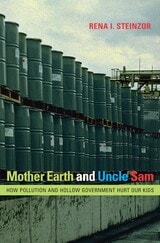
Mother Earth and Uncle Sam
How Pollution and Hollow Government Hurt Our KidsBy Rena I. Steinzor
University of Texas Press, 2007
In this compelling study, Rena Steinzor highlights the ways in which the government, over the past twenty years, has failed to protect children from harm caused by toxic chemicals. She believes these failures—under-funding, excessive and misguided use of cost/benefit analysis, distortion of science, and devolution of regulatory authority—have produced a situation in which harm that could be reduced or eliminated instead persists.
Steinzor states that, as a society, we are neglecting our children's health to an extent that we would find unthinkable as individual parents, primarily due to the erosion of the government's role in protecting public health and the environment. At this pace, she asserts, our children will inherit a planet under grave threat. We can arrest these developments if a critical mass of Americans become convinced that these problems are urgent and the solutions are near at hand.
By focusing on three specific case studies—mercury contamination through the human food chain, perchlorate (rocket fuel) in drinking water, and the effects of ozone (smog) on children playing outdoors—Steinzor creates an analysis grounded in law, economics, and science to prove her assertions about the existing dysfunctional system.
Steinzor then recommends a concise and realistic series of reforms that could reverse these detrimental trends and serve as a blueprint for restoring effective governmental intervention. She argues that these recommendations offer enough material to guide government officials and advocacy groups toward prompt implementation, for the sake of America's—and the world's—future generations.

Mrs. Shipley's Ghost
The Right to Travel and Terrorist WatchlistsJeffrey Kahn
University of Michigan Press, 2014
Today, when a single person can turn an airplane into a guided missile, no one objects to rigorous security before flying. But can the state simply declare some people too dangerous to travel, ever and anywhere? Does the Constitution protect a fundamental right to travel? Should the mode of travel (car, plane, or boat) or itinerary (domestic or international) make a constitutional difference? This book explores the legal and policy questions raised by government travel restrictions, from passports and rubber stamps to computerized terrorist watchlists.
In tracing the history and scope of U.S. travel regulations, Jeffrey Kahn begins with the fascinating story of Mrs. Ruth Shipley, a federal employee who almost single-handedly controlled access to passports during the Cold War. Kahn questions how far national security policies should go and whether the government should be able to declare some individuals simply too dangerous to travel. An expert on constitutional law, Kahn argues that U.S. citizens’ freedom to leave the country and return is a fundamental right, protected by the Constitution.
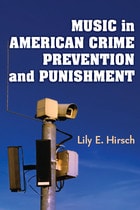
Music in American Crime Prevention and Punishment
Lily E. Hirsch
University of Michigan Press, 2014
Although the use of music for extramusical purposes has been a part of American culture for some time, the phenomenon remained largely unknown to the general public until revelations became widespread of startling military practices during the second Iraq War. In Music in American Crime Prevention and Punishment, Lily E. Hirsch explores the related terrain at the intersection of music and law, demonstrating the ways in which music has become a tool of law enforcement and justice through: police and community leaders’ use of classical music in crime deterrence and punishment; the use of rap lyrics as prosecutorial evidence; allegations of music as incitement to violence; and the role of music in U.S. prisons and in detention centers in Guantanamo, Iraq, and Afghanistan.
In the course of her study, Hirsch asks several questions: How does the law treat music? When and why does music participate in the law? How does music influence the legal process? How does the legal process influence music? And how do these appropriations affect the Romantic ideals underlying our view of music?
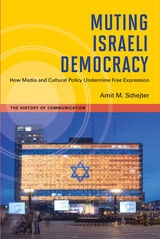
Muting Israeli Democracy
How Media and Cultural Policy Undermine Free ExpressionAmit M. Schejter
University of Illinois Press, 2009