Results by title
642 books match the query 'Linguistics' and 27 start with m
Many Ways to Be Deaf
International Variation in Deaf CommunitiesLeila Monaghan
Gallaudet University Press, 2003
Markedness Theory
Edna Andrews
Duke University Press, 1990
Mathematical Structures in Languages
Edward Keenan and Larry Moss
CSLI, 2015
Meaning and Partiality
Reinhard Muskens
CSLI, 1995
Meaning, Creativity, and the Partial Inscrutability of the Human Mind
Julius M. Moravcsik
CSLI, 1998
Meaning, Form, and Body
Mark Turner, Fey Parrill, and Vera Tobin
CSLI, 2010
Meaning, Form, and Body brings together renowned figures in the field of cognitive linguistics to discuss two related research areas in the study of linguistics: the integration of form and meaning and language and the human body. Among the numerous topics discussed are grammatical constructions, conceptual integration, and gesture.
Meaning, Intentions, and Argumentation
Kepa Korta and Garmendia
CSLI, 2008
Mechanisms of Syntactic Change
Edited by Charles N. Li
University of Texas Press, 1977
Historical linguistics, the oldest field in linguistics, has been traditionally dominated by phonological and etymological investigations. Only in the late twentieth century have linguists begun to focus their interest and research on the area of syntactic change and the insight it provides on the nature of language. This volume represents the first major contribution on the mechanisms of syntactic change.
The fourteen articles that make up this volume were selected from the Symposium on the Mechanisms of Syntactic Change held at the University of California, Santa Barbara, in 1976, one of a series of three conferences sponsored by the National Science Foundation.
These papers clearly demonstrate that the generative approach to the study of language does not explain diachronic processes in syntax. This collection is enlightening, provocative, and carefully documented with data drawn from a great variety of language families.

Metalinguistic Development
Jean Émile Gombert
University of Chicago Press, 1992
language correctly. Later comes the precocious ability to
“reflect” upon and deliberately control its use.
Metalinguistic development, or the emergence of a reflective
attitude to the comprehension and production of oral and
written language, must be distinguished from that of ordinary
verbal communication.
This is the first book to review and analyze what is
known about metacognitive processes in relation to language.
Each of its seven chapters deals systematically with the
relationship between the comprehension and production of the
phonetic, syntactic, semantic, pragmatic, and textual aspects
of language. This material is then related to the
metacognitive principles which govern reflective awareness.
A concluding chapter deals with written language and
metalinguistics.
Jean Émile Gombert's novel description of processes such
as the understanding of metaphor and humor in relation to
pragmatics and his suggestion that metalinguistic knowledge
is intimately connected with literacy contribute to a fuller
understanding of the stages of language acquisition and
mastery. With clarity and insight, Metalinguistic
Development reveals how the capacity for reflection gives
rise to emergent properties of the language system.
“A clear, critical, and interesting book about
an important topic which has not been reviewed properly
before. I particularly like the way that Jean Eacute;mile Gombert
combines a comprehensive account of American work with a very
impressive knowledge of European work.”—Peter Bryant,
University of Oxford
Jean Émile Gombert teaches genetic psychology at the
University of Dijon.
Metaphor in American Sign Language
Phyllis Perrin Wilcox
Gallaudet University Press, 2001
Only recently have linguists ceased to regard metaphors as mere frills on the periphery of language and begun to recognize them as cornerstones of discourse. Phyllis Wilcox takes this innovation one step further in her fascinating study of metaphors in American Sign Language (ASL).
Such an inquiry has long been obscured by, as Wilcox calls it, “the shroud of iconicity.” ASL’s iconic nature once discouraged people from recognizing it as a language; more recently it has served to confuse linguists examining its metaphors. Wilcox, however, presents methods for distinguishing between icon and metaphor, allowing the former to clarify, not cloud, the latter. “If the iconic influence that surrounds metaphor is set aside, the results will be greater understanding, and interpretations that are less opaque.”
Wilcox concludes her study with a close analysis of the ASL poem, “The Dogs,” by Ella Mae Lentz. In presenting Deaf Americans’, Deaf Germans’, and Deaf Italians’ reactions to the poem, Wilcox manages not only to demonstrate the influence of culture upon metaphors, but also to illuminate the sources of sociopolitical division within the American Deaf community. Metaphor in American Sign Language proves an engrossing read for those interested in linguistics and Deaf culture alike.

Metaphors Dead and Alive, Sleeping and Waking
A Dynamic ViewCornelia Müller
University of Chicago Press, 2008
To build this model, Müller presents an overview of notions of metaphor from the classical period to the present; studies in detail how metaphors function in speech, text, gesture, and images; and examines the way mixed metaphors sometimes make sense and sometimes do not. This analysis leads her to conclude that metaphors may oscillate between various degrees of sleeping and waking as their status changes depending on context and intention. Bridging the gap between conceptual metaphor theory and more traditional linguistic theories, this book is a major advance for the field and will be vital to novices and initiates alike.
Metaphors We Live By
George Lakoff and Mark Johnson
University of Chicago Press, 1981
In this updated edition of Lakoff and Johnson's influential book, the authors supply an afterword surveying how their theory of metaphor has developed within the cognitive sciences to become central to the contemporary understanding of how we think and how we express our thoughts in language.
Metrical Stress Theory
Principles and Case StudiesBruce Hayes
University of Chicago Press, 1994
Hayes incorporates the iambic/trochaic opposition into a general theory of word stress assignment, intended to account for all languages in which stress is assigned on phonological as opposed to morphological principles. His theory addresses particularly problematic areas in metrical work, such as ternary stress and unusual weight distinctions, and he proposes new theoretical accounts of them. Attempting to take more seriously the claim of generative grammar to be an account of linguistic universals, Hayes proposes analyses for the stress patterns of over 150 languages.
Hayes compares his own innovative views with alternatives from the literature, allowing students to gain an overview of the field. Metrical Stress Theory should interest all who seek to understand the role of stress in language.

Milestones in the History of English in America, Volume 76
Allen Walker Read, Richard W. Bailey, editor
Duke University Press, 0
Mixed Categories in the Hierarchical Lexicon
Robert P. Malouf
CSLI, 2000
This book presents a novel analysis of this and similar mixed category constructions in languages including Quechua, Tibetan, Arabic, Fijian, Dagaare, and Jacaltec. Under this analysis, Robert P. Malouf shows that verbal gerunds share the selectional properties of verbs and the distributional properties of nouns. He further shows that since different dimensions of grammatical information can vary independently, the behavior of mixed categories creates no paradox. These dimensions are in principle independent. However, certain types of mixed categories are quite common in the world's languages, while others are rare or nonexistent. The book discusses how cross-linguistic variation can be accounted for by a lexical categorial prototype. By stating these prototypes as default constraints in a hierarchy of lexical information, Malouf argues that one can bring insights from cognitive and functional approaches to linguistics into a formal analysis, thus building on the strengths of both approaches.
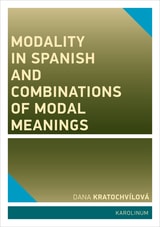
Modality in Spanish and Combinations of Modal Meanings
Dana Kratochvílová
Karolinum Press, 2019

Modern Chinese Counter-Enlightenment
Affect, Reason, and the Transcultural LexiconPeng Hsiao-yen
Hong Kong University Press, 2023
In Modern Chinese Counter-Enlightenment, Peng Hsiao-yen argues that a trend of Counter-Enlightenment had grown from the late Qing to the May Fourth era in the 1910s to the 1920s and continued to the 1940s. She demonstrates how Counter-Enlightenment was manifested with case studies such as Lu Xun’s writings in the late 1900s, the Aesthetic Education movement from the 1910s to 1920s, and the Science and Lifeview debate in the 1920s. During the period, the life philosophy movement, highlighting the epistemic debate on affect and reason, is connected with its counterparts in Germany, France, and Japan. The movement had a widespread and long-term impact on Chinese philosophy and literature. Using the transcultural lexicon as methodology, this book traces how the German term Lebensanschauung (life view), a key concept in Rudolf Eucken’s life philosophy, constituted a global tide of Counter-Enlightenment that influenced the thought of leading Chinese intellectuals in the Republican era. Peng contends that Chinese intellectuals’ transcultural connections with others in the philosophical pursuit of knowledge triggered China’s self-transformation. She successfully reconstructs the missing link in the Chinese theater of the worldwide dialectic of Enlightenment and Counter-Enlightenment.
Modern Theories of Language
The Empirical ChallengeMortéza Mahmoudian
Duke University Press, 1993
The author begins with the identification of principles which, despite differences in terminology, are held in common by most twentieth-century linguists. He shows the implications, merits, and shortcomings of the major schools of linguistic thought, as well as the techniques one can use in gathering data. Ranging over a wide variety of international linguistic thinking, Mahmoudian takes up the question of what he calls experimentation, or the extent to which the application of certain linguistic theories have validity in constucting models.
Simultaneously a survey of the current state of linguistic theory and a case for the necessity of empirical verification in linguistics, Modern Theories of Language builds a bridge across the gulf between many long-standing conflicts in the theory of language. Accessibly written, this provocative work predicts future theorerical and epistemological developments and will prove essential reading for students and scholars of linguistics, as well as specialists in cognitive psychology and Romance languages.
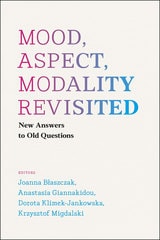
Mood, Aspect, Modality Revisited
New Answers to Old QuestionsEdited by Joanna Blaszczak, Anastasia Giannakidou, Dorota Klimek-Jankowska, and Krzysztof Migdalski
University of Chicago Press, 2016
Current literature assumes a straightforward link between grammatical category and semantic function, and descriptions of well-studied languages have cultivated a sense of predictability in patterns over time. As the editors and contributors of Mood, Aspect, Modality Revisited prove, however, this predictability and stability vanish in the study of lesser-known patterns and languages. The ten provocative essays gathered here present fascinating cutting-edge research demonstrating that the traditional grammatical distinctions are ultimately fluid—and perhaps even illusory. Developing groundbreaking and highly original theories, the contributors in this volume seek to unravel more general, fundamental principles of TAM that can help us better understand the nature of linguistic representations.
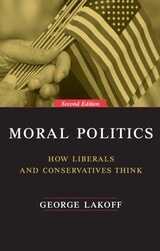
Moral Politics
How Liberals and Conservatives Think, Second EditionGeorge Lakoff
University of Chicago Press, 2002

More than Cool Reason
A Field Guide to Poetic MetaphorGeorge Lakoff and Mark Turner
University of Chicago Press, 1989
We usually think of the language of poetry, the metaphors that poets use to express their intentions, as far removed from ordinary life. But in More than Cool Reason, George Lakoff and Mark Turner show how understanding how metaphor works in poetry, the tasks it takes on and the ways it shapes our patterns of thought, can be hugely helpful to seeing and understanding how we think in all manner of other fields and areas of life. Metaphor, they show, is a tool so familiar, so everyday, that we fail to notice it. Lakoff and Turner correct that failure here, helping us see how richly metaphorical our language and thought are, and what that means for not only reading and enjoying poetry and literature, but also for linguistics, philosophy, psychology, anthropology, cognitive science, and more.
Morphology and its Relation to Phonology and Syntax
Patrick Farrell
CSLI, 1998
Morphology and the Web of Grammar
Essays in Memory of Steven G. LapointeEdited by C. Orhan Orgun and Peter Sells
CSLI, 2003
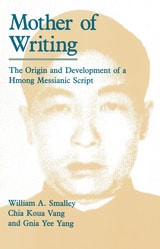
Mother of Writing
The Origin and Development of a Hmong Messianic ScriptWilliam A. Smalley, Chia Koua Vang, and Gnia Yee Yang
University of Chicago Press, 1990
An anthropological linguist who has worked among the Hmong, William A. Smalley joins Shong Lue's chief disciple, Chia Koua Vang, and one of his associates, to tell the fascinating story of how the previously unschooled farmer developed his remarkable writing system through four stages of increasing sophistication. The uniqueness of Shong Lue's achievement is highlighted by a comparison of Shong Lue's writing system to other known Hmong systems and to the history of writing as a whole.
In addition to a nontechnical linguistic analysis of the script and a survey of its current use, Mother of Writing provides an intriguing cultural account of Shong Lue's life. The book traces the twenty-year-long struggle to disseminate the script after Shong Lue's death, first by handwriting, then by primitive moveable type, an abortive attempt to design a wooden typewriter, and finally by modern wordprocessing. In a moving concluding chapter, Smalley discusses his own complex feelings about his coauthors' story.
Multicultural Aspects of Sociolinguistics in Deaf Communities
Ceil Lucas
Gallaudet University Press, 2001
This collection offers a wide variety of fascinating studies that consider multicultural aspects among deaf people worldwide. Mala Kleinfeld and Noni Warner investigate variation in the use of gay, lesbian, and bisexual signs in the Deaf community; Jan Branson, Don Miller, and I Gede Marsaja, assisted by I Wayan Negara, profile a deaf village in Bali, Indonesia in which hearing people are fluent in both sign and spoken languages. Alejandro Oviedo in Venezuela comments on bilingual deaf education in Venezuela, and Sara Schley outlines the sociolinguistic and educational implications of comparing ASL and English word definitions.
Susan Mather discusses initiation in visually constructed dialogue from reading books with 3- to 8-year-old students who are deaf or hard of hearing. Pietro Celo offers insights on the interrogative in Italian Sign Language, and Julie Wilson examines narrative structure in American Sign Language ASL) through her analysis of “the tobacco story.” Rhonda Jacobs completes this significant, wide-ranging volume with her research on second language learning, as she presents the case for ASL as a truly foreign language by posing the question, “Just how hard is it to learn ASL?”
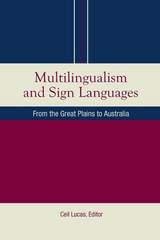
Multilingualism and Sign Languages
From the Great Plains to AustraliaCeil Lucas
Gallaudet University Press, 2006
The 12th Volume in the Sociolinguistics in Deaf Communities Series
The latest entry in the Sociolinguistics in Deaf Communities series continues to mine the rich resources found in signing communities throughout the world. Divided into four parts, this collection features 16 internationally renowned linguistics experts whose absorbing studies reflect an astonishing range of linguistic diversity.
The sole essay in Part One: Multilingualism describes historic and contemporary uses of North American Indian Sign Language. Part Two: Language Contact examines language-contact phenomena between Auslan/English interpreters and Deaf people in Australia, and the features of bimodal bilingualism in hearing, Italian, native signers. Part Three: Variation reports the results of a study on location variation in Australian Sign Language.
Part Four: Discourse Analysis begins with an analysis of how deaf parents and their hearing toddlers establish and maintain sight triangles when conducting signed conversations. The ensuing chapter explores the use of evaluation within an informal narrative in Langue des Signes Québécoise. The final chapter explicates how a signer depersonalizes the concept of “self” in an American Sign Language narrative through the use of signs for “he” and “I.”
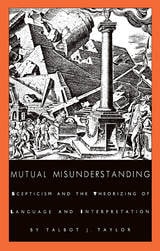
Mutual Misunderstanding
Scepticism and the Theorizing of Language and InterpretationTalbot J. Taylor
Duke University Press, 1992
Mutual Misundertanding thus presents a strikingly original analysis of the rhetorical patterns underlying Western linguistic thought, as exemplified in the works of John Locke, Jacques Derrida, Gottlob Frege, Jonathan Culler, Noam Chomsky, Ferdinand de Saussure, H. Paul Grice, Michael Dummet, Stanley Fish, Alfred Schutz, Barbara Herrnstein Smith, Harold Garfinkel, and others.
This analysis reveals how, by the combined effect of appeals to "commonsense" and anxieties about implications of relativism, scepticism has a determining role in the discursive development of a number of the intellectual disciplines making up the "human sciences" today, including critical theory, literary hermeneutics, philosophy of language and logic, communication theory, discourse and conversation analysis, pragmatics, stylistics, and linguistics. Consequently, this provocative study will be of value to readers from a wide variety of disciplinary backgrounds.