Results by title
50 books match the query 'Literature, Medieval' and 6 start with m
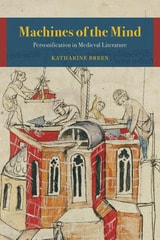
Machines of the Mind
Personification in Medieval LiteratureKatharine Breen
University of Chicago Press, 2021
In Machines of the Mind, Katharine Breen proposes that medieval personifications should be understood neither as failed novelistic characters nor as instruments of heavy-handed didacticism. She argues that personifications are instead powerful tools for thought that help us to remember and manipulate complex ideas, testing them against existing moral and political paradigms. Specifically, different types of medieval personification should be seen as corresponding to positions in the rich and nuanced medieval debate over universals. Breen identifies three different types of personification—Platonic, Aristotelian, and Prudentian—that gave medieval writers a surprisingly varied spectrum with which to paint their characters.
Through a series of new readings of major authors and works, from Plato to Piers Plowman, Breen illuminates how medieval personifications embody the full range of positions between philosophical realism and nominalism, varying according to the convictions of individual authors and the purposes of individual works. Recalling Gregory the Great’s reference to machinae mentis (machines of the mind), Breen demonstrates that medieval writers applied personification with utility and subtlety, employing methods of personification as tools that serve different functions. Machines of the Mind offers insight for medievalists working at the crossroads of religion, philosophy, and literature, as well as for scholars interested in literary character-building and gendered relationships among characters, readers, and texts beyond the Middle Ages.
[more]
Medieval Marvels and Fictions in the Latin West and Islamic World
Michelle Karnes
University of Chicago Press, 2022
A cross-cultural study of magical phenomena in the Middle Ages.
Marvels like enchanted rings and sorcerers’ stones were topics of fascination in the Middle Ages, not only in romance and travel literature but also in the period’s philosophical writing. Rather than constructions of belief accepted only by simple-minded people, Michelle Karnes shows that these spectacular wonders were near impossibilities that demanded scrutiny and investigation.
This is the first book to analyze a diverse set of writings on such wonders, comparing texts from the Latin West—including those written in English, French, Italian, and Castilian Spanish —with those written in Arabic as it works toward a unifying theory of marvels across different disciplines and cultures. Karnes tells a story about the parallels between Arabic and Latin thought, reminding us that experiences of the strange and the unfamiliar travel across a range of genres, spanning geographical and conceptual space and offering an ideal vantage point from which to understand intercultural exchange. Karnes traverses this diverse archive, showing how imagination imbues marvels with their character and power, making them at once enigmatic, creative, and resonant. Skirting the distinction between the real and unreal, these marvels challenge readers to discover the highest capabilities of both nature and the human intellect. Karnes offers a rare comparative perspective and a new methodology to study a topic long recognized as central to medieval culture.
[more]
Medieval Practices Of Space
Barbara A. Hanawalt
University of Minnesota Press, 2000
Interprets space and place in the medieval era.
Interprets space and place in the medieval era.
A glance at medieval maps tells us that cartographers of the Middle Ages divided space differently than we do today. In the great mappae mundi, for instance, Jerusalem takes center stage, with an image of the crucified Christ separating one place from another. The architects of medieval cathedrals manipulated space to clarify the roles and status of all who entered. Even in the most everyday context, space was allotted according to gender and class and was freighted with infinitely subtle meanings. The contributors to this volume cross disciplinary and theoretical boundaries to read the words, metaphors, images, signs, poetic illusions, and identities with which medieval men and women used space and place to add meaning to the world.Contributors: Kathleen Biddick, U of Notre Dame; Charles Burroughs, SUNY, Binghamton; Michael Camille, U of Chicago; Tom Conley, Harvard U; Donnalee Dox, U of Arizona; Jody Enders, U of California, Santa Barbara; Valerie K. J. Flint, U of Hull, UK; Andrzej Piotrowski, U of Minnesota; Daniel Lord Smail, Fordham U.Barbara A. Hanawalt is King George III Professor of British History at Ohio State University. Michal Kobialka is associate professor of theatre at University of Minnesota.[more]
Medieval Things
Agency, Materiality, and Narratives of Objects in Medieval German Literature and BeyondBettina Bildhauer
The Ohio State University Press, 2020
What does medieval literature look like from the point of view not of knights and ladies, but of treasure, and rings, nets and the grail? How does medieval literature imagine the agency of material things, and what exactly distinguishes human subjects from inanimate objects? Medieval Things: Agency, Materiality, and Narratives of Objects in Medieval German Literature and Beyond brings together a theoretically informed and politically engaged new materialist approach with a study of how everyday objects are understood in medieval literature. Bettina Bildhauer argues that medieval narratives can inspire current critical theory on agency and materiality. She focuses on famous and forgotten German narratives from the twelfth to the sixteenth centuries, including Wolfram of Eschenbach’s Parzival and the epic Song of the Nibelungs, and sets them in their global context. Many such tales can be reconceptualized as “thing biographies”—stories that follow the trajectory not of a human hero but of a coin, a gown, a treasure, or a ring. Many also use nets and networks to conceptualize dangerous structures of knowledge. Shine, glamour, and charisma emerge as particularly powerful ways in which material things exert a kind of agency that is neither pseudo-human nor fetishistic. In analyzing details like these from medieval literature, Bildhauer thus contributes in new ways to current theory on agency and materiality.
[more]
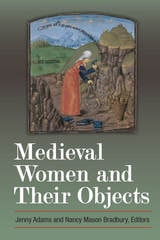
Medieval Women and Their Objects
Jenny Adams and Nancy Mason Bradbury, editors
University of Michigan Press, 2016
The essays gathered in this volume present multifaceted considerations of the intersection of objects and gender within the cultural contexts of late medieval France and England. Some take a material view of objects, showing buildings, books, and pictures as sites of gender negotiation and resistance and as extensions of women’s bodies. Others reconsider the concept of objectification in the lives of fictional and historical medieval women by looking closely at their relation to gendered material objects, taken literally as women’s possessions and as figurative manifestations of their desires.
The opening section looks at how medieval authors imagined fictional and legendary women using particular objects in ways that reinforce or challenge gender roles. These women bring objects into the orbit of gender identity, employing and relating to them in a literal sense, while also taking advantage of their symbolic meanings. The second section focuses on the use of texts both as objects in their own right and as mechanisms by which other objects are defined. The possessors of objects in these essays lived in the world, their lives documented by historical records, yet like their fictional and legendary counterparts, they too used objects for instrumental ends and with symbolic resonances. The final section considers the objectification of medieval women’s bodies as well as its limits. While this at times seems to allow for a trade in women, authorial attempts to give definitive shapes and boundaries to women’s bodies either complicate the gender boundaries they try to contain or reduce gender to an ideological abstraction. This volume contributes to the ongoing effort to calibrate female agency in the late Middle Ages, honoring the groundbreaking work of Carolyn P. Collette.
The opening section looks at how medieval authors imagined fictional and legendary women using particular objects in ways that reinforce or challenge gender roles. These women bring objects into the orbit of gender identity, employing and relating to them in a literal sense, while also taking advantage of their symbolic meanings. The second section focuses on the use of texts both as objects in their own right and as mechanisms by which other objects are defined. The possessors of objects in these essays lived in the world, their lives documented by historical records, yet like their fictional and legendary counterparts, they too used objects for instrumental ends and with symbolic resonances. The final section considers the objectification of medieval women’s bodies as well as its limits. While this at times seems to allow for a trade in women, authorial attempts to give definitive shapes and boundaries to women’s bodies either complicate the gender boundaries they try to contain or reduce gender to an ideological abstraction. This volume contributes to the ongoing effort to calibrate female agency in the late Middle Ages, honoring the groundbreaking work of Carolyn P. Collette.
[more]
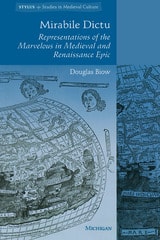
Mirabile Dictu
Representations of the Marvelous in Medieval and Renaissance EpicDouglas Biow
University of Michigan Press, 1996
Mirabile Dictu covers in six separate chapters the works of Virgil, Dante, Boccaccio, Ariosto, Tasso, and Spenser. Its broad aim is to provide a select cross-section of works in the Middle Ages and Renaissance in order systematically to examine and compare for the first time the marvelous in the light of epic genre, of literary and critical theory (both past and present), and of historically and culturally determined representational practices.
Douglas Biow organizes this volume around the literary topos of the bleeding branch through which a metamorphosed person speaks. In each chapter the author takes this "marvellous event" as his starting point for a broad-ranging comparison of the several poets who employed the image; he also investigates the ways in which a period's notion of "history" underpins its representations of the marvelous. This method offers a controlled yet flexible framework within which to develop readings that engage a multiplicity of theories and approaches.
Mirabile Dictu offers not only an insightful survey of the literary connections among this group of important poets, but also a useful point of departure for scholars and students intrigued by the reuse of epic conventions, by the peculiar role of "marvellous" events in dramatic poetry, and by the later history of classical literature.
[more]