Results by title
83 books match the query 'Man' and 18 start with m
Making a Man
Gentlemanly Appetites in the Nineteenth Century British NovelGwen Hyman
Ohio University Press, 2009
The gentleman, Making a Man argues, is a dangerous alimental force. Threatened with placelessness, he seeks to locate and mark himself through his feasting and fasting. But in doing so, he inevitably threatens to starve, to subsume, to swallow the community around him. The gentleman is at once fundamental and fundamentally threatening to the health of the nation: his alimental monstrousness constitutes the nightmare of the period’s striving, anxious, alimentally fraught middle class.
Making a Man makes use of food history and theory, literary criticism, anthropology, gender theory, economics, and social criticism to read gentlemanly consumers from Mr. Woodhouse, the gruel-eater in Jane Austen’s Emma, through the vampire and the men who hunt him in Bram Stoker’s Dracula. Hyman argues that appetite is a crucial means of casting light on the elusive identity of the gentleman, a figure who is the embodiment of power and yet is hardly embodied in Victorian literature.
Man and Beast, Volume 15
Elizabeth Weed and Ellen Rooney, eds.
Duke University Press, 0
The contributors to Man and Beast, writing from an array of academic disciplines, collectively rethink human relationships with other animals. Pointing to the ethical implications of taxonomic classifications and distinctions drawn by the natural sciences, one essay argues that these categories are neither as abstract nor as neutral as commonly assumed. Another essay offers a historicizing study of species barriers to examine the way in which zoological classifications have been breached, relegating some humans to the category of “animal” or, alternately, including in the human circle nonhuman species. Other essays consider the attribution of a human speech impediment to such famous talking cartoon animals as Porky Pig, read the social implications of such popular animal-human hybrids as “Bat Boy” of the tabloid press, and examine the representation of animals as moral agents in fables dating to Aesop, noting the appearance of such tales during periods of social upheaval and instability. All of these suggest that the category of “beast,” like that of human being, has never been either homogeneous or stable.
Contributors. Howard Bloch, Judith L. Goldstein, Harriet Ritvo, Marc Shell, Barbara Herrnstein Smith
Man and the Sacred
Roger Caillois
University of Illinois Press, 1959
Drawing on a diverse array of ethnographic contexts, including the sexual rituals of the Ba-Thong of South Africa and evidence drawn from aboriginal Australian, Eskimo, and traditional Chinese social systems, Caillois analyzes the role of the forbidden in the social cohesion of the group. He examines the character of the sacred in the light of specific instances of taboos and transgressions, exploring wide differences in attitudes toward diet and sex and extreme behaviors associated with the sacred, such as rapture and paroxysm. He also discusses the festival--an exuberant explosion following a period of strict repression--and compares its functions with those of modern war.
A classic study of one of the most fundamental aspects of human social and spiritual life, Man and the Sacred--presented here in Meyer Barash's superb English translation--is a companion volume to Caillois's Man, Play and Games.
Man and the State
Jacques Maritain
Catholic University of America Press, 1998

Man from Nebraska
A PlayTracy Letts
Northwestern University Press, 2006
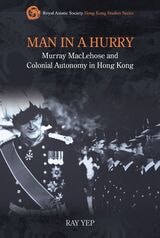
Man in a Hurry
Murray MacLehose and Colonial Autonomy in Hong KongRay Yep
Hong Kong University Press, 2024
Man in a Hurry explores the latest available archival materials and re-examines MacLehose’s pivotal governorship in Hong Kong (1971–1982). MacLehose arrived in the challenging 1970s, when there were expectations for social reforms, uneasiness in the relationship between Hong Kong and London, and the 1997 factor looming large. The governor successfully carried out various social reforms and he also handled various major issues, including the anti-corruption campaign, the Vietnamese refugee crisis, and the granting of land lease of the New Territories beyond 1997. Yep unveils the tension and bargaining between the British government and explains how interest of the colony could be asserted, defended, and negotiated. This book is an important study of Hong Kong’s "golden years" when the city’s economy took off. It is a significant contribution to our understanding of how local autonomy was defined.
Man in the Moon
Essays on Fathers and FatherhoodStephanie G'Schwind
University Press of Colorado, 2014
"Science claims it will one day be able to eliminate fathers from the equation by mating bone marrow with ovum. When that day comes, I imagine this book, along with a handful of other works (King Lear, Fun Home) will become even more necessary. Herein find the blueprints for the mystery, the maps for the uncharted, the keys to the archetype."
—Nick Flynn, author of The Reenactments and Another Bullshit Night in Suck City
"At this moment, I find myself at loose ends, lost in the various vacuums left by my father's dying and my sons' departures out into the voids. Yet this stunning constellation of essays centered me, became for me fine instruments of reckoning of where to stand in the ceaseless entropic dynamic of kin, of paternal keening. These waxing meditations demonstrate the inflationary universe, the heft and velocity of that big ol' nothing. They elegantly fill, with sober hope and the balm of joy, the terrifying, infinite spaces between those waning stars."
—Michael Martone, author of Michael Martone and Four for a Quarter
"What an unreachable mystery the father is, preoccupied, unknowable, pervasive. In these fascinating essays, a shared portrait emerges as writers articulate the perpetual puzzle of the father and, with grace and candor, explore what it means to not know him, to never know him. As one voice, these essays investigate the man—his inventories, his myths, his mere traces—who makes up our horizons, who forever shimmers there beyond our collective grasp."
—Susanna Sonnenberg, author of Her Last Death and She Matters: A Life in Friendships
Selected from the country's leading literary journals and publications—Crazyhorse, Colorado Review, The Nervous Breakdown, Creative Nonfiction, Georgia Review, Gulf Coast, The Missouri Review, The Normal School, and others—Man in the Moon brings together essays in which sons, daughters, and fathers explore the elusive nature of this intimate relationship and find unique ways to frame and understand it: through astronomy, arachnology, storytelling, map-reading, television, puzzles, DNA, and so on. In the collection's title essay, Bill Capossere considers the inextricable link between his love of astronomy and memories of his father: "The man in the moon is no stranger to me,” he writes. "I have seen his face before, and it is my father's, and his father's, and my own.” Other essays include Dinty Moore's "Son of Mr. Green Jeans: A Meditation on Missing Fathers,” in which Moore lays out an alphabetic investigation of fathers from popular culture—Ward Cleaver, Jim Anderson, Ozzie Nelson—while ruminating on his own absent father and hesitation to become a father himself. In "Plot Variations,” Robin Black attempts to understand, through the lens of teaching fiction to creative writing students, her inability to attend her father's funeral. Deborah Thompson tries to reconcile her pride in her father's pioneering research in plastics and her concerns about their toxic environmental consequences in "When the Future Was Plastic.” At turns painfully familiar, comic, and heartbreaking, the essays in this collection also deliver moments of seari
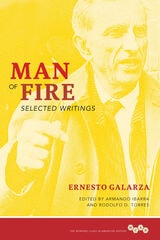
Man of Fire
Selected WritingsErnesto Galarza, Edited by Armando Ibarra and Rodolfo D. Torres
University of Illinois Press, 2013
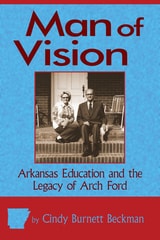
Man of Vision
Arkansas Education and the Legacy of Arch FordCindy Burnett Beckman
Butler Center for Arkansas Studies, 2016
As commissioner of the Arkansas Department of Education from 1953 to 1978, Arch Ford served under five governors. His vision was to expand educational opportunities because he believed education was the foundation for improving people’s lives. Throughout his career, he campaigned for increased educational funding, better-qualified teachers, and higher teachers’ salaries. Ford helped lead the state in peacefully integrating its schools and established twenty-three vocational-technical schools across the state. During Ford’s tenure, the Arkansas Children’s Colony was established to provide educational services to the developmentally disabled, and the Arkansas Educational Television Network was set up to provide instructional programming across the state.
The state also expanded educational opportunities to include kindergarten, special education, community colleges, and adult education. His leadership left Arkansas with a strong educational system that continued to advance. This was his legacy.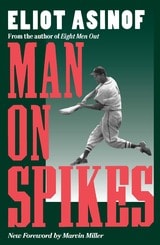
Man on Spikes
Eliot Asinof. Foreword by Marvin Miller
Southern Illinois University Press, 1998
Selected as one of baseball literature's Golden Dozen by Roger Kahn, Man on Spikes is an uncompromisingly realistic novel about a baseball player who struggles through sixteen years of personal crises and professional ordeals before finally appearing in a major league game. In a preface to this new edition, Eliot Asinof reveals the longsuffering ballplayer and friend upon which the novel is based.
Man on a Mission
James Meredith and the Battle of Ole MissAram Goudsouzian
University of Arkansas Press, 2022
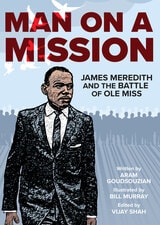
In 1962, James Meredith famously desegregated the University of Mississippi (a.k.a. Ole Miss). As the first Black American admitted to the school, he demonstrated great courage amidst the subsequent political clashes and tragic violence. After President Kennedy summoned federal troops to help maintain order, the South—and America at large—would never be the same.
Man on a Mission depicts Meredith’s relentless pursuit of justice, beginning with his childhood in rural Mississippi and culminating with the confrontation at Ole Miss. A blend of historical research and creative inspiration, this graphic history tells Meredith’s dramatic story in his own singular voice.
From the dawn of the modern civil rights movement, Meredith has offered a unique perspective on democracy, racial equality, and the meaning of America. Man on a Mission presents his captivating saga for a new generation in the era of Black Lives Matter.
Man or Monster?
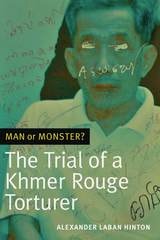
The Trial of a Khmer Rouge TorturerAlexander Laban Hinton
Duke University Press, 2016
Man to Man
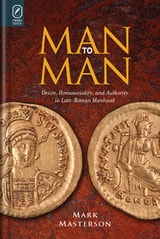
Desire, Homosociality, and Authority in Late-Roman ManhoodMark Masterson
The Ohio State University Press, 2014
At the same time, however, there was a marked ambivalence about same-sex desire and sexual behavior between men, and indeed same-sex sexual behavior was criminalized as it had never been before. While rejection and condemnation may seem to indicate a decisive distancing between authority and this desire and behavior, authority gained power from maintaining a relation to them. Demonstrating knowledge of the actual mechanics of sex between men suggested to a witness that there was nothing unknown to the authority making the demonstration: authority that knew of scandalous masculine sexual pleasure could project its power pretty much anywhere.
This startling dissonance between positive uses of same-sex desire between men and its criminalization in one and the same moment—a dissonance which recent discussions have been unable to address—requires further investigation, and this book supplies it.

Man with the Killer Smile
The Life and Crimes of a Serial Mass MurdererMitchel P. Roth
University of North Texas Press, 2022
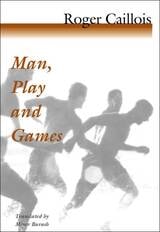
Man, Play and Games
Roger Caillois
University of Illinois Press, 1961
In this classic study, Caillois defines play as a free and voluntary activity that occurs in a pure space, isolated and protected from the rest of life. Play is uncertain, since the outcome may not be foreseen, and it is governed by rules that provide a level playing field for all participants. In its most basic form, play consists of finding a response to the opponent's action--or to the play situation--that is free within the limits set by the rules.
Caillois qualifies types of games-- according to whether competition, chance, simulation, or vertigo (being physically out of control) is dominant--and ways of playing, ranging from the unrestricted improvisation characteristic of children's play to the disciplined pursuit of solutions to gratuitously difficult puzzles. Caillois also examines the means by which games become part of daily life and ultimately contribute to various cultures their most characteristic customs and institutions.
Presented here in Meyer Barash's superb English translation, Man, Play and Games is a companion volume to Caillois's Man and the Sacred.
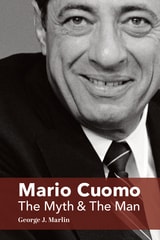
Mario Cuomo
The Myth and the ManGeorge J.
St. Augustine's Press, 2020
As governor, Mario Cuomo is remembered most for his advocacy of the “personally-opposed-but” position on abortion that led to confrontations with Catholic Church hierarchy, and for dithering about his presidential ambitions, that led the media to dub him the “Hamlet on the Hudson.” His political style reminded many of Machiavelli; Cuomo styled himself a successor to St. Thomas More.
In this political profile, George J. Marlin sets the record straight on Mario Cuomo.
Marlin traces Cuomo’s political rise and documents how and why he abandoned his public opposition to abortion to be elected New York’s chief executive.
In great detail, Marlin describes the protracted conflict between Cuomo and his church on abortion and refutes the governor’s claim that his “position on abortion is absolutely theologically sound.”
Marlin critiques Cuomo’s famous 1984 Democratic convention speech as nothing more than the usual high-toned partisan liberal bromides that offered little, if anything, that hadn’t been touted by his party for half a century.
The book also uncovers New York State’s fiscal, economic, and social decline during Cuomo’s 12 years as governor. It explains why voters repudiated Cuomo’s version of a welfare state when he sought a fourth term in 1994 and why, in the words of his son, Governor Andrew Cuomo, his father was “more accomplished as a speech-giver than as a governor.”
Marlin skillfully separates the Cuomo “Public Intellectual” myth from the political man.
Mario Cuomo, three times Governor of New York, an eloquent hard edged Catholic from Queens, dominated not only his home state but national liberal politics in the age of Reagan. Whether the subject was police or theology, Cuomo rhetorically overpowered the reporters who covered him. But he’s finally met his match in George Marlin’s Mario Cuomo The Myth and the Man. Marlin’s extraordinary equipment; a former candidate for Mayor of N.Y.C., former executive director of the New York and New Jersey Port Authority, author of books on Catholic voters and the Archbishops of New York, has made him the ideal author of what’s sure to be seen as the definitive political biography of Mario Cuomo. — Fred Siegel, Author, The Prince of the City: Giuliani, New York, and the Genius of American Life and The Future Once Happened Here: New York, D.C., L.A., and the Fate of America’s Big Cities.
“It’s easy to forget what an important and fascinating figure Mario Cuomo was during New York’s raucous political heyday of the 1970s, 80s and 90s, when the likes of Hugh Carey, Ed Koch, Al D’Amato, and Rudy Giuliani strode the political stage. Thankfully, George Marlin’s wonderful new Cuomo biography will help everyone remember both the good and bad of the remarkable man who served three terms as governor, turned down a seat on the Supreme Court and rejected the chance to run for President. Here are both Cuomo’s successes and failures — and of the latter there were many. An important work that helps restore our collective memory. — Fredric U. Dicker, the New York Post’s longtime state editor and a TV and radio commentator, covered six governors during 40 years at the state Capitol in Albany.
George Marlin is virtually peerless in blending high principle with knowledge of street-level politics and the nuts-and-bolts of otherwise mundane governance to produce readable, yet deeply insightful, social and political portraits. Mario Cuomo: The Myth and the Man, examines in fine detail one of one of New York state’s most consequential, if also deeply flawed, 20th-century gubernatorial incumbencies. Plus, readers get a bonus: Insight into what shaped the career of Mario Cuomo’s Democratic superstar son, Andrew. Marlin has been in the trenches himself and thus can separate blarney from beefsteak – which this fine volume once again demonstrates. —Bob McManus, Contributing Editor, The City Journal, was the New York Post’s Editorial Page Editor (2000-2013), and The Albany Times Union’s Executive City Editor (1975-1981).
“George Marlin not only captures the political life and journey of Mario Cuomo, but details his policy approach that led to the near demise of the Empire State. Fortunately, the Conservative Party of New York was there to carry the torch and provide the margin of victory for George Pataki ending the senior Cuomo’s reign.” —Michael Long, State Chairman, Conservative Party of New York (1988-2019)
“For both better and worse, Mario Cuomo was the quintessential American Catholic politician of an entire postwar generation: ambitious, brilliant, articulate, serious about his faith, and flexible in how and where he applied it. George Marlin is a writer of considerable skill, and he uses here it to produce a provocative, absorbing portrait of the man and his career. —Francis X. Maier, Senior Fellow in Catholic Studies at the Ethics and Public Policy Center
Masses and Man
Nationalist and Fascist Perceptions of RealityGeorge L. Mosse
University of Wisconsin Press, 2024
Masses and Man comprises three parts. The first lays out a cultural history of nationalism, essentially the first of its kind, emphasizing the importance of sacred expressions like myths, symbols, and rituals as appropriated in a political context. The second zeroes in on fascism’s most dramatic irruptions in European history in the rise of Italian Fascism and the Nazi Party in Germany, elucidating these as not just political movements but also cultural and even aesthetic ones. The third part considers nationalism and fascism from the particular standpoint of German Jews.
Taken in full, the volume offers an eloquent summation of Mosse’s groundbreaking insights into European nationalism, fascism, and Jewish history in the twentieth century. A new critical introduction by Enzo Traverso helpfully situates Mosse’s work in context and exposes the many ways in which Masses and Man, first published in 1980, remains relevant today.
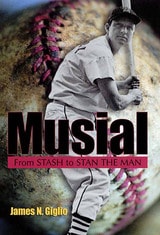
Musial
From Stash to Stan the ManJames N. Giglio
University of Missouri Press, 2001