138 books match the query 'Meaning' and 22 start with m

cover of MP3: The Meaning of a Format

MP3

The Meaning of a Format

Jonathan Sterne

Duke University Press, 2012

MP3: The Meaning of a Format recounts the hundred-year history of the world's most common format for recorded audio. Understanding the historical meaning of the MP3 format entails rethinking the place of digital technologies in the larger universe of twentieth-century communication history, from hearing research conducted by the telephone industry in the 1910s, through the mid-century development of perceptual coding (the technology underlying the MP3), to the format's promiscuous social life since the mid 1990s.

MP3s are products of compression, a process that removes sounds unlikely to be heard from recordings. Although media history is often characterized as a progression toward greater definition, fidelity, and truthfulness, MP3: The Meaning of a Format illuminates the crucial role of compression in the development of modern media and sound culture. Taking the history of compression as his point of departure, Jonathan Sterne investigates the relationships among sound, silence, sense, and noise; the commodity status of recorded sound and the economic role of piracy; and the importance of standards in the governance of our emerging media culture. He demonstrates that formats, standards, and infrastructures—and the need for content to fit inside them—are every bit as central to communication as the boxes we call "media."

[more]
cover of Man Made God: The Meaning of Life

Man Made God

The Meaning of Life

Luc Ferry

University of Chicago Press, 2002

What happens when the meaning of life based on a divine revelation no longer makes sense? Does the quest for transcendence end in the pursuit of material success and self-absorption?

Luc Ferry argues that modernity and the emergence of secular humanism in Europe since the eighteenth century have not killed the search for meaning and the sacred, or even the idea of God, but rather have transformed both through a dual process: the humanization of the divine and the divinization of the human. Ferry sees evidence for the first of these in the Catholic Church's attempts to counter the growing rejection of dogmatism and to translate the religious tradition into contemporary language. The second he traces to the birth of modern love and humanitarianism, both of which demand a concern for others and even self-sacrifice in defense of values that transcend life itself. Ferry concludes with a powerful statement in favor of what he calls "transcendental humanism"—a concept that for the first time in human history gives us access to a genuine spirituality rooted in human beings instead of the divine.
[more]
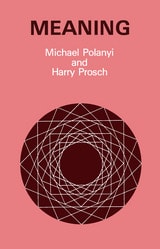
cover of Meaning

Meaning

Michael Polanyi and Harry Prosch

University of Chicago Press, 1977

Published very shortly before his death in February 1976, Meaning is the culmination of Michael Polanyi's philosophic endeavors. With the assistance of Harry Prosch, Polanyi goes beyond his earlier critique of scientific "objectivity" to investigate meaning as founded upon the imaginative and creative faculties.

Establishing that science is an inherently normative form of knowledge and that society gives meaning to science instead of being given the "truth" by science, Polanyi contends here that the foundation of meaning is the creative imagination. Largely through metaphorical expression in poetry, art, myth, and religion, the imagination is used to synthesize the otherwise chaotic and disparate elements of life. To Polanyi these integrations stand with those of science as equally valid modes of knowledge. He hopes this view of the foundation of meaning will restore validity to the traditional ideas that were undercut by modern science. Polanyi also outlines the general conditions of a free society that encourage varied approaches to truth, and includes an illuminating discussion of how to restore, to modern minds, the possibility for the acceptance of religion.
[more]
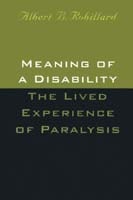
cover of Meaning Of A Disability: The Lived Experience of Paralysis

Meaning Of A Disability

The Lived Experience of Paralysis

Albert Robillard

Temple University Press, 1999

When ethnomethodologist Albert Robillard began to suffer the  symptoms of motor-neuron disease, he realized he was a living laboratory for revealing the countless taken-for-granted methods people use to produce being together. Meaning of a Disability is a detailed autobiography of the experiences and trained observations of a university professor who became paralyzed in mid-life.

With his loss of speech, Robillard was forced to communicate through a lip-reading system developed by his wife and student assistants. Restricted by this form of communication and his paralysis, he soon learned the frustrations of making his  meaning known. Hospital nurses wrongly anticipated his words. Those who translated for him inevitably distorted his meaning. Most of all, the casual pace of conversational  give-and-take was disrupted. Old friends would leave before Robillard could provide the expected interactional response.

Finding himself isolated due to his lack of both mobility and vocalization, Robillard threw himself into his academic work and began to develop settings and methods where he could satisfactorily interact with others. A researcher and writer experienced in describing the bodily and verbal methods used to coordinate and construct the most ordinary of social forms, Robillard joins in this book both his years of sociological training and his time with illness to talk with moving and illuminating analysis about a  broad range of matters. Moving gracefully from examinations of narratives about disability and illness, the stigmatizing things that healthcare providers unwittingly say to their patients, and communication problems in the intensive care unit, to more personal reflections on anger, isolation, and stories of tragedy, Robillard also discusses disability in the workplace and such seemingly simple topics as computers and vacations. Meaning of a Disability is the personal story of a highly trained observer forced to confront simultaneously the limits of the disabled person's social world and the unspoken assumptions about meaningful interaction -- as he struggles with the daily difficulties of maintaining his identity.

Meaning of a Disability will interest a wide audience, including healthcare professionals, disabled people, and caretakers as well as academics studying ethnomethodology, health and illness, conversation, symbolic interaction, storytelling, and most aspects of lived experience.
[more]
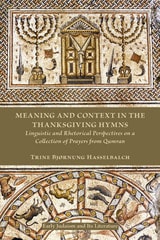
cover of Meaning and Context in the Thanksgiving Hymns: Linguistic and Rhetorical Perspectives on a Collection

Meaning and Context in the Thanksgiving Hymns

Linguistic and Rhetorical Perspectives on a Collection

Trine Bjørnung Hasselbalch

SBL Press, 2015

A new reading strategy for the Thanksgiving Hymns

Hasselbalch asserts that current theories about the social background of Thanksgiving Hymns are unable to explain its heterogeneous character. Instead the author suggests a reading strategy that leaves presumptions about the underlying social contexts aside to instead consider the collection’s hybridity as a clue to understanding the collection as a whole.

Features:

  • Systemic Functional Linguistics applied to four Hodayot
  • Analysis that highlights the role of a mediator in the agency of God
  • An approach that highlights the unity of the collection
[more]
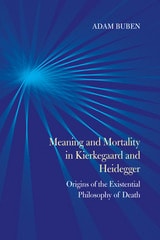
cover of Meaning and Mortality in Kierkegaard and Heidegger: Origins of the Existential Philosophy of Death

Meaning and Mortality in Kierkegaard and Heidegger

Origins of the Existential Philosophy of Death

Adam Buben

Northwestern University Press, 2016
Death is one of those few topics that attract the attention of just about every significant thinker in the history of Western philosophy, and this attention has resulted in diverse and complex views on death and what comes after. In Meaning and Mortality, Adam Buben offers a remarkably useful new framework for understanding the ways in which philosophy has discussed death by focusing first on two traditional strains in the discussion, the Platonic and the Epicurean. After providing a thorough account of this ancient dichotomy, he describes the development of an alternative means of handling death in Søren Kierkegaard and Martin Heidegger, whose work on death tends to overshadow Kierkegaard's despite the undeniable influence exerted on him by the nineteenth-century Dane. Buben argues that Kierkegaard and Heidegger prescribe a peculiar way of living with death that offers a kind of compromise between the Platonic and the Epicurean strains.
[more]
cover of Meaning and Necessity: A Study in Semantics and Modal Logic

Meaning and Necessity

A Study in Semantics and Modal Logic

Rudolf Carnap

University of Chicago Press, 1988
"This book is valuable as expounding in full a theory of meaning that has its roots in the work of Frege and has been of the widest influence. . . . The chief virtue of the book is its systematic character. From Frege to Quine most philosophical logicians have restricted themselves by piecemeal and local assaults on the problems involved. The book is marked by a genial tolerance. Carnap sees himself as proposing conventions rather than asserting truths. However he provides plenty of matter for argument."—Anthony Quinton, Hibbert Journal
[more]
cover of Meaning and Partiality

Meaning and Partiality

Reinhard Muskens

CSLI, 1995
Muskens radically simplifies Montague Semantics and generalises the theory by basing it on a partial higher order logic resulting in a theory which combines important aspects of Montague Semantics and Situation Semantics. Richard Montague formulated the revolutionary insight that we can understand the concept of meaning in ordinary languages much in the same way as we understand the semantics of logical languages. Unfortunately, he formalised his idea in an unnecessarily complex way. The present work does away with unnecessary complexities, obtains a streamlined version of the theory, shows how partialising the theory automatically provides us with the most central concepts of Situation Semantics, and offers a simple logical treatment of propositional attitude verbs, perception verbs and proper names.
[more]
cover of Meaning in History: The Theological Implications of the Philosophy of History

Meaning in History

The Theological Implications of the Philosophy of History

Karl Löwith

University of Chicago Press, 1957
Modern man sees with one eye of faith and one eye of reason. Consequently, his view of history is confused. For centuries, the history of the Western world has been viewed from the Christian or classical standpoint—from a deep faith in the Kingdom of God or a belief in recurrent and eternal life-cycles. The modern mind, however, is neither Christian nor pagan—and its interpretations of history are Christian in derivation and anti-Christian in result. To develop this theory, Karl Löwith—beginning with the more accessible philosophies of history in the nineteenth and eighteenth centuries and working back to the Bible—analyzes the writings of outstanding historians both in antiquity and in Christian times. "A book of distinction and great importance. . . . The author is a master of philosophical interpretation, and each of his terse and substantial chapters has the balance of a work of art."—Helmut Kuhn, Journal of Philosophy
[more]
cover of Meaning in Motion: New Cultural Studies of Dance

Meaning in Motion

New Cultural Studies of Dance

Jane C. Desmond, ed.

Duke University Press, 1997

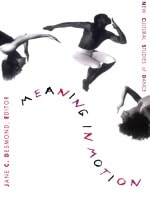
Dance, whether considered as an art form or embodied social practice, as product or process, is a prime subject for cultural analysis. Yet only recently have studies of dance become concerned with the ideological, theoretical, and social meanings of dance practices, performances, and institutions. In Meaning in Motion, Jane C. Desmond brings together the work of critics who have ventured into the boundaries between dance and cultural studies, and thus maps a little-known and rarely explored critical site.
Writing from a broad range of perspectives, contributors from disciplines as varied as art history and anthropology, dance history and political science, philosophy and women’s studies chart the questions and challenges that mark this site. How does dance enact or rework social categories of identity? How do meanings change as dance styles cross borders of race, nationality, or class? How do we talk about materiality and motion, sensation and expressivity, kinesthetics and ideology? The authors engage these issues in a variety of contexts: from popular social dances to the experimentation of the avant-garde; from nineteenth-century ballet and contemporary Afro-Brazilian Carnival dance to hip hop, the dance hall, and film; from the nationalist politics of folk dances to the feminist philosophies of modern dance. Giving definition to a new field of study, Meaning in Motion broadens the scope of dance analysis and extends to cultural studies new ways of approaching matters of embodiment, identity, and representation.

Contributors. Ann Cooper Albright, Evan Alderson, Norman Bryson, Cynthia Cohen Bull, Ann Daly, Brenda Dixon Gottschild, Susan Foster, Mark Franko, Marianne Goldberg, Amy Koritz, Susan Kozel, Susan Manning, Randy Martin, Angela McRobbie, Kate Ramsey, Anna Scott, Janet Wolff
[more]
cover of Meaning in Suffering: Caring Practices in the Health Professions

Meaning in Suffering

Caring Practices in the Health Professions

Edited by Nancy Johnston and Alwilda Scholler-Jaquish

University of Wisconsin Press, 2007
     Compelling, timely, and essential reading for healthcare providers, Meaning in Suffering addresses the multiplicity of meanings suffering brings to all it touches: patients, families, health workers, and human science professionals. Examining suffering in writing that is both methodologically rigorous and accessible, the contributors preserve first-hand experiences using narrative ethnography, existential hermeneutics, hermeneutic phenomenology, and traditional ethnography. They offer nuanced insights into suffering as a human condition experienced by persons deserving of dignity, empathy, and understanding. Collectively, these essays demonstrate that understanding the suffering of the "other" reveals something vital about the moral courage required to heal—and stay humane—in the face of suffering.
 
 
Winner, Nursing Research Category, American Journal of Nursing
[more]
cover of Meaning in the Visual Arts

Meaning in the Visual Arts

Erwin Panofsky

University of Chicago Press, 1983

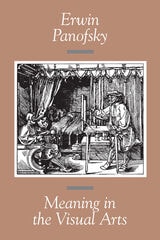
Since its original publication, Erwin Panofsky's Meaning in the Visual Arts has been standard reading for students of art history. It is both an introduction to the study of art and, for those with more specialized interests, a profound discussion of art and life in the Middle Ages and Renaissance. Panofsky's historical technique reveals an abundance of detail, detail he skillfully relates to the life and work of individual painters and their times.

The papers in this volume represent a cross-section of Panofsky's major work. Included are selections from his well-known Studies in Iconology and The Life and Art of Albrecht Dürer, plus an introduction and an epilogue—"The History of Art as a Humanistic Discipline" and "Three Decades of Art History in the United States: Impressions of a Transplanted European"—as well as pieces written especially for this collection. All display Panofsky's vast erudition and deep commitment to a humanistic conception of art and art history.
[more]
cover of Meaning of Folklore: The Analytical Essays of Alan Dundes

Meaning of Folklore

The Analytical Essays of Alan Dundes

Simon J. Bronner

Utah State University Press, 2020

The essays of Alan Dundes virtually created the meaning of folklore as an American academic discipline. Yet many of them went quickly out of print after their initial publication in far-flung journals. Brought together for the first time in this volume compiled and edited by Simon Bronner,  the selection surveys Dundes's major ideas and emphases, and is introduced by Bronner with a thorough analysis of Dundes's long career, his interpretations, and his inestimable contribution to folklore studies.

Runner-up, the Wayland Hand Award for Folklore and History, 2009
[more]
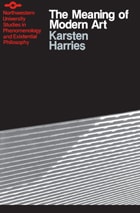
cover of Meaning of Modern Art

Meaning of Modern Art

Karsten Harries

Northwestern University Press, 1979

That modern art is different from earlier art is so obvious as to be hardly worth mentioning. Yet there is little agreement as to the meaning or the importance of this difference. Indeed, contemporary aestheticians, especially, seem to feel that modern art does not depart in any essential way from the art of the past. One reason for this view is that, with the exception of Marxism, the leading philosophical schools today are ahistorical in orientation. This is as true of phenomenology and existentialism as it is of contemporary analytic philosophy. As a result there have been few attempts by philosophers to understand the meaning of the history of art—an understanding fundamental to any grasp of the difference between modern art and its predecessors.

Art expresses an ideal image of man, and an essential part of understanding the meaning of a work of art is understanding this image. When the ideal image changes, art, too, must change. It is thus possible to look at the emergence of modern art as a function of the disintegration of the Platonic-Christian conception of man. The artist no longer has an obvious, generally accepted route to follow. One sign of this is that there is no one style today comparable to Romanesque, Gothic, Renaissance, or Baroque. This lack of direction has given the artist a new freedom. Today there is a great variety of answers to the question, "What is art?" Such variety, however, betrays an uncertainty about the meaning of art. An uneasiness about the meaning of art has led modern artists to enter into dialogue with art historians, psychologists and philosophers. Perhaps this interpretation can contribute to that dialogue.
[more]
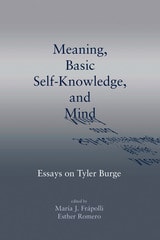
cover of Meaning, Basic Self-Knowledge, and Mind: Essays on Tyler Burge

Meaning, Basic Self-Knowledge, and Mind

Essays on Tyler Burge

Edited by María Frápolli and Esther Romero

CSLI, 2003

This volume comprises a lively and thorough discussion between philosophers and Tyler Burge about Burge's recent, and already widely accepted, position in the theory of meaning, mind, and knowledge. This position is embodied by an externalist theory of meaning and an anti-individualist theory of mind and approach to self-knowledge.

The authors of the eleven papers here expound their versions of this position and go on to critique Burge's version. Together with Burge's replies, this volume offers a major contribution to contemporary philosophy.
[more]
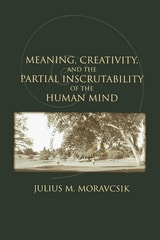
cover of Meaning, Creativity, and the Partial Inscrutability of the Human Mind

Meaning, Creativity, and the Partial Inscrutability of the Human Mind

Julius M. Moravcsik

CSLI, 1998
In this book, Julius M. Moravcsik disputes that a natural language is not and should not be represented as a formal language. The book criticizes current philosophy of language as having an altered focus without adjusting the needed conceptual tools. It develops a new theory of lexical meaning, a new conception of cognition-humans not as information processing creatures but as primarily explanation and understanding seeking creatures-with information processing as a secondary, derivative activity. In conclusion, based on the theories of lexical meaning and cognition, this work sketches an argument showing that the human understanding of human understanding must always remain just partial.
[more]
cover of Meaning, Creativity, and the Partial Inscrutability of the Human Mind: Second Edition

Meaning, Creativity, and the Partial Inscrutability of the Human Mind

Second Edition

Julius M. Moravcsik

CSLI, 2016

This book criticizes current philosophy of language as having altered its focus without adjusting the needed conceptual tools. It develops a new theory of lexical meaning and a new conception of cognition—humans not as information-processing creatures but as primarily explanation and understanding-seeking creatures—with information processing as a secondary, derivative activity. Drawing on these theories of lexical meaning and cognition, Julius M. Moravcsik argues that the ability of humans to fully comprehend human understanding will always be partial. In this second edition, Moravcsik posits a new theory that emphasizes implicitness and context in communication. In this theory, language is presented as a dynamic system with built-in mechanisms for change and expansion, thus further supporting Moravcsik’s overarching thesis that human understanding will always be incomplete.
[more]
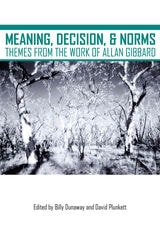
cover of Meaning, Decision, and Norms: Themes from the Work of Allan Gibbard

Meaning, Decision, and Norms

Themes from the Work of Allan Gibbard

Eds. Billy Dunaway and David Plunkett

Michigan Publishing Services, 2021

It is not an exaggeration to say that Allan Gibbard is one of the most significant contributors to philosophy over the last five decades. Gibbard’s work covers an impressive number of subfields within philosophy, including ethics, philosophy of language, decision theory, epistemology, and metaphysics. It also engages with, and makes significant contributions to, work from the natural and social sciences.

This volume is not a collection of artifacts from past decades of philosophy. Instead, it is a collection of essays that each make a significant contribution to contemporary work in philosophy. This reflects the fact that Gibbard’s work has not only had a massive influence on past discussion in philosophy but also continues to influence new directions of philosophical research.

With contributions from:
Sara Aronowitz, Simon Blackburn, Paul Boghossian, David Braddon-Mitchell, Nate Charlow, Stephen Darwall, Jamie Dreier, Billy Dunaway, Melissa Fusco, Sona Ghosh, Allan Gibbard, Bill Harper, Paul Horwich, Zoë Johnson King, Tristram McPherson, Howard Nye, Lauren Olin, Caleb Perl, David Plunkett, Peter Railton, Connie Rosati, Mark Schroeder, Alex Silk, Daniel J. Singer, Brian Skyrms, and Seth Yalcin.
[more]
cover of Meaning, Form, and Body

Meaning, Form, and Body

Mark Turner, Fey Parrill, and Vera Tobin

CSLI, 2010

Meaning, Form, and Body brings together renowned figures in the field of cognitive linguistics to discuss two related research areas in the study of linguistics: the integration of form and meaning and language and the human body. Among the numerous topics discussed are grammatical constructions, conceptual integration, and gesture.
[more]
cover of Meaning, Intentions, and Argumentation

Meaning, Intentions, and Argumentation

Kepa Korta and Garmendia

CSLI, 2008
What is the relationship between words and reality? Which are the best ways to convince or persuade other people? Besides philosophy and grammar, ancient Greeks developed rhetoric to answer these questions. The twentieth-century brought the birth of semantics and pragmatics for a systematic study of linguistic meaning and linguistic acts. Meaning, Intentions, and Argumentation brings together the work of leading contemporary scholars approaching those issues from various perspectives—from the old disciplines of philosophy and rhetoric to the newest thinking on semantics and pragmatics—to illuminate crucial aspects of meaning, communication, argumentation, and persuasion.
 
 
[more]
cover of Memory, Meaning, and Resistance: Reflecting on Oral History and Women at the Margins

Memory, Meaning, and Resistance

Reflecting on Oral History and Women at the Margins

Fran Leeper Buss

University of Michigan Press, 2017
Fran Leeper Buss, a former welfare recipient who earned a PhD in history and became a pioneer in the field of oral history, has for forty years dedicated herself to the goal of collecting the stories of marginal and working-class U.S. women. Memory, Meaning, and Resistance is based on over 100 oral histories gathered from women from a variety of racial, ethnic, and geographical backgrounds, including a traditional Mexican American midwife, a Latina poet and organizer for the United Farm Workers, and an African American union and freedom movement organizer. Buss now analyzes this body of work, identifying common themes in women’s lives and resistance that unite the oral histories she has gathered. From the beginning, her work has shed light on the inseparable, compounding effects of gender, race, ethnicity, and class on women’s lives—what is now commonly called intersectionality. Memory, Meaning, and Resistance is structured thematically, with each chapter analyzing a concept that runs through the oral histories, e.g., agency, activism, religion. The result is a testament to women’s individual and collective strength, and an invaluable guide for students and researchers, on how to effectively and sensitively conduct oral histories that observe, record, recount, and analyze women’s life stories. 
 
[more]
cover of Mountains of Fire: The Menace, Meaning, and Magic of Volcanoes

Mountains of Fire

The Menace, Meaning, and Magic of Volcanoes

Clive Oppenheimer

University of Chicago Press, 2023

Meeting with volcanoes around the world, a volcanologist interprets their messages for humankind.
 
In Mountains of Fire, Clive Oppenheimer invites readers to stand with him in the shadow of an active volcano. Whether he is scaling majestic summits, listening to hissing lava at the crater’s edge, or hunting for the far-flung ashes from Earth’s greatest eruptions, Oppenheimer is an ideal guide, offering readers the chance to tag along on the daring, seemingly-impossible journeys of a volcanologist.

In his eventful career as a volcanologist and filmmaker, Oppenheimer has studied volcanoes around the world. He has worked with scientists in North Korea to study Mount Paektu, a volcano name sung in national anthems on both sides of the Demilitarized Zone. He has crossed the Sahara to reach the fabled Tiéroko volcano in the Tibesti Mountains of Chad. He spent months camped atop Antarctica’s most active volcano, Mount Erebus, to record the pulse of its lava lake.

Mountains of Fire reveals how volcanic activity is entangled with our climate and environment, as well as our economy, politics, culture, and beliefs. These adventures and investigations make clear the dual purpose of volcanology—both to understand volcanoes for science’s sake and to serve the communities endangered and entranced by these mountains of fire. 
[more]