Results by title
134 books match the query 'Psychoanalysis' and 11 start with a
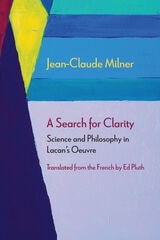
A Search for Clarity
Science and Philosophy in Lacan's OeuvreJean-Claude Milner; Translated from the French by Ed Pluth
Northwestern University Press, 2021
In A Search for Clarity, Jean‑Claude Milner argues that although Jacques Lacan’s writing is notoriously obscure his oeuvre is entirely clear. In a discussion that considers the difference between the esoteric and exoteric works of Plato and Aristotle, Milner argues that Lacan’s oeuvre is to be found in his published writings alone, not his transcribed seminars, and that these published writings contain his official doctrine. Thus, Lacan’s oeuvre is already complete, even though many of his seminars remain unpublished.
According to Milner, Lacan’s fundamental idea is that the subject psychoanalysis works on is the subject of science. Milner suggests that this is a supplement to Alexandre Koyré’s and Alexandre Kojève’s accounts of modern science, for which mathematization and a break from the ancient episteme were key.
A Search for Clarity is the definitive statement on how Lacan viewed the relationship between psychoanalysis and science, and on how Lacan’s thinking evolved as he struggled to draw out the consequences of the equation he posited between psychoanalysis and science. Milner’s work on Lacan has been essential reading in French for decades. This English translation will make his illuminating work accessible to a broader audience.

A Thousand Plateaus
Capitalism and SchizophreniaGilles Deleuze
University of Minnesota Press, 1987
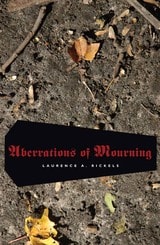
Aberrations of Mourning
Laurence A. Rickels
University of Minnesota Press, 2011
Rickels studies mourning and melancholia within and around psychoanalysis, analyzing the writings of such thinkers as Freud, Nietzsche, Lessing, Heinse, Artaud, Keller, Stifter, Kafka, and Kraus. Rickels maintains that we must shift the way we read literature, philosophy, and psychoanalysis to go beyond traditional Oedipal structures.
Aberrations of Mourning argues that the idea of the crypt has had a surprisingly potent influence on psychoanalysis, and Rickels shows how society’s disturbed relationship with death and dying, our inability to let go of loved ones, has resulted in technology to form more and more crypts for the dead by preserving them—both physically and psychologically—in new ways.
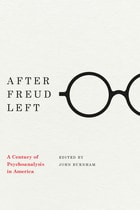
After Freud Left
A Century of Psychoanalysis in AmericaEdited by John Burnham
University of Chicago Press, 2012
From August 29 to September 21, 1909, Sigmund Freud visited the United States, where he gave five lectures at Clark University in Worcester, Massachusetts. This volume brings together a stunning gallery of leading historians of psychoanalysis and of American culture to consider the broad history of psychoanalysis in America and to reflect on what has happened to Freud’s legacy in the United States in the century since his visit.

After Queer Theory
The Limits of Sexual PoliticsJames Penney
Pluto Press, 2013
After Queer Theory makes the provocative claim that queer theory has run its course, made obsolete by the elaboration of its own logic within capitalism. James Penney argues that far from signalling the end of anti-homophobic criticism, however, the end of queer presents the occasion to rethink the relation between sexuality and politics.
Through a critical return to Marxism and psychoanalysis (Freud and Lacan), Penney insists that the way to implant sexuality in the field of political antagonism is paradoxically to abandon the exhausted premise of a politicised sexuality.
After Queer Theory argues that it is necessary to wrest sexuality from the dead end of identity politics, opening it up to a universal emancipatory struggle beyond the reach of capitalism's powers of commodification.
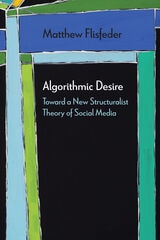
Algorithmic Desire
Toward a New Structuralist Theory of Social MediaMatthew Flisfeder
Northwestern University Press, 2021
In Algorithmic Desire, Matthew Flisfeder shows that social media is a metaphor that reveals the dominant form of contemporary ideology: neoliberal capitalism. The preeminent medium of our time, social media’s digital platform and algorithmic logic shape our experience of democracy, enjoyment, and desire. Weaving between critical theory and analyses of popular culture, Flisfeder uses examples from The King’s Speech, Black Mirror, Gone Girl, The Circle, and Arrival to argue that social media highlights the antisocial dimensions of twenty‑first-century capitalism. He counters leading critical theories of social media—such as new materialism and accelerationism—and thinkers such as Gilles Deleuze and Michel Foucault, proposing instead a new structuralist account of the ideology and metaphor of social media. Emphasizing the structural role of crises, gaps, and negativity as central to our experiences of reality, Flisfeder interprets the social media metaphor through a combination of dialectical, Marxist, and Lacanian frameworks to show that algorithms may indeed read our desire, but capitalism, not social media, truly makes us antisocial. Wholly original in its interdisciplinary approach to social media and ideology, Flisfeder’s conception of “algorithmic desire” is timely, intriguing, and sure to inspire debate.

Anti-Oedipus
Capitalism and SchizophreniaGilles Deleuze
University of Minnesota Press, 1983
Apprehending the Inaccessible
Freudian Psychoanalysis and Existential PhenomenologyRichard Askay and Jensen Farquhar
Northwestern University Press, 2006
With its unique perspective on Freud's work, Apprehending the Inaccessible puts readers in a better position to appreciate his contributions and evaluate the relationship between his and other philosophical world views. The authors, both of whom have extensive backgrounds in philosophy and psychology, present balanced critical analyses of crucial developments in, for example, the evolution of the Freudian notion of the unconscious, and the engagement of existential phenomenology with Freudian psychoanalysis. Askay and Farquhar then consider—often for the first time—individual thinkers' reflections on and interpretations of Freud, ranging from the primary figures in existential phenomenology to the most prominent figures in the existential psychoanalytic movement. Even as their work offers a new approach to Freudian thought, it reasserts the importance of alternative views found in existential phenomenology as those views pertain to psychoanalysis and the question of apprehending the inaccessible.

Archive Fever
A Freudian ImpressionJacques Derrida
University of Chicago Press, 1996
"Judaic mythos, Freudian psychoanalysis, and e-mail all get fused into another staggeringly dense, brilliant slab of scholarship and suggestion."—The Guardian
"[Derrida] convincingly argues that, although the archive is a public entity, it nevertheless is the repository of the private and personal, including even intimate details."—Choice
"Beautifully written and clear."—Jeremy Barris, Philosophy in Review
"Translator Prenowitz has managed valiantly to bring into English a difficult but inspiring text that relies on Greek, German, and their translations into French."—Library Journal

Arguing Sainthood
Modernity, Psychoanalysis, and IslamKatherine Pratt Ewing
Duke University Press, 1997
Ewing critiques Eurocentric cultural theorists and Orientalist discourse while also taking issue with expatriate postcolonial thinkers Homi Bhabha and Gayatri Spivak. She challenges the notion of a monolithic Islamic modernity in order to explore the lived realities of individuals, particularly those of Pakistani saints and their followers. By examining the continuities between current Sufi practices and earlier popular practices in the Muslim world, Ewing identifies in the Sufi tradition a reflexive, critical consciousness that has usually been associated with the modern subject. Drawing on her training in clinical and theoretical psychoanalysis as well as her anthropological fieldwork in Lahore, Pakistan, Ewing argues for the value of Lacan in anthropology as she provides the basis for retheorizing postcolonial studies.
Art and Politics
Psychoanalysis, Ideology, TheatreWalter A. Davis
Pluto Press, 2006
Starting with an analysis of the censorship of the play My Name is Rachel Corrie, which was withdrawn from production by a major New York theater due to a political pressure, Davis shows how all art that challenges the mainstream is either suppressed or distorted to suit the politics of our time---one that will not recognize the truth of human experience and the disorder at the heart of all civilization.