Results by title
69 books match the query 'Middle class' and 5 start with m
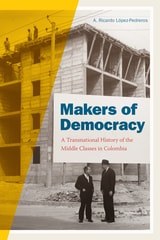
Makers of Democracy
A Transnational History of the Middle Classes in ColombiaA. Ricardo López-Pedreros
Duke University Press, 2019
In Makers of Democracy A. Ricardo López-Pedreros traces the ways in which a thriving middle class was understood to be a foundational marker of democracy in Colombia during the second half of the twentieth century. Drawing on a wide array of sources ranging from training manuals and oral histories to school and business archives, López-Pedreros shows how the Colombian middle class created a model of democracy based on free-market ideologies, private property rights, material inequality, and an emphasis on a masculine work culture. This model, which naturalized class and gender hierarchies, provided the groundwork for Colombia's later adoption of neoliberalism and inspired the emergence of alternate models of democracy and social hierarchies in the 1960s and 1970s that helped foment political radicalization. By highlighting the contested relationships between class, gender, economics, and politics, López-Pedreros theorizes democracy as a historically unstable practice that exacerbated multiple forms of domination, thereby prompting a rethinking of the formation of democracies throughout the Americas.
[more]
Mexico's Middle Class in the Neoliberal Era
Dennis Gilbert
University of Arizona Press, 2007
Mexico’s modern middle class emerged in the decades after World War II, a period of spectacular economic growth and social change. Though little studied, the middle class now accounts for one in five Mexican households. This path-breaking book explores the changing fortunes and political transformation of the middle class, especially during the last two decades, as Mexico has adopted new, market-oriented economic policies and has abandoned one-party rule.
Blending the personal narratives of middle-class Mexicans with analyses of national surveys of households and voters, Dennis Gilbert traces the development of the middle class since the 1940s. He describes how middle-class Mexicans were affected by the economic upheavals of the 1980s and 1990s and examines their shifting relations with the ruling Partido Revolucionario Institucional (PRI).
Long faithful to the PRI, the middle class gradually grew disenchanted. Gilbert examines middle-class reactions to the 1968 Tlatelolco massacre, the 1982 debt crisis, the government’s feeble response to the 1985 Mexico City earthquake, and its brazen manipulation of the vote count in the 1988 presidential election. Drawing on detailed interviews with Mexican families, he describes the effects of the 1994–95 peso crisis on middle-class households and their economic and political responses to it. His analysis of exit poll data from the 2000 elections shows that the lopsided middle-class vote in favor of opposition candidate Vicente Fox played a critical role in the election that drove the PRI from power after seven decades.
The book closes with an epilogue on the middle class and the July 2006 presidential elections.
[more]
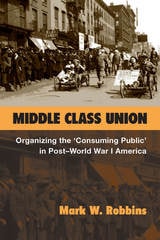
Middle Class Union
Organizing the ‘Consuming Public’ in Post-World War I AmericaMark W. Robbins
University of Michigan Press, 2017
Middle Class Union argues that the period following World War I was a pivotal moment in the development of middle-class consumer politics in the 20th century. At this time, middle-class Americans politically mobilized to define for society what was fair in the growing consumer marketplace. They projected themselves as guardians of the producerist values of hard work, honesty, and thrift, and called for greater adherence to them among the working and elite classes. In this era and in later periods, they flexed their muscles as consumers, and claimed to defend the values of the nation.
Combining social history with interdisciplinary approaches to the study of consumption and symbolic space, Middle Class Union illustrates how acts of consumption, representations of the middle class in literary, journalistic, and artistic discourses, and ground-level organizing combined to enable white-collar activists to establish themselves as both the middle class and the backbone of the nation. This book contributes to labor history by examining the nexus of class and consumption to show how many white-collar workers drew on their consumer identity to express an anti-labor politics, later facilitating the struggles of unions throughout the post–World War I years. It also contributes to political history by emphasizing how these middle-class activists laid important groundwork for both 1920s business conservatism and New Deal liberalism. They exerted their political influence well before the post–World War II period, when a self-interested and powerful middle-class consumer identity is more widely acknowledged to have taken hold.
Combining social history with interdisciplinary approaches to the study of consumption and symbolic space, Middle Class Union illustrates how acts of consumption, representations of the middle class in literary, journalistic, and artistic discourses, and ground-level organizing combined to enable white-collar activists to establish themselves as both the middle class and the backbone of the nation. This book contributes to labor history by examining the nexus of class and consumption to show how many white-collar workers drew on their consumer identity to express an anti-labor politics, later facilitating the struggles of unions throughout the post–World War I years. It also contributes to political history by emphasizing how these middle-class activists laid important groundwork for both 1920s business conservatism and New Deal liberalism. They exerted their political influence well before the post–World War II period, when a self-interested and powerful middle-class consumer identity is more widely acknowledged to have taken hold.
[more]
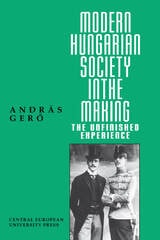
Modern Hungarian Society in the Making
András Gero
Central European University Press, 1995
Illuminates the problems connected with Hungary's transition to a civil society while providing insights into the development of political culture and the rise of civil and national consequences.
[more]
Money, Morals, and Manners
The Culture of the French and the American Upper-Middle ClassMichèle Lamont
University of Chicago Press, 1992
Drawing on remarkably frank, in-depth interviews with 160 successful men in the United States and France, Michèle Lamont provides a rare and revealing collective portrait of the upper-middle class—the managers, professionals, entrepreneurs, and experts at the center of power in society. Her book is a subtle, textured description of how these men define the values and attitudes they consider essential in separating themselves—and their class—from everyone else.
Money, Morals, and Manners is an ambitious and sophisticated attempt to illuminate the nature of social class in modern society. For all those who downplay the importance of unequal social groups, it will be a revelation.
"A powerful, cogent study that will provide an elevated basis for debates in the sociology of culture for years to come."—David Gartman, American Journal of Sociology
"A major accomplishment! Combining cultural analysis and comparative approach with a splendid literary style, this book significantly broadens the understanding of stratification and inequality. . . . This book will provoke debate, inspire research, and serve as a model for many years to come."—R. Granfield, Choice
"This is an exceptionally fine piece of work, a splendid example of the sociologist's craft."—Lewis Coser, Boston College
[more]