Results by title
64 books match the query 'Military policy' and 4 start with m
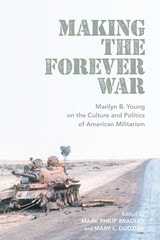
Making the Forever War
Marilyn B. Young on the Culture and Politics of American MilitarismMary L. Dudziak
University of Massachusetts Press, 2021
The late historian Marilyn B. Young, a preeminent voice on the history of U.S. military conflict, spent her career reassessing the nature of American global power, its influence on domestic culture and politics, and the consequences felt by those on the receiving end of U.S. military force. At the center of her inquiries was a seeming paradox: How can the United States stay continually at war, yet Americans pay so little attention to this militarism?
Making the Forever War brings Young's articles and essays on American war together for the first time, including never before published works. Moving from the first years of the Cold War to Korea, Vietnam, and more recent "forever" wars in Iraq and Afghanistan, Young reveals the ways in which war became ever-present, yet more covert and abstract, particularly as aerial bombings and faceless drone strikes have attained greater strategic value. For Young, U.S. empire persisted because of, not despite, the inattention of most Americans. The collection concludes with an afterword by prominent military historian Andrew Bacevich.
Making the Forever War brings Young's articles and essays on American war together for the first time, including never before published works. Moving from the first years of the Cold War to Korea, Vietnam, and more recent "forever" wars in Iraq and Afghanistan, Young reveals the ways in which war became ever-present, yet more covert and abstract, particularly as aerial bombings and faceless drone strikes have attained greater strategic value. For Young, U.S. empire persisted because of, not despite, the inattention of most Americans. The collection concludes with an afterword by prominent military historian Andrew Bacevich.
[more]
Making the Immigrant Soldier
How Race, Ethnicity, Class, and Gender Intersect in the US MilitaryCristina-Ioana Dragomir
University of Illinois Press, 2023
Immigrants to the United States have long used the armed forces as a shortcut to citizenship. Cristina-Ioana Dragomir profiles Lily, Alexa, and Vikrant, three immigrants of varying nationalities and backgrounds who chose military service as their way of becoming American citizens. Privileging the trio’s own words and experiences, Dragomir crafts a human-focused narrative that moves from their lives in their home countries and decisions to join the military to their fraught naturalization processes within the service. Dragomir illuminates how race, ethnicity, class, and gender impacted their transformation from immigrant to soldier, veteran, and American. She explores how these factors both eased their journeys and created obstacles that complicated their access to healthcare, education, economic resources, and other forms of social justice.
A compelling union of analysis and rich storytelling, Making the Immigrant Soldier traces the complexities of serving in the military in order to pursue the American dream.
[more]

Military Occupation and Diplomacy
Soviet Troops in Romania, 1944–1958Sergiu Verona
Duke University Press, 1992
In 1958, after fourteen years of military occupation, Khrushchev—in an unprecedented act—withdrew the Soviet Union’s troops from Romania as part of a political move intended to encourage the withdrawal of Western military forces from Europe. In analyzing this crucial historic episode, Sergiu Verona’s comprehensive study illustrates the dynamics of Soviet military presence in Romania and provides a framework for understanding Soviet security policy, then and now, as well as the interaction between Soviet military objectives and diplomacy.
Drawing on declassified archival material in the United States and the United Kingdom, the author considers Khrushchev’s reversal of Stalinist expansionism by examining the motivation, function, and operation of the initial occupation of Romania; the complex involvement of Soviet diplomacy and its perception by the United States and other Western powers; the process by which Khrushchev decided to withdraw Soviet troops from that country; and the impact of this decision on Soviet policy. Verona extends his analysis, providing comparisons between Khrushchev’s and Gorbachev’s approaches to Eastern Europe, noting that similarities exist not only in domestic policies but in the realm of foreign policy as well.
Drawing on declassified archival material in the United States and the United Kingdom, the author considers Khrushchev’s reversal of Stalinist expansionism by examining the motivation, function, and operation of the initial occupation of Romania; the complex involvement of Soviet diplomacy and its perception by the United States and other Western powers; the process by which Khrushchev decided to withdraw Soviet troops from that country; and the impact of this decision on Soviet policy. Verona extends his analysis, providing comparisons between Khrushchev’s and Gorbachev’s approaches to Eastern Europe, noting that similarities exist not only in domestic policies but in the realm of foreign policy as well.
[more]
Military Realism
The Logic and Limits of Force and Innovation in the U.S. ArmyPeter Campbell
University of Missouri Press, 2024
After the Vietnam War, the U.S. Army considered counterinsurgency (COIN) a mistake to be avoided. Many found it surprising, then, when setbacks in recent conflicts led the same army to adopt a COIN doctrine. Scholarly debates have primarily employed existing theories of military bureaucracy or culture to explain the army’s re-embrace of COIN, but Peter Campbell advances a unique argument centering on military realism to explain the complex evolution of army doctrinal thinking from 1960 to 2008.
In five case studies of U.S. Army doctrine, Campbell pits military realism against bureaucratic and cultural perspectives in three key areas—nuclear versus conventional warfare, preferences for offense versus defense, and COIN missions—and finds that the army has been more doctrinally flexible than those perspectives would predict. He demonstrates that decision makers, while vowing in the wake of Vietnam to avoid (COIN) missions, nonetheless found themselves adapting to the geopolitical realities of fighting “low intensity” conflicts. In essence, he demonstrates that pragmatism has won out over dogmatism. At a time when American policymakers remain similarly conflicted about future defense strategies, Campbell’s work will undoubtedly shape and guide the debate.
In five case studies of U.S. Army doctrine, Campbell pits military realism against bureaucratic and cultural perspectives in three key areas—nuclear versus conventional warfare, preferences for offense versus defense, and COIN missions—and finds that the army has been more doctrinally flexible than those perspectives would predict. He demonstrates that decision makers, while vowing in the wake of Vietnam to avoid (COIN) missions, nonetheless found themselves adapting to the geopolitical realities of fighting “low intensity” conflicts. In essence, he demonstrates that pragmatism has won out over dogmatism. At a time when American policymakers remain similarly conflicted about future defense strategies, Campbell’s work will undoubtedly shape and guide the debate.
[more]