Results by title
187 books match the query 'Minorities' and 15 start with m

Making History Matter
Robert Dawidoff
Temple University Press, 2000
As a scholar of intellectual and cultural history, Dawidoff takes the stance that historians ought to take an active role in our democratic culture, informing and participating in public discourse. He argues for a broad reach when it comes to cultural expression, resisting the polarization of formal intellectual history and folk or commercial popular culture. In his view, Ralph Waldo Emerson and Katherine Hepburn are equally worthy topics for a historian's consideration, provided that they are treated with equal seriousness of purpose and analytic rigor. In "The Gay Nineties" section that closes the book, he traces key events in the continual struggle for gay and lesbian civil rights and takes on such unresolved issues as safer sex, needle exchange programs to control HIV transmission, and the public controversy around the portrayal of gay and lesbian television characters.
Divided into sections that deal with the patriarchs of American political and intellectual culture, expressive culture, and a historian's public voice, this book is a model of engaged and engaging writing. Accessible and witty, Making History Matter will appeal to general and academic readers interested in American history as well as gay and lesbian political and cultural issues.
Managing Diversity in Organizations
Robert T. Golembiewski
University of Alabama Press, 1995
Managing Diversity in Organizations focuses on a key issue that organizations are facing—diversity. It is here, and it is growing. The only question now is how well we deal with diversity, especially in organizational contexts.
Golembiewski identifies the many forces and factors propelling us into the age of diversity in organizations—ethical, political, philosophic, demographic, and so on—and details the historical and contemporary approaches. Most practice has focused on a "level playing field" or equal opportunity and "tilting the playing field" or equal outcomes. This volume focuses on diversity as a strategic device rather than as a nicety rooted in behavioral and organizational research. Managing diversity successfully in organizations requires a thorough understanding of management infrastructure that is consistent with diversity--especially structures of work, policies, and procedures that institutionalize and build diversity.
Mapping Multiculturalism
Gordon, Avery F.
University of Minnesota Press, 1996
Mayors and Schools
Minority Voices and Democratic Tensions in Urban EducationStefanie Chambers
Temple University Press, 2006
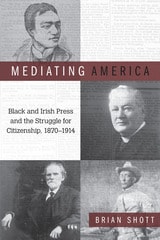
Mediating America
Black and Irish Press and the Struggle for Citizenship, 1870-1914Brian Shott
Temple University Press, 2019
Until recently, print media was the dominant force in American culture. The power of the paper was especially true in minority communities. African Americans and European immigrants vigorously embraced the print newsweekly as a forum to move public opinion, cohere group identity, and establish American belonging.
Mediating America explores the life and work of T. Thomas Fortune and J. Samuel Stemons as well as Rev. Peter C. Yorke and Patrick Ford—respectively two African American and two Irish American editor/activists in the late nineteenth and early twentieth centuries. Historian Brian Shott shows how each of these “race men” (the parlance of the time) understood and advocated for his group’s interests through their newspapers. Yet the author also explains how the newspaper medium itself—through illustrations, cartoons, and photographs; advertisements and page layout; and more—could constrain editors’ efforts to guide debates over race, religion, and citizenship during a tumultuous time of social unrest and imperial expansion.
Black and Irish journalists used newspapers to recover and reinvigorate racial identities. As Shott proves, minority print culture was a powerful force in defining American nationhood.

Medina by the Bay
Scenes of Muslim Study and SurvivalMaryam Kashani
Duke University Press, 2023
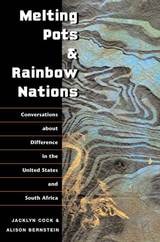
Melting Pots and Rainbow Nations
Conversations about Difference in the United States and South AfricaJacklyn Cock and Alison Bernstein
University of Illinois Press, 2002
This passionate, intelligent commentary is an invigorating look at the implications of difference and diversity in two contrasting but similar societies: the United States and South Africa. Melting Pots and Rainbow Nations addresses how differences--of gender, race, culture, biology, and sexual orientation--are variously understood and acted on in both countries.
The authors argue that the concepts of difference and diversity, although valuable, are hollow if disconnected from specific social and historical contexts in which power relations create and perpetuate disadvantage. Their thoughtful exploration includes accounts of their own experiences of difference and their perspectives on such pioneering women as Elizabeth Bishop, Frene Ginwala, Audre Lorde, Ruth First, Jane Goodall, and Mamphela Ramphele.

Mexican Americans and Health
¡Sana! ¡Sana!Adela de la Torre and Antonia Estrada
University of Arizona Press, 2001
- how values such as machismo, familismo, and marianismo influence care-seeking decisions and treatment of illness;
- how factors such as cultural values, socioeconomic status, peer pressure, and family concerns can contribute to substance abuse;
- how cultural attitudes toward sex can heighten the risk of AIDS—and how approaches to AIDS prevention and education need to reflect core cultural values such as familismo, respeto, and confianza. The book also addresses concerns of Mexican Americans regarding the health care system. These include not only access to care and to health insurance but also the shortage of bilingual and bicultural health care professionals. This coverage stresses not only the importance of linguistic competency but also the need to understand folklore illnesses, herbal remedies, and spiritual practices that can delay the treatment of illness and either complement or compromise treatment. Of all the issues that face the contemporary Mexican American community, none is as important to its very survival as health and health care. This timely book gives readers a broad understanding of these complex issues and points the way toward a healthier future for all people of Mexican origin. Mexican Americans and Health and Chicano Popular Culture are the first volumes in the series The Mexican American Experience, a cluster of modular texts designed to provide greater flexibility in undergraduate education. Each book deals with a single topic concerning the Mexican American population. Instructors can create a semester-length course from any combination of volumes, or may choose to use one or two volumes to complement other texts.

Mexican Americans and Health
¡Sana! ¡Sana!Adela de la Torre and Antonio Estrada
University of Arizona Press, 2015
Given recent developments in health care and policy and a steadily increasing population of people of Mexican origin in the United States, a comprehensive look at Mexican American health has never been more necessary. Adela de la Torre and Antonio Estrada first accomplished such an overview with Mexican Americans and Health in 2001, and they have since continued to revise and expand their initial work. With a multitude of additions and renovations, Mexican Americans and Health, 2nd Edition provides a timely and accessible description of current topics in Latino health.
De la Torre and Estrada once again present a broad and nuanced understanding of recent issues involving Mexican American health and well-being, this time with the addition of discussions on:
* the new U.S. Human Development Index to contextualize the health, education, and income status of Mexican Americans relative to other population groups,
* emerging diseases, such as diabetes and obesity,
* recent health-care reforms under the Obama administration,
* substance abuse, sexual risk, and psychological distress among HIV-positive individuals in the gay/bisexual community,
* and predictions of future trends for the next decade.
This new volume has been updated throughout to reflect the many developments in health care since its first edition. Mexican Americans and Health, 2nd Edition continues to present data on a large number of health issues that are important and relevant to the Mexican American population, while describing the social contexts in which they are occurring. Its comprehensive and interdisciplinary approach brings originality and focus to a dynamic literature.
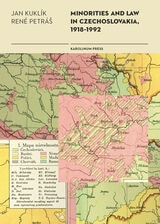
Minorities and Law in Czechoslovakia
Jan Kuklík and René Petráš
Karolinum Press, 2017
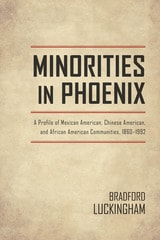
Minorities in Phoenix
A Profile of Mexican American, Chinese American, and African American Communities, 1860-1992Bradford Luckingham
University of Arizona Press, 1994
Settled in the mid-nineteenth century by Anglo and Mexican pioneers, Phoenix emerged as an Anglo-dominated society that presented formidable obstacles to minorities seeking access to jobs, education, housing, and public services. It was not until World War II and the subsequent economic boom and civil rights era that opportunities began to open up. Drawing on a variety of sources, from newspaper files to statistical data to oral accounts, Luckingham profiles the general history of each community, revealing the problems it has faced and the progress it has made. His overview of the public life of these three ethnic groups shows not only how they survived, but how they contributed to the evolution of one of America's fastest-growing cities.
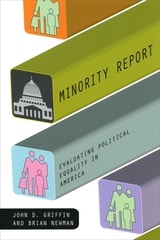
Minority Report
Evaluating Political Equality in AmericaJohn D. Griffin and Brian Newman
University of Chicago Press, 2008

Missing Stories
Leslie Kelen
Utah State University Press, 2000
Utah's ethnic diversity is often overlooked. In a society sometimes presumed to be homogeneous, there is a danger that the varied experiences of its members will be lost to history. Missing Stories, available here for the first time in paperback, effectively counters such misconceptions and explores the rich history of ethnic and minority groups in the state. Several representatives from each of eight such groups tell in their own voices stories of themselves, their families, and their communities. The groups represented are Utes, African-Americans, Jews, Chinese, Italians, Japanese, Greeks, and Hispanics. In a preface to each section of oral history interviews, a respected historian of the community introduces background and heritage, setting the context for the personal recollections that follow. Also included are striking photographs by Kent Miles and George Janecek that capture much of the personality and character of the interviewees.
These oral histories recount migrations to new homes in Utah or adjustment to white settlement of traditional homelands in the state. They bring to light the struggles of individuals and families to survive and the formation and maintenance of communities in frequently adverse conditions, whether on reservations or farms, in small towns or large cities. The histories are enriched by accounts of challenges met and overcome and enlivened by stories of events and persons who sometimes achieved legendary status within and outside the groups. Missing Stories reveals the many ways that ethnic and minority groups have contributed to Utah's history and fills in missing pieces necessary to a complete portrayal of the state's society and culture.
More Peoples of Las Vegas
One City, Many FacesJerry L Simich
University of Nevada Press, 2010
The remarkable economic growth of Las Vegas between 1980 and 2007 created a population boom and a major increase in the ethnic and religious diversity of the city. Today, over 21 percent of the city’s population is foreign born, and over 30 percent speak a language other than English at home. The local court system offers interpreters in 82 languages, and in 2005/2006, for example, more than 11,000 people, originating from 138 countries, were naturalized there as American citizens.More Peoples of Las Vegas extends the survey of this city’s cosmopolitan population begun in The Peoples of Las Vegas (University of Nevada Press, 2005). As in the previous book, this volume includes well-established groups like the Irish and Germans, and recently arrived groups like the Ethiopians and Guatemalans. Essays describe the history of each group in Las Vegas and the roles they play in the life and economy of the city. The essays also explore the influence of modern telecommunications and accessible air travel, showing how these factors allow newcomers to create transnational identities and maintain ties with families and culture back home. They also examine the role of local institutions—including clubs, religious organizations, shops, restaurants, and newspapers and other media—in helping immigrants maintain their ethnic and religious identities and in disseminating national and even regional cultures of origin.More Peoples of Las Vegas adds to our awareness of the rich and varied ethnic and religious character of Las Vegans. In a broader context, it offers thoughtful perspectives on the impact of globalization on a major American city and on the realities of immigrant life in the twenty-first century.
My Race Is My Gender
Portraits of Nonbinary People of ColorStephanie Hsu
Rutgers University Press, 2024
Genderqueer and nonbinary people of color often experience increased marginalization, belonging to an ethnic group that seldom recognizes their gender identity and a queer community that subscribes to white norms. Yet for this very reason, they have a lot to teach about how racial, sexual, and gender identities intersect. Their experiences of challenging social boundaries demonstrate how queer communities can become more inclusive and how the recognition of nonbinary genders can be an anti-racist practice.
My Race is My Gender is the first anthology by nonbinary writers of color to include photography and visual portraits, centering their everyday experiences of negotiating intersectional identities. While informed by queer theory and critical race theory, the authors share their personal stories in accessible language. Bringing together Black, Indigenous, Latine, and Asian perspectives, its six contributors present an intergenerational look at what it means to belong to marginalized queer communities in the U.S. and feel solidarity with a global majority at the same time. They also provide useful insights into how genderqueer and nonbinary activism can both energize and be fueled by such racial justice movements as Black Lives Matter.