Results by title
1947 books match the query 'Music' and 195 start with m
MP3
The Meaning of a FormatJonathan Sterne
Duke University Press, 2012
MP3s are products of compression, a process that removes sounds unlikely to be heard from recordings. Although media history is often characterized as a progression toward greater definition, fidelity, and truthfulness, MP3: The Meaning of a Format illuminates the crucial role of compression in the development of modern media and sound culture. Taking the history of compression as his point of departure, Jonathan Sterne investigates the relationships among sound, silence, sense, and noise; the commodity status of recorded sound and the economic role of piracy; and the importance of standards in the governance of our emerging media culture. He demonstrates that formats, standards, and infrastructures—and the need for content to fit inside them—are every bit as central to communication as the boxes we call "media."
Macau and Catholic Sacred Music Across the Sino-Western Divide
Jen-yen Chen
University of Michigan Press, 2026
Drawing from sound studies and musicological methods, Chen argues that Chinese descriptions of Catholic sounds in Macau, including the ringing of church bells, the playing of the organ, and choral singing, illuminate spatial, sonic, and ideological mobilities that reconfigure Chinese and European identities. Macau and Catholic Music Across the Sino-Western Divide also extends to contemporary times to explore how present day members of Macau’s Catholic community position themselves in relation to the historical narratives often told about their city, cultivating a rich individuality of identity that refuses conformity to fixed notions of Asianness or Westernness.

Macbeth
Melodramma in Four Acts. Libretto by Francesco Maria PiaveGiuseppe Verdi
University of Chicago Press, 2005
Published in three volumes, this critical edition of Macbeth is the only one based entirely on autograph sources. Containing the later version as the principal score, it is the first edition to consult the composer's manuscripts of the revised pieces, preserved at the Bibliothèque Nationale in Paris. An appendix contains the earlier movements, and David Lawton provides a wide-ranging introduction to the opera's complex history. This critical edition of Macbeth includes here for the first time Verdi's preferred text—the version he set to music—as well as his own stage directions and thus offers the most vivid and dramatic reading to date.
Mad Music
Charles Ives, the Nostalgic RebelStephen Budiansky
University Press of New England, 2014
Made from Bone
Trickster Myths, Music, and History from the AmazonJonathan D. Hill
University of Illinois Press, 2008
Made-from-Bone is the first work to provide a complete set of English translations of narratives about the mythic past and its transformations from the indigenous Arawak-speaking people of South America. Among the Arawak-speaking Wakuénai of southernmost Venezuela, storytellers refer to these narratives as "words from the primordial times," and they are set in an unfinished space-time before there were any clear distinctions between humans and animals, men and women, day and night, old and young, and powerful and powerless. The central character throughout these primordial times and the ensuing developments that open up the world of distinct peoples, species, and places is a trickster-creator, Made-from-Bone, who survives a prolonged series of life-threatening attacks and ultimately defeats all his adversaries.
Carefully recorded and transcribed by Jonathan D. Hill, these narratives offer scholars of South America and other areas the only ethnographically generated cosmogony of contemporary or ancient native peoples of South America. Hill includes translations of key mythic narratives along with interpretive and ethnographic discussion that expands on the myths surrounding this fascinating and enigmatic character with broad appeal throughout various folkloric traditions.
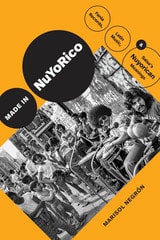
Made in NuYoRico
Fania Records, Latin Music, and Salsa’s Nuyorican MeaningsMarisol Negrón
Duke University Press, 2024
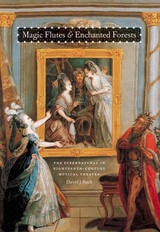
Magic Flutes and Enchanted Forests
The Supernatural in Eighteenth-Century Musical TheaterDavid J. Buch
University of Chicago Press, 2008
David J. Buch reveals that despite—and perhaps even because of—their fundamental irrationality, fantastic and exotic themes acquired extraordinary force and popularity during the period, pervading theatrical works with music in the French, German, and Italian mainstream. Considering prominent compositions by Gluck, Rameau, and Haydn, as well as many seminal contributions by lesser-known artists, Buch locates the origins of these magical elements in such historical sources as ancient mythology, European fairy tales, the Arabian Nights, and the occult. He concludes with a brilliant excavation of the supernatural roots of Mozart’s The Magic Flute and Don Giovanni, building a new foundation for our understanding of the magical themes that proliferated in Mozart’s wake.

Mahler's Symphonic World
Music for the Age of UncertaintyKarol Berger
University of Chicago Press, 2025
Between 1888 and 1909 Gustav Mahler completed nine symphonies and the orchestral song cycle Das Lied von der Erde; his tenth symphony was left incomplete at his death in 1911. Mahler’s Symphonic World provocatively suggests that over his lifetime, the composer pursued a single vision and a single, ideal symphony that strived to capture his personal outlook on human existence. Writing at the turn of the twentieth century, when all trust in firm philosophical and spiritual foundations had evaporated, Mahler’s music reflected a deep preoccupation with human suffering and transience and a search for sources of possible consolation.
In Karol Berger’s reading, each of the symphonies follows a similar trajectory, with an opening quest leading to the final unveiling of a transcendent, consolatory vision. By juxtaposing single movements—the opening Allegros, the middle movements, the Finales—across different works, Berger traces recurring plotlines and imagery and discloses the works’ multiple interrelationships as well as their cohesiveness around a central idea. Ultimately, Mahler’s Symphonic World locates Mahler’s music within the matrix of intellectual currents that defined his epoch and offers a revelatory picture of his musical way of being in the world.

Mahler
A Musical PhysiognomyTheodor W. Adorno
University of Chicago Press, 1992
Since its appearance in 1960 in German, Mahler has established itself as a classic of musical interpretation. Now available in English, the work is presented here in a translation that captures the stylistic brilliance of the original.
Theodor W. Adorno (1903-69), one of the foremost members of the Frankfurt school of critical theory, studied with Alban Berg in Vienna during the late twenties, and was later the director of the Institute of Social Research at the University of Frankfurt from 1956 until his death. His works include Aesthectic Theory, Introduction to the Sociology of Music, The Jargon of Authenticity, Prism, and Philosophy of Modern Music.
Make It New
Reshaping Jazz in the 21st CenturyBill Beuttler
Lever Press, 2019

Making Believe
Questions About Mennonites and ArtMagdalene Redekop
University of Manitoba Press, 2020
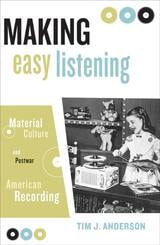
Making Easy Listening
Material Culture and Postwar American RecordingTim Anderson
University of Minnesota Press, 2006
Making Easy Listening presents a social and cultural history of the contentious, diverse, and experimental culture of musical production and enjoyment that aims to understand how recording technologies fit into and influence musicians’, as well as listeners’, lives. With attention to the details of what it means to play a particular record in a distinct cultural context, Anderson connects neglected genres of the musical canon—classical and easy listening music, Broadway musicals, and sound effects records—with the development of sound aesthetics and technical music practices that leave an indelible imprint on individuals. Tracing the countless impacts that this period of innovation exacted on the mass media, Anderson reveals how an examination of this historical era—and recorded music as an object—furthers a deeper understanding of the present-day American music industry.
Tim J. Anderson is assistant professor of communication at Denison University.
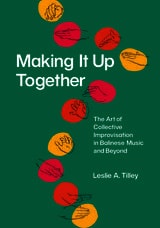
Making It Up Together
The Art of Collective Improvisation in Balinese Music and BeyondLeslie A. Tilley
University of Chicago Press, 2019
Through two contrasting Balinese case studies—of the reyong gong chime’s melodic norot practice and the interlocking drumming tradition kendang arja—Tilley proposes and tests analytical frameworks for examining collectively improvised performance. At the micro-level, Tilley’s analyses offer insight into the note-by-note decisions of improvising performers; at the macro-level, they illuminate larger musical, discursive, structural, and cultural factors shaping those decisions. This multi-tiered inquiry reveals that unpacking how performers play and imagine as a collective is crucial to understanding improvisation and demonstrates how music analysis can elucidate these complex musical and interactional relationships.
Highlighting connections with diverse genres from various music cultures, Tilley’s examinations of collective improvisation also suggest rich potential for cross-genre exploration. The surrounding discussions point to larger theories of communication and interaction, creativity and cognition that will be of interest to a range of readers—from ethnomusicologists and music theorists to cognitive psychologists, jazz studies scholars, and improvising performers. Setting new parameters for the study of improvisation, Making It Up Together opens up fresh possibilities for understanding the creative process, in music and beyond.
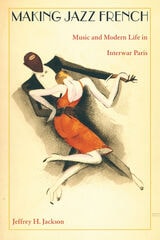
Making Jazz French
Music and Modern Life in Interwar ParisJeffrey H. Jackson
Duke University Press, 2003
Drawing on memoirs, press accounts, and cultural criticism, Jackson uses the history of jazz in Paris to illuminate the challenges confounding French national identity during the interwar years. As he explains, many French people initially regarded jazz as alien because of its associations with America and Africa. Some reveled in its explosive energy and the exoticism of its racial connotations, while others saw it as a dangerous reversal of France’s most cherished notions of "civilization." At the same time, many French musicians, though not threatened by jazz as a musical style, feared their jobs would vanish with the arrival of American performers. By the 1930s, however, a core group of French fans, critics, and musicians had incorporated jazz into the French entertainment tradition. Today it is an integral part of Parisian musical performance. In showing how jazz became French, Jackson reveals some of the ways a musical form created in the United States became an international phenomenon and acquired new meanings unique to the places where it was heard and performed.
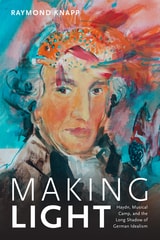
Making Light
Haydn, Musical Camp, and the Long Shadow of German IdealismRaymond Knapp
Duke University Press, 2018
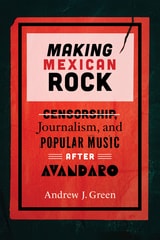
Making Mexican Rock
Censorship, Journalism, and Popular Music after AvándaroAndrew J. Green
Vanderbilt University Press, 2024
Yet in light of the failures of successive democratically elected governments in Mexico, these histories are worth critically revisiting and updating. What stories about music censorship can be told after Mexico’s transition to multi-party democracy? Placing history and ethnography into dialogue, Making Mexican Rock explores historical and recent experiences of censorship and repression against popular music, focusing on the independent rock scene (or “escena independiente”) in Mexico City.
Informed by the so-called new censorship theory, ethnomusicologist Andrew J. Green challenges historical accounts that equate acts of censorship with state activity. The open-ended account of censorship assumed here helps us to understand, instead, how conceptions of censorship and expressive freedom transformed toward the end of single-party rule; how practices of policing live rock adapted to neoliberal securitization; and how histories of rock censorship have been invoked by those seeking to construct and protect emergent music scenes. Making Mexican Rock thus both decenters histories of music censorship from the state, and extends them into the country’s recent history.
Making Music Indigenous
Popular Music in the Peruvian AndesJoshua Tucker
University of Chicago Press, 2019
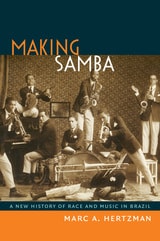
Making Samba
A New History of Race and Music in BrazilMarc A. Hertzman
Duke University Press, 2013
The success of "Pelo telephone" embroiled Donga in controversy. A group of musicians claimed that he had stolen their work, and a prominent journalist accused him of selling out his people in pursuit of profit and fame. Within this single episode are many of the concerns that animate Making Samba, including intellectual property claims, the Brazilian state, popular music, race, gender, national identity, and the history of Afro-Brazilians in Rio de Janeiro. By tracing the careers of Rio's pioneering black musicians from the late nineteenth century until the 1970s, Marc A. Hertzman revises the histories of samba and of Brazilian national culture.
Making Value
Music, Capital, and the SocialTimothy D. Taylor
Duke University Press, 2024
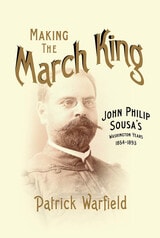
Making the March King
John Philip Sousa's Washington Years, 1854-1893Patrick Warfiled
University of Illinois Press, 2013
Warfield examines Sousa's wide-ranging experience composing, conducting, and performing in the theater, opera house, concert hall, and salons, as well as his leadership of the United States Marine Band and the later Sousa Band, early twentieth-century America's most famous and successful ensemble. Sousa composed not only marches during this period but also parlor, minstrel, and art songs; parade, concert, and medley marches; schottisches, waltzes, and polkas; and incidental music, operettas, and descriptive pieces. Warfield's examination of Sousa's output reveals a versatile composer much broader in stylistic range than the bandmaster extraordinaire remembered as the March King.
In particular, Making the March King demonstrates how Sousa used his theatrical training to create the character of the March King. The exuberant bandmaster who pleased audiences was both a skilled and charismatic conductor and a theatrical character whose past and very identity suggested drama, spectacle, and excitement. Sousa's success was also the result of perseverance and lessons learned from older colleagues on how to court, win, and keep an audience. Warfield presents the story of Sousa as a self-made business success, a gifted performer and composer who deftly capitalized on his talents to create one of the most entertaining, enduring figures in American music.
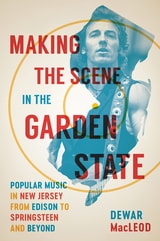
Making the Scene in the Garden State
Popular Music in New Jersey from Edison to Springsteen and BeyondDewar MacLeod
Rutgers University Press, 2020
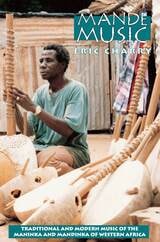
Mande Music
Traditional and Modern Music of the Maninka and Mandinka of Western AfricaEric Charry
University of Chicago Press, 2000

Mandolin Man
The Bluegrass Life of Roland WhiteBob Black
University of Illinois Press, 2022
Roland White’s long career has taken him from membership in Bill Monroe’s Blue Grass Boys and Lester Flatt’s Nashville Grass to success with his own Roland White Band. A master of the mandolin and acclaimed multi-instrumentalist, White has mentored a host of bluegrass musicians and inspired countless others.
Bob Black draws on extensive interviews with White and his peers and friends to provide the first in-depth biography of the pioneering bluegrass figure. Born into a musical family, White found early success with the Kentucky Colonels during the 1960s folk revival. The many stops and collaborations that marked White's subsequent musical journey trace the history of modern bluegrass. But Black also delves into the seldom-told tale of White's life as a working musician, one who endured professional and music industry ups-and-downs to become a legendary artist and beloved teacher.
An entertaining merger of memories and music history, Mandolin Man tells the overdue story of a bluegrass icon and his times.
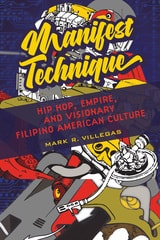
Manifest Technique
Hip Hop, Empire, and Visionary Filipino American CultureMark R. Villegas
University of Illinois Press, 2021
Filipino Americans have been innovators and collaborators in hip hop since the culture’s early days. But despite the success of artists like Apl.de.Ap of the Black Eyed Peas and superstar producer Chad Hugo, the genre’s significance in Filipino American communities is often overlooked. Mark R. Villegas considers sprawling coast-to-coast hip hop networks to reveal how Filipino Americans have used music, dance, and visual art to create their worlds. Filipino Americans have been exploring their racial position in the world in embracing hip hop’s connections to memories of colonial and racial violence. Villegas scrutinizes practitioners’ language of defiance, placing the cultural grammar of hip hop within a larger legacy of decolonization.
An important investigation of hip hop as a movement of racial consciousness, Manifest Technique shows how the genre has inspired Filipino Americans to envision and enact new ideas of their bodies, their history, and their dignity.
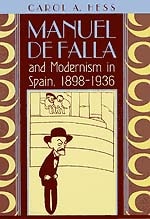
Manuel de Falla and Modernism in Spain, 1898-1936
Carol A. Hess
University of Chicago Press, 2001

Marga Richter
Sharon Mirchandani
University of Illinois Press, 2012
This is the first full-length introduction to the life and works of significant American composer Marga Richter (born 1926), who has written more than one hundred works for orchestra, chamber ensemble, dance, opera, voice, chorus, piano, organ, and harpsichord. Still actively composing in her eighties, Richter is particularly known for her large-scale works performed by ensembles such as the London Philharmonic Orchestra and the Civic Orchestra of Chicago and for other pieces performed by prominent artists including pianist Menahem Pressler, conductor Izler Solomon, and violinist Daniel Heifetz.
Interspersing consideration of Richter's musical works with discussion of her life, her musical style, and the origins and performances of her works, Sharon Mirchandani documents a successful composer's professional and private life throughout the twentieth century. Covering Richter's formative years, her influences, and the phases of her career from the 1950s to the present, Mirchandani closely examines Richter's many interesting, attractive musical works that draw inspiration from distinctly American, Irish/English, and Asian sources. Drawing extensively on interviews with the composer, Mirchandani also provides detailed descriptions of Richter's scores and uses reviews and other secondary sources to provide contexts for her work, including their relationship to modern dance, to other musical styles, and to 1970s feminism.

Maria Longworth Storer
From Music and Art to Popes and PresidentsConstance J. Moore; Nancy M. Broermann
Ohio University Press, 2019
Published by the University of Cincinnati Press
While the adage may go, “Behind every great man is a great woman,” the story of Maria Longworth Storer necessitates a new adage—at the front of every great city is a great woman. After being shunted into the biographies and history books of other people, Longworth Storer is now finally given center stage on the one hundred and seventieth anniversary of her birth.
Maria Longworth Storer: From Music and Art to Popes and Presidents is the most comprehensive biography of this one of a kind Cincinnatian. Known as the founder of the first female-run manufacturing company in the United States, Rookwood Pottery, Longworth Storer was passionate about women’s rights, her city, and issues of poverty and the arts. She owned Rookwood pottery for nine years, and then transferred ownership after earning recognition at the Exhibition of American Art Industry in Philadelphia and receiving a gold medal at the Exposition Universelle in Paris. Aside from her success with Rookwood, Longworth Storer was central to making the Queen City the major cultural landmark it is today. Although the rest of her life was no less remarkable as the wife of notorious diplomat Bellamy Storer, later embroiled in the famous Roosevelt-Storer scandal, little has been written about her contributions and exploits in diplomatic relations and her powerful influence on turn-of-the-twentieth-century political leaders.
Featuring new archival research, and never before seen photos of the Storer family, authors Constance J. Moore and Nancy M. Broermann have compiled a portrait of Maria Longworth Storer that is rich in detail, fitting to both the wide, often eclectic, breadth of Longworth Storer’s projects, and to the depth of her impact on leaders from Washington D.C. to Europe.
Moving through major moments in both American and Cincinnati history, and intersecting with significant historical figures including Teddy Roosevelt and William Howard Taft, Moore and Broermann expose the broader historical narrative of Longworth Storer’s life without letting her unique spirit and individual accomplishments become overshadowed by them.
Through thoughtful, balanced narrative, readers get to know a remarkable woman whose fascinating and dramatic life as a political figure, women’s rights advocate, and patron of the arts has had a long lasting legacy on the Queen City and the Shaping of our nation’s diplomatic policies.
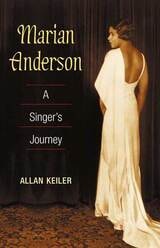
Marian Anderson
A Singer's JourneyAllan Keiler
University of Illinois Press, 2002
Allan Keiler chronicles the life of the legendary singer and activist from the childhood manifestation of her musical genius to her worldwide celebrity. As he shows, community and familial support could not shield her from the economic hardship and bigotry she encountered in her early performing days. Early successes in London and Berlin set the stage for her American breakthrough while the triumphant 1939 Lincoln Memorial concert established her immediately as an icon in the struggle against discrimination. Keiler reveals a woman more comfortable as artist than activist. But if Anderson's intense privacy and devotion to her work distanced her from a direct role in the civil rights movement, she remained a powerful symbol of possibility.
Drawing on rare archives and meetings with Anderson before her death, Marian Anderson is a magnificent study of a groundbreaking American artist.
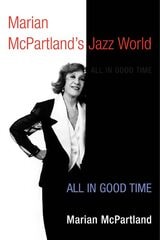
Marian McPartland's Jazz World
All in Good TimeMarian McPartland
University of Illinois Press, 1987
In this collection of musical portraits, jazz pianist and radio host Marian McPartland pays tribute to such beloved and legendary figures as Benny Goodman, Bill Evans, Joe Morello, Paul Desmond, Alec Wilder, Mary Lou Williams, and others. McPartland’s reminiscences and anecdotes about these jazz greats are informed by her encyclopedic knowledge of their music, making this richly detailed collection an important addition to the literature of jazz.
In a preface to this edition, McPartland extends her commentary to include details of her long-running National Public Radio show “Marian McPartland’s Piano Jazz” and memories of her late husband, famed Chicago trumpeter Jimmy McPartland.

Mario Barradas and Son Jarocho
The Journey of a Mexican Regional MusicYolanda Broyles-González, Rafael Figueroa Hernández, and Francisco González
University of Texas Press, 2022
Son Jarocho was born as the regional sound of Veracruz but over time became a Mexican national genre, even transnational, genre—a touchstone of Chicano identity in the United States. Mario Barradas and Son Jarocho traces a musical journey from the Gulf Coast to interior Mexico and across the border, describing the transformations of Son Jarocho along the way.
This comprehensive cultural study pairs ethnographic and musicological insights with an oral history of the late Mario Barradas, one of Son Jarocho’s preeminent modern musicians. Chicano musician Francisco González offers an insider’s account of Barradas’s influence and Son Jarocho’s musical qualities, while Rafael Figueroa Hernández delves into Barradas’s recordings and films. Yolanda Broyles-González examines the interplay between Son Jarocho’s indigenous roots and contemporary role in Mexican and US society. The result is a nuanced portrait of a vital and evolving musical tradition.

Martinu and His World
Edited by Aleš Brezina and Michael Beckerman
University of Chicago Press, 2025
Bohuslav Martinů was one of the most extraordinary and prolific composers of the twentieth century. Martinů and His World offers a portrait of the composer in all his complexity. Born in the present-day Czech Republic, Martinů was rendered stateless as a result of events around World War II and the Communist takeover of Czechoslovakia. He lived for more than a decade in the United States, where he had great success, and died in Switzerland.
Martinů composed more than four hundred works in all genres of instrumental and vocal music, and infused each with a special combination of the lyrical and the dramatic. Alongside an unerring sense of form, his works draw on a kaleidoscope of elements from such sources as Dvořák, American jazz of the 1920s, English Renaissance madrigals, the late Baroque concerto grosso, French Impressionism, Czech and Moravian folk songs, and the contemporary music of his day.
This volume pays special attention to Martinů’s little-known operatic works and presents for the first time both a recently discovered personal diary and a series of interviews with important figures who were part of his American years.
Martinů and His World reveals the composer as an essential voice of his time, an original thinker about music past and present, who lived through the political complexities of the twentieth century and stood up to them both as a human being and as an artist.

Mary Climbs In
The Journeys of Bruce Springsteen's Women FansLorraine Mangione
Rutgers University Press, 2023
Mary Climbs In illuminates this once overlooked but increasingly important and multi-faceted conversation about female audiences for Springsteen’s music. Drawing on unique surveys of fans themselves, the study offers insight into women’s experiences in their own voices. Authors Lorraine Mangione and Donna Luff explore the depth of women fans’ connection to Springsteen and the profound ways this connection has shaped their lives. Reflections from fans enliven each page as readers journey through the camaraderie and joy of concerts, the sorrow and confusion of personal loss and suffering, the love and closeness of community, and the search for meaning and for the self. Viewed through a psychological lens, women fans’ relationship with Springsteen is revealed in all its complexity as never before. Mary Climbs In is an important interdisciplinary contribution to the growing field of Springsteen studies and a must-read for any fan.
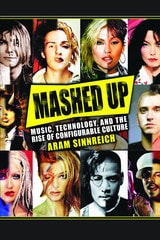
Mashed Up
Music, Technology, and the Rise of Configurable CultureAram Sinnreich
University of Massachusetts Press, 2010
From ancient times to the present day, writers and thinkers have remarked on the unique power of music to evoke emotions, signal identity, and bond or divide entire societies, all without the benefit of literal representation. Even if we can't say precisely what our favorite melody means, we know very well what kind of effect it has on us, and on our friends and neighbors.
According to Aram Sinnreich, this power helps to explain why music has so often been regulated in societies around the globe and throughout history. Institutional authorities ranging from dynastic China's “Office to Harmonize Sounds” to today's copyright collecting societies like BMI and ASCAP leverage the rule of law and the power of the market to make sure that some musical forms and practices are allowed and others are prohibited.
Yet, despite the efforts of these powerful regulators, musical cultures consistently devise new and innovative ways to work around institutional regulations. These workarounds often generate new styles and traditions in turn, with effects far beyond the cultural sphere.
Mashed Up chronicles the rise of “configurability,” an emerging musical and cultural moment rooted in today's global, networked communications infrastructure. Based on interviews with dozens of prominent DJs, attorneys, and music industry executives, the book argues that today's battles over sampling, file sharing, and the marketability of new styles such as “mash-ups” and “techno” presage social change on a far broader scale.
Specifically, the book suggests the emergence of a new ethic of configurable collectivism; an economic reunion of labor; a renegotiation of the line between public and private; a shift from linear to recursive logic; and a new “DJ consciousness,” in which the margins are becoming the new mainstream. Whether these changes are sudden or gradual, violent or peaceful, will depend on whether we heed the lessons of configurability, or continue to police and punish the growing ranks of the mashed up.
Masses for the Sistine Chapel
Vatican City, Biblioteca Aposotlica Vaticana, Cappella Sistina, MS 14Edited and with an Introduction by Richard Sherr
University of Chicago Press, 2010
Donated in the late fifteenth century to the papal choir, the musical manuscript Cappella Sistina14 reflects a new style of mass composition used by some of the era’s most noted composers. Masses for the Sistine Chapel makes the complete contents of the Cappella Sistina14—held in the Vatican Library—available for the first time.
Featuring fifteen masses and four mass fragments, this volume includes works by such composers as Guillaume Du Fay, Johannes Ockeghem, and Antoine Busnoys. In a comprehensive introduction and critical commentary on each work, Richard Sherr places the choirbook in its historical context, describing its physical makeup as well as the repertory. Sherr’s critical edition of this celebrated manuscript finally provides the insight necessary to inform future performances and recordings of its influential contents.

Masters of Contemporary Brazilian Song
MPB, 1965-1985By Charles A. Perrone
University of Texas Press, 1993
Masters of Contemporary Brazilian Song is a critical study of MPB (música popular brasileira), a term that refers to varieties of urban popular music of the 1960s and 1970s, incorporating samba, Bossa Nova, and new materials.
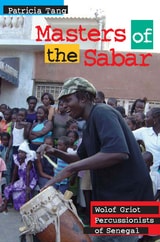
Masters of the Sabar
Wolof Griot Percussionists of SenegalPatricia Tang
Temple University Press, 2006

Masterworks of the Orchestral Repertoire
A Guide for ListenersDonald N. Ferguson
University of Minnesota Press, 1968
Masterworks of the Orchestral Repertoire was first published in 1968. Minnesota Archive Editions uses digital technology to make long-unavailable books once again accessible, and are published unaltered from the original University of Minnesota Press editions.
The fullest enjoyment of an orchestral performance or a record concert comes with a background of knowledge about the music itself. This handbook is designed to help music lovers get the ultimate pleasure from their listening by providing them with that background about a large portion of the orchestral repertoire.
Professor Ferguson analyzes and interprets the most important classical symphonies, overtures, and concertos, as well as selected orchestral works of modern composers. He goes beyond a conventional analysis of structure since he believes (with a majority of the music-loving public) that great music is actually a communication -- that it expresses significant emotions. The great composers, on their own testimony, have striven not merely to create perfect forms but to interpret human experience. Mingled with the analyses, then, the reader will find comments on the expressive purport of the music.
For twenty-five years Professor Ferguson has supplied the program notes for the subscription concerts of the Minneapolis Symphony Orchestra, and this volume is an outgrowth of that activity. In preparing the material for book publication, however, he studied the musical compositions anew, and the resulting chapters provide a much deeper exploration of the musical subjects than did the program notes. The themes of important works are illustrated by musical notations, and a brief glossary explains technical terms.

Mathias Spahlinger
Neil Thomas Smith
Intellect Books, 2021
One of the most stimulating and provocative figures of the new music scene, Mathias Spahlinger has long been a touchstone for leftist, “critical” composition in Germany, yet his work has received very little attention in Anglophone scholarship until now.
Spahlinger’s practice offers a unique negotiation of the modernist legacy as well as passionate political and philosophical engagement. Born in 1944, today his position as one of the most venerable exponents of post-WWII modernism in his homeland is undeniable: his music is regularly performed, he has received commissions from many of the major orchestras and new music groups in Germany, and in 2014 he received the Berliner Kunstpreis, Berlin’s top art prize.
Bringing a critical perspective to Spahlinger’s life and work, this monograph provides an essential reference for scholars of new music and twentieth-century modernism.
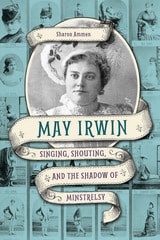
May Irwin
Singing, Shouting, and the Shadow of MinstrelsySharon Ammen
University of Illinois Press, 2017
Sharon Ammen's in-depth study traces Irwin's hurly-burly life. Irwin gained fame when, layering aspects of minstrelsy over ragtime, she popularized a racist "Negro song" genre. Ammen examines this forgotten music, the society it both reflected and entertained, and the ways white and black audiences received Irwin's performances. She also delves into Irwin's hands-on management of her image and career, revealing how Irwin carefully built a public persona as a nurturing housewife whose maternal skills and performing acumen reinforced one another. Irwin's act, soaked in racist song and humor, built a fortune she never relinquished. Yet her career's legacy led to a posthumous obscurity as the nation that once adored her evolved and changed.

May It Fill Your Soul
Experiencing Bulgarian MusicTimothy Rice
University of Chicago Press, 1994
In the context of this history, Rice brings Bulgarian folk music to life by focusing on the biography of the Varimezov family, including the musician Kostadin and his wife Todora, a singer. Combining interviews with his own experiences of learning how to play, sing and dance Bulgarian folk music, Rice presents one of the most detailed accounts of traditional, aural learning processes in the ethnomusicological literature.
Using a combination of traditionally dichotomous musicological and ethnographic approaches, Rice tells the story of how individual musicians learned their tradition, how they lived it during the pre-Communist era of family farming, how the tradition changed with industrialization brought under Communism, and finally, how it flourished and evolved in the recent, unstable political climate.
This work—complete with a compact disc and numerous illustrations and musical examples—contributes not only to ethnomusicological theory and method, but also to our understanding of Slavic folklore, Eastern European anthropology, and cultural processes in Socialist states.

Maya Achi Marimba Music In Guatemala
Sergio Navarrete Pellicer
Temple University Press, 2005
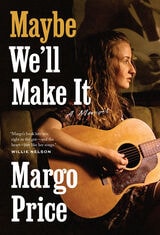
Maybe We'll Make It
A MemoirMargo Price
University of Texas Press, 2022
An October 2022 IndieNext pick
”[An] engaging and beautifully narrated quest for personal fulfillment and musical recognition...This is a fast-paced tale in which music and love always take center stage...A truly gifted musician, Price writes about her journey with refreshing candor.”—Kirkus, starred review
”Brutally honest…a vivid and poignant memoir.”—The Guardian
Country music star Margo Price shares the story of her struggle to make it in an industry that preys on its ingenues while trying to move on from devastating personal tragedies.
When Margo Price was nineteen years old, she dropped out of college and moved to Nashville to become a musician. She busked on the street, played open mics, and even threw out her TV so that she would do nothing but write songs. She met Jeremy Ivey, a fellow musician who would become her closest collaborator and her husband. But after working on their craft for more than a decade, Price and Ivey had no label, no band, and plenty of heartache.
Maybe We’ll Make It is a memoir of loss, motherhood, and the search for artistic freedom in the midst of the agony experienced by so many aspiring musicians: bad gigs and long tours, rejection and sexual harassment, too much drinking and barely enough money to live on. Price, though, refused to break, and turned her lowest moments into the classic country songs that eventually comprised the debut album that launched her career. In the authentic voice hailed by Pitchfork for tackling "Steinbeck-sized issues with no-bullshit humility," Price shares the stories that became songs, and the small acts of love and camaraderie it takes to survive in a music industry that is often unkind to women. Now an award-winning artist with a global fanbase, Price tells a love story of music, collaboration, and the struggle to build a career while trying to maintain her singular voice and style.
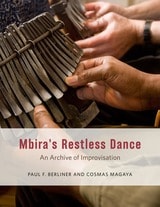
Mbira's Restless Dance
An Archive of ImprovisationPaul F. Berliner and Cosmas Magaya
University of Chicago Press, 2020
Mbira’s Restless Dance is written to be played. This two-volume, spiral-bound set features musical transcriptions of thirty-nine compositions and variations, annotated with the master player’s advice on technique and performance, his notes and observations, and commentary by Berliner. Enhanced with extensive website audiovisuals, Mbira’s Restless Dance is in effect a series of masterclasses with Magaya, suitable for experienced mbira players and those learning the fundamentals.
Together with Berliner's The Art of Mbira, in which he provides an indispensable historical and cultural guide to mbira in a changing world, Mbira's Restless Dance breaks new ground in the depth and specificity of its exploration of an African musical tradition, and in the entwining of the authors’ collaborative voices. It is a testament to the powerful relationship between music and social life—and the rewards of lifelong musical study, performance, and friendship.
Medievalism, Popular Culture and Politics in Metal Music
The Case of Hispanic Epic ThemesAmaranta Saguar García
Intellect Books, 2026
Challenging the common view of metal music as just a form of Western pop culture, this innovative book draws attention to medievalizing epicism, a distinctive strand within metal that evokes the medieval and the epic in both aesthetics and sensibility. While often shaped by fantasy literature, cinema, and more recently, video games, this fascination with the medieval has deeper roots in nationalist ideologies. Through a rich exploration of Spain and Portugal’s transitions after their period of authoritarian rule, this book reveals how medievalizing epicism plays a key role in shaping nationalist and ethnocentric discourses, fascist narratives, and official efforts to foster patriotic sentiment, and how metal bands confront these origins.
Drawing on an impressive breadth of scholarship and a deep knowledge of metal music culture, Amaranta Saguar García skillfully weaves together diverse reference points without losing focus or clarity. This book invites both scholars and music fans to reflect more broadly on how metal music imagines and reuses medieval heritage.
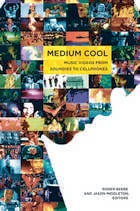
Medium Cool
Music Videos from Soundies to CellphonesRoger Beebe and Jason Middleton, eds.
Duke University Press, 2007
The essays take on a range of topics, including questions of authenticity, the tension between high-art influences and mass-cultural appeal, the prehistory of music video, and the production and dissemination of music videos outside the United States. Among the thirteen essays are a consideration of how the rapper Jay-Z uses music video as the primary site for performing, solidifying, and discarding his various personas; an examination of the recent emergence of indigenous music video production in Papua New Guinea; and an analysis of the cultural issues being negotiated within Finland’s developing music video industry. Contributors explore precursors to contemporary music videos, including 1950s music television programs such as American Bandstand, Elvis’s internationally broadcast 1973 Aloha from Hawaii concert, and different types of short musical films that could be viewed in “musical jukeboxes” of the 1940s and 1960s. Whether theorizing music video in connection to postmodernism or rethinking the relation between sound and the visual image, the essays in Medium Cool reveal music video as rich terrain for further scholarly investigation.
Contributors. Roger Beebe, Norma Coates, Kay Dickinson, Cynthia Fuchs, Philip Hayward, Amy Herzog, Antti-Ville Kärjä, Melissa McCartney, Jason Middleton, Lisa Parks, Kip Pegley, Maureen Turim, Carol Vernallis, Warren Zanes
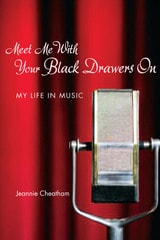
Meet Me with Your Black Drawers On
My Life in MusicBy Jeannie Cheatham
University of Texas Press, 2006
Jeannie Cheatham is a living legend in jazz and blues. A pianist, singer, songwriter, and co-leader of the Sweet Baby Blues Band, she has played and sung with many of the greats in blues and jazz—T-Bone Walker, Dinah Washington, Cab Callaway, Joe Williams, Al Hibbler, Odetta, and Jimmy Witherspoon. Cheatham toured with Big Mama Thornton off and on for ten years and was featured with Thornton and Sippie Wallace in the award-winning PBS documentary Three Generations of the Blues. Her music, which has garnered national and international acclaim, has been described as unrestrained, exuberant, soulful, rollicking, wicked, virtuous, wild, and truthful. Cheatham's signature song, "Meet Me with Your Black Drawers On" is a staple in jazz and blues clubs across America and in Europe, Africa, and Japan.
In this delightfully frank autobiography, Jeannie Cheatham recalls a life that has been as exuberant, virtuous, wild, and truthful as her music. She begins in Akron, Ohio, where she grew up in a vibrant multiethnic neighborhood surrounded by a family of strong women. From those roots, she launched a musical career that took her from the Midwest to California, doing time along the way everywhere from a jail cell in Dayton, Ohio, where she was innocently caught in a police raid, to the University of Wisconsin-Madison—where she and Jimmy Cheatham taught music. Cheatham writes of a life spent fighting racism and sexism, of rage and resolve, misery and miracles, betrayals and triumphs, of faith almost lost in dark places, but mysteriously regained in a flash of light. Cheatham's autobiography is also the story of her fifty-years-and-counting love affair and musical collaboration with her husband and band partner, Jimmy Cheatham.
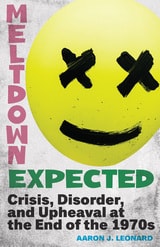
Meltdown Expected
Crisis, Disorder, and Upheaval at the end of the 1970sAaron J. Leonard
Rutgers University Press, 2024
Meltdown Expected tells the story of the power shifts from late 1978 through 1979 whose repercussions are still being felt. Iran’s revolution led to a hostage crisis while neighbouring Afghanistan became the site of a proxy war between the USSR and the US, who supplied aid to Islamic mujahideen fighters that would later form the Taliban. Meanwhile, as tragedies like the Jonestown mass suicide and the assassination of Harvey Milk captured the nation’s attention, the government quietly reasserted and expanded the FBI’s intelligence powers. Drawing from recently declassified government documents and covering everything from Three Mile Island to the rise of punk rock, Aaron J. Leonard paints a vivid portrait of a tumultuous yet pivotal time in American history.
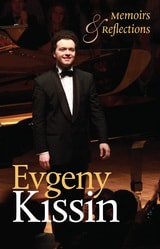
Memoirs and Reflections
Evgeny Kissin
University Press of New England, 2018
Memory, Space and Sound
Edited by Johannes Brusila, Bruce Johnson, and John Richardson
Intellect Books, 2016
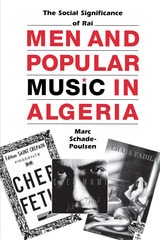
Men and Popular Music in Algeria
The Social Significance of RaïBy Marc Schade-Poulsen
University of Texas Press, 1999
Raï music is often called the voice of the voiceless in Algeria, a society currently swept by tragic conflict. Raï is the voice of Algerian men, young men caught between generations and classes, in political strife, and in economic inequality. In a ground-breaking study, anthropologist Marc Schade-Poulsen uses this popular music genre as a lens through which he views Algerian society, particularly male society. He situates raï within Algerian family life, moral codes, and broader power relations.
Schade-Poulsen did his research in the 1990s, in clubs, recording studios, at weddings, and with street musicians. He describes the history of raï, which emerged in the late 1970s and spread throughout North Africa at the same time the Islamist movement was growing to become the most potent socio-political movement in Algeria.
Outsiders consider raï to be Western in origin, but Schade-Poulsen shows its Islamic roots as well. The musicians do use Western instruments, but the music itself mixes Algerian popular songs and rhythms with the beat of American disco, Egyptian modalities, Moroccan wedding tunes, and the songs of Julio Iglesias. The lyrics deal with male-female relationships but also with generational relationships and the problems of youth, as they struggle to find a place in a conflicted society.
The study, in its innovative approach to music as a template of society, helps the reader understand the two major movements among today's Algerian youth: one toward the mosque and the other toward the West.