Results by title
59 books match the query 'Narratives' and 5 start with m
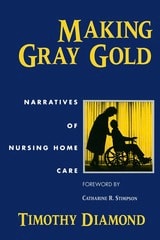
Making Gray Gold
Narratives of Nursing Home CareTimothy Diamond
University of Chicago Press, 1992
In a society in which some two million people live in 16,000 nursing homes, with their numbers escalating daily, this thought-provoking work demands immediate and widespread attention.
"[An] unnerving portrait of what it's like to work and live in a nursing home. . . . By giving voice to so many unheard residents and workers Diamond has performed an important service for us all."—Diane Cole, New York Newsday
"With Making Gray Gold, Timothy Diamond describes the commodification of long-term care in the most vivid representation in a decade of round-the-clock institutional life. . . . A personal addition to the troublingly impersonal national debate over healthcare reform."—Madonna Harrington Meyer, Contemporary Sociology
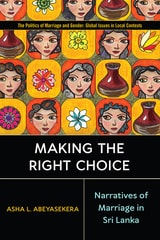
Making the Right Choice
Narratives of Marriage in Sri LankaAsha L. Abeyasekera
Rutgers University Press, 2021
Making the Right Choice unravels the entangled relationship between marriage, morality, and the desire for modernity as it plays out in the context of middle-class status concerns and aspirations for upward social mobility within the Sinhala-Buddhist community in urban Sri Lanka. By focusing on individual life-histories spanning three generations, the book illuminates how narratives about a gendered self and narratives about modernity are mutually constituted and intrinsically tied to notions of agency. The book uncovers how "becoming modern" in urban Sri Lanka, rather than causing inter-generational conflict, is a collective aspiration realized through the efforts of bringing up educated and independent women capable of making "right" choices. The consequence of this collective investment is a feminist conundrum: agency does not denote the right to choose, but the duty to make the "right" choice; hence agency is experienced not as a sense of "freedom," but rather as a burden of responsibility.
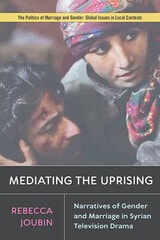
Mediating the Uprising
Narratives of Gender and Marriage in Syrian Television DramaRebecca Joubin
Rutgers University Press, 2020
While for some screenwriters a return to pre-2011 life would be welcome after so much bloodshed, others advocated profound cultural and social transformation, instead. They employed marriage and gender metaphors in the stories they wrote to engage in political critique, even at the risk of creating marketing difficulties for the shows or they created escapist stories such as transnational adaptations and Old Damascus tales. Serving as heritage preservation, Mediating the Uprising underscores that television drama creators in Syria have many ways of engaging in protest, with gender and marriage at the heart of the polemic.
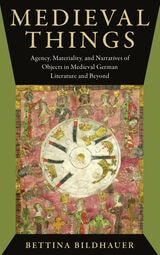
Medieval Things
Agency, Materiality, and Narratives of Objects in Medieval German Literature and BeyondBettina Bildhauer
The Ohio State University Press, 2020
Modern Luck
Narratives of Fortune in the Long Twentieth CenturyRobert S. C. Gordon
University College London, 2023
Beliefs, superstitions, and tales about luck are present across all human cultures. Humans are perennially fascinated by luck and by its association with happiness and danger, uncertainty and aspiration. Yet it remains an elusive, ungraspable idea, one that slips and slides over time: all cultures reimagine what luck is and how to tame it at different stages in their history, and our own era is no exception to the rule.
Modern Luck sets out to explore the enigma of luck’s presence in modernity, examining the hybrid forms it has taken on in the modern imagination, and in particular in the field of modern stories. Analyzing a rich and unusually eclectic range of narratives taken from literature, film, music, television, and theatre, from Dostoevsky to Philip K. Dick, Pinocchio to Cimino, Curtiz to Kieslowski, it lays out first the usages and meanings of the language of luck, and then the key figures, patterns, and motifs that govern the stories told about it, from the late nineteenth century to the present day.