Results by title
166 books match the query 'Native American' and 8 start with m
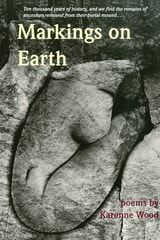
Markings on Earth
Karenne Wood
University of Arizona Press, 2001
“Ten thousand years of history, and we find the remains
of ancestors removed from their burial mound . . . “
Impressions of the past, markings on earth, are part of the world of Karenne Wood. A member of the Monacan tribe of Virginia, she writes with insight and grace on topics that both reflect and extend her Native heritage.
Markings on Earth is a cyclical work that explores the many dimensions of human experience, from our interaction with the environment to personal relationships. In these pages we relive the arrival of John Smith in America and visit the burial mounds of the Monacan people, experience the flight of the great blue heron and witness the dance of the spider. We also share the personal journey of one individual who seeks to overcome her sense of alienation from her people and her past.
Wood’s palette is not only Nature but human nature as well. She writes pointedly about shameful episodes of American history, such as the devastation of Appalachia by mining companies and the “disappearance” of Indian peoples. She also addresses forms of everyday violence known to many of us, such as alcoholism and sexual abuse. Wood conveys an acceptance of history and personal trauma, but she finds redemption in a return to tradition and a perception of the world’s natural grace.
Through these elegantly crafted words, we come to know that Native writers need not be limited to categorical roles determined by their heritage. Markings on Earth displays a fidelity to human experience, evoking that experience through poems honed to perfection. It is an affirmation of survival, a work that suggests one person’s life cannot be separated from the larger story of its community, its rootedness in history, and its timeless connections to the world.

Maxanax Chempapísi / Bloodwriting
Deborah A. Miranda
University of Arizona Press, 2027
In Maxanax Chempapísi / Bloodwriting lyric poems exploring Esselen words and concepts traverse a supporting cast of prose poems about contemporary life as a queer, Indigenous recovering academic. Deborah A. Miranda witnesses the lives of women who are lovers, mothers, daughters, sisters, and grandmothers caught in a chain of ongoing apocalypse that stretches from the colonization of North America to the current Anthropocene.
These poems are small but potent ceremonies that center relationship as medicinal. They speak of the ugliness of genocide, substance abuse, environmental destruction, and homophobia with searing fury. They linger on the sacred powers found within a river—“A web of fireflies weaving constellations in the alder’s branches”—or the wonder of “The first woman / who stole my heart / rose up / from the earth / like a creation story.” Throughout this collection, images weave connections between women’s bodies and the moon, bodies and earth, bodies and constellations that surround us. Esselen, Miranda’s Indigenous language, acts as a bridge that translates some of these ancient struggles and insights into contemporary images.
This collection resists the separation of the body, the spirit, and the sacred. It seeks a reunion of true relationship in the midst of chaos and uncertainty. Miranda balances praise for the burning—but still beautiful and holy—world and grief for the loss of beings and places that cannot be recovered.
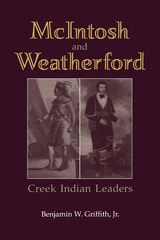
McIntosh and Weatherford
Creek Indian LeadersBenjamin W. Griffith
University of Alabama Press, 1998
The human story behind the Creek War and the coming of Indian Removal.
About the time of the American Revolutionary war, when the Creek Indians owned land that is today approximately the lower two-thirds of Alabama and of Georgia west of the Oconee River, two sons were born to Indian mothers and Scots fathers in obscure towns in the territory of the Creek Nation. Both sons were named William, and both were to become leaders of their mothers’ people.
The two remarkable men lived during a period of war and turbulence along the frontier in Alabama and Georgia. More often the subjects of folk tale and legend than serious historical inquiry, McIntosh and Weatherford fought on opposing sides in the Creek War of 1813-1814. McIntosh allied himself with Andrew Jackson and the friendly Lower Creeks, while Weatherford joined with the hostile Red Stick and was the leader of a band of Upper Creeks in the massacre at Fort Mims. McIntosh, who was given the rank of brigadier general for his military feats, was involved in the machinations that led to the ceding of Creek lands to Georgia. As a result, he died in disgrace at the hands of his fellow Creeks. Weatherford, once hated and feared, died a planter and local hero in Alabama near the site of Fort Mims.
Mixed-Blood Histories
Race, Law, and Dakota Indians in the Nineteenth-Century MidwestJameson R. Sweet
University of Minnesota Press, 2025
An unprecedented study that puts mixed-ancestry Native Americans back into the heart of Indigenous history
Historical accounts tend to neglect mixed-ancestry Native Americans: racially and legally differentiated from nonmixed Indigenous people by U.S. government policy, their lives have continually been treated as peripheral to Indigenous societies. Mixed-Blood Histories intervenes in this erasure. Using legal, linguistic, and family-historical methods, Jameson R. Sweet writes mixed-ancestry Dakota individuals back into tribal histories, illuminating the importance of mixed ancestry in shaping and understanding Native and non-Native America from the nineteenth century through today.
When the U.S. government designated mixed-ancestry Indians as a group separate from both Indians and white Americans—a distinction born out of the perception that they were uniquely assimilable as well as manipulable intermediate figures—they were afforded rights under U.S. law unavailable to other Indigenous people, albeit inconsistently, which included citizenship and the rights to vote, serve in public office, testify in court, and buy and sell land. Focusing on key figures and pivotal “mixed-blood histories” for the Dakota nation, Sweet argues that in most cases, they importantly remained Indians and full participants in Indigenous culture and society. In some cases, they were influential actors in establishing reservations and negotiating sovereign treaties with the U.S. government.
Culminating in a pivotal reexamination of the U.S.-Dakota War of 1862, Mixed-Blood Histories brings greater diversity and complexity to existing understandings of Dakota kinship, culture, and language while offering insights into the solidification of racial categories and hierarchies in the United States.
Retail e-book files for this title are screen-reader friendly with images accompanied by short alt text and/or extended descriptions.
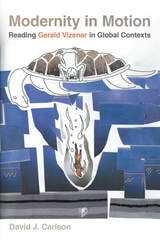
Modernity in Motion
Reading Gerald Vizenor in Global ContextsDavid J. Carlson
Michigan State University Press, 2026
Modernity in Motion offers a groundbreaking exploration of Anishinaabe writer Gerald Vizenor’s richly layered body of work spanning fiction, nonfiction, and poetry. Through the lens of transnational Indigenous studies, this compelling study reveals how Vizenor’s concept of transmotion, which he defines as the interplay between local and global identities, reconstructs modernity as a dynamic force of transformation.
Close readings illuminate Vizenor’s radical storytelling, which bridges seemingly disparate worlds: the White Earth Reservation, Nazi-occupied Paris, post-Hiroshima Japan, and beyond. By weaving these far-flung geographies into unexpected constellations, Vizenor challenges readers to rethink Indigenous history, sovereignty, and creative expression within a global framework.
Positioned at the intersection of tribal-centric and world literature paradigms, Modernity in Motion is essential reading for scholars of Indigenous studies and comparative literature.
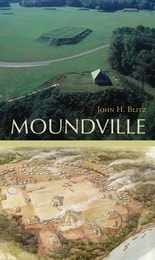
Moundville
John H. Blitz
University of Alabama Press, 2008
Exploring the legacy of America’s great mound builders.
In the 13th century, Moundville was one of the largest Native American settlements north of Mexico. Spread over 325 acres were 29 earthen mounds arranged around a great plaza, a mile-long stockade, and dozens of dwellings for thousands of people. Moundville, in size and complexity second only to the Cahokia site in Illinois, was a heavily populated town, as well as a political and religious center.
Moundville was sustained by tribute of food and labor provided by the people who lived in the nearby floodplain as well as other smaller mound centers. The immediate area appears to have been thickly populated, but by about A.D. 1350, Moundville retained only ceremonial and political functions. A decline ensued, and by the 1500s the area was abandoned. By the time the first Europeans reached the Southeast in the 1540s, the precise links between Moundville's inhabitants and what became the historic Native American tribes had become a mystery.
Illustrated with 50 color photos, maps, and figures, Moundville tells the story of the ancient people who lived there, the modern struggle to save the site from destruction, and the scientific saga of the archaeologists who brought the story to life. Moundville is the book to read before, during, or after a visit to Alabama’s prehistoric metropolis.
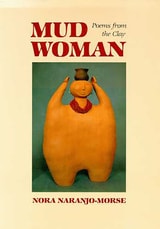
Mud Woman
Poems from the ClayNora Naranjo-Morse
University of Arizona Press, 1992
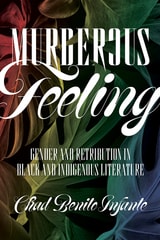
Murderous Feeling
Gender and Retribution in Black and Indigenous LiteratureChad Benito Infante
University of Minnesota Press, 2026
Examining revenge narratives as a feminist response to slavery and settler colonialism
From Octavia Butler’s Kindred to The Round House by Louise Erdrich, themes of retribution resound throughout the work of renowned Black and Indigenous women and queer authors. Revealing how the Black Power Movement and the American Indian Movement influenced literature from the 1960s onward, Murderous Feeling explores how these writers have employed revenge narratives as a response to white supremacy and colonialism.
Chad Benito Infante shows how, rather than using retributive violence to cultivate a heroic, masculine ideal, Black and Native women and queer writers use revenge as a way to raise philosophical questions about justice and the reclamation of power in the face of white supremacy. Pairing canonical texts—including work by James Baldwin, Leslie Marmon Silko, Craig Womack, Toni Morrison, and others—he demonstrates how this uniquely queer and feminist literary tradition, the “grammar of interrogation,” allows for generative ambivalence and curiosity about the possibilities and failures of violence.
In highlighting these narratives’ potential to steer anticolonial efforts, Murderous Feeling reconceptualizes literary violence not as an individualized act of cleansing but as a tool for revolutionary inquiry.
Retail e-book files for this title are screen-reader friendly.