Results by title
75 books match the query 'Nigeria' and 4 start with m
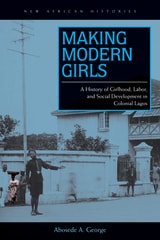
Making Modern Girls
A History of Girlhood, Labor, and Social Development in Colonial LagosAbosede A. George
Ohio University Press, 2014
Winner of the 2015 Aidoo-Snyder Book Prize for outstanding book on African women's experiences. (African Studies Association)
Honorable Mention, New York African Studies Association Book Prize
In Making Modern Girls, Abosede A. George examines the influence of African social reformers and the developmentalist colonial state on the practice and ideology of girlhood as well as its intersection with child labor in Lagos, Nigeria. It draws from gender studies, generational studies, labor history, and urban history to shed new light on the complex workings of African cities from the turn of the twentieth century through the nationalist era of the 1950s.
The two major schemes at the center of this study were the modernization project of elite Lagosian women and the salvationist project of British social workers. By approaching children and youth, specifically girl hawkers, as social actors and examining the ways in which local and colonial reformers worked upon young people, the book offers a critical new perspective on the uses of African children for the production and legitimization of national and international social development initiatives.
Making Modern Girls demonstrates how oral sources can be used to uncover the social history of informal or undocumented urban workers and to track transformations in practices of childhood over the course of decades. George revises conventional accounts of the history of development work in Africa by drawing close attention to the social welfare initiatives of late colonialism and by highlighting the roles that African women reformers played in promoting sociocultural changes within their own societies.
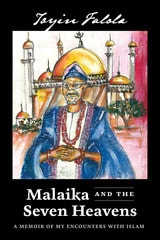
Malaika and the Seven Heavens
A Memoir of My Encounters with IslamToyin Falola
University of Michigan Press, 2025
Although faith is a lifelong journey, Falola identifies key moments in his upbringing that shaped his perception of faith, such as observing Islamic prayers, witnessing the significance of pilgrimage, engaging with spiritual leaders, and interacting with both Muslims and non-Muslims. By blending personal observations and reflections with the broader historical and cultural contexts of Islam, the book provides a unique perspective on the lived experiences of Muslims. In addition, Falola’s comparative perspective on the interaction of Christianity, Islam, and African Traditional Religion illustrates how these faiths influence and coexist with one another. Chapters explore firsthand experiences at madrassas, Islamic education, the influence of Islamic music on Yoruba culture, the historical importance of places like Oja Oba in Ibadan, the role of women in Islam, the intersection of traditional medicine with Islamic healing practices, and the broader social and political implications of Islam in Nigerian cities such as Ilorin and Lagos. Ultimately, Malaika and the Seven Heavens aims to foster a deeper appreciation for our shared humanity, inspire meaningful conversations that bridge cultural divides, and enrich our collective knowledge.
Moral Economies of Corruption
State Formation and Political Culture in NigeriaSteven Pierce
Duke University Press, 2016
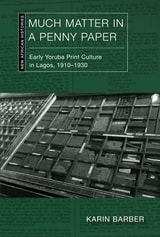
Much Matter in a Penny Paper
Early Yoruba Print Culture in Lagos, 1910–1930Karin Barber
Ohio University Press, 2026
A groundbreaking study of Yoruba-language print culture in colonial Lagos
Much Matter in a Penny Paper offers the first in-depth exploration of the emergence of an African-language print culture in early twentieth-century Lagos, Nigeria. Focusing on the 1910s and 1920s—a period of rapid experimentation and innovation—Karin Barber examines the rise of Yoruba-language newspapers and the vibrant civic sphere they helped create.
The 1910s was notable for an upsurge of local Yoruba-language history books, and during the 1920s entrepreneurial editors and writers launched five Yoruba-language weeklies in quick succession. These publications drew in readers beyond the educated elite, expanding public discourse and experimenting with new genres of writing. From moralizing pamphlets and dramatic sketches to serialized narratives voiced by women, Yoruba print producers reimagined oral and written traditions, blending popular songs, anecdotes, and poetic forms into a dynamic new medium.
This book is about not only what was printed but also how and why. It investigates the material practices of print production, the motivations of its creators, and the expectations of its audiences. Drawing on editorials, reader correspondence, and other paratextual commentary, it reveals how Yoruba writers and readers understood the role of print in capturing the present, preserving the past, projecting the wisdom of the day forward for the benefit of future generations, and generating deep Yoruba texts rich in poetic energy.
Through detailed portraits of key figures—editors, pamphleteers, and a mysterious oral historian—Barber traces the interconnections between publications and genres, showing how they formed an active bilingual sphere of communication. The interplay between Yoruba- and English-language media, as well as the creative exploitation of both languages, emerges as a defining feature of this period’s print culture. By treating the Yoruba print archive as a “transcript of emergence,” this study offers new insights into how cultural innovations take shape. It is essential reading for scholars of African history, media studies, sociolinguistics, and print culture.