92 books match the query 'Notes' and 3 start with m
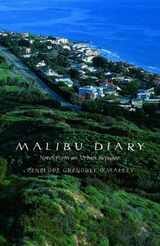
cover of Malibu Diary: Notes From An Urban Refugee

Malibu Diary

Notes From An Urban Refugee

Penelope O'Malley

University of Nevada Press, 2004
In 1986, Penelope O’Malley moved to Malibu, at that time a small community of oddballs and cantankerous isolationists, hoping to find peaceful exile from Los Angeles and a life that had become too frantic and confused. She knew little then of the landscape that she hoped would inspire her—who owned it, what manner of flora and fauna it might support—and she wasn’t much interested. Nor did she give much thought to the people who would become her neighbors. As it turned out, her life on this urban-wildland frontier was very different from what she had planned. Malibu Diary is O’Malley’s account of her years as a resident of this beautiful, beleaguered Southern California coastal community. Here, a landscape of rare beauty conceals geological and climatic treachery, and human presence endangers a rich but fragile ecosystem. Far from isolating herself from the ills of contemporary urban life, O’Malley found herself deeply engaged in a community where realtors lusted after the magnificent hills and beachfront, Native Americans fought to protect the artifacts of their ancestors, and locals, no matter how resistant to development, were forced to address such pressing urban issues as zoning and sewage treatment. Malibu’s decision to incorporate introduced politics into the quiet village while horrendous fires and floods destroyed property and the natural environment. Malibu Diary combines environmental history, personal memoir, and a meditation on the complicated relationships between humans and the landscapes they destroy. It is also the story of a colorful community, of how change has happened—and why—and what it has meant. And it is, ultimately, the story of many communities where people try to resist development, “assuming little responsibility to ameliorate the effects of our having settled here.” 
[more]
cover of Means Without End: Notes on Politics

Means Without End

Notes on Politics

Giorgio Agamben

University of Minnesota Press, 2000
An essential reevaluation of the proper role of politics in contemporary life. In this critical rethinking of the categories of politics within a new sociopolitical and historical context, the distinguished political philosopher Giorgio Agamben builds on his previous work to address the status and nature of politics itself. Bringing politics face-to-face with its own failures of consciousness and consequence, Agamben frames his analysis in terms of clear contemporary relevance. He proposes, in his characteristically allusive and intriguing way, a politics of gesture—a politics of means without end.Among the topics Agamben takes up are the "properly" political paradigms of experience, as well as those generally not viewed as political. He begins by elaborating work on biopower begun by Foucault, returning the natural life of humans to the center of the polis and considering it as the very basis for politics. He then considers subjects such as the state of exception (the temporary suspension of the juridical order); the concentration camp (a zone of indifference between public and private and, at the same time, the secret matrix of the political space in which we live); the refugee, who, breaking the bond between the human and the citizen, moves from marginal status to the center of the crisis of the modern nation-state; and the sphere of pure means or gestures (those gestures that, remaining nothing more than means, liberate themselves from any relation to ends) as the proper sphere of politics. Attentive to the urgent demands of the political moment, as well as to the bankruptcy of political discourse, Agamben’s work brings politics back to life, and life back to politics.Giorgio Agamben teaches philosophy at the Collège International de Philosophie in Paris and at the University of Macerata in Italy. He is the author of Language and Death (1991), Stanzas (1992), and The Coming Community (1993), all published by the University of Minnesota Press.
[more]
cover of Mexican Folk Narrative from the Los Angeles Area: Introduction, Notes, and Classification

Mexican Folk Narrative from the Los Angeles Area

Introduction, Notes, and Classification

By Elaine K. Miller

University of Texas Press, 1973

Urban Los Angeles is the setting in which Elaine Miller has collected her narratives from Mexican-Americans. The Mexican folk tradition, varied and richly expressive of the inner life not only of a people but also of the individual as each lives it and personalizes it, is abundantly present in the United States. Since it is in the urban centers that most Mexican-Americans have lived, this collection represents an important contribution to the study of that tradition and to the study of the changes urban life effects on traditional folklore.

The collection includes sixty-two legendary narratives and twenty traditional tales. The legendary narratives deal with the virgins and saints as well as with such familiar characters as the vanishing hitchhiker, the headless horseman, and the llorona. Familiar characters appear in the traditional tales—Juan del Oso, Blancaflor, Pedro de Ordimalas, and others. Elaine Miller concludes that the traditional tales are dying out in the city because tale telling itself is not suited to the fast pace of modern urban life, and the situations and characters in the tales are not perceived by the people to be meaningfully related to the everyday challenges and concerns of that life. The legendary tales survive longer in an urban setting because, although containing fantastic elements, they are related to the beliefs and hopes of the narrator—even in the city one may be led to buried treasure on some dark night by a mysterious woman.

The penchant of the informants for the fantastic in many of their tales often reflects their hopes and fears, such as their dreams of suddenly acquiring wealth or their fears of being haunted by the dead. Miller closely observes the teller's relation to the stories—to the duendes, the ánimas, Death, God, the devil—and she notes the tension on the part of the informant in his relation to their religion.

The material is documented according to several standard tale and motif indices and is placed within the context of the larger body of Hispanic folk tradition by the citation of parallel versions throughout the Hispanic world. The tales, transcribed from taped interviews, are presented in colloquial Spanish accompanied by summaries in English.

[more]