Results by title
208 books match the query 'Ohio' and 7 start with m
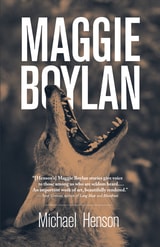
Maggie Boylan
Michael Henson
Ohio University Press, 2018
Finalist, 2019 Weatherford Award (Fiction) • A Great Group Reads Selection for National Reading Group Month from The Women’s National Book Association
Set in Appalachian Ohio amid an epidemic of prescription opiate abuse, Michael Henson’s linked collection tells of a woman’s search for her own peculiar kind of redemption, and brings the novel-in-stories form to new heights. Maggie Boylan is an addict, thief, liar, and hustler. But she is also a woman of deep compassion and resilience. The stories follow Maggie as she spirals through her addictive process, through the court system and treatment, and into a shaky new beginning.
In these masterful stories, we rarely occupy Maggie’s perspective, but instead gain a multilayered portrait of a community as we see other people’s lives bump up against hers—and we witness her inserting herself into their spheres, refusing to be rebuffed. The result is a prismatic view of a community fighting to stay upright against the headwinds of a drug epidemic: always on edge, always human.
Making Equity Planning Work
Leadership in the Public SectorNorman Krumholz and John Forester, foreword by Alan A. Altshuler
Temple University Press, 1990
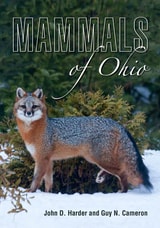
Mammals of Ohio
John D. Harder
Ohio University Press, 2022
An updated, informative review of the status and biology of the fifty-five species of mammals living wild in Ohio, richly illustrated with photographs, maps, drawings, and original artwork.
This comprehensive reference illustrates how species within each of the seven orders of mammals in Ohio share modes of reproduction, locomotion, and nutrition, providing a framework for understanding the fascinating world of mammalian biology. Presentations of natural history in each account of the various species are enhanced with descriptions of intriguing adaptations for avoiding demise from predators, food shortages, and the frigid conditions of Ohio winters. The book is richly illustrated with range maps, exquisite skull drawings, beautiful photography, and engaging artwork.
Challenges to wildlife conservation are considerable in Ohio, with its vast industrialized urban centers distributed across a largely agricultural landscape. With frequent citations of scientific reports and conservation efforts of the Ohio Division of Wildlife and of other public and private entities, this book instills an appreciation for the rich mammalian fauna of Ohio, as well as knowledge on how to join efforts to protect it.
Covering all of the state’s mammals, from tiny, obscure shrews to the magnificent white-tailed deer, Mammals of Ohio is a definitive resource for professional biologists and students. The narrative style throughout the book is accessible, providing the general reader with an appreciation for the full scope of the rich mammalian diversity in the state.
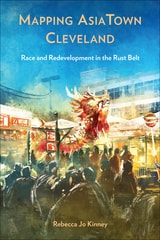
Mapping AsiaTown Cleveland
Race and Redevelopment in the Rust BeltRebecca Jo Kinney
Temple University Press, 2025
Mapping AsiaTown Cleveland challenges ideas about the invisibility of Asian Americans in the urban Midwest by linking the contemporary development of Cleveland’s “AsiaTown” to the multiple and fragmented histories of Cleveland’s Asian American communities from the 1940s to present day. Kinney’s sharp insights illustrate how region matters for Japanese Americans who resettled from concentration camps and Chinese Americans food purveyors, as well as the ways in which Asian American community leaders have had to fight for visibility and representation in city planning—even as the Cleveland Asian Festival is branded as a marquee “diversity” event for the city.
Mapping AsiaTown Cleveland recognizes the vibrant Asian American community formations and belonging that have developed in seemingly unexpected spaces and places.
In the series Asian American History and Culture
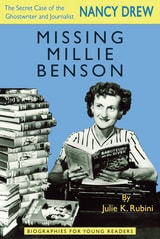
Missing Millie Benson
The Secret Case of the Nancy Drew Ghostwriter and JournalistJulie K. Rubini
Ohio University Press, 2015
Growing up in Ladora, Iowa, Mildred “Millie” Benson had ample time to develop her imagination and sense of adventure. While still a journalism graduate student at the University of Iowa, Millie began writing for the Stratemeyer Syndicate, which published the phenomenally popular Hardy Boys series, among others. Soon, Millie was tapped for a new series starring amateur sleuth Nancy Drew, a young, independent woman not unlike Millie herself. Under the pen name Carolyn Keene, Millie wrote the first book, The Secret of the Old Clock, and twenty-two other Nancy Drew Mystery Stories. In all, Millie wrote more than a hundred novels for young people.
Millie was also a journalist for the Toledo Times and the Toledo Blade. At sixty-two, she obtained her pilot’s license. Follow the clues throughout Missing Millie to discover the story of this ghostwriter, journalist, and adventurer.
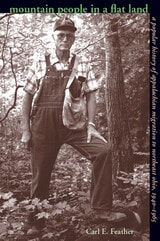
Mountain People in a Flat Land
A Popular History of Appalachian Migration to Northeast Ohio, 1940–1965Carl E. Feather
Ohio University Press, 1998
But the cost of a bus ticket was more than a week's wages in a lumber camp, and the mountaineer paid dearly in loss of kin, culture, homeplace, and freedom.
Numerous scholarly works have addressed this migration that brought more than one million mountaineers to Ohio alone. But Mountain People in a Flat Land is the first popular history of Appalachian migration to one community — Ashtabula County, an industrial center in the fabled “best location in the nation.”
These migrants share their stories of life in Appalachia before coming north. There are tales of making moonshine, colorful family members, home remedies harvested from the wild, and life in coal company towns and lumber camps.
The mountaineers explain why, despite the beauty of the mountains and the deep kinship roots, they had to leave Appalachia.
Stories of their hardships, cultural clashes, assimilation, and ultimate successes in the flatland provide a moving look at an often stereotyped people.
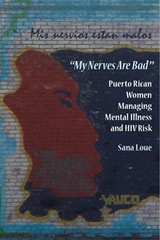
My Nerves Are Bad
Puerto Rican Women Managing Mental Illness and HIV RiskSana Loue
Vanderbilt University Press, 2011
Sana Loue lets us see the remarkable strength of many of the women and hear in their own words about their efforts to survive, despite long histories of childhood physical and sexual abuse, partner violence, substance use, poverty, and severe mental illness. We also witness the violence that surrounds them and the HIV risk that becomes a part of their lives in their efforts to survive economically and emotionally.