Results by title
117 books match the query 'Opera' and 5 start with m
Macbeth
Melodramma in Four Acts. Libretto by Francesco Maria PiaveGiuseppe Verdi
University of Chicago Press, 2005
Published in three volumes, this critical edition of Macbeth is the only one based entirely on autograph sources. Containing the later version as the principal score, it is the first edition to consult the composer's manuscripts of the revised pieces, preserved at the Bibliothèque Nationale in Paris. An appendix contains the earlier movements, and David Lawton provides a wide-ranging introduction to the opera's complex history. This critical edition of Macbeth includes here for the first time Verdi's preferred text—the version he set to music—as well as his own stage directions and thus offers the most vivid and dramatic reading to date.

More Opera Scenes for Class and Stage
From One Hundred Selected OperasMary Elaine Wallace and Robert Wallace
Southern Illinois University Press, 1990
Reviewing the first volume of Opera Scenes for Class and Stage, Walter Ducloux wrote in the Opera Journal: "If you can come up, within five seconds, with an operatic excerpt involving two sopranos, four mezzo-sopranos, two tenors, and a bass, you don't need this book. Otherwise hurry and buy it. I keep it on my night table."
In More Opera Scenes, the Wallaces have reviewed 100 additional operas and have chosen over 700 scenes. The popular "Table of Voice Categories" providing more than 300 combinations is also featured in this volume.

Mosè in Egitto
Azione tragico-sacra in Three Acts by Andrea Leone TottolaGioachino Rossini
University of Chicago Press, 2005
This critical edition presents the version performed in 1820 after Rossini had revised the unsuccessful and now lost third act of 1818. The edition includes an appendix with the original aria for Pharaoh written by Michele Carafa, which was performed throughout the nineteenth century even after Rossini replaced it with one of his own. Also featured are vocal ornamentation used in Paris performances and detailed information on the Paris productions between 1822 and 1840. This comprehensive critical edition provides a reliable source for interpretation and study of a work that Rossini called "sublime."
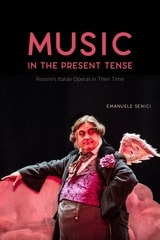
Music in the Present Tense
Rossini’s Italian Operas in Their TimeEmanuele Senici
University of Chicago Press, 2019
Emanuele Senici’s new book provides a fresh look at the motives behind the Rossinian furore and its aftermath by examining the composer’s works in the historical context in which they were conceived, performed, seen, heard, and discussed. Situating the operas firmly within the social practices, cultural formations, ideological currents, and political events of early nineteenth-century Italy, Senici reveals Rossini’s dramaturgy as a radically new and specifically Italian reaction to the epoch-making changes witnessed in Europe at the time. The first book-length study of Rossini’s Italian operas to appear in English, Music in the Present Tense exposes new ways to explore nineteenth-century music and addresses crucial issues in the history of modernity, such as trauma, repetition, and the healing power of theatricality.
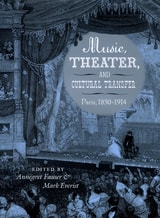
Music, Theater, and Cultural Transfer
Paris, 1830-1914Edited by Annegret Fauser and Mark Everist
University of Chicago Press, 2009
Opera and musical theater dominated French culture in the 1800s, and the influential stage music that emerged from this period helped make Paris, as Walter Benjamin put it, the “capital of the nineteenth century.” The fullest account available of this artistic ferment and its international impact, Music, Theater, and Cultural Transfer explores the diverse institutions that shaped Parisian music and extended its influence across Europe, the Americas, and Australia.
The contributors to this volume, who work in fields ranging from literature to theater to musicology, focus on the city’s musical theater scene as a whole rather than on individual theaters or repertories. Their broad range enables their collective examination of the ways in which all aspects of performance and reception were affected by the transfer of works, performers, and management models from one environment to another. By focusing on this interplay between institutions and individuals, the authors illuminate the tension between institutional conventions and artistic creation during the heady period when Parisian stage music reached its zenith.