Results by title
55 books match the query 'Pease, Donald E.' and 3 start with m
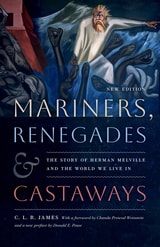
Mariners, Renegades and Castaways
The Story of Herman Melville and the World We Live InC. L. R. James
Brandeis University Press, 2025
Political theorist and cultural critic, novelist, and cricket enthusiast, C. L. R. James (1901–89) was a brilliant polymath who was described by Edward Said as “a centrally important twentieth-century figure.” Through such landmark works as The Black Jacobins, Beyond a Boundary, and American Civilization, James’s thought continues to influence and inspire scholars in a variety of fields.
In this complete edition of his seminal work of literary and cultural criticism, Mariners, Renegades, and Castaways, James anticipated many of the concerns and ideas that have shaped the contemporary fields of American and postcolonial studies. In this provocative study of Moby Dick in which he challenged the prevailing Americanist interpretation that opposed a “totalitarian” Ahab and a “democratic, American” Ishmael, James offers instead a vision of a factory-like Pequod whose “captain of industry” leads the crew to their doom. In addition to demonstrating how such an interpretation supported the United States’ emerging national security state, he also related the narrative of Moby Dick to his own persecuted position at the height of McCarthyism. It is precisely this personal, deeply original material that was excised from the first edition of this book.
With a new foreword by Professor Chanda Prescod-Weinstein—theoretical physicist, advocate for a just science, and James’s granddaughter—and an introduction by Professor Donald E. Pease at Dartmouth College that places the work in its critical and cultural context, Mariners, Renegades, and Castaways is once again available in a new edition.
Materializing Democracy
Toward a Revitalized Cultural PoliticsRuss Castronovo and Dana D. Nelson, eds.
Duke University Press, 2002
Covering topics ranging from rights discourse to Native American performance, from identity politics to gay marriage, and from rituals of public mourning to the Clinton-Lewinsky affair, the contributors seek to understand the practices, ideas, and material conditions that enable or foreclose democracy’s possibilities. Through readings of subjects as diverse as Will Rogers, Alexis de Tocqueville, slave narratives, interactions along the Texas-Mexico border, and liberal arts education, the contributors also explore ways of making democracy available for analysis. Materializing Democracy suggests that attention to disparate narratives is integral to the development of more complex, vibrant versions of democracy.
Contributors. Lauren Berlant, Wendy Brown, Chris Castiglia, Russ Castronovo, Joan Dayan, Wai Chee Dimock, Lisa Duggan, Richard R. Flores, Kevin Gaines, Jeffrey C. Goldfarb, Michael Moon, Dana D. Nelson, Christopher Newfield, Donald E. Pease
Morocco Bound
Disorienting America's Maghreb, from Casablanca to the Marrakech ExpressBrian T. Edwards
Duke University Press, 2005
Edwards reads a broad range of texts to recuperate the disorienting possibilities for rethinking American empire. Examining work by William Burroughs, Jane Bowles, Ernie Pyle, A. J. Liebling, Jane Kramer, Alfred Hitchcock, Clifford Geertz, James Michener, Ornette Coleman, General George S. Patton, and others, he puts American texts in conversation with an archive of Maghrebi responses. Whether considering Warner Brothers’ marketing of the movie Casablanca in 1942, journalistic representations of Tangier as a city of excess and queerness, Paul Bowles’s collaboration with the Moroccan artist Mohammed Mrabet, the hippie communities in and around Marrakech in the 1960s and early 1970s, or the writings of young American anthropologists working nearby at the same time, Edwards illuminates the circulation of American texts, their relationship to Maghrebi history, and the ways they might be read so as to reimagine the role of American culture in the world.