Results by title
103 books match the query 'Philosophy, Modern' and 9 start with m
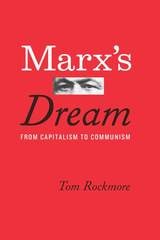
Marx's Dream
From Capitalism to CommunismTom Rockmore
University of Chicago Press, 2018
With Marx’s Dream, Tom Rockmore offers a much-needed alternative view, distinguishing rigorously between Marx and Marxism. Rockmore breaks with the Marxist view of Marx in three key ways. First, he shows that the concern with the relation of theory to practice—reflected in Marx’s famous claim that philosophers only interpret the world, while the point is to change it—arose as early as Socrates, and has been central to philosophy in its best moments. Second, he seeks to free Marx from his unsolicited Marxist embrace in order to consider his theory on its own merits. And, crucially, Rockmore relies on the normal standards of philosophical debate, without the special pleading to which Marxist accounts too often resort. Marx’s failures as a thinker, Rockmore shows, lie less in his diagnosis of industrial capitalism’s problems than in the suggested remedies, which are often unsound.
Only a philosopher of Rockmore’s stature could tackle a project this substantial, and the results are remarkable: a fresh Marx, unencumbered by doctrine and full of insights that remain salient today.

Mastering Discourse
The Politics of Intellectual CulturePaul A. Bové
Duke University Press, 1992
Mastering Discourses offers an account of why "theory" fails to deal adequately with the politics of discursive cultures and warns that unless critics take much more seriously their own disciplinary inscriptions they will always reproduce structures of power and knowledge that they claim to oppose. Moreover, Bové argues, they will not fulfill the main role of the post-enlightenment intellectual, namely: to respond effectively to the present, through new theoretical and historical formulations that address the changing world of transnational capitalism and its neoliberal ideologies.
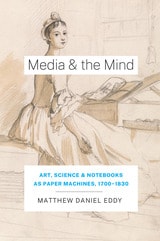
Media and the Mind
Art, Science, and Notebooks as Paper Machines, 1700-1830Matthew Daniel Eddy
University of Chicago Press, 2022
We often think of reason as a fixed entity, as a definitive body of facts that do not change over time. But during the Enlightenment, reason also was seen as a process, as a set of skills enacted on a daily basis. How, why, and where were these skills learned? Concentrating on Scottish students living during the long eighteenth century, this book argues that notebooks were paper machines and that notekeeping was a capability-building exercise that enabled young notekeepers to mobilize everyday handwritten and printed forms of material and visual media in a way that empowered them to judge and enact the enlightened principles they encountered in the classroom. Covering a rich selection of material ranging from simple scribbles to intricate watercolor diagrams, the book reinterprets John Locke’s comparison of the mind to a blank piece of paper, the tabula rasa. Although one of the most recognizable metaphors of the British Enlightenment, scholars seldom consider why it was so successful for those who used it. Each chapter uses one core notekeeping skill to reveal the fascinating world of material culture that enabled students in the arts, sciences, and humanities to transform the tabula rasa metaphor into a dynamic cognitive model. Starting in the home, moving to schools, and ending with universities, the book reconstructs the relationship between media and the mind from the bottom up. It reveals that the cognitive skills required to make and use notebooks were not simply aids to reason; rather, they were part of reason itself.
Merleau-Ponty's Ontology
Second EditionM.C. Dillon
Northwestern University Press, 1997
Merleau-Ponty’s Developmental Ontology
David Morris
Northwestern University Press, 2018
Merleau-Ponty's Developmental Ontology shows how the philosophy of Maurice Merleau-Ponty, from its very beginnings, seeks to find sense or meaning within nature, and how this quest calls for and develops into a radically new ontology.
David Morris first gives an illuminating analysis of sense, showing how it requires understanding nature as engendering new norms. He then presents innovative studies of Merleau-Ponty's The Structure of Behavior and Phenomenology of Perception, revealing how these early works are oriented by the problem of sense and already lead to difficulties about nature, temporality, and ontology that preoccupy Merleau-Ponty's later work. Morris shows how resolving these difficulties requires seeking sense through its appearance in nature, prior to experience—ultimately leading to radically new concepts of nature, time, and philosophy.
Merleau-Ponty's Developmental Ontology makes key issues in Merleau-Ponty's philosophy clear and accessible to a broad audience while also advancing original philosophical conclusions.
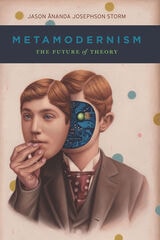
Metamodernism
The Future of TheoryJason Ananda Josephson Storm
University of Chicago Press, 2021
Metamodernism works through the postmodern critiques and uncovers the mechanisms that produce and maintain concepts and social categories. In so doing, Storm provides a new, radical account of society’s ever-changing nature—what he calls a “Process Social Ontology”—and its materialization in temporary zones of stability or “social kinds.” Storm then formulates a fresh approach to philosophy of language by looking beyond the typical theorizing that focuses solely on human language production, showing us instead how our own sign-making is actually on a continuum with animal and plant communication.
Storm also considers fundamental issues of the relationship between knowledge and value, promoting a turn toward humble, emancipatory knowledge that recognizes the existence of multiple modes of the real. Metamodernism is a revolutionary manifesto for research in the human sciences that offers a new way through postmodern skepticism to envision a more inclusive future of theory in which new forms of both progress and knowledge can be realized.
Michael Oakeshott on Religion, Aesthetics, and Politics
Elizabeth Campbell Corey
University of Missouri Press, 2006
For much of his career, British political philosopher Michael Oakeshott was identified with Margaret Thatcher’s conservative policies. He has been called by some a guru to the Tories, while others have considered him one of the last proponents of British Idealism. Best known for such books as Experience and Its Modes and Rationalism in Politics, Oakeshott has been the subject of numerous studies, but always with an emphasis on his political thought.
Gnosticism and considers both thinkers’ treatment of Hobbes to delineate their philosophical differences.
Moderately Modern
Rémi Brague
St. Augustine's Press, 2017
Modernity on Endless Trial
Leszek Kolakowski
University of Chicago Press, 1990
"Exemplary. . . . It should be celebrated." —Arthur C. Danto, New York Times Book Review
"This book . . . express[es] Kolakowski's thought on God, man, reason, history, moral truth and original sin, prompted by observation of the dramatic struggle among Christianity, the Enlightenment and modern totalitarianism. It is a wonderful collection of topics." —Thomas Nagel, Times Literary Supplement
"No better antidote to bumper-sticker thinking exists than this collection of 24 'appeals for moderation in consistency,' and never has such an antidote been needed more than it is now." —Joseph Coates, Chicago Tribune
"Whether learned or humorous, these essays offer gems in prose of diamond hardness, precision, and brilliance." —Thomas D'Evelyn, The Christian Science Monitor
A "Notable Books of the Year 1991" selection, New York Times Book Review—a "Noted with Pleasure" selection, New York Times Book Review—a "Summer Reading 1991" selection, New York Times Book Review—a "Books of the Year" selection, The Times.