Results by title
1148 books match the query 'Political Ideologies' and 45 start with m
Macroeconomic Policies and the Development of Markets in Transition Economies
Fabrizio Coricelli
Central European University Press, 1998
Madison's Nightmare
How Executive Power Threatens American DemocracyPeter M. Shane
University of Chicago Press, 2009
The George W. Bush administration’s ambitious—even breathtaking—claims of unilateral executive authority raised deep concerns among constitutional scholars, civil libertarians, and ordinary citizens alike. But Bush’s attempts to assert his power are only the culmination of a near-thirty-year assault on the basic checks and balances of the U.S. government—a battle waged by presidents of both parties, and one that, as Peter M. Shane warns in Madison’s Nightmare, threatens to utterly subvert the founders’ vision of representative government.
Tracing this tendency back to the first Reagan administration, Shane shows how this era of "aggressive presidentialism" has seen presidents exerting ever more control over nearly every arena of policy, from military affairs and national security to domestic programs. Driven by political ambition and a growing culture of entitlement in the executive branch—and abetted by a complaisant Congress, riven by partisanship—this presidential aggrandizement has too often undermined wise policy making and led to shallow, ideological, and sometimes outright lawless decisions. The solution, Shane argues, will require a multipronged program of reform, including both specific changes in government practice and broader institutional changes aimed at supporting a renewed culture of government accountability.
From the war on science to the mismanaged war on terror, Madison’s Nightmare outlines the disastrous consequences of the unchecked executive—and issues a stern wake-up call to all who care about the fate of our long democratic experiment.

Magical Marxism
Subversive Politics and the ImaginationAndy Merrifield
Pluto Press, 2011
Following his hugely popular book, The Wisdom of Donkeys, Andy Merrifield breathes new life into the Marxist tradition.
Magical Marxism demands something more of traditional Marxism - something more interesting and liberating. It asks that we imagine a Marxism that moves beyond debates about class, the role of the state and the dictatorship of the proletariat. In escaping the formalist straitjacket of orthodox Marxist critique, Merrifield argues for a reconsideration of Marxism and its potential, applying previously unexplored approaches to Marxist thinking that will reveal vital new modes of political activism and debate.
This book will provoke and inspire in equal measure. It gives us a Marxism for the 21st century, which offers dramatic new possibilities for political engagement.
Making Constituencies
Representation as Mobilization in Mass DemocracyLisa Jane Disch
University of Chicago Press, 2021
Since the turn of the twenty-first century, the idea of a divided United States has become commonplace. In the wake of the 2020 election, some commentators warned that the American public was the most divided it has been since the Civil War. Political scientists, political theorists, and public intellectuals have suggested that uninformed, misinformed, and disinformed voters are at the root of this division. Some are simply unwilling to accept facts or science, which makes them easy targets for elite manipulation. It also creates a grass-roots political culture that discourages cross-partisan collaboration in Washington.
Yet, manipulation of voters is not as grave a threat to democracy in America as many scholars and pundits make it out to be. The greater threat comes from a picture that partisans use to rally their supporters: that of an America sorted into opposing camps so deeply rooted that they cannot be shaken loose and remade. Making Constituencies proposes a new theory of representation as mobilization to argue that divisions like these are not inherent in society, but created, and political representatives of all kinds forge and deploy them to cultivate constituencies.
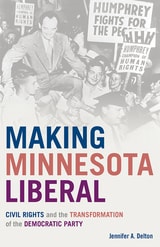
Making Minnesota Liberal
Civil Rights and the Transformation of the Democratic PartyJennifer A. Delton
University of Minnesota Press, 2002
The surprising story of how Minnesota politicians in the 1950s helped redirect American politics—now in paperback
How did a largely white state like Minnesota become a springboard for leadership in civil rights? Why did it produce a generation of liberals—Hubert Humphrey, Walter Mondale, Donald Fraser, Orville Freeman, and Eugene McCarthy—whose ideals transformed the Democratic party?
In Making Minnesota Liberal, Jennifer A. Delton delves into the roots of Minnesota politics for the answer, tracing the change from the regional, third-party, class-oriented politics of the Farmer-Labor party to the national, two-party, pluralistic liberalism of the Democratic-Farmer-Labor party (DFL). While others have examined how anticommunism and the Cold War shaped this transformation, Delton takes a new approach, showing the key roles played by antiracism and the civil rights movement. In telling this story, Delton contributes to our understanding not only of Minnesota’s political history but also of the relationship between antiracism and American politics in the twentieth century.
Making Minnesota Liberal combines political history with a discussion of the symbolic role played by race in political battles between whites. Delton recounts the creation of Minnesota’s Farmer-Labor party, its merger with the Democrats, and the acrimonious battle for control of the DFL just after World War II. She argues that the Humphrey liberals won this battle in part because antiracism activities enabled previously antagonistic groups, divided by ethnicity, religion, and class, to unify around a common cause.
Delton contends that although liberal Minnesotans’s concern for racial justice was genuine, it also provided them with national political relevance and imbued their bid for power with a sense of morality. Ultimately the language of tolerance and diversity that emerged from antiracism prepared Minnesotans for Humphrey’s vision of a pluralistic and state-centered liberalism, which eventually became the model for Democratic politics nationwide. Making Minnesota Liberal is an absorbing and trenchant account of a key moment in American history, one that continues to resonate in our time.
Making Sense of American Liberalism
Edited by Jonathan Bell and Timothy Stanley
University of Illinois Press, 2012
Making Value
Music, Capital, and the SocialTimothy D. Taylor
Duke University Press, 2024
Making and Breaking the Yugoslav Working Class
The Story of Two Self-Managed FactoriesGoran Music
Central European University Press, 2021
Workers' self-management was one of the unique features of communist Yugoslavia. Goran Musić has investigated the changing ways in which blue-collar workers perceived the recurring crises of the regime. Two self-managed metal enterprises, one in Serbia another in Slovenia, provide the frame of the analysis in the time span between 1945 and 1989. These two factories became famous for strikes in 1988 that evoked echoes in popular discourses in former Yugoslavia. Drawing on interviews, factory publications and other media, local archives, and secondary literature, Musić analyzes the two cases, going beyond the clichés of political manipulation from the top and workers' intrinsic attraction to nationalism.
The author explains how, in the later phase of communist Yugoslavia, growing social inequalities among the workers and undemocratic practices inside the self-managed enterprises facilitated the spread of a nationalist and pro-market ideology on the shop floors. Yet rather than being a mass taken advantage of by populist leaders, the working class Musić presents is one with agency and voice, a force that played an important role in shaping the fate of the country. The book thus seeks to open a debate on the social processes leading up to the dissolution of Yugoslavia.

Mao Zedong and China in the Twentieth-Century World
A Concise HistoryRebecca E. Karl
Duke University Press, 2010

March to Independence
The Revolutionary War in the Southern Colonies, 1775–1776Michael Cecere
Westholme Publishing, 2027
The Independence Trilogy
The American Revolutionary War began when Massachusetts militiamen and British troops clashed at Lexington and Concord on April 19, 1775. Two months later, a much larger engagement occurred at Bunker Hill in Boston. The conflict then expanded into a continent-wide war for independence from Great Britain. Or so we are taught. A closer look at events in the South in the eighteen months following Lexington and Concord tells different story. The practice of teaching the Revolutionary War as one generalized conflict between the American colonies and Great Britain assumes the South’s support for the Revolutionary War was a foregone conclusion. However, once shots were fired, it was not certain that the southern colonies would support the independence movement. What is clear is that both the fledgling American republic and the British knew that the southern colonies were critical to any successful prosecution of the war by either side.
In March to Independence: The American Revolution in the Southern Colonies, 1775–1776, historian Michael Cecere, consulting primary source documents, examines how Virginia, North Carolina, South Carolina, and Georgia ended up supporting the colonies to the north, while East Florida remained within the British sphere. South Carolina, Georgia, and East Florida all retained their royal governors through the summer of 1775, and no military engagements occurred in any of the southern colonies in the six months following the battles in Massachusetts. The situation changed significantly in the fall, however, with armed clashes in Virginia and South Carolina; by early 1776 the war had spread to all of the southern colonies except East Florida. Although their march to independence did not follow the exact route as the colonies to the north, events in the South pulled the southern colonists in the same direction, culminating with a united Declaration of Independence on July 4, 1776. This book explores the crucial events in the southern colonies that led all but East Florida to support the American cause.
Marx Beyond Marx
Antonio Negri
Pluto Press, 1992
Marx and History
From Primitive Society to the Communist FutureBy D. Ross Gandy
University of Texas Press, 1979
In this book Marx's observations on history, which are found scattered throughout his voluminous writings, are brought together and subjected to searching analysis.
D. Ross Gandy writes in refreshingly direct language, without resorting to jargon. For the first time we have a thoughtful assessment of Marx's views on all the epochs that cross his historical vision. Gandy treats Marx's ideas on primitive societies, on ancient Roman and Asiatic civilization, on the structure of feudalism, on strategies for overthrowing capitalism, and on the hypothetical communist future. Among the author's departures from traditional readings of Marx are his interpretations of class struggle, his conception of social strata, and his cogent analysis of the "new Marxism."
Since many aspects of Marxist historical theory have been neglected or distorted, Gandy's remarkably clear commentary, based on extensive research—including an exhaustive study of the forty-volume Marx-Engels Werke—will doubtless stimulate debate among sociologists and other students of social change, political scientists, and historians.
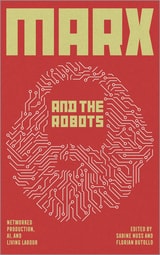
Marx and the Robots
Networked Production, AI, and Human LabourFlorian Butollo
Pluto Press, 2022
It covers a broad range of digital aspects now proliferating across our work and lives, including chapters on the digitalization of agriculture, robotics in the factory and the labor process on crowdworking platforms. It looks to how 20th century Marxist predictions of the 'workerless factory' are, or are not, coming true, and how 'Platform Capitalism' should be understood and critiqued.
Through rich empirical, theoretical and historical material, this book is necessary reading for those wanting a clear overview of our digital world.
Marx at the Margins
On Nationalism, Ethnicity, and Non-Western SocietiesKevin B. Anderson
University of Chicago Press, 2016
Marx's Dream
From Capitalism to CommunismTom Rockmore
University of Chicago Press, 2018
With Marx’s Dream, Tom Rockmore offers a much-needed alternative view, distinguishing rigorously between Marx and Marxism. Rockmore breaks with the Marxist view of Marx in three key ways. First, he shows that the concern with the relation of theory to practice—reflected in Marx’s famous claim that philosophers only interpret the world, while the point is to change it—arose as early as Socrates, and has been central to philosophy in its best moments. Second, he seeks to free Marx from his unsolicited Marxist embrace in order to consider his theory on its own merits. And, crucially, Rockmore relies on the normal standards of philosophical debate, without the special pleading to which Marxist accounts too often resort. Marx’s failures as a thinker, Rockmore shows, lie less in his diagnosis of industrial capitalism’s problems than in the suggested remedies, which are often unsound.
Only a philosopher of Rockmore’s stature could tackle a project this substantial, and the results are remarkable: a fresh Marx, unencumbered by doctrine and full of insights that remain salient today.
Marxism and the Interpretation of Culture
Edited by Cary Nelson and Lawrence Grossberg
University of Illinois Press, 1988
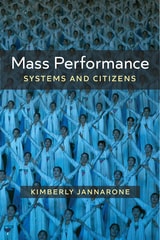
Mass Performance
Systems and CitizensKimberly Jannarone
University of Michigan Press, 2025
Although not a comprehensive study of such events, Jannarone’s analysis of the selected mass performance systems yields new theoretical perspectives on these phenomena, a central focus of her study being how political leaders find ways to create a physically coordinated mass body politic, even during times of hardship and war. By interpreting and historicizing mass assemblies of bodies, this study analyzes the choreographies and organizations that brought thousands of people together as an ensemble and kept them together in meaning-making motion.
Masses and Man
Nationalist and Fascist Perceptions of RealityGeorge L. Mosse
University of Wisconsin Press, 2024
Masses and Man comprises three parts. The first lays out a cultural history of nationalism, essentially the first of its kind, emphasizing the importance of sacred expressions like myths, symbols, and rituals as appropriated in a political context. The second zeroes in on fascism’s most dramatic irruptions in European history in the rise of Italian Fascism and the Nazi Party in Germany, elucidating these as not just political movements but also cultural and even aesthetic ones. The third part considers nationalism and fascism from the particular standpoint of German Jews.
Taken in full, the volume offers an eloquent summation of Mosse’s groundbreaking insights into European nationalism, fascism, and Jewish history in the twentieth century. A new critical introduction by Enzo Traverso helpfully situates Mosse’s work in context and exposes the many ways in which Masses and Man, first published in 1980, remains relevant today.

Masterpieces of History
The Peaceful End of the Cold War in Europe, 1989The National Security Archive Savranskaya
Central European University Press, 2010
Mastery and Drift
Professional-Class Liberals since the 1960sEdited by Brent Cebul and Lily Geismer
University of Chicago Press, 2025
Since the 1960s, American liberalism and the Democratic Party have been remade along professional class lines, widening liberalism’s impact but narrowing its social and political vision. In Mastery and Drift, historians Brent Cebul and Lily Geismer have assembled a group of scholars to address the formation of “professional-class liberalism” and its central role in remaking electoral politics and the practice of governance. Across subjects as varied as philanthropy, consulting, health care, welfare, race, immigration, economics, and foreign conflicts, the authors examine not only the gaps between liberals’ egalitarian aspirations and their approaches to policymaking but also how the intricacies of contemporary governance have tended to bolster professional-class liberals’ power.
The contributors to Mastery and Drift all came of age amid the development of professional-class liberalism, giving them distinctive and important perspectives in understanding its internal limitations and its relationship to neoliberalism and the Right. With never-ending disputes over the meaning of liberalism, the content of its governance, and its relationship to a resurgent Left, now is the time to consider modern liberalism’s place in contemporary American life.
Materializing Democracy
Toward a Revitalized Cultural PoliticsRuss Castronovo and Dana D. Nelson, eds.
Duke University Press, 2002
Covering topics ranging from rights discourse to Native American performance, from identity politics to gay marriage, and from rituals of public mourning to the Clinton-Lewinsky affair, the contributors seek to understand the practices, ideas, and material conditions that enable or foreclose democracy’s possibilities. Through readings of subjects as diverse as Will Rogers, Alexis de Tocqueville, slave narratives, interactions along the Texas-Mexico border, and liberal arts education, the contributors also explore ways of making democracy available for analysis. Materializing Democracy suggests that attention to disparate narratives is integral to the development of more complex, vibrant versions of democracy.
Contributors. Lauren Berlant, Wendy Brown, Chris Castiglia, Russ Castronovo, Joan Dayan, Wai Chee Dimock, Lisa Duggan, Richard R. Flores, Kevin Gaines, Jeffrey C. Goldfarb, Michael Moon, Dana D. Nelson, Christopher Newfield, Donald E. Pease
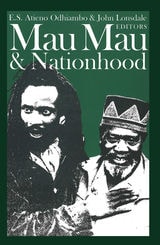
Mau Mau and Nationhood
Arms, Authority, and NarrationE. S. Atieno Odhiambo
Ohio University Press, 2003
Fifty years after the declaration of the state of emergency, Mau Mau still excites argument and controversy, not least in Kenya itself. Mau Mau and Nationhood is a collection of essays providing the most recent thinking on the uprising and its aftermath.
The work of well-established scholars as well as of young researchers with fresh perspectives, Mau Mau and Nationhood achieves a multilayered analysis of a subject of enduring interest. According to Terence Ranger, Emeritus Rhodes Professor, Oxford, “In some ways the historiography of Mau Mau is a supreme example not only of ambiguity and complexity, but also of redemption of a topic once thought incapable of rational analysis.”

Media, Nationalism and European Identities
Karol Jakubowicz
Central European University Press, 2011

Memoirs of a Palestinian Communist
The Secret Life of Najati SidqiNajati Sidqi; translated by Margaret Litvin, Gideon Gordon, and Anas Farhan
University of Texas Press, 2025
The secret life of a Palestinian Communist activist during the leadup to World War II.
In the public eye, Najati Sidqi was known as a journalist and writer, a translator of Russian classics, and an outspoken opponent of Nazism. However, Sidqi concealed a critical component of his life from the world and his family. He was an underground activist for the Palestinian Communist Party, a risky and influential pursuitthat took him to early Bolshevik Moscow, British courts and prison cells in Palestine, Nazi Germany, intrigue-heavy interwar Paris, and Civil War Spain, Morocco, and Algeria. Throughout his journey, Sidqi continued to write, even as he faced fascism, intense surveillance, active warzones, the death of friends, and exile.
Memoirs of a Palestinian Communist brings Sidqi’s incredible life and work to light, wryly narrating his international travels, his work as an activist, and his political dealings at a crucial moment for Palestine and the international fight against fascism. Translated from Arabic into English for the first time, it is a riveting firsthand account of an often-overlooked aspect of the history of the global left. Generous supplementary materials make the memoir accessible to students and non-specialist scholars: a preface by Sidqi’s grandson, a foreword by renowned historian Joel Beinin, a translators’ introduction that presents new research on Sidqi’s family history, a map of his travels, and a timeline, as well as a bibliographic essay offering pointers for further research.
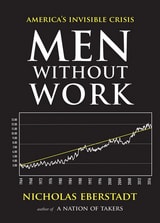
Men Without Work
America's Invisible CrisisNicholas Eberstadt
Templeton Press, 2016
By one reading, things look pretty good for Americans today: the country is richer than ever before and the unemployment rate is down by half since the Great Recession—lower today, in fact, than for most of the postwar era.
But a closer look shows that something is going seriously wrong. This is the collapse of work—most especially among America’s men. Nicholas Eberstadt, a political economist who holds the Henry Wendt Chair in Political Economy at the American Enterprise Institute, shows that while “unemployment” has gone down, America’s work rate is also lower today than a generation ago—and that the work rate for US men has been spiraling downward for half a century. Astonishingly, the work rate for American males aged twenty-five to fifty-four—or “men of prime working age”—was actually slightly lower in 2015 than it had been in 1940: before the War, and at the tail end of the Great Depression.
Today, nearly one in six prime working age men has no paid work at all—and nearly one in eight is out of the labor force entirely, neither working nor even looking for work. This new normal of “men without work,” argues Eberstadt, is “America’s invisible crisis.”
So who are these men? How did they get there? What are they doing with their time? And what are the implications of this exit from work for American society?
Nicholas Eberstadt lays out the issue and Jared Bernstein from the left and Henry Olsen from the right offer their responses to this national crisis.
For more information, please visit http://menwithoutwork.com.
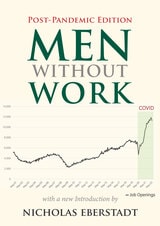
Men without Work
Post-Pandemic Edition (2022)Eberstadt, Nicholas
Templeton Press, 2022
The grim truth: over six million prime-age men were neither working nor looking for work. Conventional unemployment measures ignored these labor force dropouts, but their ranks had been rising relentlessly for half a century. Eberstadt’s unflinching analysis was, in the words of The New York Times, “an unsettling portrait not just of male unemployment, but also of lives deeply alienated from civil society.”
The famed American work ethic was once near universal: men of sound mind and body took pride in contributing to their communities and families. No longer, warned Eberstadt. And now—six years and one catastrophic pandemic later—the problem has not only worsened: it has seemingly been spreading among prime-age women and workers over fifty-five.
In a brand new introduction, Eberstadt explains how the government’s response to Covid-19 inadvertently exacerbated the flight from work in America. From indiscriminate pandemic shutdowns to almost unconditional “unemployment” benefits, Americans were essentially paid not to work.
Thus today, despite the vaccine rollouts, inexplicable numbers of working age men and women are sitting on the sidelines while over 11 million jobs go unfilled. Current low rates of unemployment, touted by pundits and politicians, are grievously misleading. The truth is that fewer prime-age American men are looking for readily available work than at any previous juncture in our history. And others may be catching the “Men Without Work” virus too.
Given the devastating economic impact of the Covid calamity and the unforeseen aftershocks yet to come, this reissue of Eberstadt’s groundbreaking work is timelier than ever.
Menace of Our Time
The Long War Against American CommunismAaron J. Leonard
Rutgers University Press, 2025
A survey of the far-reaching measures the U.S. government brought to bear against the CPUSA, from poison-pen letters to the Red Scare and beyond.
Beginning at the turn of the twentieth century and ending only with the Soviet Union’s collapse in 1991, the U.S. government and major elements in the wider society waged an unrelenting campaign to suppress and criminalize domestic communism. This long-overdue book details the longest and most extensive repressive operation ever undertaken by U.S. authorities against a domestic political organization that, however problematic, was largely operating within the scope of constitutionally mandated freedoms. Beyond that, this is the story of how systemic measures against U.S. communists—in contrast to the vaunted claims of American political freedom—defined the political landscape of the last century.
Menace of Our Time tracks the suppression efforts aimed at the group, including the state laws of the twenties that imprisoned the fledgling communist leadership; the tactics used by police and local authorities against communists as they fought for unions, racial equality, and the unemployed; the trials and imprisonment of communist leaders mid-century; the extra-legal efforts of the Counterintelligence Program (COINTELPRO) in the sixties; and the ongoing, relentless surveillance by the FBI that followed. In examining the far-reaching measures the government brought to bear against the Communist Party USA, Aaron J. Leonard provides a clearer picture of the mechanics of social and political repression that abound in the society we still inhabit.
Mill on Democracy
From the Athenian Polis to Representative GovernmentNadia Urbinati
University of Chicago Press, 2002
Redirecting attention to Mill as a political thinker, Nadia Urbinati argues that this claim misrepresents Mill's thinking. Although he did not elaborate a theory of democracy, Mill did devise new avenues of democratic participation in government that could absorb the transformation of politics engendered by the institution of representation. More generally, Urbinati assesses Mill's contribution to modern democratic theory by critiquing the dominant "two liberties" narrative that has shaped Mill scholarship over the last several decades. As Urbinati shows, neither Isaiah Berlin's theory of negative and positive freedom nor Quentin Skinner's theory of liberty as freedom from domination adequately captures Mill's notion of political theory.
Drawing on Mill's often overlooked writings on ancient Greece, Urbinati shows that Mill saw the ideal representative government as a "polis of the moderns," a metamorphosis of the unique features of the Athenian polis: the deliberative character of its institutions and politics; the Socratic ethos; and the cooperative implications of political agonism and dissent. The ancient Greeks, Urbinati shows, and Athenians in particular, are the key to understanding Mill's contribution to modern democratic theory and the theory of political liberty.
Urbinati concludes by demonstrating the importance of Mill's deliberative model of politics to the contemporary debate on liberal and republican views of liberty. Her fresh and persuasive approach not only clarifies Mill's political ideas but also illustrates how they can help enrich our contemporary understanding of democracy.

Mind and Labor on the Farm in Black-Earth Russia, 1861-1914
David Kerans
Central European University Press, 2001

Modern Autocracy
The Rise of Authoritarian Economies—and Why Only Some Can SucceedSimon Commander and Saul Estrin
University of Chicago Press, 2027
Strongman governments are back. What becomes of their economies?
Autocracy has once again become a rising force. Today, two thirds of the world’s population live under regimes where electoral democracy is either absent or debased. Moreover, even many functioning democracies are now facing a significant share of their citizens who favor switching to authoritarian rule. But as states return to their old authoritarian ways, what happens to their still-modernized economies?
Simon Commander and Saul Estrin examine the scale of this change—and the unevenly distributed economic consequences that will soon accompany it. Modern Autocracy reveals how authoritarian economies generally perform worse than economies in democratic states, in part because many authoritarian states are centralized around a leader whose economic stewardship facilitates political favor and cronyism. In all, these features, combined with the likelihood of repression, sap economic vitality and stymie competition, innovation, and, ultimately, growth.
The exception, the authors reveal, is that autocracies can perform better when they’re built around an institutional framework rather than simply a leader. That is because they can pursue strategic goals, including innovation; even so, their autocratic foundations open up major vulnerabilities and tensions. Brimming with political relevance, Modern Autocracy is a defining taxonomy of economies and their natures in this century.
Modern Isonomy
Democratic Participation and Human Rights Protection as a System of Equal RightsGerald Stourzh
University of Chicago Press, 2021
The ideal, Stourzh argues, is a state, and indeed a world, in which individual rights, including the right to participate in politics equally, are clearly defined and possessed by all. Stourzh begins with ancient Greek thought contrasting isonomy—which is associated with the rule of the many—with “gradated societies,” oligarchies, and monarchies. He then discusses the American experiment with the development of representative democracy as well as the French Revolution, which proclaimed that all people are born and remain free and with equal rights. But progress on the creation and protection of rights for all has been uneven. Stourzh discusses specifically the equalization of slaves, peasants, women, Jews, and indigenous people. He demonstrates how deeply intertwined the protection of equal rights is with the development of democracy and gives particular attention to the development of constitutional adjudication, notably the constitutional complaint of individuals. He also discusses the international protection human rights. Timely and thought-provoking, Modern Isonomy is an erudite exploration of political and human rights.
Modern Monsters
Political Ideologues and Their War Against the Catholic ChurchGeorge J. Marlin
St. Augustine's Press, 2026
There is no mystery shrouding the toppling pillars of Western civilization and human culture, and George Marlin can no longer watch. Like many readers who are seeing the same destructive forces roaming unchecked and wish to confront them, Marlin has with keenness composed a kind of response that contextualizes the problem and its historical masters, these so-called post-modern "monsters." Among these are Martin Luther, Machiavelli, Hobbes, Hegel, Comte, Mussolini, Hitler, and Marx. His treatment of Antonio Gramsci's "anti-Church" is particularly jolting and redeems the underrepresented efforts of two Catholic popes to defend human dignity. Marlin is notorious for making sense sting a bit in the reader who has been too complacent, and encouraging those who wish to fortify and steel the intuitions of the intellect.
Modern Monsters exposes the lack of coherency and bitterness (the only 'natural' attributes of ideology) and claims that ideological thinking in the post-modern era is waging open war with the foundations of Judeo-Christian society. Its chief target is the Catholic Church. Marlin rightly calls out the irony in ideologues, as theirs is simply another kind of idolatry and "secular religion."
This concise review of the fatal attraction to ideologies and their applications takes the reader quickly to the heart of the matter and introduces him to a plethora of voices that ought to be heard instead. Indeed, one of the delights of this book is the host of true intellects he calls upon to make his point. In that sense, despite his emphasis on a society in ruin, Marlin's lasting effect is leaving us in the company of those who model what it is to live as worthy heirs of the Western tradition.
Modernism
Representations of National CultureAhmet Ersoy
Central European University Press, 2010
Modernism
The Creation of Nation-StatesMichal Kopecek
Central European University Press, 2010

Modernity, Islam, and Secularism in Turkey
Bodies, Places, and TimeAlev Cinar
University of Minnesota Press, 2005
Moneybags Must Be So Lucky
On the Literary Structure of CapitalRobert P. Wolff
University of Massachusetts Press, 1988

Monumentality
Geographies, Histories, IdeologiesElizabeth Kassler-Taub
J. Paul Getty Trust, The, 0
An exploration of how monuments—both physical and conceptual—shape memory, identity, and public debate across cultures and time.
This compelling volume invites readers to reimagine how monuments shape history, identity, and public space. Monumentality is explored as a dynamic and contested idea—one that moves beyond grand buildings and enduring structures to understand how societies remember the past and envision the future.
Engaging scholarly essays, accompanied by focused reflections on objects held in Getty collections, analyze the emotional, ideological, and technological dimensions of monuments by tracing their changing meanings across cultures and historical periods. Spanning themes of destruction, circulation, territorialization, and empire, the book investigates topics such as the ruin aesthetic of the Paris Commune, the material remnants of Buddhism in India, the construction of Cold War dams, and the influence of Almohad minaret architecture. Throughout, readers will encounter the enduring effects of colonialism, modernization, and settlements on societies around the world—from nineteenth-century West Africa to postwar Japan and Guam to present-day Israel and Ukraine.
Together, these studies integrate histories of art, architecture, and urban landscapes to examine the role of monuments in contemporary life. Monumentality offers fresh perspectives on what we choose to honor, why the past is preserved (or forgotten), and how the complex narratives embedded in memorials or public art condition our experience of the present.
Moral Issues
How Public Opinion on Abortion and Gay Rights Affects American Religion and PoliticsPaul Goren and Christopher Chapp
University of Chicago Press, 2024
A new perspective on how beliefs about abortion and gay rights reshaped American politics.
Many believe that religious and partisan identities undergird American public opinion. However, when it comes to abortion and gay rights, the reverse may be closer to the truth.
Drawing on wide-ranging evidence, Paul Goren and Christopher Chapp show that views on abortion and gay rights are just as durable and politically impactful—and often more so—than political and religious identities. Goren and Chapp locate the lasting strength of stances on abortion and gay rights in the automatic, visceral emotions that the media has primed since the late 1980s. Moral Issues examines how attitudes toward these moralized issues affect, and can sometimes even disrupt, religious and partisan identities. Indeed, over the last thirty years, these attitudes have accelerated the rise of the religious “nones,” who have no religious affiliation, and promoted moral sorting into the Democratic and Republican parties.
Moral Politics
How Liberals and Conservatives Think, Third EditionGeorge Lakoff
University of Chicago Press, 2016
Lakoff reveals radically different but remarkably consistent conceptions of morality on both the left and right. Moral worldviews, like most deep ways of understanding the world, are unconscious—part of our “hard-wired” brain circuitry. When confronted with facts that don’t fit our moral worldview, our brains work automatically and unconsciously to ignore or reject these facts, and it takes extraordinary openness and awareness of this phenomenon to pay critical attention to the vast number of facts we are presented with each day. For this new edition, Lakoff has added a new preface and afterword, extending his observations to major ideological conflicts since the book's original publication, from the Affordable Care Act to the wars in Iraq and Afghanistan, the recent financial crisis, and the effects of global warming. One might have hoped such massive changes would bring people together, but the reverse has actually happened; the divide between liberals and conservatives has become stronger and more virulent.
To have any hope of bringing mutual respect to the current social and political divide, we need to clearly understand the problem and make it part of our contemporary public discourse. Moral Politics offers a much-needed wake-up call to both the left and the right.
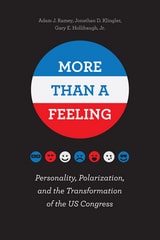
More Than a Feeling
Personality, Polarization, and the Transformation of the US CongressAdam J. Ramey, Jonathan D. Klingler, and Gary E. Hollibaugh Jr.
University of Chicago Press, 2017
With More Than a Feeling, Adam J. Ramey, Jonathan D. Klingler, and Gary E. Hollibaugh, Jr. have developed an innovative framework incorporating what are known as the Big Five dimensions of personality—openness to experience, conscientiousness, extraversion, agreeableness, and neuroticism—to improve our understanding of political behavior among members of Congress. To determine how strongly individuals display these traits, the authors identified correlates across a wealth of data, including speeches, campaign contributions and expenditures, committee involvement, willingness to filibuster, and even Twitter feeds. They then show how we might expect to see the influence of these traits across all aspects of Congress members’ political behavior—from the type and quantity of legislation they sponsor and their style of communication to whether they decide to run again or seek a higher office. They also argue convincingly that the types of personalities that have come to dominate Capitol Hill in recent years may be contributing to a lot of the gridlock and frustration plaguing the American political system.
Movements in Times of Democratic Transition
Bert Klandermans
Temple University Press, 2015
The editors and contributors to Movements in Times of Democratic Transition examine in comparative detail how social movements act within the context of the democratic transitions they have been fighting for, and how they are affected by the changes they helped bring about. Offering insights into the nature of how social movements decline, radicalize, revitalize, or spark new cycles of activism, Movements in Times of Democratic Transition provides a comprehensive analysis of these key questions of mobilization research.
Contributors include: Paul Almeida, Christopher J. Colvin, Stephen Ellis, Grzegorz Ekiert, Grzegorz Forys, Krzysztof Gorlach, Camila Penna, Sebastián Pereyra, Steven Robbins, Ton Salman, Mate Szabo, Ineke van Kessel, Michal Wenzel, and the editors.
Moving Against the System
The 1968 Congress of Black Writers and the Shaping of Global Black ConsciousnessEdited by David Austin
Pluto Press, 2018
Against a backdrop of widespread racism in the West and ongoing colonialism and imperialism in the Global South, this group of activists, writers, and political figures gathered to discuss the history and struggles of people of African descent and the meaning of black power.
For the first time since 1968, David Austin brings alive the speeches and debates of the most important international gathering of black radicals of the era. With never-before-seen texts from Stokely Carmichael, Walter Rodney and C.L.R. James, these documents will prove invaluable to anyone interested in black radical thought and political activism of the 1960s.
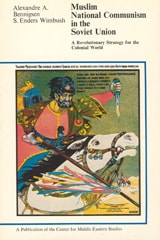
Muslim National Communism in the Soviet Union
A Revolutionary Strategy for the Colonial WorldAlexandre A. Bennigsen and S. Enders Wimbush
University of Chicago Press, 1978
The authors show that the ideas of Muslim national communism persist in the land of their birth and have spread to such developing societies as China, Algeria, and Indonesia. This doctrine is an important factor in the ideological split and increasing tensions between industrial and nonindustrial nations, East and West, and now North and South, which grip the world communist movement.

Muslims in a Post-9/11 America
A Survey of Attitudes and Beliefs and Their Implications for U.S. National Security PolicyRachel M. Gillum
University of Michigan Press, 2018
Muslims in a Post-9/11 America examines how public fears about Muslims in the United States compare with the reality of American Muslims’ attitudes on a range of relevant issues. While most research on Muslim Americans focuses on Arab Muslims, a quarter of the Muslim American population, Rachel Gillum includes perspectives of Muslims from various ethnic and national communities—from African Americans to those of Pakistani, Iranian, or Eastern European descent. Using interviews and one of the largest nationwide surveys of Muslim Americans to date, Gillum examines more than three generations of Muslim American immigrants to assess how segments of the Muslim American community are integrating into the U.S. social fabric, and how they respond to post-9/11 policy changes. Gillum’s findings challenge perceptions of Muslims as a homogeneous, isolated, un-American, and potentially violent segment of the U.S. population.
Despite these realities, negative political rhetoric around Muslim Americans persists. The findings suggest that the policies designed to keep America safe from terrorist attacks may have eroded one of law enforcement’s greatest assets in the fight against violent extremism—a relationship of trust and goodwill between the Muslim American community and the U.S. government. Gillum argues for policies and law enforcement tactics that will bring nuanced understandings of this diverse category of Americans and build trust, rather than alienate Muslim communities.