355 books match the query 'Political and social views' and 11 start with m
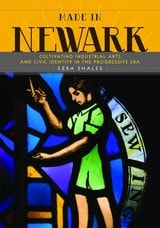
cover of Made in Newark: Cultivating Industrial Arts and Civic Identity in the Progressive Era

Made in Newark

Cultivating Industrial Arts and Civic Identity in the Progressive Era

Shales, Ezra

Rutgers University Press, 2010

What does it mean to turn the public library or museum into a civic forum? Made in Newark describes a turbulent industrial city at the dawn of the twentieth century and the ways it inspired the library's outspoken director, John Cotton Dana, to collaborate with industrialists, social workers, educators, and New Women.

This is the story of experimental exhibitions in the library and the founding of the Newark Museum Associationùa project in which cultural literacy was intertwined with civics and consumption. Local artisans demonstrated crafts, connecting the cultural institution to the department store, school, and factory, all of which invoked the ideal of municipal patriotism. Today, as cultural institutions reappraise their relevance, Made in Newark explores precedents for contemporary debates over the ways the library and museum engage communities, define heritage in a multicultural era, and add value to the economy.
[more]
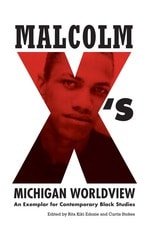
cover of Malcolm X's Michigan Worldview: An Exemplar for Contemporary Black Studies

Malcolm X's Michigan Worldview

An Exemplar for Contemporary Black Studies

Rita Kiki Edozie

Michigan State University Press, 2024
The provocative debate about Malcolm X’s legacy that emerged after the publication of Manning Marable’s 2011 biography raised critical questions about the revolutionary Black Nationalist’s importance to American and world affairs: What was Malcolm’s association with the Nation of Islam? How should we interpret Malcolm’s discourses? Was Malcolm antifeminist? What is Malcolm’s legacy in contemporary public affairs? How do Malcolm’s early childhood experiences in Michigan shape and inform his worldview? Was Malcolm trending toward socialism during his final year? Malcolm X’s Michigan Worldview responds to these questions by presenting Malcolm’s subject as an iconography used to deepen understanding of African descendent peoples’ experiences through advanced research and disciplinary study. A Black studies reader that uses the biography of Malcolm X both to interrogate key aspects of the Black world experience and to contribute to the intellectual expansion of the discipline, the book presents Malcolm as a Black subject who represents, symbolizes, and associates meaning with the Black/Africana studies discipline. Through a range of multidisciplinary prisms and themes including discourse, race, culture, religion, gender, politics, and community, this rich volume elicits insights about the Malcolm iconography that contribute to the continuous formulation, deepening, and strengthening of the Black studies discipline.
[more]
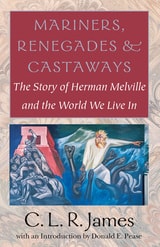
cover of Mariners, Renegades and Castaways: The Story of Herman Melville and the World We Live In

Mariners, Renegades and Castaways

The Story of Herman Melville and the World We Live In

C. L. R. James

Dartmouth College Press, 2001
Political theorist and cultural critic, novelist and cricket enthusiast, C. L. R. James (1901 - 1989) was a brilliant polymath who has been described by Edward Said as "a centrally important 20th-century figure." Through such landmark works as The Black Jacobins, Beyond a Boundary, and American Civilization, James's thought continues to influence and inspire scholars in a wide variety of fields. "There is little doubt," wrote novelist Caryl Phillips in The New Republic, "that James will come to be regarded as the outstanding Caribbean mind of the twentieth century." In his seminal work of literary and cultural criticism, Mariners, Renegades and Castaways, James anticipated many of the concerns and ideas that have shaped the contemporary fields of American and Postcolonial Studies, yet this widely influential book has been unavailable in its complete form since its original publication in 1953. A provocative study of Moby Dick in which James challenged the prevailing Americanist interpretation that opposed a "totalitarian" Ahab and a "democratic, American" Ishmael, he offered instead a vision of a factory-like Pequod whose "captain of industry" leads the "mariners, renegades and castaways" of its crew to their doom. In addition to demonstrating how such an interpretation supported the emerging US national security state, James also related the narrative of Moby Dick, and its resonance in American literary and political culture, to his own persecuted position at the height (or the depth) of the Truman/McCarthy era. It is precisely this personal, deeply original material that was excised from the only subsequent edition. With a new introduction by Donald E. Pease that places the work in its critical and cultural context, Mariners, Renegades and Castaways is once again available in its complete form.
[more]
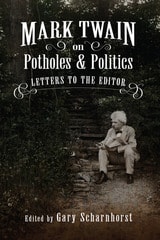
cover of Mark Twain on Potholes and Politics: Letters to the Editor

Mark Twain on Potholes and Politics

Letters to the Editor

Edited by Gary Scharnhorst

University of Missouri Press, 2014

Whether he was taking us along for a journey down the Mississippi with a couple of runaways or delivering speeches on the importance of careful lying, Mark Twain had an innate ability to captivate readers and listeners alike with his trademark humor and sarcasm. Twain never lacked for material, either, as his strong opinions regarding most issues gave him countless opportunities to articulate his thoughts in the voice that only he could provide.

A frequent outlet for Twain’s wit was in letters to the editors of various newspapers and periodicals. Sharing his thoughts and opinions on topical issues ranging from national affairs to local social events, with swipes along the way at woman suffrage, potholes, literary piracy and other scams, slow mail delivery, police corruption, capital punishment, and the removal of Huck Finn from libraries, Twain never hesitated to speak his mind. And now thanks to Gary Scharnhorst, more than a hundred of these letters are available in one place for us to enjoy.

From his opinions on the execution of an intellectually brilliant murderer, to his scathing review of a bureau he perceived as “a pack of idiots” running on a currency of doughnuts, Twain’s pure, unbridled voice is evident throughout his letters. Mark Twain on Potholes and Politicsgives readers a chance to delve further than ever before into the musings of the most recognizable voice in American literature.
[more]
cover of Mark Twain's Pudd'nhead Wilson: Race, Conflict and Culture

Mark Twain's Pudd'nhead Wilson

Race, Conflict and Culture

Susan Gillman and Forrest Robinson, eds.

Duke University Press, 1990

This collection seeks to place Pudd’nhead Wilson—a neglected, textually fragmented work of Mark Twain’s—in the context of contemporary critical approaches to literary studies. The editors’ introduction argues the virtues of using Pudd’nhead Wilson as a teaching text, a case study in many of the issues presently occupying literary criticism: issues of history and the uses of history, of canon formation, of textual problematics, and finally of race, class, and gender.

In a variety of ways the essays build arguments out of, not in spite of, the anomalies, inconsistencies, and dead ends in the text itself. Such wrinkles and gaps, the authors find, are the symptoms of an inconclusive, even evasive, but culturally illuminating struggle to confront and resolve difficult questions bearing on race and sex. Such fresh, intellectually enriching perspectives on the novel arise directly from the broad-based interdisciplinary foundations provided by the participating scholars. Drawing on a wide variety of critical methodologies, the essays place the novel in ways that illuminate the world in which it was produced and that further promise to stimulate further study.

Contributors. Michael Cowan, James M. Cox, Susan Gillman, Myra Jehlen, Wilson Carey McWilliams, George E. Marcus, Carolyn Porter, Forrest Robinson, Michael Rogin, John Carlos Rowe, John Schaar, Eric Sundquist
[more]
cover of Marx at the Margins: On Nationalism, Ethnicity, and Non-Western Societies

Marx at the Margins

On Nationalism, Ethnicity, and Non-Western Societies

Kevin B. Anderson

University of Chicago Press, 2010

In Marx at the Margins, Kevin Anderson uncovers a variety of extensive but neglected texts by the well-known political economist which cast what we thought we knew about his work in a startlingly different light. Analyzing a variety of Marx’s writings, including journalistic work written for the New York Tribune, Anderson presents us with a Marx quite at odds with our conventional interpretations. Rather than providing us with an account of Marx as an exclusively class-based thinker, Anderson here offers a portrait of Marx for the twenty-first century: a global theorist whose social critique was sensitive to the varieties of human social and historical development, including not just class, but nationalism, race, and ethnicity, as well.

Marx at the Margins ultimately argues that alongside his overarching critique of capital, Marx created a theory of history that was multi-layered and not easily reduced to a single model of development or revolution. Through highly-informed readings on work ranging from Marx’s unpublished 1879–82 notebooks to his passionate writings about the antislavery cause in the United States, this volume delivers a groundbreaking and canon-changing vision of Karl Marx that is sure to provoke lively debate in Marxist scholarship and beyond.
[more]
cover of Marx at the Margins: On Nationalism, Ethnicity, and Non-Western Societies

Marx at the Margins

On Nationalism, Ethnicity, and Non-Western Societies

Kevin B. Anderson

University of Chicago Press, 2016
In Marx at the Margins, Kevin Anderson uncovers a variety of extensive but neglected texts by Marx that cast what we thought we knew about his work in a startlingly different light. Analyzing a variety of Marx’s writings, including journalistic work written for the New York Tribune, Anderson presents us with a Marx quite at odds with conventional interpretations. Rather than providing us with an account of Marx as an exclusively class-based thinker, Anderson here offers a portrait of Marx for the twenty-first century: a global theorist whose social critique was sensitive to the varieties of human social and historical development, including not just class, but nationalism, race, and ethnicity, as well. Through highly informed readings of work ranging from Marx’s unpublished 1879–82 notebooks to his passionate writings about the antislavery cause in the United States, this volume delivers a groundbreaking and canon-changing vision of Karl Marx that is sure to provoke lively debate in Marxist scholarship and beyond. For this expanded edition, Anderson has written a new preface that discusses the additional 1879–82 notebook material, as well as the influence of the Russian-American philosopher Raya Dunayevskaya on his thinking.
[more]
cover of Money and Modernity: Pound, Williams, and the Spirit of Jefferson

Money and Modernity

Pound, Williams, and the Spirit of Jefferson

Alec Marsh

University of Alabama Press, 1998
Marsh locates Pound and Williams firmly in the Jeffersonian tradition and examines their epic poems as manifestations of a Jeffersonian ideology in modernist terms.

The modernist poets William Carlos Williams and Ezra Pound were latter-day Jeffersonians whose politics and poetry were strongly marked by the populism of the late 19th century. They were sharply aware of the social contradictions of modernization and were committed to a highly politicized, often polemical poetry that criticized finance capitalism and its institutions--notably banks--in the strongest terms.

Providing a history of the aesthetics of Jeffersonianism and its collision with modernism in the works of Pound and Williams, Alec Marsh traces "the money question" from the republican period through the 1940s. Marsh can thus read two modernist epics--Pound's Cantos and Williams's Paterson--as the poets hoped they would be read, as attempts to break the hold of "false" financial values on the American imagination.

Marsh argues that Pound's and Williams's similar Jeffersonian outlooks were the direct result of the political battles of the 1890s concerning the meaning of money. Although Pound's interest in money and economics is well known, few people are aware that both poets were active in the Social Credit monetary-reform movement of the 1930s and 1940s, a movement shown by Marsh to have direct links to Jeffersonianism via American populism.  Ultimately, the two poets took divergent paths, with Pound swerving toward Italian fascism (as exemplified in his Jefferson and/or Mussolini) and Williams becoming deeply influenced by the American pragmatism of John Dewey. Thus, Marsh concludes, Pound embraced the fascist version of state-capitalism whereas his old friend proclaimed a pragmatic openness to the new selves engendered by corporate capitalism.

Money and Modernity exemplifies the best of recent literary criticism in its incorporation of American studies and cultural studies approaches to bring new insight to modern masterworks.
[more]
cover of Montaigne and the Origins of Modern Philosophy

Montaigne and the Origins of Modern Philosophy

Ann Hartle

Northwestern University Press, 2013

Montaigne’s Essays are rightfully studied as giving birth to the literary form of that name. Ann Hartle’s Montaigne and the Origins of Modern Philosophy argues that the essay is actually the perfect expression of Montaigne as what he called "a new figure: an unpremeditated and accidental philosopher." Unpremeditated philosophy is philosophy made sociable—brought down from the heavens to the street, where it might be engaged in by a wider audience. In the same philosophical act, Montaigne both transforms philosophy and invents "society," a distinctly modern form of association. Through this transformation, a new, modern character emerges: the individual, who is neither master nor slave and who possesses the new virtues of integrity and generosity. In Montaigne’s radically new philosophical project, Hartle finds intimations of both modern epistemology and modern political philosophy.
[more]
cover of Moving from the Margins: A Chicana Voice on Public Policy

Moving from the Margins

A Chicana Voice on Public Policy

Adela de la Torre

University of Arizona Press, 2002

Immigration reform. Bilingual education. Affirmative action. Such issues trigger knee-jerk reactions from many people, and in California those reactions are likely to fall along strict ethnic lines. A white majority has long called the shots in voter initiatives, but with Mexican Americans becoming the majority population in southern California, their views on these matters can no longer be ignored. In Moving from the Margins, an outspoken member of the Mexican American community explores issues that have molded politics over the past decade in a state where division seems more common than unity.

Addressing immigration, education, health care, and economic and political concerns, Adela de la Torre provides a distinctly Chicana perspective that often differs from that of mainstream readers and voters. Drawn from the author's syndicated column in the Los Angeles Times along with writings from other publications, Moving from the Margins includes incisive and often provocative commentaries that provide insights into the roots of ethnic tensions in the Golden State.

The book also includes readers' reactions to the articles, creating a dialogue of ideas while confronting fears of what many Americans view as an alien culture. Whether addressing entitlements granted to noncitizens, the future of public schools, or access to health care, de la Torre challenges readers to move beyond their own frame of reference and consider new points of view. The issues she faces have shaped today's California—and they also lie at the heart of urban public policy in America for the twenty-first century.
[more]
cover of My Brother's Keeper: George McGovern and Progressive Christianity

My Brother's Keeper

George McGovern and Progressive Christianity

Mark A. Lempke

University of Massachusetts Press, 2017

George McGovern is chiefly remembered for his landslide loss to Richard Nixon in 1972. Yet at the time, his candidacy raised eyebrows by invoking the prophetic tradition, an element of his legacy that is little studied. In My Brother's Keeper, Mark A. Lempke explores the influence of McGovern's evangelical childhood, Social Gospel worldview, and conscientious Methodism on a campaign that brought antiwar activism into the mainstream.

McGovern's candidacy signified a passing of the torch within Christian social justice. He initially allied with the ecumenical movement and the mainline Protestant churches during a time when these institutions worked easily with liberal statesmen. But the senator also galvanized a dynamic movement of evangelicals rooted in the New Left, who would dominate subsequent progressive religious activism as the mainline entered a period of decline. My Brother's Keeper argues for the influential, and often unwitting, role McGovern played in fomenting a “Religious Left” in 1970s America, a movement that continues to this day. It joins a growing body of scholarship that complicates the dominant narrative of that era's conservative Christianity.

[more]