Results by title
57 books match the query 'Portugal' and 6 start with m
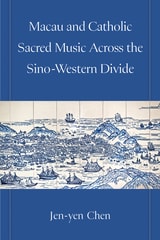
Macau and Catholic Sacred Music Across the Sino-Western Divide
Jen-yen Chen
University of Michigan Press, 2026
Drawing from sound studies and musicological methods, Chen argues that Chinese descriptions of Catholic sounds in Macau, including the ringing of church bells, the playing of the organ, and choral singing, illuminate spatial, sonic, and ideological mobilities that reconfigure Chinese and European identities. Macau and Catholic Music Across the Sino-Western Divide also extends to contemporary times to explore how present day members of Macau’s Catholic community position themselves in relation to the historical narratives often told about their city, cultivating a rich individuality of identity that refuses conformity to fixed notions of Asianness or Westernness.
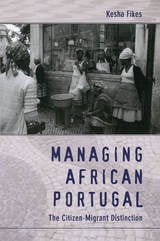
Managing African Portugal
The Citizen-Migrant DistinctionKesha Fikes
Duke University Press, 2009
The ethnographic focus is a former undocumented fish market that at one time employed both Portuguese and Cape Verdean women. Both groups eventually sought work in low-wage professions as maids, nannies, and restaurant-kitchen help. The visibility of poor Portuguese women as domestics was thought to undermine the appearance of Portuguese modernity; by contrast, the association of poor African women with domestic work confirmed it. Fikes argues that we can better understand how Portugal interpreted its economic absorption into the EU by attending to the different directions in which working-poor Portuguese and Cape Verdean women were routed in the mid-1990s and by observing the character of the new work relationships that developed among them. In Managing African Portugal, Fikes pushes for a study of migrant phenomena that considers not only how the enactment of citizenship by the citizen manages the migrant, but also how citizens are simultaneously governed through their uptake and assumption of new EU citizen roles.
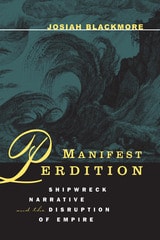
Manifest Perdition
Shipwreck Narrative And The Disruption Of EmpireJosiah Blackmore
University of Minnesota Press, 2002
A new take on a famous collection of shipwreck narratives that places them at the center of resistance to colonialism
Shipwreck, death, and survival; terror, hunger, and salvation—these are the experiences of the passengers onboard merchant Portuguese ships sailing the high seas in the sixteenth and seventeenth centuries. And this is the stuff of the stories committed to print by survivors upon their return to the homeland. These Portuguese shipwreck narratives, rescued for all time in the eighteenth century by Bernardo Gomes de Brito in História Trágico-Marítima (1735-36), or The Tragic History of the Sea, are the subject of Manifest Perdition, a work that reveals their important—and until now, largely ignored—place in literary history.
In this book we see how the dramatic, compelling, and often gory accounts of shipwreck, depicting a world out of control, challenge state-sponsored versions of events in the prevailing historiographic culture. Written during the heyday of Iberian maritime expansion and colonialism, the shipwreck narrative builds an alternative historical record to the vision and reality of empire elaborated by the official chroniclers of the realm. Manifest Perdition presents both theoretical considerations this genre and close readings of several texts, readings that disclose a poetics of the shipwreck text, of how survivors characteristically yet multifariously narrated their world. Included is a study of the medieval Iberian poetic predecessors of the shipwreck tale, as well as an exploration of the Portuguese Inquisition’s attempt to commandeer and steer the reading of the unruly narratives. The book engages issues of literary theory, historiography, and colonialism to portray the Portuguese shipwreck narrative for the first time as both a product of and a resistance to the prolific culture of sixteenth- and seventeenth-century expansionist history.
Migration, Mill Work, and Portuguese Communities in New England
Edited by Cristiana Bastos, Bela Feldman-Bianco, and Miguel Moniz
Tagus Press, 2024
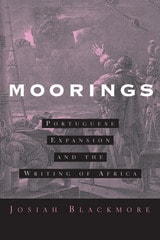
Moorings
Portuguese Expansion and the Writing of AfricaJosiah Blackmore
University of Minnesota Press, 2008
How Africa was perceived in the early modern imaginary
In this first book to study Portuguese texts about Africa, Moorings brings an important but little-known body of European writings to bear on contemporary colonial thought. Images of Africa as monstrous, dangerous, and lush were created in early Portuguese imperial writings and dominated its representation in European literature. Moorings establishes these key works in their proper place: foundational to Western imperial discourse.
Attentive to history as well as the nuances of language, Josiah Blackmore leads readers from the formation of the “Moor” in medieval Iberia to the construction of a full colonial imaginary, as found in the works of two writers: the royal chronicler Gomes Eanes de Zurara and the epic poet Luís de Camões. Blackmore’s original work helps to explain how concepts and myths—such as the “otherness” of Africa and Africans—originated, functioned, and were perpetuated.Delving into the Portuguese imperial experience, Moorings enriches our understanding of historical and literary imagination during a significant period of Western expansion.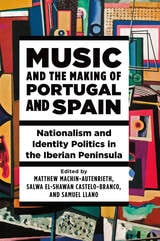
Music and the Making of Portugal and Spain
Nationalism and Identity Politics in the Iberian PeninsulaEdited by Matthew Machin-Autenrieth, Salwa el-Shawan Castelo-Branco, and Samuel Llano
University of Illinois Press, 2023
What does music in Portugal and Spain reveal about the relationship between national and regional identity building? How do various actors use music to advance nationalism? How have state and international heritage regimes contributed to nationalist and regionalist projects? In this collection, contributors explore these and other essential questions from a range of interdisciplinary vantage points. The essays pay particular attention to the role played by the state in deciding what music represents Portuguese or Spanish identity. Case studies examine many aspects of the issue, including local recording networks, so-called national style in popular music, and music’s role in both political protest and heritage regimes. Topics include the ways the Salazar and Franco regimes adapted music to align with their ideological agendas; the twenty-first-century impact of UNESCO’s Intangible Cultural Heritage program on some of Portugal and Spain's expressive practices; and the tensions that arise between institutions and community in creating and recreating meanings and identity around music.
Contributors: Ricardo Andrade, Vera Marques Alves, Salwa El-Shawan Castelo-Branco, Cristina Sánchez-Carretero, José Hugo Pires Castro, Paulo Ferreira de Castro, Fernán del Val, Héctor Fouce, Diego García-Peinazo, Leonor Losa, Josep Martí, Eva Moreda Rodríguez, Pedro Russo Moreira, Cristina Cruces Roldán, and Igor Contreras Zubillaga