Results by title
74 books match the query 'Psychopathology' and 4 start with m

Melancholy, Love, and Time
Boundaries of the Self in Ancient LiteraturePeter Toohey
University of Michigan Press, 2004
Ancient literature features many powerful narratives of madness, depression, melancholy, lovesickness, simple boredom, and the effects of such psychological states upon individual sufferers. Peter Toohey turns his attention to representations of these emotional states in the Classical, Hellenistic, and especially the Roman imperial periods in a study that illuminates the cultural and aesthetic significance of this emotionally charged literature. His probing analysis shows that a shifting representation of these afflicted states, and the concomitant sense of isolation from one's social affinities and surroundings, manifests a developing sense of the self and self-consciousness in the ancient world.
This book makes important contributions to a variety of disciplines including classical studies, comparative literature, literary and art history, history of medicine, history of emotions, psychiatry, and psychology.
Peter Toohey is Professor and Department Head of Greek and Roman Studies at the University of Calgary, Canada.
[more]

Mental Traveler
A Father, a Son, and a Journey through SchizophreniaW. J. T. Mitchell
University of Chicago Press, 2020
How does a parent make sense of a child’s severe mental illness? How does a father meet the daily challenges of caring for his gifted but delusional son, while seeking to overcome the stigma of madness and the limits of psychiatry? W. J. T. Mitchell’s memoir tells the story—at once representative and unique—of one family’s encounter with mental illness and bears witness to the life of the talented young man who was his son.
Gabriel Mitchell was diagnosed with schizophrenia at age twenty-one and died by suicide eighteen years later. He left behind a remarkable archive of creative work and a father determined to honor his son’s attempts to conquer his own illness. Before his death, Gabe had been working on a film that would show madness from inside and out, as media stereotype and spectacle, symptom and stigma, malady and minority status, disability and gateway to insight. He was convinced that madness is an extreme form of subjective experience that we all endure at some point in our lives, whether in moments of ecstasy or melancholy, or in the enduring trauma of a broken heart. Gabe’s declared ambition was to transform schizophrenia from a death sentence to a learning experience, and madness from a curse to a critical perspective.
Shot through with love and pain, Mental Traveler shows how Gabe drew his father into his quest for enlightenment within madness. It is a book that will touch anyone struggling to cope with mental illness, and especially for parents and caregivers of those caught in its grasp.
[more]
Mmpi-A Content Scales
Assessing Psychopathology in AdolescentsCarolyn L. Williams
University of Minnesota Press, 1992
[more]
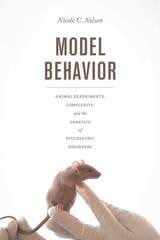
Model Behavior
Animal Experiments, Complexity, and the Genetics of Psychiatric DisordersNicole C. Nelson
University of Chicago Press, 2018
Mice are used as model organisms across a wide range of fields in science today—but it is far from obvious how studying a mouse in a maze can help us understand human problems like alcoholism or anxiety. How do scientists convince funders, fellow scientists, the general public, and even themselves that animal experiments are a good way of producing knowledge about the genetics of human behavior? In Model Behavior, Nicole C. Nelson takes us inside an animal behavior genetics laboratory to examine how scientists create and manage the foundational knowledge of their field.
Behavior genetics is a particularly challenging field for making a clear-cut case that mouse experiments work, because researchers believe that both the phenomena they are studying and the animal models they are using are complex. These assumptions of complexity change the nature of what laboratory work produces. Whereas historical and ethnographic studies traditionally portray the laboratory as a place where scientists control, simplify, and stabilize nature in the service of producing durable facts, the laboratory that emerges from Nelson’s extensive interviews and fieldwork is a place where stable findings are always just out of reach. The ongoing work of managing precarious experimental systems means that researchers learn as much—if not more—about the impact of the environment on behavior as they do about genetics. Model Behavior offers a compelling portrait of life in a twenty-first-century laboratory, where partial, provisional answers to complex scientific questions are increasingly the norm.
Behavior genetics is a particularly challenging field for making a clear-cut case that mouse experiments work, because researchers believe that both the phenomena they are studying and the animal models they are using are complex. These assumptions of complexity change the nature of what laboratory work produces. Whereas historical and ethnographic studies traditionally portray the laboratory as a place where scientists control, simplify, and stabilize nature in the service of producing durable facts, the laboratory that emerges from Nelson’s extensive interviews and fieldwork is a place where stable findings are always just out of reach. The ongoing work of managing precarious experimental systems means that researchers learn as much—if not more—about the impact of the environment on behavior as they do about genetics. Model Behavior offers a compelling portrait of life in a twenty-first-century laboratory, where partial, provisional answers to complex scientific questions are increasingly the norm.
[more]