Results by title
52 books match the query 'Idea' and 2 start with a
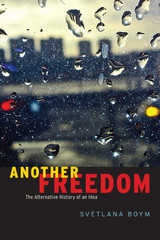
Another Freedom
The Alternative History of an IdeaSvetlana Boym
University of Chicago Press, 2010
The word “freedom” is so overly used—and frequently abused—that it is always in danger of becoming nothing but a cliché. In Another Freedom, Svetlana Boym offers us a refreshing new portrait of the age-old concept. Exploring the rich cross-cultural history of the idea of freedom, from its origins in ancient Greece to the present day, she argues that our attempts to imagine freedom should occupy the space of not only “what is” but also “what if.” Beginning with notions of sacrifice and the emergence of a public sphere for politics and art, Boym expands her account to include the relationships between freedom and liberation, modernity and terror, and political dissent and creative estrangement. While depicting a world of differences, she affirms lasting solidarities based on the commitment to the passionate thinking that reflections on freedom require. To do so, Boym assembles a remarkable cast of characters: Aeschylus and Euripides, Kafka and Mandelstam, Arendt and Heidegger, and a virtual encounter between Dostoevsky and Marx on the streets of Paris.
By offering a fresh look at the strange history of this idea, Another Freedom delivers a nuanced portrait of freedom, one whose repercussions will be felt well into the future.
By offering a fresh look at the strange history of this idea, Another Freedom delivers a nuanced portrait of freedom, one whose repercussions will be felt well into the future.
[more]
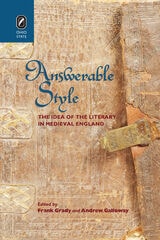
Answerable Style
The Idea of the Literary in Medieval EnglandFrank Grady and Andrew Galloway
The Ohio State University Press, 2013
Renewed interest in aesthetics, in form, and the idea of the literary has led some scholars to announce the arrival of a “new formalism,” but the provisional histories of such a critical rebirth tend to begin well after the beginning, paying scant attention to medieval literary scholarship, much less the Middle Ages. The essays in Answerable Style: The Idea of the Literary in Medieval England offer a collective rebuke to the assumption that any such aesthetic turn can succeed without careful attention to the history and criticism of “the medieval literary.”
Taking as their touchstone the influential work of Anne Middleton, whose searching explorations of the dialectical intersection of form and history in Middle English writing lie at the heart of the medievalist’s literary critical enterprise, the essays in this volume address the medieval idea of the literary, with special focus on the poetry of Chaucer, Langland, and Gower. The essays, by a notable array of medievalists, range from the “contact zones” between clerical culture and vernacular writing, to manuscript study and its effects on the modalities of “persona” and voicing, to the history of emotion as a basis for new literary ideals, to the reshapings of the genre of tragedy in response to late-medieval visions of history, and finally to the relations between poets writing in different medieval vernaculars. With this unusually broad yet thematically complementary set of essays, Answerable Style offers a set of key critical and historical reference points for questions currently preoccupying literary study.
[more]