Results by title
54 books match the query 'Reader' and 3 start with m

Mediterranean Security at the Crossroads
A ReaderNikolaos A. Stavrou, ed.
Duke University Press, 1999
The Mediterranean is a diverse and volatile region, especially in its post—Cold War state, and it is entering a new phase of uncertainty. Twenty-two sovereign states surround this body of water: six are part of the Western alliance system, three have engaged in or supported terrorism, and others face serious internal tensions arising from territorial claims and ethnic strife. An expansion of a previous issue of Mediterranean Quarterly, this book brings together a distinguished array of diplomats, politicians, scholars, and policymakers representing twelve countries and a variety of interests and ideas to discuss this unique region and to explore its prospects for peace and stability.
New essays in this expanded volume include a reflection by former President Jimmy Carter on the causes of war and their links to human suffering, a prophetic analysis of the post-Cold War environment in the Mediterranean by former U.N. Secretary General Boutros-Boutros Ghali, an essay on the strategic significance of Turkey in the eastern Mediterranean by the former Turkish ambassador to the United States, and, in light of recent events in Kosovo and elsewhere in the former Yugoslavia, a piece on the issue of Balkan security by the editor. Introducing the volume is a foreword by former U.S. Secretary of State George P. Schultz and an essay focusing on NATO in the Mediterranean by Javier Solana, the Secretary General of NATO. Central to the Mediterranean debate is the question of NATO’s role in its future. Some contributors suggest that the southward expansion of NATO could be an important first step toward stability, while others argue that the Mediterranean should be treated as an integrated geostrategic region, with a central place in Western security considerations. Other essays discuss the comparative experience of UNPROFOR and IFOR in the former Yugoslavia; the role of Italy in the future of the Mediterranean; the economic challenges facing the Middle East; and the role of Israel and its relationship to its neighbors.
Mediterranean Security at the Crossroads is one of the first in-depth looks at this region from a strictly post-Cold War perspective.
Contributors. Hanan Bar-On, Ted Galen Carpenter, Jimmy Carter, Charles G. Cogan, Gregorios Demestichas, Boutros-Boutros Ghali, Carlo Jean, Nuzhet Kandemir, Nicolai A. Kovalsky, William H. Lewis, Peter H. Liotta, John A. MacInnis, Phebe Marr, Matthew Nimetz, George P. Schultz, Javier Solana, Richard F. Staar, Nikolaos A. Stavrou, George Vella, W. Bruce Weinrod
[more]
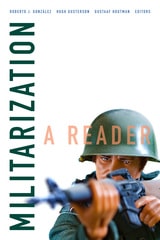
Militarization
A ReaderRoberto J. González, Hugh Gusterson, and Gustaaf Houtman, editors
Duke University Press, 2019
Militarization: A Reader offers a range of critical perspectives on the dynamics of militarization as a social, economic, political, cultural, and environmental phenomenon. It portrays militarism as the condition in which military values and frameworks come to dominate state structures and public culture both in foreign relations and in the domestic sphere. Featuring short, readable essays by anthropologists, historians, political scientists, cultural theorists, and media commentators, the Reader probes militarism's ideologies, including those that valorize warriors, armed conflict, and weaponry. Outlining contemporary militarization processes at work around the world, the Reader offers a wide-ranging examination of a phenomenon that touches the lives of billions of people.
In collaboration with Catherine Besteman, Andrew Bickford, Catherine Lutz, Katherine T. McCaffrey, Austin Miller, David H. Price, David Vine
In collaboration with Catherine Besteman, Andrew Bickford, Catherine Lutz, Katherine T. McCaffrey, Austin Miller, David H. Price, David Vine
[more]
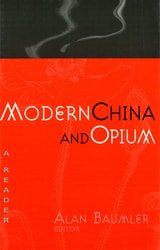
Modern China and Opium
A ReaderAlan Baumler, Editor
University of Michigan Press, 2001
The Chinese struggle to create a modern nation was tied closely to the opium trade. Throughout much of the nineteenth and early twentieth centuries, China's economy, politics, and society were steeped in opium and opium money. All of China's modern governments took the crusade to liberate the nation from this "plague" as one of their essential tasks. However, the opium problem proved to be more complex than many had imagined. There was much disagreement over both the nature of the problem and the solution. Was opium a relatively harmless substance--only a danger to the weak-willed--or a poison that would inevitably destroy the nation? How could the state control this slippery substance and the people who used it? These were more than abstract questions, as all Chinese states profited from the opium trade and most Chinese either used the substance or knew people who did. By presenting a selection of original source readings from the Qing dynasty, the Republic, and the Communist government, this book makes comprehensible the many debates among Chinese involving opium in the modern period. The readings are drawn from a variety of sources including memoirs, diplomatic reports, and journals. It will be of particular interest to students of modern China. Alan Baumler is Assistant Professor of History, Indiana University of Pennsylvania.
[more]