Results by title
76 books match the query 'Representation' and 5 start with m
Making Constituencies
Representation as Mobilization in Mass DemocracyLisa Jane Disch
University of Chicago Press, 2021
Since the turn of the twenty-first century, the idea of a divided United States has become commonplace. In the wake of the 2020 election, some commentators warned that the American public was the most divided it has been since the Civil War. Political scientists, political theorists, and public intellectuals have suggested that uninformed, misinformed, and disinformed voters are at the root of this division. Some are simply unwilling to accept facts or science, which makes them easy targets for elite manipulation. It also creates a grass-roots political culture that discourages cross-partisan collaboration in Washington.
Yet, manipulation of voters is not as grave a threat to democracy in America as many scholars and pundits make it out to be. The greater threat comes from a picture that partisans use to rally their supporters: that of an America sorted into opposing camps so deeply rooted that they cannot be shaken loose and remade. Making Constituencies proposes a new theory of representation as mobilization to argue that divisions like these are not inherent in society, but created, and political representatives of all kinds forge and deploy them to cultivate constituencies.
Maya Intellectual Renaissance
Identity, Representation, and LeadershipBy Victor D. Montejo
University of Texas Press, 2005
When Mayan leaders protested the celebration of the Quincentenary of the "discovery" of America and joined with other indigenous groups in the Americas to proclaim an alternate celebration of 500 years of resistance, they rose to national prominence in Guatemala. This was possible in part because of the cultural, political, economic, and religious revitalization that occurred in Mayan communities in the later half of the twentieth century. Another result of the revitalization was Mayan students' enrollment in graduate programs in order to reclaim the intellectual history of the brilliant Mayan past. Victor Montejo was one of those students.
This is the first book to be published outside of Guatemala where a Mayan writer other than Rigoberta Menchu discusses the history and problems of the country. It collects essays Montejo has written over the past ten years that address three critical issues facing Mayan peoples today: identity, representation, and Mayan leadership. Montejo is deeply invested in furthering the discussion of the effectiveness of Mayan leadership because he believes that self-evaluation is necessary for the movement to advance. He also criticizes the racist treatment that Mayans experience, and advocates for the construction of a more pluralistic Guatemala that recognizes cultural diversity and abandons assimilation. This volume maps a new political alternative for the future of the movement that promotes inter-ethnic collaboration alongside a reverence for Mayan culture.
Memory And Representation
Constructed Truths & Competing RealitiesElisabeth Dena Eber
University of Wisconsin Press, 2001
These case studies present a new and creative synthesis of the multiple meanings of memory and representation within the context of contemporary perceptions of truth.
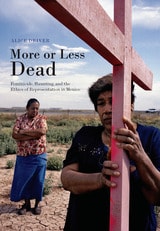
More or Less Dead
Feminicide, Haunting, and the Ethics of Representation in MexicoAlice Driver
University of Arizona Press, 2015
More or Less Dead analyzes how such violence against women has been represented in news media, books, films, photography, and art. Alice Driver argues that the various cultural reports often express anxiety or criticism about how women traverse and inhabit the geography of Ciudad Juárez and further the idea of the public female body as hypersexualized. Rather than searching for justice, the various media—art, photography, and even graffiti—often reuse victimized bodies in sensationalist, attention-grabbing ways. In order to counteract such views, local activists mark the city with graffiti and memorials that create a living memory of the violence and try to humanize the victims of these crimes.
The phrase “more or less dead” was coined by Chilean author Roberto Bolaño in his novel 2666, a penetrating fictional study of Juárez. Driver explains that victims are “more or less dead” because their bodies are never found or aren’t properly identified, leaving families with an uncertainty lasting for decades—or forever.
The author’s clear, precise journalistic style tackles the ethics of representing feminicide victims in Ciudad Juárez. Making a distinction between the words “femicide” (the murder of girls or women) and “feminicide” (murder as a gender-driven event), one of her interviewees says, “Women are killed for being women, and they are victims of masculine violence because they are women. It is a crime of hate against the female gender. These are crimes of power.”
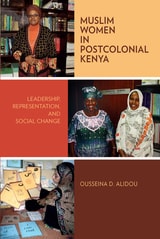
Muslim Women in Postcolonial Kenya
Leadership, Representation, and Social ChangeOusseina D. Alidou
University of Wisconsin Press, 2013