Results by title
165 books match the query 'Resistance' and 4 start with m
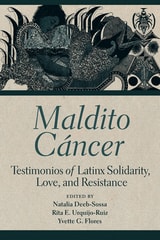
Maldito Cáncer
Testimonios of Latinx Solidarity, Love, and ResistanceNatalia Deeb-Sossa
University of Arizona Press, 2027
This poignant collection brings together powerful testimonios from Chicanx and Latinx patients, family members, caregivers, and community advocates who have faced el maldito cáncer. Authors share first-person narratives of illness, fear, love, solidarity, and resilience, illuminating how Latinx communities navigate cancer journeys within a complex and often inequitable health-care system.
The contributors—ranging from students and community members to renowned scholars and artists—offer their stories through essays, creative nonfiction, poetry, bilingual chapters, and drawings.
These testimonios honor the diverse ways Latinxs process and communicate the emotional, physical, and cultural realities of cancer. Each section is framed by a short editor introduction that highlights key themes and invites readers to reflect on the resonant insights each story brings. Across four sections—patient voices, family members, community perspectives, and closing reflections—the book reveals how individuals confront illness with courage and how families and communities create networks of care grounded in culture, love, and collective strength.
Exposing physical and emotional vulnerabilities, instances of pain, suffering, worry, and anguish, Maldito Cáncer also opens a space for healing and connection. It offers a new lens to understanding cancer through culturally informed, justice-centered narratives. These acts of testimoniando offer a gift to us: resistance, connection, and hope.
Contributors
Alfonso Aranda
Cathy Arellano
Estela Mara Bensimon
Cindy Camacho-Gutierrez
Daniela A. Carreon
Angie Chabram
Natalia Deeb-Sossa
Yvette G. Flores
Fran García Vásquez
Jennifer Gottlieb
Osa Hidalgo de la Riva
Ekta Kandhway
Skye Kelty
Jorge Antonio Losoya
Dalia Magaña
Maribel Martínez
Pedro Noguera
Lorraine Ramos
Mónica Torreiro-Casal
Rita E. Urquijo-Ruiz
Patricia Zavella
Mariupol 2013-2022
Stories of Mobilization and ResistanceHana Josticova
Central European University Press, 2024
The chapters in this book represent successive phases of one story – that of Mariupol, formerly Ukraine’s tenth largest city, and the second largest in the Donbas region. The author, a young Slovak academic, conducted her ethnographic fieldwork in this coastal town between November 2018 and August 2021. She was one of the last academics to do research in Mariupol before its invasion and eventual occupation by Russia.
During these years, Hana Jošticová was overwhelmed by acts of mobilization and resistance that went in opposite directions: support for a Western direction of Ukraine’s future, and support for the status quo that the victory of the Euromaidan seemed to threaten.
She noted the sequence of events presented in the media and through the lens of individual frames and narratives. Her book is a collection and interpretation of memories and testimonies from both sides: those who actively resisted Russian influence; and those who sparked their own revolution, the ‘Russian Spring.’ Her focus is on self-mobilized individuals who resorted to action outside of established organizational structures spontaneously, autonomously, without resources and guarantees of safety. Her evidence indicates that popular support for the Russian Spring had less to do with Russia than with the social, economic, or cultural characteristics of the Donetsk region.
Years of immersive research convinced the author that individuals are as important as masses, ideas are as powerful as material resources, and beliefs and emotions are as critical as weapons.
Memory, Meaning, and Resistance
Reflecting on Oral History and Women at the MarginsFran Leeper Buss
University of Michigan Press, 2017
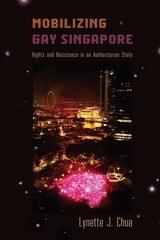
Mobilizing Gay Singapore
Rights and Resistance in an Authoritarian StateLynette J Chua
Temple University Press, 2015
For decades, Singapore's gay activists have sought equality and justice in a state where law is used to stifle basic civil and political liberties. In her groundbreaking book, Mobilizing Gay Singapore, Lynette Chua asks, what does a social movement look like in an authoritarian state? She takes an expansive view of the gay movement to examine its emergence, development, strategies, and tactics, as well as the roles of law and rights in social processes.
Chua tells this important story using in-depth interviews with gay activists, observations of the movement's activities-including "Pink Dot" events, where thousands of Singaporeans gather in annual celebrations of gay pride-movement documents, government statements, and media reports. She shows how activists deploy "pragmatic resistance" to gain visibility and support, tackle political norms that suppress dissent, and deal with police harassment, while avoiding direct confrontations with the law.
Mobilizing Gay Singapore also addresses how these brave, locally engaged citizens come out into the open as gay activists and expand and diversify their efforts in the global queer political movement.