Results by title
81 books match the query 'Revolutions, Uprisings & Rebellions' and 5 start with m
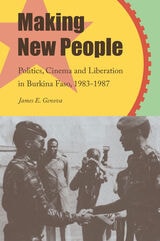
Making New People
Politics, Cinema, and Liberation in Burkina Faso, 1983–1987James Genova
Michigan State University Press, 2022
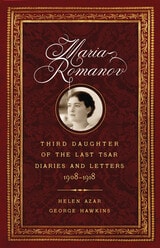
Maria Romanov
Third Daughter of the Last Tsar, Diaries and Letters, 1908–1918Helen Azar
Westholme Publishing, 2019
In the twilight of the nineteenth century, a third daughter was born to Tsar Nicholas II and his wife Alexandra. Grand Duchess Maria Nikolaevna—known to her family and friends simply as “Mashka”—grew into an empathetic, down-to-earth girl, unaffected by her imperial status. Often overshadowed by her two older sisters, Olga and Tatiana, and later, her brother Alexei and younger sister Anastasia, Maria ultimately proved to have a uniquely strong and solid personality.
In Maria Romanov: Third Daughter of the Last Tsar, Diaries and Letters, 1908–1918, by translator and researcher Helen Azar with George Hawkins, Mashka’s voice is heard again through her intimate writings, presented for the first time in English. The Grand Duchess was much more than a pretty princess wearing white dresses in hundreds of faded sepia photographs; Maria’s surviving diaries and letters offer a fascinating insight into the private life of a loving family—from festivals and faith, to Rasputin and the coming Revolution; it is clear why this middle child ultimately became a pillar of strength and hope for them all. Maria’s gentle character belied her incredible courage, which emerged in the darkest hours of her brief life. “The incarnation of modesty elevated by suffering,” as Maria was described during the last weeks of her life, she was able to maintain her kindness and optimism, even in the midst of violence and degradation.
On a stuffy summer night in 1918, only a few weeks after her nineteenth birthday, Maria was murdered along with the rest of her family in a cellar of a house chosen for this “special purpose.” Two sets of charred remains, confirmed to be Maria’s and her brother Alexei’s, were not discovered until almost ninety years later, separately from those of the other victims of the massacre. As the authors relate, it is still unknown if these remains will ever be allowed to be laid to rest.
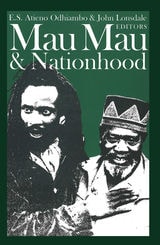
Mau Mau and Nationhood
Arms, Authority, and NarrationE. S. Atieno Odhiambo
Ohio University Press, 2003
Fifty years after the declaration of the state of emergency, Mau Mau still excites argument and controversy, not least in Kenya itself. Mau Mau and Nationhood is a collection of essays providing the most recent thinking on the uprising and its aftermath.
The work of well-established scholars as well as of young researchers with fresh perspectives, Mau Mau and Nationhood achieves a multilayered analysis of a subject of enduring interest. According to Terence Ranger, Emeritus Rhodes Professor, Oxford, “In some ways the historiography of Mau Mau is a supreme example not only of ambiguity and complexity, but also of redemption of a topic once thought incapable of rational analysis.”
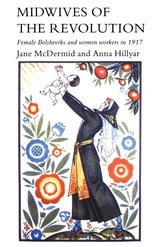
Midwives of the Revolution
Female Bolsheviks and Women Workers in 1917Jane McDermid
Ohio University Press, 1999
The Bolshevik seizure of power in 1917 and the ensuing communist regime have often been portrayed as a man’s revolution, with women as bystanders or even victims. Midwives of the Revolution examines the powerful contribution made by women to the overthrow of tsarism in 1917 and their importance in the formative years of communism in Russia.
Focusing on the masses as well as the high-ranking intelligentsia, Midwives of the Revolution is the first sustained analysis of female involvement in the revolutionary era of Russian history. The authors investigate the role of Bolshevik women and the various forms their participation took. Drawing on the experiences of representative individuals, the authors discuss the important relationship between Bolshevik women and the workers in the turbulent months of 1917.
The authors demonstrate that women were an integral part of the revolutionary process and challenge assumptions that they served merely to ignite an essentially masculine revolt. By placing women center stage, without exaggerating their roles, this study enriches our understanding of a momentous event in twentieth-century history.
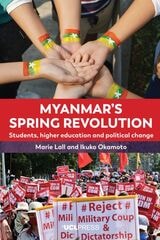
Myanmar’s Spring Revolution
Students, Higher Education and Political ChangeMarie Lall and Ikuko Okamoto
University College London, 2026
Drawing on firsthand research in a conflict-affected region, this book offers a powerful case study of revolution, displacement, and institutional failure after Myanmar's 2021 military coup.
The 2021 military coup in Myanmar was received as a moral shock by a large part of the country's population. The book gives voice to the students and academics who were key to the youth-led post-coup protests and are still fighting the military with their bodies and minds, by taking up arms and creating their own higher education institutions.