Results by title
397 books match the query 'Rome' and 15 start with m
Machiavelli's New Modes and Orders
A Study of the Discourses on LivyHarvey C. Mansfield
University of Chicago Press, 2001
Mansfield's aim is to discern Machiavelli's intention in writing the book: he argues that Machiavelli wanted to introduce new modes and orders in political philosophy in order to make himself the founder of modern politics. Mansfield maintains that Machiavelli deliberately concealed part of his intentions so that only the most perceptive reader could see beneath the surface of the text and understand the whole of his book. Previously out of print, Mansfield's penetrating study brings to light the hidden thoughts lurking in the details of the Discourses on Livy to inform and challenge its readers at every step along the way.
Mail and Female
Epistolary Narrative and Desire in Ovid's HeroidesSara H. Lindheim
University of Wisconsin Press, 2003
Using feminist and psychoanalytic approaches to examine the "female voice" in the Heroides, Sara H. Lindheim closely reads these fictive letters in which the women seemingly tell their own stories. She points out that in Ovid’s verse epistles all the women represent themselves in a strikingly similar and disjointed fashion. Lindheim turns to Lacanian theory of desire to explain these curious and hauntingly repetitive representations of the heroines in the "female voice." Lindheim’s approach illuminates what these poems reveal about both masculine and feminine constructions of the feminine
Making Men Ridiculous
Juvenal and the Anxieties of the IndividualChristopher Nappa
University of Michigan Press, 2018
In his sixteen verse satires, Juvenal presents speakers who decry the breakdown in traditional Roman values and the status of Roman men as they are confronted by upstart foreigners, devious and deviant women, class traitors, the power of the imperial household, and even the body itself. The satirist castigates vice and immorality even as he revels in describing them. This book locates Juvenal’s targets among the matrices of birth, wealth, class, gender, and ethnicity and walks carefully through a number of his most arresting vignettes in order to show not only what, but how, he satirizes. Moreover, the analysis shows that Juvenal’s portraits sometimes escape his grasp, and, as often as not, he ends up undermining the voice with which he speaks and the values he claims to hold dear. Individual chapters look at the satirist himself, rebellious bodies, disgraced aristocrats, uppity (even murderous) wives, and the necessary but corrupting power of money. The conclusion considers the endurance of both the targets and the rhetoric behind them in the modern world.
Making Men Ridiculous will interest scholars and advanced students of ancient satire, later European satire, imperial Roman culture and literature, and class, gender, and sexuality in the ancient world.
Man to Man
Desire, Homosociality, and Authority in Late-Roman ManhoodMark Masterson
The Ohio State University Press, 2014
At the same time, however, there was a marked ambivalence about same-sex desire and sexual behavior between men, and indeed same-sex sexual behavior was criminalized as it had never been before. While rejection and condemnation may seem to indicate a decisive distancing between authority and this desire and behavior, authority gained power from maintaining a relation to them. Demonstrating knowledge of the actual mechanics of sex between men suggested to a witness that there was nothing unknown to the authority making the demonstration: authority that knew of scandalous masculine sexual pleasure could project its power pretty much anywhere.
This startling dissonance between positive uses of same-sex desire between men and its criminalization in one and the same moment—a dissonance which recent discussions have been unable to address—requires further investigation, and this book supplies it.
Marcus Aurelius in Love
Marcus Aurelius and Marcus Cornelius Fronto
University of Chicago Press, 2007
In 1815 a manuscript containing one of the long-lost treasures of antiquity was discovered—the letters of Marcus Cornelius Fronto, reputed to have been one of the greatest Roman orators. But this find disappointed many nineteenth-century readers, who had hoped for the letters to convey all of the political drama of Cicero’s. That the collection included passionate love letters between Fronto and the future emperor Marcus Aurelius was politely ignored—or concealed. And for almost two hundred years these letters have lain hidden in plain sight.
Marcus Aurelius in Love rescues these letters from obscurity and returns them to the public eye. The story of Marcus and Fronto began in 139 CE, when Fronto was selected to instruct Marcus in rhetoric. Marcus was eighteen then and by all appearances the pupil and teacher fell in love. Spanning the years in which the relationship flowered and died, these are the only love letters to survive from antiquity—homoerotic or otherwise. With a translation that reproduces the effusive, slangy style of the young prince and the rhetorical flourishes of his master, the letters between Marcus and Fronto will rightfully be reconsidered as key documents in the study of the history of sexuality and classics.
Martial
The World of the EpigramWilliam Fitzgerald
University of Chicago Press, 2007
In this age of the sound bite, what sort of author could be more relevant than a master of the epigram? Martial, the most influential epigrammatist of classical antiquity, was just such a virtuoso of the form, but despite his pertinence to today’s culture, his work has been largely neglected in contemporary scholarship. Arguing that Martial is a major author who deserves more sustained attention, William Fitzgerald provides an insightful tour of his works, shedding new and much-needed light on the Roman poet’s world—and how it might speak to our own.
Writing in the late first century CE—when the epigram was firmly embedded in the social life of the Roman elite—Martial published his poems in a series of books that were widely read and enjoyed. Exploring what it means to read such a collection of epigrams, Fitzgerald examines the paradoxical relationship between the self-enclosed epigram and the book of poems that is more than the sum of its parts. And he goes on to show how Martial, by imagining these books being displayed in shops and shipped across the empire to admiring readers, prophetically behaved like a modern author. Chock-full of epigrams itself—in both Latin and English versions—Fitzgerald’s study will delight classicists, literary scholars, and anyone who appreciates an ingenious witticism.
Mask of the Parasite
A Pathology of Roman PatronageCynthia Damon
University of Michigan Press, 1997
Materia Magica
The Archaeology of Magic in Roman Egypt, Cyprus, and SpainAndrew T. Wilburn
University of Michigan Press, 2015
This exciting new study draws on objects excavated or discovered in the late nineteenth or early twentieth century at three Mediterranean sites. Through the three case studies, Materia Magica identifies specific forms of magic that may be otherwise unknown. It isolates the practitioners of magic and examines whether magic could be used as a form of countercultural resistance. Andrew T. Wilburn discovers magic in the objects of ancient daily life, suggesting that individuals frequently turned to magic, particularly in crises. Local forms of magic may have differed, and Wilburn proposes that the only way we can find small-town sorcerers is through careful examination of the archaeological evidence.
Studying the remains of spells enacted by practitioners, Wilburn's work unites the analysis of the words written on artifacts and the physical form of these objects. He situates these items within their contexts, to study how and why they were used. Materia Magica approaches magic as a material endeavor, in which spoken spells, ritual actions, and physical objects all played vital roles in the performance of a rite.
Materia Magica develops a new method for identifying and interpreting the material remains of magical practice by assessing artifacts within their archaeological contexts. Wilburn suggests that excavations undertaken in recent centuries can yield important lessons about the past, and he articulates the ways in which we can approach problematic data.
Materialising the Roman Empire
Edited by Jeremy Tanner and Andrew Gardner
University College London, 2024
Materialising the Roman Empire defines an innovative research agenda for Roman archaeology, highlighting the diverse ways in which the Empire was made materially tangible in the lives of its inhabitants. The volume explores how material culture was integral to the process of imperialism, both as the Empire grew, and as it fragmented, and in doing so it provides up-to-date overviews of major topics in Roman archaeology.
Each chapter offers a thorough overview of a major field within the archaeology of the Roman Empire. The book’s authors explore the distinctive contribution that archaeology and the study of material culture can make to our understanding of the key institutions and fields of activity in the Roman Empire. The opening chapters address major technologies that, at first glance, appear to be mechanisms of integration across the Roman Empire: roads, writing, and coinage. The focus then shifts to the analysis of key social structures oriented around material forms and activities found all over the Roman world, such as trade, urbanism, slavery, craft production, and frontiers. Finally, the book extends to more abstract dimensions of the Roman world: art, empire, religion, and ideology, in which the significant themes remain the dynamics of power and influence. The whole builds towards a broad exploration of the nature of imperial power and the interconnections that stimulated new community identities and created new social divisions.

Meat and the Birth of Rome
Zooarchaeology, Foodways, and Religious RitualsVictoria C. Moses
University of Alabama Press, 2026
Meat and the Birth of Rome explores faunal remains from archaeological sites dating to the early Iron Age through early Republican period in Rome and its environs and challenges a prevailing view of Rome’s exceptionalism. Victoria C. Moses tempers the myth by illuminating the roles of meat production, distribution, and consumption and ritual sacrifice in the social hierarchy, economy, and religious practices as Rome grew. During the transformative period around the eighth century BCE, Romans conserved older foodways and their diverse ritual practices. These findings within the broader zooarchaeological data from peninsular Italy show that, despite Rome’s later success, it shared many early characteristics with its neighbors.
This compelling narrative adds to the current archaeological conversations and research on the history of the eternal city.
Memoria Romana
Memory in Rome and Rome in Memoryedited by Karl Galinsky
University of Michigan Press, 2014
Concern with memory permeated Roman literature, history, rhetorical training, and art and architecture. This is the first book to look at the phenomenon from a variety of perspectives, including cognitive science. There is no orthodoxy in memory studies and the approaches are both empirical and theoretical. A central issue is: who and what preserved and shaped cultural memory in Rome, and how did that process work? Areas and subjects covered include the Romans' view of the changing physical fabric of the city, monuments (by etymology related to memory) such as the Arch of Constantine, memory and the Roman triumph, Roman copies of Greek sculpture and their relation to memory, the importance of written information and of continuing process, the creation of memory in Republican memoirs and Flavian poetry, the invention of traditions, and the connection of cultural and digital memory.
The ten chapters present original findings that complement earlier scholarship from the perspective of memory and open up new horizons for inquiry. The introduction by volume editor Karl Galinsky situates the work within current studies on cultural and social memory, and the concluding chapter by Daniel Libeskind provides the perspective of a contemporary practitioner.
Additional contributors include Richard Jenkyns, Harriet I. Flower, T. P. Wiseman, Karl-J. Hölkeskamp, Gianpiero Rosati, Diane Favro, Jessica Hughes, Anna Anguissola, Lisa Marie Mignone, and Bernard Frischer.
Metamorphosis of Language in Apuleius
A Study of Allusion in the NovelEllen D. Finkelpearl
University of Michigan Press, 1998
When Apuleius wrote his Metamorphoses, the novel--indeed the very concept of fiction in prose--was new. This study argues that Apuleius' repeated allusions to earlier Latin authors such as Vergil, Ovid, and Seneca represent an exploration on his part of the relationship between the novel and more established genres of the era. Apuleius' struggle with this tradition, Finkelpearl maintains, parallels the protagonist's move from an acceptance of the dominance of traditional forms to a sense of arrival and self- discovery.
An introductory chapter includes general discussion of the theory and practice of allusion. Finkelpearl then revisits the issues of parody in Apuleius. She also includes discussion of Apuleius' use of Vergil's Sinon, the Charite episode in relation to Apuleius' African origins, and the stepmother episode. Finally a new reading of Isis is offered, which emphasizes her associations with writing and matches the multiformity of the goddess with the novel's many voices.
This book will be of interest to scholars of literature and the origins of the novel, multiculturalism, and classical literature.
Ellen D. Finkelpearl is Associate Professor of Classics at Scripps College, Claremont, California.
Mothering and Motherhood in Ancient Greece and Rome
Edited by Lauren Hackworth Petersen and Patricia Salzman-Mitchell
University of Texas Press, 2012
Motherhood played a central role in ancient Greece and Rome, despite the virtual absence of female participation in the public spheres of life. Mothers could wield enormous influence as the reproductive bodies of society and, in many cases, of culture. Yet motherhood and acts of mothering have received relatively little focused and sustained attention by modern scholars, who have concentrated almost exclusively on analyzing depictions of ancient women more generally.
In this volume, experts from across the humanities present a wealth of evidence from legal, literary, and medical texts, as well as art, architecture, ritual, and material culture, to reveal the multilayered dimensions of motherhood in both Greece and Rome and to confront the fact that not all mothers and acts of mothering can be easily categorized. The authors consider a variety of mothers—from the mythical to the real, from empress to prostitute, and from citizen to foreigner—to expose both the mundane and the ideologically charged lives of mothers in the Classical world. Some essays focus on motherhood as a largely private (emotional, intimate) experience, while others explore the ramifications of public, oftentimes politicized, displays of motherhood. This state-of-the art look at mothers and mothering in the ancient world also takes on a contemporary relevance as the authors join current debates on motherhood and suggest links between the lives of ancient mothers and the diverse, often conflicting roles of women in modern Western society.
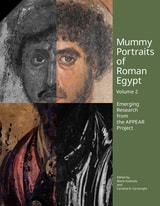
Mummy Portraits of Roman Egypt, Volume 2
Emerging Research from the APPEAR ProjectMarie Svoboda
J. Paul Getty Trust, The, 2026
Nearly a thousand funerary portraits from Roman Egypt, once interred with mummified remains, survive in museums around the world. These fascinating paintings offer the unparalleled opportunity for viewers to come face-to-face with people who lived and died some two thousand years ago.
The international collaboration known as APPEAR (Ancient Panel Paintings: Examination, Analysis, and Research) was launched in 2013 to promote the study of these objects and gather research findings in a shared database. This second volume of Mummy Portraits of Roman Egypt compiles seventeen scholarly papers from the APPEAR conference hosted in October 2022 at the Allard Pierson Museum, Amsterdam. Conservators, scientists, and curators presented new research on topics such as technical imaging; nondestructive analytical techniques; provenance and collecting; treatment histories; connoisseurship and forgeries; comparisons of works across institutions; and scientific studies of woods, pigments, coatings, binders, and supports. This volume will be a valuable resource to conservators, scientists, curators, and collectors.
The free online edition of this open-access publication is available at getty.edu/publications/mummy-portraits-2/ and includes zoomable illustrations and graphs. Also available are free PDF and EPUB downloads of the book.
Murder Was Not a Crime
Homicide and Power in the Roman RepublicBy Judy E. Gaughan
University of Texas Press, 2009
Embarking on a unique study of Roman criminal law, Judy Gaughan has developed a novel understanding of the nature of social and political power dynamics in republican government. Revealing the significant relationship between political power and attitudes toward homicide in the Roman republic, Murder Was Not a Crime describes a legal system through which families (rather than the government) were given the power to mete out punishment for murder.
With implications that could modify the most fundamental beliefs about the Roman republic, Gaughan's research maintains that Roman criminal law did not contain a specific enactment against murder, although it had done so prior to the overthrow of the monarchy. While kings felt an imperative to hold monopoly over the power to kill, Gaughan argues, the republic phase ushered in a form of decentralized government that did not see itself as vulnerable to challenge by an act of murder. And the power possessed by individual families ensured that the government would not attain the responsibility for punishing homicidal violence.
Drawing on surviving Roman laws and literary sources, Murder Was Not a Crime also explores the dictator Sulla's "murder law," arguing that it lacked any government concept of murder and was instead simply a collection of earlier statutes repressing poisoning, arson, and the carrying of weapons. Reinterpreting a spectrum of scenarios, Gaughan makes new distinctions between the paternal head of household and his power over life and death, versus the power of consuls and praetors to command and kill.