Results by title
15 books match the query 'Java'

Eight Prison Camps
A Dutch Family in Japanese JavaDieuwke Wendelaar Bonga
Ohio University Press, 1996
Eldest daughter of eight children, the author grew up in Surakarta, Java, in what is now Indonesia. In the months following the bombing of Pearl Harbor, however, Dutch nationals were rounded up by Japanese soldiers and put in internment camps. Her father and brother were sent to separate men’s camps, leaving the author, her mother, and the five younger children in the women’s camp. In this and later seven other prison camps in central Java, their lives gradually deteriorated from early days of fear and crowding to near starvation, forced labor, beatings, and seeing others disappear or die. On the family’s return to Holland after the war, they found a nation recovering from German occupation and largely ignorant of the horror of the Far East experience.
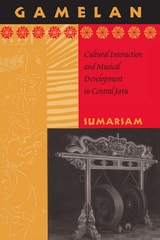
Gamelan
Cultural Interaction and Musical Development in Central JavaSumarsam
University of Chicago Press, 1995
Drawing on sources ranging from a twelfth-century royal poem to the writing of a twentieth-century nationalist, Sumarsam shows how the Indian-inspired contexts and ideology of the Javanese performing arts were first adjusted to the Sufi tradition and later shaped by European performance styles in the eighteenth and nineteenth centuries. He then turns to accounts of gamelan theory and practice from the colonial and postcolonial periods. Finally, he presents his own theory of gamelan, stressing the relationship between purely vocal melodies and classical gamelan composition.
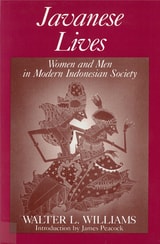
Javanese Lives
Women and Men in Modern Indonesian SocietyWilliams, Walter L.
Rutgers University Press, 1991
Java is the most populous island of Indonesia, the fifth largest nation in the world. Yet despite its importance, outsiders know little about the country or its people. With the help of Indonesian students and scholars, Walter L. Williams has collected and translated the life histories of twenty-seven Javanese women and men. The people interviewed tell how they have coped with rapid social and economic change, and the transformation of their traditions. Williams has carefully selected the individuals he includes to represent a wide diversity of Java's people. We hear from fascinating men and women of various religions, from the rich and the poor, and from different ethnic backgrounds. Diversity is a constant theme, as evidenced by a poor pedicab driver who can barely scrape along, by a rich businesswoman who explains how she balances her professional and domestic roles, by an educated and respected homosexual school principal, and by an illiterate mother of fourteen children. All of them present in their lives a unique Javanese approach to living.
These oral histories were derived from elderly people, who have a larger perspective on the changes they have seen in their lifetimes. The focus of the first section of the book is the way people have adapted in their daily lives to massive social and economic changes. In the middle section, we hear from the Javanese who represent traditional values in the midst of change. Finally, we hear from educators and parents who tell us of their concerns for Indonesian youth and the future of Indonesia.
Karawitan
Source Readings in Javanese Gamelan and Vocal Music, Volume 1Edited by Judith Becker with assistance from Alan H. Feinstein
University of Michigan Press, 1984
Karawitan
Source Readings in Javanese Gamelan and Vocal Music, Volume 2Edited by Judith Becker with assistance from Alan H. Feinstein
University of Michigan Press, 1987
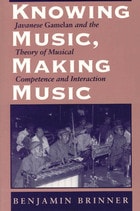
Knowing Music, Making Music
Javanese Gamelan and the Theory of Musical Competence and InteractionBenjamin Brinner
University of Chicago Press, 1995
Using illustrative examples from a variety of traditions, Benjamin Brinner first examines the elements and characteristics of musical competence, the different kinds of competence in a musical community, the development of multiple competences, and the acquisition and transformation of competence through time. He then shows how these factors come into play in musical interaction, establishing four intersecting theoretical perspectives based on ensemble roles, systems of communication, sound structures, and individual motivations. These perspectives are applied to the dynamics of gamelan performance to explain the social, musical, and contextual factors that affect the negotiation of consensus in musical interaction. The discussion ranges from sociocultural norms of interpersonal conduct to links between music, dance, theater, and ritual, and from issues of authority and deference to musicians' self-perceptions and mutual assessments.
Much more than a portrait of artists making music together, this book brings together a variety of cognitive approaches and a wide range of examples from many cultures to suggest ways of integrating our knowledge of music making both in individual cultures and crossculturally.
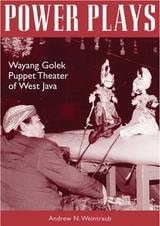
Power Plays
Wayang Golek Puppet Theater of West JavaAndrew N. Weintraub
Ohio University Press, 2004
Using interviews with performers, musical transcriptions, translations of narrative and song texts, and archival materials, author Andrew N. Weintraub analyzes the shifting and flexible nature of a set of performance practices called Padalangan, the art of the puppeteer. He focuses on “superstar” performers and the musical troupes that dominated wayang golek during the New Order political regime of former president Suharto (1966-98) and the ensuing three years of the post-Suharto period. Studies of actual performances illuminate stylistic and formal elements and situate wayang golek as a social process in Sundanese culture and society. Power Plays includes an interactive multimedia CD-ROM of wayang golek.
Power Plays shows how meanings about identity, citizenship, and community are produced through theater, music, language, and discourse. While based in ethnographic theory and methods, this book is at the center of a new synthesis emerging among ethnomusicology, anthropology, and cultural studies. Its cross-disciplinary approach will inspire researchers studying similar struggles over cultural authority and popular representation in culture and the performing arts.
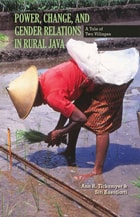
Power, Change, and Gender Relations in Rural Java
A Tale of Two VillagesAnn R. Tickamyer
Ohio University Press, 2012
Women’s status in rural Java can appear contradictory to those both inside and outside the culture. In some ways, women have high status and broad access to resources, but other situations suggest that Javanese women lack real power and autonomy. Javanese women have major responsibilities in supporting their families and controlling household finances. They may also own and manage their own property. Yet these symbols and potential sources of independence and influence are determined by a culturally prescribed, state-reinforced, patriarchal gender ideology that limits women’s autonomy. Power, Change, and Gender Relations in Rural Java examines this contradiction as well as sources of stability and change in contemporary Javanese gender relations.
The authors conducted their research in two rural villages in Yogyakarta, Indonesia, during three important historical and political periods: the end of the New Order regime; the transitional period of reformation; and the subsequent establishment of a democratic government. Their collaboration brings a unique perspective, analyzing how gender is constructed and reproduced and how power is exercised as Indonesia faces the challenges of building a new social order.
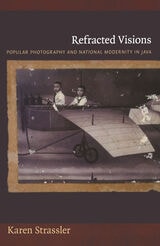
Refracted Visions
Popular Photography and National Modernity in JavaKaren Strassler
Duke University Press, 2010
Oriented to projects of selfhood, memory, and social affiliation, popular photographs recast national iconographies in an intimate register. They convey the longings of Indonesian national modernity: nostalgia for rural idylls and “tradition,” desires for the trappings of modernity and affluence, dreams of historical agency, and hopes for political authenticity. Yet photography also brings people into contact with ideas and images that transcend and at times undermine a strictly national frame. Photography’s primary practitioners in the postcolonial era have been Chinese Indonesians. Acting as cultural brokers who translate global and colonial imageries into national idioms, these members of a transnational minority have helped shape the visual contours of Indonesian belonging even as their own place within the nation remains tenuous. Refracted Visions illuminates the ways that everyday photographic practices generate visual habits that in turn give rise to political subjects and communities.

Shadows of Empire
Colonial Discourse and Javanese TalesLaurie J. Sears
Duke University Press, 1996
Though Javanese shadow theater (wayang) has existed for hundreds of years, our knowledge of its history, performance practice, and role in Javanese society only begins with Dutch documentation and interpretation in the nineteenth century. Analyzing the Mahabharata and Ramayana tales in relation to court poetry, Islamic faith, Dutch scholarship, and nationalist journals, Sears shows how the shadow theater as we know it today must be understood as a hybrid of Javanese and Dutch ideas and interests, inseparable from a particular colonial moment. In doing so, she contributes to a re–envisioning of European histories that acknowledges the influence of Asian, African, and New World cultures on European thought—and to a rewriting of colonial and postcolonial Javanese histories that questions the boundaries and content of history and story, myth and allegory, colonialism and culture.
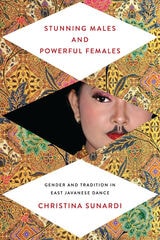
Stunning Males and Powerful Females
Gender and Tradition in East Javanese DanceChristina Sunardi
University of Illinois Press, 2015
Christina Sunardi ventures into the regency of Malang in east Java to study and perform with dancers. Through formal interviews and casual conversation, Sunardi learns about their lives and art. Her work shows how performers continually transform dance traditions to negotiate, and renegotiate, the boundaries of gender and sex--sometimes reinforcing lines of demarcation, sometimes transgressing them, and sometimes doing both simultaneously. But Sunardi's investigation moves beyond performance. It expands notions of the spiritual power associated with female bodies and feminine behavior, and the ways women, men, and waria (males who dress and live as female) access the magnetic power of femaleness.
A journey into understudied regions and ideas, Stunning Males and Powerful Females reveals how performances seemingly fixed by tradition are instead dynamic environments for cultural negotiation and change surrounding questions of sex and gender.
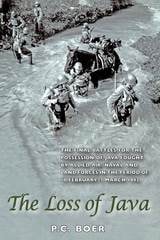
The Loss of Java
The Final Battles for the Possession of Java Fought by Allied Air, Naval and Land Forces in the Period of 18 February - 7 March 1942P.C. Boer
National University of Singapore Press, 2011
P.C. Boer considers whether the assessment of Major General Van Oyen that deploying the Allied air forces might prevent Japanese invasion of Java was realistic, and whether reliance on air power limited the capacity of land and naval forces to repel Japan's advances. The generally accepted idea is that the Allies were ineffective in their fight against the Japanese invaders but in fact the Japanese suffered serious losses. Boer's study shows that Dutch strategy grew out of a carefully-devised plan of defense, and that the battle for Java comprised not one (the Battle of the Java Sea) but four major engagements. However, Japanese commanders at various levels consciously took steps that exposed their forces to great risk but succeeded in putting the Allies under great pressure. In the end the Royal Netherlands East Indies Army (KNIL) and the allied forces capitulated on 8 March 1942.
This book is a translation of Het Verlies Van Java: Een kwestie van Air Power. De eindstrijd om Nederlands-Indie van de geallieerde lucht-, zee- en landstrijdkrschten in de periode van 18 februari t/m 7 maart 1942 (Amsterdam: Bataafsche Leeuw BV for the Koninklijke Militaire Academie, 2006).

The Pulse of the Earth
Political Geology in JavaAdam Bobbette
Duke University Press, 2023
The Religion of Java
Clifford Geertz
University of Chicago Press, 1976
The Religion of Java will interest specialists in Southeast Asia, anthropologists and sociologists concerned with the social analysis of religious belief and ideology, students of comparative religion, and civil servants dealing with governmental policy toward Indonesia and Southeast Asia.
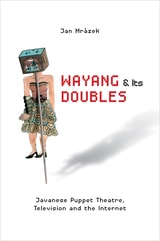
Wayang and Its Doubles
Javanese Puppet Theatre, Television and the InternetJan Mrázek
National University of Singapore Press, 2019
This book explores the ways two complex forms of media coexist and meet as well as haunt and invade each other. It looks at performance aesthetics and the technicalities of television production, as well as issues of time, space, light, place, and movement. It compares audience experiences of live and televised performances, and highlights the collaboration and struggle between performers and television producers. Interviews with performers from both sides are brought into a larger conversation on media and technology, one that includes ideas from Karl Marx, Martin Heidegger, Maurice Merleau-Ponty, Jacques Derrida, Paul Virilio, and James Siegel. The book also looks ahead to new formats that have the potential to disrupt in ways never imagined: the worlds of streaming and social media.