Results by title
546 books match the query 'Semiotics & Theory' and 28 start with m
Machado de Assis and Narrative Theory
Language, Imitation, Art, and Verisimilitude in the Last Six NovelsEarl E. Fitz
Bucknell University Press, 2019
Published by Bucknell University Press. Distributed worldwide by Rutgers University Press.
Making Conversation in Modernist Fiction
Elizabeth Alsop
The Ohio State University Press, 2019
If historically dialogue had been treated as a subordinate element in fiction—a tool for developing character or advancing plot—this book demonstrates that writers such as Henry James, Ernest Hemingway, James Joyce, William Faulkner, Virginia Woolf, and Gertrude Stein would increasingly emphasize it as a poetic structure in its own right. In this way, Alsop argues, modernist writers “make” conversation in radically new ways and for a diverse range of expressive and communicative ends. Over the course of five chapters that explore this previously overlooked avenue of modernist innovation, Making Conversation offers readers a radical new paradigm not only for understanding fictional talk but also for interpreting some of the most celebrated examples of early twentieth-century narrative.
Making Sense in Life and Literature
Hans Ulrich Gumbrecht
University of Minnesota Press, 1992
“The translation of these essays by Gumbrecht on literary theory and history marks the appearance in English of one of Europe’s most learned, productive, and inventive scholars. Their range is extraordinary. They show that Gumbrecht is not only a sophisticated theorist and historian of literature, but a master practitioner of cultural studies.” --Hayden White, University of California, Santa Cruz
Maladies of the Will
The American Novel and the Modernity ProblemJennifer L. Fleissner
University of Chicago Press, 2022
What if the modern person were defined not by reason or sentiment, as Enlightenment thinkers hoped, but by will? Western modernity rests on the ideal of the autonomous subject, charting a path toward self-determination. Yet novelists have portrayed the will as prone to insufficiency or excess—from indecision to obsession, wild impulse to melancholic inertia. Jennifer Fleissner’s ambitious book shows how the novel’s attention to the will’s maladies enables an ongoing interrogation of modern premises from within.
Maladies of the Will reveals the nineteenth-century American novel’s relation to a wide-ranging philosophical tradition, highly relevant to our own tumultuous present. In works from Moby-Dick and The Scarlet Letter to Elizabeth Stoddard’s The Morgesons and Charles W. Chesnutt’s The Marrow of Tradition, the will’s grandeur and its perversity emerge as it alternately aligns itself with and pits itself against a bigger Will—whether of God, the state, society, history, or life itself. Today, when invocations of autonomy appear beside the medicalization of many behaviors, and democracy’s tenet of popular will has come into doubt, Maladies of the Will provides a map to how we got here, and how we might think these vital dilemmas anew.
Managing Readers
Printed Marginalia in English Renaissance BooksWilliam W. E. Slights
University of Michigan Press, 2001
The recent revolution in the protocols of reading brought on by computer technology has forced questions about the nature of book-based knowledge in our global culture. Managing Readers traces changes in the protocols of annotation and directed reading--from medieval religious manuscripts and Renaissance handbooks for explorers, rhetoricians, and politicians to the elegant clear-text editions of the Enlightenment and the hypertexts of our own time. Developing such concepts as textual authority, generic difference, and reader-response, Slights demonstrates that printed marginalia were used to confirm the authority of the text and to undermine it, to supplement "dark" passages, and to colonize strategic hermeneutic spaces. The book contains twenty-two illustrations of pages from rare-book archives that make immediately clear how distinctive the management of the reading experience was during the first century-and-a-half of printing in England.
William W. E. Slights is Professor of English, University of Saskatchewan. He is also author of Ben Jonson and the Art of Secrecy.
Many Gods and Many Voices
The Role of the Prophet in English and American ModernismLouis L. Martz
University of Missouri Press, 1998
In Many Gods and Many Voices distinguished scholar Louis L. Martz addresses works by Ezra Pound, T. S. Eliot, William Carlos Williams, H. D., and D. H. Lawrence, with brief treatment of the relation of Pound's Cantos to Joyce's Ulysses. In a graceful, lucid style, Martz argues that a prophetic tradition is represented in the Cantos, The Waste Land, Paterson, and H. D.'s Trilogy and Helen in Egypt, along with Lawrence's Plumed Serpent and the second version of Lady Chatterley's Lover. Pound's often- cited view that an epic is a poem that "includes history" does not define epic alone, for the books of biblical prophecy also contain history: the history of Israel's misdeeds and continuous redemption.
On the other hand, Martz suggests that the term prophecy should not be limited to works that foretell the future, arguing that the biblical prophet is concerned primarily with the present. The prophet is a reformer, a denouncer of evil, as well as a seer of possible redemption. He hears "voices" and transmits the message of those voices to his people, in the hope of moving them away from wickedness and toward the ways of truth. According to Martz, such was the mission that inspired Walt Whitman and that Whitman passed on to Pound, Eliot, Williams, and Lawrence. (H. D. found her own sources of inspiration in Greek and Egyptian lore.)
Martz's premise is that biblical prophecy, with its mingling of poetry and prose, its abrupt shifts from violent denunciation to exalted poetry, provides a precedent for the texture of these modernist works that will help readers to appreciate the mingling of "voices" and the complex mixture of elements. Examining their interrelationships and their common themes, Many Gods and Many Voices offers fresh insights into these modern writers.
Markedness Theory
Edna Andrews
Duke University Press, 1990
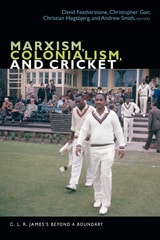
Marxism, Colonialism, and Cricket
C. L. R. James's Beyond a BoundaryDavid Featherstone, Christopher Gair, Christian Høgsbjerg and Andrew Smith, editors
Duke University Press, 2018
Contributors. Anima Adjepong, David Austin, Hilary McD. Beckles, Michael Brearley, Selwyn R. Cudjoe, David Featherstone, Christopher Gair, Paget Henry, Christian Høgsbjerg, C. L. R. James, Selma James, Roy McCree, Minkah Makalani, Clem Seecharan, Andrew Smith, Neil Washbourne, Claire Westall
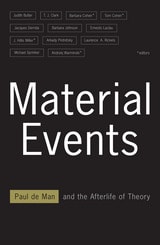
Material Events
Paul de Man and the Afterlife of TheoryTom Cohen
University of Minnesota Press, 2000
Renowned contributors use the late work of this crucial figure to open new speculations on "materiality."
A "material event," in one of Paul de Man’s definitions, is a piece of writing that enters history to make something happen. This interpretation hovers over the publication of this volume, a timely reconsideration of de Man’s late work in its complex literary, critical, cultural, philosophical, political, and historical dimensions.
A distinguished group of scholars responds to the problematic of "materialism" as posed in Paul de Man’s posthumous final book, Aesthetic Ideology. These contributors, at the forefront of critical theory, productive thinking, and writing in the humanities, explore the question of "material events" to illuminate not just de Man’s work but their own. Prominent among the authors here is Jacques Derrida, whose extended essay “Typewriter Ribbon: Limited Inc (2)” returns to a celebrated episode in Rousseau’s Confessions that was discussed by de Man in Allegories of Reading.
The importance of de Man’s late work is related to a broad range of subjects and categories and-in Derrida’s provocative reading of de Man’s concept of "materiality"-the politico-autobiographical texts of de Man himself. This collection is essential reading for all those interested in the present state of literary and cultural theory.
Contributors: Judith Butler, UC Berkeley; T. J. Clark, UC Berkeley; Jacques Derrida, École des Hautes Études en Sciences Sociales and UC Irvine; Barbara Johnson, Harvard U; Ernesto Laclau, U of Essex; Arkady Plotnitsky, Purdue U; Laurence A. Rickels, UC Santa Barbara; and Michael Sprinker.
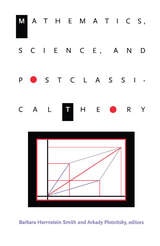
Mathematics, Science, and Postclassical Theory
Barbara Herrnstein Smith and Arkady Plotnitsky, eds.
Duke University Press, 1997
In a substantive introductory essay, the editors explain the notion of "postclassical theory" and discuss the significance of ideas such as emergence and undecidability in current work in and on science and mathematics. Other essays include a witty examination of the relations among mathematical thinking, writing, and the technologies of virtual reality; an essay that reconstructs the conceptual practices that led to a crucial mathematical discovery—or construction—in the 19th century; a discussion of the implications of Bohr’s complementarity principle for classical ideas of reality; an examination of scientific laboratories as "hybrid" communities of humans and nonhumans; an analysis of metaphors of control, purpose, and necessity in contemporary biology; an exploration of truth and lies, and the play of words and numbers in Shakespeare, Frege, Wittgenstein, and Beckett; and a final chapter on recent engagements, or nonengagements, between rationalist/realist philosophy of science and contemporary science studies.
Contributors. Malcolm Ashmore, Michel Callon, Owen Flanagan, John Law, Susan Oyama, Andrew Pickering, Arkady Plotnitsky, Brian Rotman, Barbara Herrnstein Smith, John Vignaux Smyth, E. Roy Weintraub
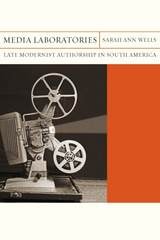
Media Laboratories
Late Modernist Authorship in South AmericaSarah Ann Wells
Northwestern University Press, 2017
Media Laboratories explores a pivotal time for South American literature of the 1930s and ’40s. Cinema, radio, and the typewriter, once seen as promising catalysts for new kinds of writing, began to be challenged by authors, workers, and the public. What happens when media no longer seem novel and potentially democratic but rather consolidated and dominant? Moving among authors from Brazil, Argentina, and Uruguay, and among the genres of fiction, the essay, popular journalism, and experimental little magazines, Sarah Ann Wells shows how writers on the periphery of global modernity were fashioning alternative approaches to these media. Analyzing authors such as Clarice Lispector, Jorge Luis Borges, and Felisberto Hernández, along with their lesser-known contemporaries, Media Laboratories casts a wide net: from spectators of Hollywood and Soviet montage films, to inventors of imaginary media, to proletarian typists who embodied the machine-human encounters of the period. The text navigates contemporary scholarly and popular debates about the relationship of literature to technological innovation, media archaeology, sound studies, populism, and global modernisms. Ultimately, Wells underscores a question that remains relevant: what possibilities emerge when the enthusiasm for new media has been replaced by anxiety over their potentially pernicious effects in a globalizing, yet vastly unequal, world?
Media of Serial Narrative
Frank Kelleter
The Ohio State University Press, 2017
Media of Serial Narrative focuses on key sites and technologies of popular seriality since the mid-nineteenth century and up to today: newspapers, comics, cinema, television, and digital communication. Paying close attention to the affordances of individual media, as well as to their historical interactions, the fourteen chapters survey the forms, processes, and functions of popular serial storytelling. With individual chapters by Frank Kelleter, Jared Gardner, Daniel Stein, Christina Meyer, Scott Higgins, Shane Denson, Ruth Mayer, Kathleen Loock, Constantine Verevis, Jason Mittell, Sudeep Dasgupta, Sean O’Sullivan, Henry Jenkins, Christine Hämmerling, Mirjam Nast, and Andreas Sudmann, Media of Serial Narrative is an exciting and broad-ranging intervention in the fields of seriality, media, and narrative studies.
Medieval Things
Agency, Materiality, and Narratives of Objects in Medieval German Literature and BeyondBettina Bildhauer
The Ohio State University Press, 2020
Melodrama
An Aesthetics of ImpossibilityJonathan Goldberg
Duke University Press, 2016
Metaromanticism
Aesthetics, Literature, TheoryPaul Hamilton
University of Chicago Press, 2003
Through a close look at the aesthetics of Friedrich Schiller and Jean-Jacques Rousseau, and key works by Samuel Taylor Coleridge, Percy and Mary Shelley, John Keats, Sir Walter Scott, Jane Austen, and many others, Hamilton shows how the romantic movement's struggle with its own tenets was not an effort to seek an alternative way of thought, but instead a way of becoming what it already was. And yet, as he reveals, the romanticists were still not content with their own self-consciousness. Pushed to the limit, such contemplation either manifested itself as self-disgust or found aesthetic ideas regenerated in discourses outside of aesthetics altogether.
Mikhail Bakhtin
The Duvakin Interviews, 1973Slav N Gratchev
Bucknell University Press, 2019
Published by Bucknell University Press. Distributed worldwide by Rutgers University Press.
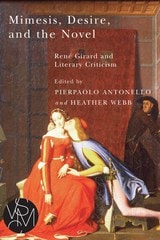
Mimesis, Desire, and the Novel
Rene Girard and Literary CriticismPierpaolo Antonello
Michigan State University Press, 2015
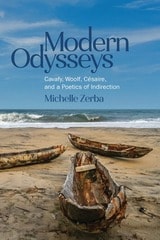
Modern Odysseys
Cavafy, Woolf, Césaire, and a Poetics of IndirectionMichelle Zerba
The Ohio State University Press, 2021
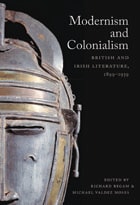
Modernism and Colonialism
British and Irish Literature, 1899–1939Richard Begam and Michael Valdez Moses, eds.
Duke University Press, 2007
Ranging over poetry, fiction, and criticism, the essays provide fresh appraisals of Joseph Conrad, T. S. Eliot, Ezra Pound, Virginia Woolf, D. H. Lawrence, Wyndham Lewis, E. M. Forster, W. B. Yeats, James Joyce, Elizabeth Bowen, Hugh MacDiarmid, and Evelyn Waugh, as well as Robert Louis Stevenson and H. Rider Haggard. The essays that bookend the collection connect the modernists to their Victorian precursors, to postwar literary critics, and to postcolonial poets. The rest treat major works written or published between 1899 and 1939, the boom years of literary modernism and the period during which the British empire reached its greatest geographic expanse. Among the essays are explorations of how primitivism figured in the fiction of Lawrence and Lewis; how, in Ulysses, Joyce used modernist techniques toward anticolonial ends; and how British imperialism inspired Conrad, Woolf, and Eliot to seek new aesthetic forms appropriate to the sense of dislocation they associated with empire.
Contributors. Nicholas Allen, Rita Barnard, Richard Begam, Nicholas Daly, Maria DiBattista, Ian Duncan, Jed Esty, Andrzej Gąsiorek, Declan Kiberd, Brian May, Michael Valdez Moses, Jahan Ramazani, Vincent Sherry
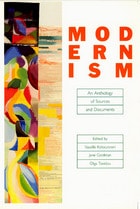
Modernism
An Anthology of Sources and DocumentsEdited by Vassiliki Kolocotroni, Jane Goldman, and Olga Taxidou
University of Chicago Press, 1998
By favoring short extracts over lengthier originals, the editors cover a remarkable range and variety of modernist thinking. Included are not just the familiar high modernist landmarks such as Gustave Flaubert, Ezra Pound, and James Joyce, but also a diverse representation from the sciences, politics, philosophy, and the arts, including Charles Darwin, Thorstein Veblen, W. E. B. Du Bois, Isadora Duncan, John Reed, Adolf Hitler, and Sergei Eisenstein. Another welcome feature is a substantial selection of hard-to-find manifestos from the many modernist movements, among them futurism, cubism, Dada, surrealism, and anarchism.
Modernist Ethics and Posthumanism
Derek Ryan and Mark West, special issue editors
Duke University Press, 0
From snakes to sheep, from hyenas to moths, from rural landscapes to childhood objects, this special issue examines the role of nonhuman alterity in the ethics of modernism. Drawing on the posthumanist theory of Jacques Derrida, Bruno Latour, Jane Bennett, and others, “Modernist Ethics and Posthumanism” offers original close readings of both canonical and more marginalized modernist figures. The contributors analyze unrecognizable creatures in D. H. Lawrence and Virginia Woolf; indeterminate animals in E. M. Forster; networks of human and nonhuman agents in Rainer Maria Rilke and Woolf; pacifism among people, animals, and things in Samuel Beckett; responsibility and rural environments in Mary Butts; and objects, both lost and found, and the threat of extinction in Elizabeth Bowen. What emerges from these essays is an account of modernist ethics that is embedded in relations between human and nonhuman and that gains its force through experiments in both content and form.
Derek Ryan is lecturer in modernist literature at the University of Kent and the author of Animal Theory: A Critical Introduction. Mark West is a recent PhD graduate of the University of Glasgow.
Contributors: Gabriel Hankins, Laci Mattison, Stephen Ross, Derek Ryan, Jeff Wallace, Sam Wiseman
Monster Theory
Reading CultureJeffrey Jerome Cohen
University of Minnesota Press, 1996
In viewing the monstrous body as a metaphor for the cultural body, the contributors to Monster Theory consider beasts, demons, freaks, and fiends as symbolic expressions of cultural unease that pervade a society and shape its collective behavior. Through a historical sampling of monsters, these essays argue that our fascination for the monstrous testifies to our continued desire to explore difference and prohibition.
Contributors: Mary Baine Campbell, Brandeis U; David L. Clark, McMaster U; Frank Grady, U of Missouri, St. Louis; David A. Hedrich Hirsch, U of Illinois; Lawrence D. Kritzman, Dartmouth College; Kathleen Perry Long, Cornell U; Stephen Pender; Allison Pingree, Harvard U; Anne Lake Prescott, Barnard College; John O'Neill, York U; William Sayers, George Washington U; Michael Uebel, U of Virginia; Ruth Waterhouse.
Monstrous Intimacies
Making Post-Slavery SubjectsChristina Sharpe
Duke University Press, 2010
Monstrous Progeny
A History of the Frankenstein NarrativesFriedman, Lester D
Rutgers University Press, 2016
Morals Of History
Tzvetan Todorov
University of Minnesota Press, 1995
Morocco Bound
Disorienting America's Maghreb, from Casablanca to the Marrakech ExpressBrian T. Edwards
Duke University Press, 2005
Edwards reads a broad range of texts to recuperate the disorienting possibilities for rethinking American empire. Examining work by William Burroughs, Jane Bowles, Ernie Pyle, A. J. Liebling, Jane Kramer, Alfred Hitchcock, Clifford Geertz, James Michener, Ornette Coleman, General George S. Patton, and others, he puts American texts in conversation with an archive of Maghrebi responses. Whether considering Warner Brothers’ marketing of the movie Casablanca in 1942, journalistic representations of Tangier as a city of excess and queerness, Paul Bowles’s collaboration with the Moroccan artist Mohammed Mrabet, the hippie communities in and around Marrakech in the 1960s and early 1970s, or the writings of young American anthropologists working nearby at the same time, Edwards illuminates the circulation of American texts, their relationship to Maghrebi history, and the ways they might be read so as to reimagine the role of American culture in the world.
Museum of Words
The Poetics of Ekphrasis from Homer to AshberyJames A. W. Heffernan
University of Chicago Press, 1993
In the first book ever to explore this museum, James Heffernan argues that ekphrasis stages a battle for mastery between the image and the word. Moving from the epics of Homer, Virgil, and Dante to contemporary American poetry, this book treats the history of struggle between rival systems of representation. Readable and well illustrated, this study of how poets have represented painting and sculpture is a major contribution to our understanding of the relation between the arts.
Mutual Misunderstanding
Scepticism and the Theorizing of Language and InterpretationTalbot J. Taylor
Duke University Press, 1992
Mutual Misundertanding thus presents a strikingly original analysis of the rhetorical patterns underlying Western linguistic thought, as exemplified in the works of John Locke, Jacques Derrida, Gottlob Frege, Jonathan Culler, Noam Chomsky, Ferdinand de Saussure, H. Paul Grice, Michael Dummet, Stanley Fish, Alfred Schutz, Barbara Herrnstein Smith, Harold Garfinkel, and others.
This analysis reveals how, by the combined effect of appeals to "commonsense" and anxieties about implications of relativism, scepticism has a determining role in the discursive development of a number of the intellectual disciplines making up the "human sciences" today, including critical theory, literary hermeneutics, philosophy of language and logic, communication theory, discourse and conversation analysis, pragmatics, stylistics, and linguistics. Consequently, this provocative study will be of value to readers from a wide variety of disciplinary backgrounds.