Results by title
127 books match the query 'Sexual behavior' and 5 start with m

Male Fantasies
Volume 1: Women Floods Bodies HistoryKlaus Theweleit
University of Minnesota Press, 1987
This first volume of Male Fantasies centers on the fantasies that preoccupied a group of men who played a crucial role in the rise of Nazism. These men were officers in the Freikorps--private, volunteer armies that roamed Germany, serving the cause of domestic repression in the aftermath of World War I. Klaus Theweleit draws upon the novels, letters, and autobiographies of these proto-fascists and their contemporaries, as well as cartoons, advertisements, engravings, and posters. He explores these sources, not to discover what their creators thought about fighting or the fatherland, but to seek out and reconstruct their images of women. He shows that the Freikorps male identity was shaped by the dread and revulsion that characterized their relations with women (real or imagined) and that this dread was, in turn, linked to the aggressive racism and anticommunism at the heart of most fascist movements.
Theweleit’s second volume, Male Bodies: Psychoanalyzing the White Terror, carries Male Fantasies from the female image to the self-image of manhood and its ritualized forms of mass behavior, culminating in warfare. It also is available from the University of Minnesota Press.

Male Fantasies
Volume 2: Male Bodies: Psychoanalyzing the White TerrorKlaus Theweleit
University of Minnesota Press, 1989
Theweleit’s project in Male Fantasies is to discover the emotional core of fascism as it was revealed in the novels and memoirs of the Freikorps, mercenary bands that fought Germany’s border disputes and put down worker revolts in the aftermath of World War I. His excavation of Freikorps literary remains (and the writings of some of their protofascist contemporaries) enabled Theweleit to reconstruct the mythical content of the fascist imagination. An integral part of Male Fantasies is Theweleit’s choice of illustrations--cartoons, advertisements, engravings, posters--that serve as an ironic commentary on the text and extend its meaning in time and space.
In this second volume of the two-volume work Theweleit discovers how the repudiation of one’s own body--and of femininity--became a psychic compulsion associating masculinity with hardness, self-denial, and destruction. We are shown how the body becomes a mechanism for eluding the dreaded liquid--the “Red Flood,” lava, mud--and the “feminine” emotions associated with it. Armored, organized by mental and physical procedures like the military drill, the male body is transformed into a “man of steel.” As Theweleit shows, only in war does this body find redemption from constraint.
The first volume of Male Fantasies, also available from the University of Minnesota Press, deals primarily with the image of women in the collective unconscious of the fascist warrior that threatens to engulf the male ego.

Mediating Morality
The Politics of Teen Pregnancy in the Post-Welfare EraClare Daniel
University of Massachusetts Press, 2017
Daniel investigates coordinated teen pregnancy prevention efforts within federal political discourse, along with public policy, popular culture, national advocacy, and local initiatives, revealing the evidence of this transformation. In the 1970s and 1980s, political leaders from both parties used teen pregnancy to strengthen their attacks on racialized impoverished communities. With a new welfare policy in 1996 that rhetoric moved toward blaming teen pregnancy—seemingly in a race- and class-neutral way—on the teens who engaged in sex prematurely and irresponsibly. Daniel effectively illustrates that the construction of teen pregnancy as an individual's problem has been a key component in a neoliberal agenda that frees the government from the responsibility of addressing systemic problems of poverty, lack of access to education, ongoing structural racism, and more.
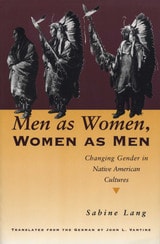
Men as Women, Women as Men
Changing Gender in Native American CulturesBy Sabine Lang
University of Texas Press, 1998
As contemporary Native and non-Native Americans explore various forms of "gender bending" and gay and lesbian identities, interest has grown in "berdaches," the womanly men and manly women who existed in many Native American tribal cultures. Yet attempts to find current role models in these historical figures sometimes distort and oversimplify the historical realities.
This book provides an objective, comprehensive study of Native American women-men and men-women across many tribal cultures and an extended time span. Sabine Lang explores such topics as their religious and secular roles; the relation of the roles of women-men and men-women to the roles of women and men in their respective societies; the ways in which gender-role change was carried out, legitimized, and explained in Native American cultures; the widely differing attitudes toward women-men and men-women in tribal cultures; and the role of these figures in Native mythology. Lang's findings challenge the apparent gender equality of the "berdache" institution, as well as the supposed universality of concepts such as homosexuality.

Minor Troubles
Racial Figurations of Youth Sexuality and Childhood's QueernessErin J. Rand
The Ohio State University Press, 2025
In Minor Troubles, Erin J. Rand investigates a series of controversies about youth sexuality and queerness from the early twenty-first century: adult concerns about teen sexting, the bullying and suicides of queer kids, trans youths’ access to gender-segregated bathrooms at school, and sex education. In the public deliberation and mediation of each of these controversies, the imagined qualities of childhood—innocence, vulnerability, nonsexuality, and, crucially, whiteness—are deployed by adults to justify the protection of children. However, these rhetorical figurations of childhood often produce material precarities for actual young people, especially youth of color and queer, trans, and gender-nonconforming youth.
Rand foregrounds the fundamental role of racialization in forming ideas about childhood, arguing that the image of innocent white childhood depends upon the dehumanization of racialized youth. Moreover, the rhetorical process of figuration produces vulnerability and constrains agency for real young people and creates cultural ideas about childhood that come to justify policies, discipline behaviors, regulate identities, control knowledges, and determine interventions that shape children’s lives, bodies, and experiences.