Results by title
389 books match the query 'State' and 19 start with m
Making Minnesota Liberal
Civil Rights And The Transformation Of The Democratic PartyJennifer A. Delton
University of Minnesota Press, 2002
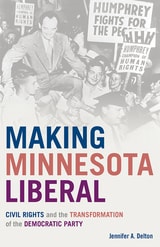
Making Minnesota Liberal
Civil Rights and the Transformation of the Democratic PartyJennifer A. Delton
University of Minnesota Press, 2002
The surprising story of how Minnesota politicians in the 1950s helped redirect American politics—now in paperback
How did a largely white state like Minnesota become a springboard for leadership in civil rights? Why did it produce a generation of liberals—Hubert Humphrey, Walter Mondale, Donald Fraser, Orville Freeman, and Eugene McCarthy—whose ideals transformed the Democratic party?
In Making Minnesota Liberal, Jennifer A. Delton delves into the roots of Minnesota politics for the answer, tracing the change from the regional, third-party, class-oriented politics of the Farmer-Labor party to the national, two-party, pluralistic liberalism of the Democratic-Farmer-Labor party (DFL). While others have examined how anticommunism and the Cold War shaped this transformation, Delton takes a new approach, showing the key roles played by antiracism and the civil rights movement. In telling this story, Delton contributes to our understanding not only of Minnesota’s political history but also of the relationship between antiracism and American politics in the twentieth century.
Making Minnesota Liberal combines political history with a discussion of the symbolic role played by race in political battles between whites. Delton recounts the creation of Minnesota’s Farmer-Labor party, its merger with the Democrats, and the acrimonious battle for control of the DFL just after World War II. She argues that the Humphrey liberals won this battle in part because antiracism activities enabled previously antagonistic groups, divided by ethnicity, religion, and class, to unify around a common cause.
Delton contends that although liberal Minnesotans’s concern for racial justice was genuine, it also provided them with national political relevance and imbued their bid for power with a sense of morality. Ultimately the language of tolerance and diversity that emerged from antiracism prepared Minnesotans for Humphrey’s vision of a pluralistic and state-centered liberalism, which eventually became the model for Democratic politics nationwide. Making Minnesota Liberal is an absorbing and trenchant account of a key moment in American history, one that continues to resonate in our time.
Man and the State
Jacques Maritain
Catholic University of America Press, 1998

Mapping the State
English Boundaries and the 1832 Reform ActMartin Spychal
University of London Press, 2024
The 1832 Reform Act was a landmark moment in the development of modern British politics. By overhauling the country’s ancient representative system, the legislation reshaped constitutional arrangements at Westminster, reinvigorated political relationships between the center and the provinces, and established the political structures and precedents that both shaped and hindered Britain’s slow lurch towards democracy by 1928.
Mapping the State leads to a fundamental rethinking of the 1832 Reform Act by demonstrating how boundary reform and the reconstruction of England’s electoral map by the little-known 1831–1832 boundary commission underpinned this turning point in the development of the British political nation. Eschewing traditional approaches to the 1832 Reform Act, it draws from a significant new archival discovery—the working papers of the boundary commission—and a range of innovative quantitative techniques to provide a major reassessment of why and how the 1832 Reform Act passed, its impact on reformed politics both at Westminster and in the constituencies, and its significance to the expansion of the modern British state.
Market Friendly or Family Friendly?
The State and Gender Inequality in Old AgeMadonna Harrington Meyer
Russell Sage Foundation, 2007
Markets of Dispossession
NGOs, Economic Development, and the State in CairoJulia Elyachar
Duke University Press, 2005
Julia Elyachar studied the efforts of bankers, social scientists, ngo members, development workers, and state officials to turn the craftsmen and unemployed youth of Cairo into the vanguard of a new market society based on microenterprise. She considers these efforts in relation to the alternative notions of economic success held by craftsmen in Cairo, in which short-term financial profit is not always highly valued. Through her careful ethnography of workshop life, Elyachar explains how the traditional market practices of craftsmen are among the most vibrant modes of market life in Egypt. Long condemned as backward, these existing market practices have been seized on by social scientists and development institutions as the raw materials for experiments in “free market” expansion. Elyachar argues that the new economic value accorded to the cultural resources and social networks of the poor has fueled a broader process leading to their economic, social, and cultural dispossession.

Massachusetts Politics and Public Policy
Studies in Power and LeadershipRichard A. Hogarty
University of Massachusetts Press, 2002
Hogarty examines both the process of policymaking and the complexities of on-the-ground implementation, identifying the various participants and their roles and strategies. He describes power struggles that are entangled in intricate webs of personal and political relationships, and explores their historical antecedents.
Based on an extensive review of newspaper and media accounts, a survey of the surprisingly scanty professional literature, a close scrutiny of public documents, and dozens of personal interviews, the book addresses such topics as the delivery of mental health services, urban transportation, environmental protection, public safety, welfare, corrections, the death penalty, public higher education, ethnic politics, and state ethics reform. Hogarty analyzes the shifting problems of accountability that arise when public services are provided by a variety of political actors and organizations with a wide range of ideological motivations and social and cultural commitments.

Mayors and Money
Fiscal Policy in New York and ChicagoEster R. Fuchs
University of Chicago Press, 1992

Me, Governor?
My Life in the Rough-and-Tumble World of New Jersey PoliticsRichard J. Codey
Rutgers University Press, 2011

Medicine, Law, and the State in Imperial Russia
Elisa M. Becker
Central European University Press, 2011
Memories before the State
Postwar Peru and the Place of Memory, Tolerance, and Social InclusionJoseph P. Feldman
Rutgers University Press, 2021
Memories before the State examines the discussions and debates surrounding the creation of the Place of Memory, Tolerance, and Social Inclusion (LUM), a national museum in Peru that memorializes the country’s internal armed conflict of the 1980s and 1990s. Emerging from a German donation that the Peruvian government initially rejected, the Lima-based museum project experienced delays, leadership changes, and limited institutional support as planners and staff devised strategies that aligned the LUM with a new class of globalized memorial museums and responded to political realities of the country’s postwar landscape. The book analyzes forms of authority that emerge as an official institution seeks to incorporate and manage diverse perspectives on recent violence.

Michigan Government, Politics, and Policy
John S. Klemanski and David A. Dulio, editors
University of Michigan Press, 2017
As the state continues to deal with many of these challenges, Michiganders more than ever need a clear picture of how their state’s political institutions, actors, and processes work. To that end, this book provides a comprehensive analysis of Michigan’s politics and government that will help readers better understand the state’s history and its future prospects. Chapters elucidate the foundational aspects of the state’s government (the Michigan Constitution and intergovernmental relations); its political institutions (the state legislature, governor, and court system); its politics (political parties and elections); and its public policy (education, economic development, and budget and fiscal policy). The book’s four themes—historical context, decline, responses to challenges, and state-local government relations—run throughout and are buttressed by coverage of recent events. Moreover, they are brought together in a compelling chapter with a particular focus on the Flint water crisis.
An ideal fit for courses on state and local government, this thorough, well-written text will also appeal to readers simply interested in learning more about the inner workings of government in the Great Lakes State.
Michigan's Con-Con 11
Women and State Constitution-making in 1961Lynn Liberato
Michigan State University Press, 2025

Miles Lord
The Maverick Judge Who Brought Corporate America to JusticeRoberta Walburn
University of Minnesota Press, 2017
The life of a crusading federal judge who stood up and fought for “the little guy”
This is the story of Miles Lord (1919–2016), who rose from humble beginnings on Minnesota’s Iron Range to become one of the most colorful and powerful judges in the country, described as “an unabashed Prairie populist” and “a live-wire slayer of corporate behemoths.” He cut a wide swath through history on his path to the bench: coming of age alongside a cadre of young Midwestern social-gospel progressives, including Hubert H. Humphrey, Eugene McCarthy, and Walter Mondale, in the days before they reached national fame; teaming with Bobby Kennedy as a hotshot prosecutor in pursuit of Jimmy Hoffa; and serving as the secret envoy between his friends Hubert and Eugene in their battle for the soul of the Democratic party in the historic 1968 presidential campaign. Later, after donning his black robe, he reshaped jurisprudence with precedent-breaking rulings—on issues ranging from women’s rights to consumer protection to education reform—and breaking trail when he ordered the shutdown of the Reserve Mining Company in northern Minnesota, which was spewing its waste into Lake Superior, in the most sensational trial of the early environmental era.
One of Judge Lord’s landmark cases—and interlaced as a centerpiece narrative of this book—involved the Dalkon Shield intrauterine device, which caused horrific infections in thousands of women, resulting in infertility and sometimes death. Author Roberta Walburn served as the judge’s law clerk during that litigation in 1983–84, and she provides a page-turning account (both an insider’s view and an in-depth chronicle) of what was called “one of the most disastrous episodes of American corporate misconduct.” In the end, more than 200,000 women received nearly $3 billion in compensation, and the Fortune 500 defendant was left in ruins. But Judge Lord was hauled up on judicial misconduct charges for his no-holds-barred actions that were certainly provocative but also stand as a timely reminder, even (or especially) today, of the challenges in balancing the scales of justice for a legal system that too often skews to the rich and powerful.
The author deftly weaves the Dalkon Shield drama into the larger story of the life of a one-of-a-kind man, crafting a sweeping and spirited true-life tale with not only her first-hand experiences as the judge’s law clerk but also with unrestricted access to the judge’s personal files. This is a rare and compelling portrait of a remarkable man and his place in both Minnesota and U.S. history.
Minnesota
A History of the StateTheodore C. Blegen
University of Minnesota Press, 2004
Missouri's Confederate
Claiborne Fox Jackson and the Creation of Southern Identity in the Border WestChristopher Phillips
University of Missouri Press, 2000
Claiborne Fox Jackson (1806-1862) remains one of Missouri's most controversial historical figures. Elected Missouri's governor in 1860 after serving as a state legislator and Democratic party chief, Jackson was the force behind a movement for the neutral state's secession before a federal sortie exiled him from office. Although Jackson's administration was replaced by a temporary government that maintained allegiance to the Union, he led a rump assembly that drafted an ordinance of secession in October 1861 and spearheaded its acceptance by the Confederate Congress. Despite the fact that the majority of the state's populace refused to recognize the act, the Confederacy named Missouri its twelfth state the following month. A year later Jackson died in exile in Arkansas, an apparent footnote to the war that engulfed his region and that consumed him.
In this first full-length study of Claiborne Fox Jackson, Christopher Phillips offers much more than a traditional biography. His extensive analysis of Jackson's rise to power through the tangle that was Missouri's antebellum politics and of Jackson's complex actions in pursuit of his state's secession complete the deeper and broader story of regional identity--one that began with a growing defense of the institution of slavery and which crystallized during and after the bitter, internecine struggle in the neutral border state during the American Civil War. Placing slavery within the realm of western democratic expansion rather than of plantation agriculture in border slave states such as Missouri, Philips argues that southern identity in the region was not born, but created. While most rural Missourians were proslavery, their "southernization" transcended such boundaries, with southern identity becoming a means by which residents sought to reestablish local jurisdiction in defiance of federal authority during and after the war. This identification, intrinsically political and thus ideological, centered—and still centers—upon the events surrounding the Civil War, whether in Missouri or elsewhere. By positioning personal and political struggles and triumphs within Missourians' shifting identity and the redefinition of their collective memory, Phillips reveals the complex process by which these once Missouri westerners became and remain Missouri southerners.
Missouri's Confederate not only provides a fascinating depiction of Jackson and his world but also offers the most complete scholarly analysis of Missouri's maturing antebellum identity. Anyone with an interest in the Civil War, the American West, or the American South will find this important new biography a powerful contribution to our understanding of nineteenth-century America and the origins—as well as the legacy—of the Civil War.

Monopoly Rule
Party Government in the American StatesJanine A. Parry and Zoe Nemerever
University of Michigan Press, 2027
As the high drama of national elections keeps watchers on the edge of their seats, a different phenomenon altogether characterizes the politics of the American states: long-term one-party monopolies. Widely (and wrongly) assumed to be specific to the South, one-party domination is as ubiquitous as it is consequential. Monopoly Rule documents the startling pervasiveness of state party monopolies since the 1930s.
Even in the “battleground states” of recent presidential elections, Janine A. Parry and Zoe Nemerever make the case that one party or the other usually holds a large and enduring advantage outside the presidential contest. Using a novel State Party Control Index, the authors demonstrate the troubling effects of these partisan juggernauts, including upticks in elite malfeasance, voter complacency, and democratic backsliding. Despite the renewed willingness of contemporary party elites to advance their electoral success by rigging the rules, Monopoly Rule argues that contemporary state and local experiments in ranked choice voting, independent redistricting, and campaign finance reform offer options for reinvigorating the health of American democracy.

Museum Diplomacy
Transnational Public History and the U.S. Department of StateRichard J. W. Harker
University of Massachusetts Press, 2020
As more historic sites and museums seek to surmount social, cultural, and economic barriers between themselves and their communities in their exhibitions and programming, the Museums Connect program provides important lessons on how to overcome entrenched hierarchies of power in public history.
Muslims in the United States
The State of ResearchKaren Isaksen Leonard
Russell Sage Foundation, 2003