Results by title
333 books match the query 'Television' and 14 start with m
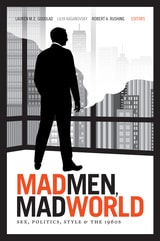
Mad Men, Mad World
Sex, Politics, Style, and the 1960sLauren M. E. Goodlad, Lilya Kaganovsky, and Robert A. Rushing, eds.
Duke University Press, 2013
In the introduction, the editors explore the show's popularity; its controversial representations of race, class, and gender; its powerful influence on aesthetics and style; and its unique use of period historicism and advertising as a way of speaking to our neoliberal moment. Mad Men, Mad World also includes an interview with Phil Abraham, an award-winning Mad Men director and cinematographer. Taken together, the essays demonstrate that understanding Mad Men means engaging the show not only as a reflection of the 1960s but also as a commentary on the present day.
Contributors. Michael Bérubé, Alexander Doty, Lauren M. E. Goodlad, Jim Hansen, Dianne Harris, Lynne Joyrich, Lilya Kaganovsky, Clarence Lang, Caroline Levine, Kent Ono, Dana Polan, Leslie Reagan, Mabel Rosenheck, Robert A. Rushing, Irene Small, Michael Szalay, Jeremy Varon
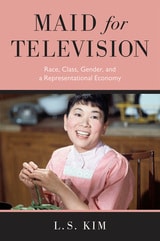
Maid for Television
Race, Class, Gender, and a Representational EconomyL. S. Kim
Rutgers University Press, 2023
Maid for Television examines race, class, and gender relations as embodied in a long history of television servants from 1950 to the turn of the millennium. Although they reside at the visual peripheries, these figures are integral to the idealized American family. Author L. S. Kim redirects viewers' gaze towards the usually overlooked interface between characters, which is drawn through race, class, and gender positioning. Maid for Television tells the stories of servants and the families they work for, in so doing it investigates how Americans have dealt with difference through television as a medium and a mediator.The book philosophically redirects the gaze of television and its projection of racial discourse.
Mainstreaming Gays
Critical Convergences of Queer Media, Fan Cultures, and Commercial TelevisionEve Ng
Rutgers University Press, 2023
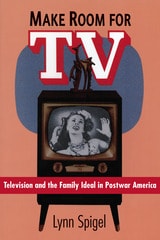
Make Room for TV
Television and the Family Ideal in Postwar AmericaLynn Spigel
University of Chicago Press, 1992
In this fascinating book, Lynn Spigel chronicles the enormous impact of television in the formative years of the new medium: how, over the course of a single decade, television became an intimate part of everyday life. What did Americans expect from it? What effects did the new daily ritual of watching television have on children? Was television welcomed as an unprecedented "window on the world," or as a "one-eyed monster" that would disrupt households and corrupt children?
Drawing on an ambitious array of unconventional sources, from sitcom scripts to articles and advertisements in women's magazines, Spigel offers the fullest available account of the popular response to television in the postwar years. She chronicles the role of television as a focus for evolving debates on issues ranging from the ideal of the perfect family and changes in women's role within the household to new uses of domestic space. The arrival of television did more than turn the living room into a private theater: it offered a national stage on which to play out and resolve conflicts about the way Americans should live.
Spigel chronicles this lively and contentious debate as it took place in the popular media. Of particular interest is her treatment of the way in which the phenomenon of television itself was constantly deliberated—from how programs should be watched to where the set was placed to whether Mom, Dad, or kids should control the dial.
Make Room for TV combines a powerful analysis of the growth of electronic culture with a nuanced social history of family life in postwar America, offering a provocative glimpse of the way television became the mirror of so many of America's hopes and fears and dreams.
Makeover TV
Selfhood, Citizenship, and CelebrityBrenda R. Weber
Duke University Press, 2009
Based on her analysis of more than 2,500 hours of makeover TV, Weber argues that the much-desired After-body speaks to and makes legible broader cultural narratives about selfhood, citizenship, celebrity, and Americanness. Although makeovers are directed at both male and female viewers, their gendered logic requires that feminized subjects submit to the controlling expertise wielded by authorities. The genre does not tolerate ambiguity. Conventional (middle-class, white, ethnically anonymous, heterosexual) femininity is the goal of makeovers for women. When subjects are male, makeovers often compensate for perceived challenges to masculine independence by offering men narrative options for resistance or control. Foregoing a binary model of power and subjugation, Weber provides an account of makeover television that is as appreciative as it is critical. She reveals the makeover show as a rich and complicated text that expresses cultural desires and fears through narratives of selfhood.

Mature Audiences
Television in the Lives of EldersKaren E. Riggs
Rutgers University Press, 1998
Mean Girl Feminism
How White Feminists Gaslight, Gatekeep, and GirlbossKim Hong Nguyen
University of Illinois Press, 2024
Mean girl feminism encourages girls and women to be sassy, sarcastic, and ironic as feminist performance. Yet it coopts its affect, form, and content from racial oppression and protest while aiming meanness toward people in marginalized groups.
Kim Hong Nguyen’s feminist media study examines four types of white mean girl feminism prominent in North American popular culture: the bitch, the mean girl, the power couple, and the global mother. White feminists mime the anger, disempowerment, and resistance felt by people of color and other marginalized groups. Their performance allows them to pursue and claim a special place within established power structures, present as intellectually superior, substitute nonpolitical playacting for a politics of solidarity and community, and position themselves as better, more enlightened masters than patriarchy. But, as Nguyen shows, the racialized meanness found across pop culture opens possibilities for building an intersectional feminist politics that rejects performative civility in favor of turning anger into liberation.
Media Crossroads
Intersections of Space and Identity in Screen CulturesPaula J. Massood, Angel Daniel Matos, and Pamela Robertson Wojcik, editors
Duke University Press, 2021
Contributors. Amy Corbin, Desirée J. Garcia, Joshua Glick, Noelle Griffis, Malini Guha, Ina Rae Hark, Peter C. Kunze, Paula J. Massood, Angel Daniel Matos, Nicole Erin Morse, Elizabeth Patton, Matthew Thomas Payne, Merrill Schleier, Jacqueline Sheean, Sarah Louise Smyth, Erica Stein, Kirsten Moana Thompson, John Vanderhoef, Pamela Robertson Wojcik
Mediating the Uprising
Narratives of Gender and Marriage in Syrian Television DramaRebecca Joubin
Rutgers University Press, 2020
While for some screenwriters a return to pre-2011 life would be welcome after so much bloodshed, others advocated profound cultural and social transformation, instead. They employed marriage and gender metaphors in the stories they wrote to engage in political critique, even at the risk of creating marketing difficulties for the shows or they created escapist stories such as transnational adaptations and Old Damascus tales. Serving as heritage preservation, Mediating the Uprising underscores that television drama creators in Syria have many ways of engaging in protest, with gender and marriage at the heart of the polemic.
Medium Cool
Music Videos from Soundies to CellphonesRoger Beebe and Jason Middleton, eds.
Duke University Press, 2007
The essays take on a range of topics, including questions of authenticity, the tension between high-art influences and mass-cultural appeal, the prehistory of music video, and the production and dissemination of music videos outside the United States. Among the thirteen essays are a consideration of how the rapper Jay-Z uses music video as the primary site for performing, solidifying, and discarding his various personas; an examination of the recent emergence of indigenous music video production in Papua New Guinea; and an analysis of the cultural issues being negotiated within Finland’s developing music video industry. Contributors explore precursors to contemporary music videos, including 1950s music television programs such as American Bandstand, Elvis’s internationally broadcast 1973 Aloha from Hawaii concert, and different types of short musical films that could be viewed in “musical jukeboxes” of the 1940s and 1960s. Whether theorizing music video in connection to postmodernism or rethinking the relation between sound and the visual image, the essays in Medium Cool reveal music video as rich terrain for further scholarly investigation.
Contributors. Roger Beebe, Norma Coates, Kay Dickinson, Cynthia Fuchs, Philip Hayward, Amy Herzog, Antti-Ville Kärjä, Melissa McCartney, Jason Middleton, Lisa Parks, Kip Pegley, Maureen Turim, Carol Vernallis, Warren Zanes
Messiah of the New Technique
John Howard Lawson, Communism, and American Theatre, 1923-1937Jonathan L. Chambers
Southern Illinois University Press, 2006
Messiah of the New Technique: John Howard Lawson, Communism, and American Theatre, 1923–1937 is a critical and political biography and a cultural and social history that focuses on Lawson’s career in the theatre. Using a materialist methodology, Jonathan L. Chambers emphasizes the evolution and interplay of the playwright’s artistic vision and political ideology, considering his art as both a documentation of this evolution and a product of the socio-political and cultural matrix in which he was immersed.
Spanning the playwright’s career, the volume details Lawson’s early indoctrination in and commitment to the avant-garde, his use and development of various nonrealistic playwriting techniques, his subtle though unfocused attacks on bourgeois society, and the varied critical responses he received. Chambers addresses Lawson’s involvement with the New Playwrights’ Theatre and his participation in the protests surrounding the case of Nicola Sacco and Bartolomeo Vanzetti, which stimulated his growing commitment to left-wing politics and radical causes.
Chambers also analyzes the social and cultural factors that shaped Lawson’s growing interest in revolutionary politics, his tutelage in Marxism under Edmund Wilson, and his tenure as president of the Screen Writers Guild. He also covers the final phase of Lawson’s playwriting career, which reveals the playwright’s internal struggle. That struggle, suggests Chambers, pitted Lawson’s view of aesthetics against his political ideology and is reflected in his scripts and theoretical writings.
Messiah of the New Technique provides a wealth of new material about both the playwright and the period, offering a critical synopsis of the artist’s career, addressing his often vehement rebuttals to his critics, and summarizing both his political activism and his creative and critical endeavors in the last forty years of his life.
Millennials Killed the Video Star
MTV's Transition to Reality ProgrammingAmanda Ann Klein
Duke University Press, 2021

Mondo Exotica
Sounds, Visions, Obsessions of the Cocktail GenerationFrancesco Adinolfi Edited and translated by Karen Pinkus with Jason Vivrette
Duke University Press, 2008
Adinolfi interviewed a number of exotica greats, and Mondo Exotica incorporates material from his interviews with Martin Denny, Esquivel, the Italian film composers Piero Piccioni and Piero Umiliani, and others. It begins with an extended look at the postwar popularity of exotica in the United States. Adinolfi describes how American bachelors and suburbanites embraced the Polynesian god Tiki as a symbol of escape and sexual liberation; how Les Baxter’s album Ritual of the Savage (1951) ushered in the exotica music craze; and how Martin Denny’s Exotica built on that craze, hitting number one in 1957. Adinolfi chronicles the popularity of performers from Yma Sumac, “the Peruvian Nightingale,” to Esquivel, who was described by Variety as “the Mexican Duke Ellington,” to the chanteuses Eartha Kitt, Julie London, and Ann-Margret. He explores exotica’s many sub-genres, including mood music, crime jazz, and spy music. Turning to Italy, he reconstructs the postwar years of la dolce vita, explaining how budget spy films, spaghetti westerns, soft-core porn movies, and other genres demonstrated an attraction to the foreign. Mondo Exotica includes a discography of albums, compilations, and remixes.
Monitored Peril
Asian Americans and the Politics of TV RepresentationDarrell Y. Hamamoto
University of Minnesota Press, 1994
The first major study of Asian American representation on U.S. television.
Early in the movement of Asian labor to the United States, immigrants from the Far East were viewed by the dominant Euro-American society as a peril to a white, Christian nation. How far have we come since then? This first comprehensive study of Asian American representation on network television supplies some unsettling answers.
A meticulous work of history, cultural criticism, and political analysis, Monitored Peril illuminates the unstable relationship between the discursive practices of commercial television programs, liberal democratic values, and white supremacist ideology. The book clearly demonstrates the pervasiveness of racialized discourse throughout U.S. society, especially as it is reproduced by network television. In treating his topic, Darrell Hamamoto addresses a wide variety of issues facing diverse Asian American communities: interracial conflict, conservative politics, U.S.-Japan trade friction, and postcolonial Vietnam. Through an examination of selected programs from the 1950s to the present, he attempts to correct the consistently distorted optic of network television. Finally, he calls for an engaged independent Asian American media practice, and for the expansion of public sector television. Selected as a CHOICE Outstanding Academic Book for 1995ISBN 0-8166-2368-6 cloth $49.95xISBN 0-8166-2369-4 paper $18.95320 pages 6 x 9AugustContentsPreface1. White Christian Nation2. Asians in the American West3. War against Japanese America4. Asian Americans and U.S. Empire5. Southeast Asian America6. Contemporary Asian America7. Counterprogramming EpilogueRelated BacklistThe Bronze Screen: Chicana and Chicano Film CultureRosa Linda FregosoExplores Chicana and Chicano popular culture in Hollywood commercial and independent cinema. (1993)