Results by title
80 books match the query 'Tennessee' and 4 start with m

Magdalene House
A Place about MercySarah VanHooser Suiter
Vanderbilt University Press, 2012
However, the story of the Magdalene community is not about these statistics, but about the stories the women tell. They say they thrive in the community because it is a place where they are free to be themselves, safe to give and receive love, and free to speak their trutheven to complain sometimes about how their storytelling is exploited "for the good of the community." A Place about Mercy is a participantobservation account of the history of this remarkable community founded in 1997, its structure, its Thistle Farms beauty products operation, and Reverend Becca Stevens's communal and spiritual vision. The book is finally about what it means to walk the path of healing with a group of unlikely women as guide.
Magdalene House was the subject of a multiplepart documentary on National Public Radio.
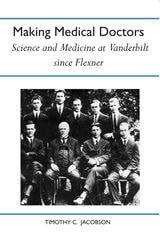
Making Medical Doctors
Science and Medicine at Vanderbilt since FlexnerTimothy C. Jacobson
University of Alabama Press, 1987
Making Medical Doctors is not a conventional institutional history, but rather a study of the union of science and medicine in a particularly illustrative institutional setting. Its general subject is the institution where science and medicine most dramatically came together: the modern medical school and medical center. Its particular subject is the medical school and center of Vanderbilt University, which was rebuilt in the 1920s as a model for medical education and research. Making Medical Doctors also explores the intellectual and financial sources of institutional development: the worlds of Abraham Flexner, Frederick T. Gates, and Henry S. Pritchett, three foundation masters of the early 20th century. It examines closely the vanished medical world of that generation of doctors who reached the height of their influence in the period between the two world wars and describes how they actually did medicine, surgery, and science.
The convergence of science and medicine in the 19th and 20th centuries produced what we know today as modern medicine. The balance of power and interdependence between science and medicine have changed vastly from the 1920s and 1930s, as Vanderbilt’s story clearly illustrates.
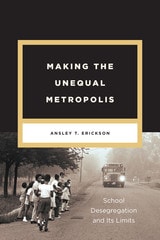
Making the Unequal Metropolis
School Desegregation and Its LimitsAnsley T. Erickson
University of Chicago Press, 2016
Taking Nashville as her focus, Erickson uncovers the hidden policy choices that have until now been missing from popular and legal narratives of inequality. In her account, inequality emerges not only from individual racism and white communities’ resistance to desegregation, but as the result of long-standing linkages between schooling, property markets, labor markets, and the pursuit of economic growth. By making visible the full scope of the forces invested in and reinforcing inequality, Erickson reveals the complex history of, and broad culpability for, ongoing struggles in our schools.
Mastodons to Mississippians
Adventures in Nashville's Deep PastAaron Deter-Wolf
Vanderbilt University Press, 2021
Was Nashville once home to a giant race of humans?
No, but in 1845, you could have paid a quarter to see the remains of one who allegedly lived here before The Flood. That summer, Middle Tennessee well diggers had unearthed the skeleton of an American mastodon. Before it went on display, it was modified and augmented with wooden “bones” to make it look more like a human being and passed off as an antediluvian giant. Then, like so many Nashvillians, after a little success here, it went on tour and disappeared from history.
But this fake history of a race of Pre-Nashville Giants isn’t the only bad history of what, and who, was here before Nashville. Sources written for schoolchildren and the public lead us to believe that the first Euro-Americans arrived in Nashville to find a pristine landscape inhabited only by the buffalo and boundless nature, entirely untouched by human hands. Instead, the roots of our city extend some 14,000 years before Illinois lieutenant-governor-turned-fur-trader Timothy Demonbreun set foot at Sulphur Dell.
During the period between about AD 1000 and 1425, a thriving Native American culture known to archaeologists as the Middle Cumberland Mississippian lived along the Cumberland River and its tributaries in today’s Davidson County. Earthen mounds built to hold the houses or burials of the upper class overlooked both banks of the Cumberland near what is now downtown Nashville. Surrounding densely packed village areas including family homes, cemeteries, and public spaces stretched for several miles through Shelby Bottoms, and the McFerrin Park, Bicentennial Mall, and Germantown neighborhoods. Other villages were scattered across the Nashville landscape, including in the modern neighborhoods of Richland, Sylvan Park, Lipscomb, Duncan Wood, Centennial Park, Belle Meade, White Bridge, and Cherokee Park.
This book is the first public-facing effort by legitimate archaeologists to articulate the history of what happened here before Nashville happened.