Results by title
224 books match the query 'Theory, etc' and 7 start with m
Making Sense in Life and Literature
Hans Ulrich Gumbrecht
University of Minnesota Press, 1992
“The translation of these essays by Gumbrecht on literary theory and history marks the appearance in English of one of Europe’s most learned, productive, and inventive scholars. Their range is extraordinary. They show that Gumbrecht is not only a sophisticated theorist and historian of literature, but a master practitioner of cultural studies.” --Hayden White, University of California, Santa Cruz
Marxist Literary Criticism Today
Barbara Foley
Pluto Press, 2019
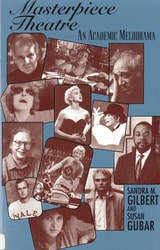
Masterpiece Theatre
An Academic MelodramaSandra M Gilbert and Susan Gubar
Rutgers University Press, 1995
Is there a plot against the life of letters today?!!!! A mysterious assailant has tied a nameless text to a railroad track near Boondock State University. While young untenured English professor Jane Marple enlists a group of odd and oddly rivalrous academicians to help her identify and save the text, a coalition of powerful conservatives begins to suspect and rally against a left-wing conspiracy. But all are foiled when the amnesiac text is abducted on the Euro-Centric Express, where Ms. Marple encounters a number of suspiciously eccentric theorists temporarily set loose from their usual haunts in Marxist, deconstructionist, new historicist, and postcolonial circles. You'll laugh with our heroine, you'll cry with her, but you'll never guess how--using the very latest technology and in the midst of sometimes sinister stage and screen celebrities--she brings the last of three thrilling episodes in the canon wars to an end at a WOW (Writers of the World) conference set in the heart of the Big Apple.
In this hilarious romp through the culture wars, Sandra M. Gilbert and Susan Gubar send up everyone including, sometimes, themselves, while at the same time they speculate seriously on the future of literature and literacy in a society where both are increasingly endangered. The cast includes well-known critics, politicians, writers, pop stars, media personalities, and a juicy assortment of technocrats, CEOs, and other culture vultures. Any similarities you find between these characters and actual persons, living or dead, are probably glaring. So, hum the opening notes of Masterpiece Theatre as you sit back, relax, and consider (yes!) the fate of the printed word in Western civilization.
Masterpiece Theatre is the latest--and funniest--round in the culture wars. No member of Modern Language Association, lover of literature and literacy, cultural pundit, or talking head should be without a copy.
Medieval Things
Agency, Materiality, and Narratives of Objects in Medieval German Literature and BeyondBettina Bildhauer
The Ohio State University Press, 2020
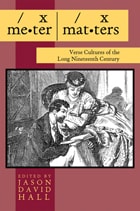
Meter Matters
Verse Cultures of the Long Nineteenth CenturyJason David Hall
Ohio University Press, 2011
Across the nineteenth century, meter mattered—in more ways and to more people than we might well appreciate today. For the period’s poets, metrical matters were a source of inspiration and often vehement debate. And the many readers, teachers, and pupils encountered meter and related topics in both institutional and popular forms.
The ten essays in Meter Matters showcase the range of metrical practice of poets from Wordsworth and Byron to Hopkins, Swinburne, and Tennyson; at the same time, the contributors bring into focus some of the metrical theorizing that shaped poetic thinking and responses to it throughout the nineteenth century. Paying close attention to the historical contours of Romantic and Victorian meters, as well as to the minute workings of the verse line, Meter Matters presents a fresh perspective on a subject that figured significantly in the century’s literature, and in its culture.
Midrash and Theory
Ancient Jewish Exegesis and Contempory Literary StudiesDavid Stern
Northwestern University Press, 1998
As midrash--the literature of classical Jewish Scriptural interpretation--has become the focus of new interest in contemporary literary circles, it has been invoked as a precursor of post-structuralist theory and criticism. At the same time, the midrashic imagination has undergone a revival in the larger Jewish community and shown itself capable of exercising a powerful influence and hold on a new type of contemporary Jewish writing. Stern examines this resurgence of fascination with ancient Jewish interpretation from the persepctive of the cultural relevance of midrash and its connection to its original historical and literary contexts.

Myth and Archive
A Theory of Latin American NarrativeRoberto González-Echevarría
Duke University Press, 1998
Providing ways to link literary and nonliterary narratives, González Echevarría examines a variety of archival writings—from the chronicles of the discovery and conquest of the New World to scientific travel narratives and records of criminal confessions—and explores the relationship of these writings to novels by authors such as García Márquez, Borges, Barnet, Sarmiento, Carpentier, and Garcilaso de la Vega. Moving beyond demonstrating that early forms of creative narrative had their geneses in the sixteenth-century authoritative discourse of the Spanish Empire, González Echevarría shows how this same originating process has been repeated in other key moments in the history of the Latin American narrative. He shows how the discourse of scientific discovery was the model for much nineteenth-century literature, as well as how anthropological writings on the nature of language and myth have come to shape the ideology and form of literature in the twentieth century. This most recent form of Latin American narrative creates its own mythic form through an atavistic return to its legal origins—the archive.
This acclaimed book—originally published in 1990—will be of continuing interest to historians, anthropologists, literary theorists, and students of Latin American culture.