Results by title
88 books match the query 'Translation' and 7 start with m

Maimonides' "Guide of the Perplexed" in Translation
A History from the Thirteenth Century to the TwentiethEdited by Josef Stern, James T. Robinson, and Yonatan Shemesh
University of Chicago Press, 2019
A collection of essays by scholars from a range of disciplines, the book unfolds in two parts. The first traces the history of the translations of the Guide, from medieval to modern renditions. The second surveys its influence in translation on Latin scholastic, early modern, and contemporary Anglo-American philosophy, as well as its impact in translation on current scholarship. Interdisciplinary in approach, this book will be essential reading for philosophers, historians, and religious studies scholars alike.

Mao Zedong’s “Talks at the Yan’an Conference on Literature and Art”
A Translation of the 1943 Text with CommentaryBonnie S. McDougall
University of Michigan Press, 1980
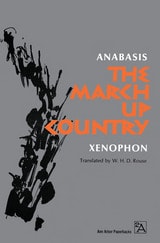
March Up Country
a translation of Xenophon's AnabasisW. H. D. Rouse
University of Michigan Press, 1958

Marsilio Ficino, Three Books on Life
A Critical Edition and TranslationCarol V. Kaske
Arizona Center for Medieval and Renaissance Studies, 2019

Matters of Significance
Replication, Translation and Academic Freedom in developmental scienceMarinus H. van IJzendoorn and Marian J. Bakermans-Kranenburg
University College London, 2024
Application of scientific findings to effective practice and informed policymaking is an aspiration for much research in the biomedical, behavioral, and developmental sciences. But too often translations of science to practice are conceptually narrow and developed quickly as salves to an urgent problem. For developmental science, widely implemented parenting interventions are prime examples of technical translations from knowledge about the causes of children’s mental distress. Aiming to support family relationships and facilitate adaptive child development, these programs are rushed through when the scientific findings on which they are based remain contested and without enough evidence of success from randomized controlled trials.
In Matters of Significance, the authors draw on forty years of experience with theoretical, empirical, meta-analytic, and translational work in child development research to highlight the complex relations between replication, translation, and academic freedom. They argue that challenging fake facts promulgated by under-replicated and underpowered studies is also a method of translation. Such a challenge can, in the highlighted field of attachment and emotion regulation research, bust popular myths about the decisive role of genes, hormones, or the brain on parenting and child development, with a balancing impact on practice and policy making. The authors argue that academic freedom from interference by pressure groups, stakeholders, funders, or university administrators in the core stages of research is a necessary but besieged condition for adversarial research and myth-busting.
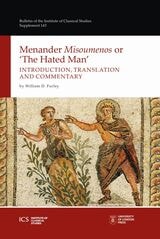
Menander "Misoumenos" or "The Hated Man"
Introduction, Translation, and CommentaryWilliam Furley
University of London Press, 2021
Menander’s Misoumenos, or The Hated Man, is one of his most popular plays to have survived from classical times. Dating to approximately 300 BCE, it tells the story of a mercenary soldier and the captive girl he acquires while on campaign in Cyprus. The play follows the soldier’s growing despair as the girl spurns his advances and slowly turns against him, culminating in his suicidal thoughts.
The play belongs to the ancient genre of New Comedy, of which Menander was the acknowledged master. This edition presents a significantly updated text and the fullest English language translation of the play to date. It aims to restore as much as possible of the action of Misoumenos, reconstructing the language, stagecraft, and theatrical dialogue of the original based on hypothesis and reconstruction. Some sections can be restored nearly in full, permitting access to brilliantly original theatrical dialogue which had been lost for over two millennia. Apart from meter and sophisticated idiom, the themes of love, despair, and sadness that Menander treats are utterly timeless.

Modern Swedish Prose in Translation
Karl Erik Lagerlof, Editor
University of Minnesota Press, 1979
Modern Swedish Prose in Translation was first published in 1979. Minnesota Archive Editions uses digital technology to make long-unavailable books once again accessible, and are published unaltered from the original University of Minnesota Press editions.
These excerpts from Swedish prose works - mostly novels - reflect major shifts in mood and style in the 25 years since 1950. Editor Karl Erik Lagerlof traces cultural and political developments in Sweden from the post-World War II era, when writers felt themselves in a world devoid of political meaning and rejected realism as a literary mode, down to the intensely political years of the Vietnam era. The selections in this anthology range from the anti-ideological works of the postwar years to recent documentary methods influenced by Marxism, structuralism, and a renewed political consciousness.