90 books match the query 'Trees' and 6 start with m
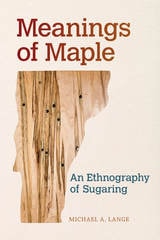
cover of Meanings of Maple: An Ethnography of Sugaring

Meanings of Maple

An Ethnography of Sugaring

Michael Lange

University of Arkansas Press, 2017

In Meanings of Maple, Michael A. Lange provides a cultural analysis of maple syrup making, known in Vermont as sugaring, to illustrate how maple syrup as both process and product is an aspect of cultural identity.

Readers will go deep into a Vermont sugar bush and its web of plastic tubes, mainline valves, and collection tanks. They will visit sugarhouses crammed with gas evaporators and reverse-osmosis machines. And they will witness encounters between sugar makers and the tourists eager to invest Vermont with mythological fantasies of rural simplicity.

So much more than a commodity study, Meanings of Maple frames a new approach for evaluating the broader implications of iconic foodways, and it will animate conversations in food studies for years to come.
[more]
cover of Memory of Trees: A Daughter’s Story of a Family Farm

Memory of Trees

A Daughter’s Story of a Family Farm

Gayla Marty

University of Minnesota Press, 2013


Memory of Trees is a multigenerational story of Gayla Marty’s family farm near Rush City, Minnesota. Cleared from woodlands by her great-grandfather Jacob in the 1880s, the farm passed to her father, Gordon, and his brother, Gaylon. Hewing to a conservative Swedish Baptist faith, the two brothers worked the farm, raising their families in side-by-side houses.


As the years go by, the families grow—and slowly grow apart. Uncle Gaylon, more doctrinaire in his faith, rails against the permissiveness of Gayla’s parents. Financial tensions arise as well when the farm economy weakens and none of the children is willing or able to take over. Gayla is encouraged to leave for college, international travel, and city life, but the farm remains essential to her sense of self, even after the family decides to sell the land.


When Gaylon has an accident on a tractor, Gayla becomes driven to reconnect with him and to find out why she and her uncle—once so close but now estranged—were the only two members of the family who had resisted selling the land. Guided by vivid images of the farm’s many beautiful trees, she pores over sacred and classical works as well as layers of her own memory to understand the forces that have transformed the American landscape and culture in the last half of the twentieth century. Beneath the belief in land as a giver of life and blessing, she discovers a powerful anxiety born of human uprootedness and loss. Movingly written, Memory of Trees will resonate for many with attachments to small towns or farms, whether they continue to work the land or, like so many, have left for a different life.


[more]
cover of Michigan Shrubs and Vines: A Guide to Species of the Great Lakes Region

Michigan Shrubs and Vines

A Guide to Species of the Great Lakes Region

Burton V. Barnes, Christopher W. Dick, and Melanie E. Gunn

University of Michigan Press, 2016
Shrubs and vines are some of the most diverse and widespread plants in the Great Lakes Region. Michigan Shrubs and Vines is the must-have book for anyone who wishes to identify and learn about these fascinating plants. Presented in the same attractive, easy-to-use format as the classic Michigan Trees, the book gives detailed descriptions of 132 species, providing concise information on key characters, habitat, distribution, and growth pattern. Precise line drawings accompany each species description and illustrate arrangement and characteristics of leaves, flowers, and fruits in addition to stem structure to assist with reliable year-round identification. A thorough introduction covers the features and forms of shrubs and vines as well as their natural history, their role in landscape ecosystems, and their occurrence in regional ecosystems of North America and plant communities of the Great Lakes. This long awaited companion to Michigan Trees will appeal to botanists, ecologists, students, and amateur naturalists alike.

[more]
cover of Michigan Trees, Revised and Updated: A Guide to the Trees of the Great Lakes Region

Michigan Trees, Revised and Updated

A Guide to the Trees of the Great Lakes Region

Burton V. Barnes and Warren H. Wagner, Jr.

University of Michigan Press, 2004

Now in its tenth decade of publication, Michigan Trees has been, since it was first introduced in 1913, the must-have reference book for anyone who wants to know about the trees of this unique North American region.

In this new and updated edition, several new species have been added to the lineup, as well as sections on tree ecology and fall color. Written and illustrated in a style that appeals at once to academic botanists and armchair arborphiles alike, Michigan Trees gives readers everything they need to know for identifying trees in the Great Lakes state. Included with each description are fascinating notes and asides (for example, this tidbit on the jack pine: "Parklike or savanna stands in north-central Michigan are prime habitat for the rare Kirtland's warbler that breeds nowhere else in the world."). Also includes a tree key and identification section illustrated with elegantly simple line drawings that reveal the tiny, signature details that make each tree unique.

Burton V. Barnes is Professor of Forestry at the University of Michigan. Formerly a research forester, he is best known for his research and publications in forest ecology and forest genetics.

Warren H. Wagner, Jr. was a world authority on ferns. He had been Professor Emeritus of Botany and Natural Resources at the University of Michigan before his death at the age of 80 in 2000.
[more]
cover of Midwestern Native Shrubs and Trees: Gardening Alternatives to Nonnative Species: An Illustrated Guide

Midwestern Native Shrubs and Trees

Gardening Alternatives to Nonnative Species: An Illustrated Guide

Charlotte Adelman, Bernard L. Schwartz

Ohio University Press, 2016

In this companion volume to the bestselling The Midwestern Native Garden: Native Alternatives to Nonnative Flowers and Plants, Charlotte Adelman and Bernard L. Schwartz offer another indispensible guide to replacing nonnative plants with native alternatives. This time, their subject is the native woody species that are the backbone of our gardens and landscapes. Among other ecological benefits, native shrubs and trees provide birds and butterflies with vital food and reproductive sites that nonnative species cannot offer. And they tend to be hardier and easier to maintain. The authors provide a comprehensive selection of native woody alternatives that, season by season, provide effects similar to those of nonnative shrubs and trees used for ornamental purposes and shade. These plants are suitable for all garden styles, provide blooms and fall color, and have the same cultivation requirements as their nonnative counterparts. Nature notes alert readers to the native species’ unique ecological roles. Unlike other gardening guides, Midwestern Native Shrubs and Trees goes beyond mere suggestion to provide gardeners with the tools they need to make informed, thoughtful choices. Knowing which native species to plant for desired effects empowers landscapers and gardeners to take on a greater role in protecting our midwestern environment.
[more]
cover of Mountains Of Memory: A Fire Lookout'S Life

Mountains Of Memory

A Fire Lookout'S Life

Don Scheese

University of Iowa Press, 2001

In Mountains of Memory, seasoned wilderness dweller Don Scheese charts a long season of watching for and fighting fires in Idaho's River of No Return Wilderness&151the largest federal wilderness area in the mainland United States. An inspiring tale of self-discovery,Mountains of Memory paints a complex portrait of the natural, institutional, and historical forces that have shaped the great forested landscapes of the American West.

A student of nature writing as well as a fire lookout with over a decade of experience, Scheese recounts his life at the top of the world, along with daring adventures such as backpacking and mountaineering in the Bighorn Crags and kayaking down the Middle Fork of the Salmon River. All the while, he touches upon the mysterious and powerful realities of the wilderness around him and stunning dawns visible within the glass cage perched on a 9,000-foot mountain, stirring flashes of lightning visible all around the dark landscape as the radio crackles with reports of strikes observed and fires spotted, long-awaited trips down the mountain to civilization for cold beer and hot pizza.
In the tradition of Edward Abbey and Gary Snyder, Don Scheese offers readers a meditation on the meaning and value of wilderness at the beginning of the twenty-first century.
[more]