Results by title
98 books match the query 'Urban renewal' and 6 start with m
MERCHANT OF ILLUSION
James Rouse, America’s Salesman of the Businessman’s UtopiaNicholas Dagen Bloom
The Ohio State University Press, 2004
Making Mexican Chicago
From Postwar Settlement to the Age of GentrificationMike Amezcua
University of Chicago Press, 2022
Though Chicago is often popularly defined by its Polish, Black, and Irish populations, Cook County is home to the third-largest Mexican-American population in the United States. The story of Mexican immigration and integration into the city is one of complex political struggles, deeply entwined with issues of housing and neighborhood control. In Making Mexican Chicago, Mike Amezcua explores how the Windy City became a Latinx metropolis in the second half of the twentieth century.
In the decades after World War II, working-class Chicago neighborhoods like Pilsen and Little Village became sites of upheaval and renewal as Mexican Americans attempted to build new communities in the face of white resistance that cast them as perpetual aliens. Amezcua charts the diverse strategies used by Mexican Chicagoans to fight the forces of segregation, economic predation, and gentrification, focusing on how unlikely combinations of social conservatism and real estate market savvy paved new paths for Latinx assimilation. Making Mexican Chicago offers a powerful multiracial history of Chicago that sheds new light on the origins and endurance of urban inequality.
Making the Mission
Planning and Ethnicity in San FranciscoOcean Howell
University of Chicago Press, 2015
In Making the Mission, Ocean Howell tells the story of how residents of the Mission District organized to claim the right to plan their own neighborhood and how they mobilized a politics of place and ethnicity to create a strong, often racialized identity—a pattern that would repeat itself again and again throughout the twentieth century. Surveying the perspectives of formal and informal groups, city officials and district residents, local and federal agencies, Howell articulates how these actors worked with and against one another to establish the very ideas of the public and the public interest, as well as to negotiate and renegotiate what the neighborhood wanted. In the process, he shows that national narratives about how cities grow and change are fundamentally insufficient; everything is always shaped by local actors and concerns.
Marketing Schools, Marketing Cities
Who Wins and Who Loses When Schools Become Urban AmenitiesMaia Bloomfield Cucchiara
University of Chicago Press, 2013
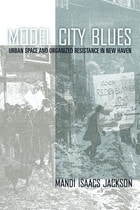
Model City Blues
Urban Space and Organized Resistance in New HavenMandi Isaacs Jackson
Temple University Press, 2008
Model City Blues tells the story of how regular people, facing a changing city landscape, fought for their own model of the “ideal city” by creating grassroots plans for urban renewal. Filled with vivid descriptions of significant moments in a protracted struggle, it offers a street-level account of organized resistance to institutional plans to transform New Haven, Connecticut in the 1960s. Anchored in the physical spaces and political struggles of the city, it brings back to center stage the individuals and groups who demanded that their voices be heard.
By reexamining the converging class- and race-based movements of 1960s New Haven, Mandi Jackson helps to explain the city's present-day economic and political struggles. More broadly, by closely analyzing particular sites of resistance in New Haven, Model City Blues employs multiple academic disciplines to redefine and reimagine the roles of everyday city spaces in building social movements and creating urban landscapes.
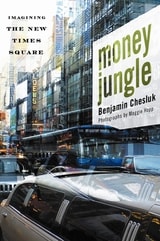
Money Jungle
Imagining the New Times SquareChesluk, Benjamin
Rutgers University Press, 2008
For more than a century, Times Square has mesmerized the world with the spectacle of its dazzling supersigns, its theaters, and its often-seedy nightlife. New York City’s iconic crossroads has drawn crowds of revelers, thrill-seekers, and other urban denizens, not to mention lavish outpourings of advertising and development money.
Many have hotly debated the recent transformation of this legendary intersection, with voices typically falling into two opposing camps. Some applaud a blighted red-light district becoming a big-budget, mainstream destination. Others lament an urban zone of lawless possibility being replaced by a Disneyfied, theme-park version of New York. In Money Jungle, Benjamin Chesluk shows that what is really at stake in Times Square are fundamental questions about city life—questions of power, pleasure, and what it means to be a citizen in contemporary urban space.
Chesluk weaves together surprising stories of everyday life in and around the Times Square redevelopment, tracing the connections between people from every level of this grand project in social and spatial engineering: the developers, architects, and designers responsible for reshaping the urban public spaces of Times Square and Forty-second Street; the experimental Midtown Community Court and its Times Square Ink. job-training program for misdemeanor criminals; encounters between NYPD officers and residents of Hell’s Kitchen; and angry confrontations between city planners and neighborhood activists over the future of the area.
With an eye for offbeat, telling details and a perspective that is at once sympathetic and critical, Chesluk documents how the redevelopment has tried, sometimes successfully and sometimes not, to reshape the people and places of Times Square. The result is a colorful and engaging portrait, illustrated by stunning photographs by long-time local photographer Maggie Hopp, of the street life, politics, economics, and cultural forces that mold America’s urban centers.