Results by title
53 books match the query 'Wildlife' and 4 start with m

Mammals of the Southeastern United States
Troy L. Best and John L. Hunt
University of Alabama Press, 2020
First comprehensive account of the mammals of the entire southeastern US
The southeastern United States is home to a remarkable and diverse mammalian fauna that is a significant part of the region’s rich natural heritage. Mammals of the Southeastern United States presents accounts of 137 species that currently or previously occurred in the Southeast. Although accessible and useful for the generalist, this book provides an up-to-date compilation of basic knowledge about native and nonnative mammals of the region that is suitable for students of all ages and for professional mammalogists and biologists alike.
This volume profiles common species like the eastern gray squirrel, the white-tailed deer, and the Virginia opossum, but also includes among its accounts many extant species, such as the jaguar and porcupine, that once occurred in the region; native species, like the Caribbean monk seal, that are now extinct; native species that have been extirpated, or wiped out, from all or part of the region, such as the red wolf, cougar, American bison, and elk; and many introduced species, including the Mexican mouse opossum, common squirrel monkey, and capybara.
Each species account includes full-color images of the animal, plates featuring at least three views of its skull, color distribution maps of its approximate geographic range in the Southeast and in North America, and an up-to-date synthesis of several aspects of its biology, including habitat, diet, predators, parasites, diseases, and behaviors. An introductory chapter on conservation summarizes the current status of mammalian populations in the region and provides insight into some of the threats mammals now encounter in the Southeast.
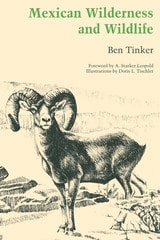
Mexican Wilderness and Wildlife
By Ben Tinker
University of Texas Press, 1978
From the mountainous area bordering Arizona and New Mexico, the western range of the Sierra Madres reaches south into Mexico to the state of Jalisco. The eastern range stretches from the Texas border down to Morelia and the Valley of Mexico. Ben Tinker spent years exploring this rugged wilderness and the vast deserts of Sonora and Baja California. Mexican Wilderness and Wildlife condenses a lifetime of outdoor lore and learning.
Tinker provides detailed life sketches of Mexico's Desert Bighorn Sheep, Pronghorn Antelope, Mule Deer, Whitetail Deer, Peccary, Grizzly and Black Bears, Wild Turkey, Jaguar, Mountain Lion, Timber Wolf, Coyote, and Bobcat. Each is illustrated by wildlife artist Doris Tischler, and Tinker describes their habitats, habits, reproduction, and peculiarities. Information is supplied on the physical measurements of several species of major wildlife. Tinker's observations are laced with anecdotes about his experiences in Mexico's remote backcountry—encounters with bandits, survival in the desert mountains, and the chance discovery of archaeological ruins.
The book describes the terrain and flora of the four life zones inhabited by major game and predatory animals. The section on desert water is a fascinating account of how animals thrive among cacti, thorn trees, and creosote bush remote from streams and waterholes. There is also a brief discussion of conservation efforts in Mexico, chapters on trout fishing in the Sierra Madre Occidental and Baja California, and a guide to big game habitats. This volume will be valuable to hunters, conservationists, naturalists, and others interested in the wilderness and wildlife of Mexico.
Ben Tinker collected much of the material for this book during the years he roamed northern Mexico as Federal Game Guardian. Though an American, Tinker had long been familiar with Mexican wildlife through his Sonoran ranching operation and was known for his interest in conservation when he was appointed by Alvaro Obregón in 1922.

Mortal Stakes
Hunters and Hunting in Contemporary AmericaJan E. Dizard
University of Massachusetts Press, 2003
Each autumn, millions of men and increasing numbers of women don camouflage or blaze orange outfits and go afield in pursuit of game. For much of American history, there was no need to explain why they did this. Hunting was simply another aspect of the annual cycle of planting, breeding, and harvesting. But modern hunting began separating from its agrarian roots well over a century ago, and although it has retained its connection to the metaphor of the harvest, the self-perceptions and motives of hunters today are no longer transparent, especially to nonhunters. Indeed, hunting—and those who hunt—have become targets of a vocal and growing array of critics.
In Mortal Stakes, Jan E. Dizard examines the place of hunting in contemporary America. Drawing on detailed interviews with hunters as well as opinion surveys and demographic statistics, he analyzes the meanings these men and women attach to hunting and situates this traditional activity in its current setting. He looks at who hunts, how they compare socially and politically with nonhunters, and how they see themselves and are seen by others.
With fewer and fewer Americans closely linked to the land, hunting seems less ordinary and less necessary. As the gulf between hunters and nonhunters widens, hunters have begun to think of themselves as a minority group which, like other minorities, suffers from prejudice and stereotyping. As a result, Dizard argues, hunting is fast becoming one more front in an expanding “culture war” over what it means to be an American.
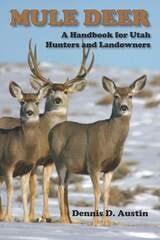
Mule Deer
A Handbook for Utah Hunters and LandownersDennis D. Austin
Utah State University Press, 2010
A complete guide to the history, biology, hunting, and management of mule deer in Utah. The author, Dennis D. Austin, is a retired research scientist with more than thirty years of experience working as a wildlife biologist for the Utah Division of Wildlife Resources.