Results by title
1296 books match the query 'Women authors' and 70 start with m
MAKING THE “AMERICA OF ART”
Cultural Nationalism and Nineteenth-Century Women WritersNaomi Z. Sofer
The Ohio State University Press, 2005
By the end of the 19th century it had become possible for American women to identify themselves as serious Artists. This was a relatively new phenomenon, one that became possible only after American women writers had dismantled the conceptual frameworks that had authorized their artistic production since the early days of the Republic.
Making the “America of Art” demonstrates that beginning in the 1850s, women writers challenged the terms of the Scottish Common Sense philosophy, which had made artistic endeavors acceptable in the new Republic by subordinating aesthetic motivation to moral and educational goals. Harriet Beecher Stowe and Augusta Jane Evans drew on Ruskin to argue for the creation of a religiously based national aesthetic. In the postbellum years Louisa May Alcott, Rebecca Harding Davis, Elizabeth Stuart Phelps, and Constance Fenimore Woolson continued the process in a series of writings that revolved around three central areas of concern: the place of the popular in the realm of high art; the role of the genius; and the legacy of the Civil War.
Sofer significantly revises the history of 19th-century American women’s authorship by detailing the gradual process that produced women writers wholly identified with literary high culture at the century’s end. Sofer argues that, counter to conventional wisdom, American women writers produced a large body of theoretical writing on the central aesthetic questions of the day. Although the writers Sofer studies were finally unable to construct viable new models for women’s artistic production, their attempts to do so are an essential piece of American literary history.
MIDDLE PASSAGES AND THE HEALING PLACE OF HISTORY
MIGRATION AND IDENTITY IN BLACK WOMEN'S LITERATUREELIZABETH BROWN-GUILLORY
The Ohio State University Press, 2006
This volume reveals that black women across the globe share a common ground fraught with struggles, but the narratives bear out that these women are not easily divided and that they stand upon each other’s shoulders dispensing healing balms. Black women’s history and herstory commingle; the trauma that ensued when Africans were loaded onto ships in chains continues to haunt black women, and men, too, wherever they find themselves in this present moment of the Diaspora.
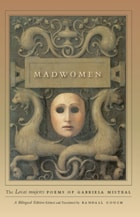
Madwomen
The "Locas mujeres" Poems of Gabriela Mistral, a Bilingual EditionGabriela Mistral
University of Chicago Press, 2008
A schoolteacher whose poetry catapulted her to early fame in her native Chile and an international diplomat whose boundary-defying sexuality still challenges scholars, Gabriela Mistral (1889–1957) is one of the most important and enigmatic figures in Latin American literature of the last century. The Locas mujeres poems collected here are among Mistral’s most complex and compelling, exploring facets of the self in extremis—poems marked by the wound of blazing catastrophe and its aftermath of mourning.
From disquieting humor to balladlike lyricism to folkloric wisdom, these pieces enact a tragic sense of life, depicting “madwomen” who are anything but mad. Strong and intensely human, Mistral’s poetic women confront impossible situations to which no sane response exists. This groundbreaking collection presents poems from Mistral’s final published volume as well as new editions of posthumous work, featuring the first English-language appearance of many essential poems. Madwomen promises to reveal a profound poet to a new generation of Anglophone readers while reacquainting Spanish readers with a stranger, more complicated “madwoman” than most have ever known.
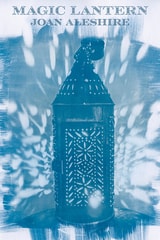
Magic Lantern
Joan Aleshire
Four Way Books, 2026
Conceived of as a memoir in poems of late-life love and its betrayal, Magic Lantern traces the borders of loss and investigates the source of our strength to traverse them, finding the roots of resilience in ordinary interactions and illuminating the undramatic power of simple connections. "At a time of our lives when the only hands / we can expect to touch us this gently / will be wearing latex gloves," Aleshire recounts a tender moment before romantic rupture. "The technician in the ER said softly, / trying to attach your heart monitors, / You’re so hairy, I’m not sure / this will stick, but I thought / it didn’t matter how intimately / they handled you; my love / had covered, would cover / you, before and after them." When the realization of the beloved’s treachery obliterates this lucidity and generosity, the speaker feels violated and estranged from herself, reducing the narrative of the affair to “what we did / in the dark, until we became / the dark.” The private destabilization of this heartache pales but compounds the shadows of a world already rent by international war and domestic political upheaval, but Aleshire orients toward another light source: the rewarding labor of building community and the noble pursuit of seeking meaning itself. The title poem executes a beautiful metacommentary on the value of art, which is to say going to the effort, trying for trying’s sake. At a local filmmaker’s screening, the speaker marvels at the powerful impression the artist has rendered with black-and-white film, astonished by how “the depths and brights, / shadows and gleams... make us watching / feel more.” In these deeply compassionate and vulnerable poems, Aleshire draws our attention to the artistry of our lives, the luminosity we stroke and orchestrate through our meticulous care and enduring bonds. This is the light we see by. A transportative seventh collection, Magic Lantern draws the disordered overwhelm of the human experience into a dazzling, seamless sequence of images, setting the ordinary into motion so that it not only coheres, but glows.
Maid as Muse
How Servants Changed Emily Dickinson’s Life and LanguageAífe Murray
University of New Hampshire Press, 2010
Major Women Writers of Seventeenth-Century England
James Fitzmaurice, Josephine A. Roberts, Carol L. Barash, Eugene R. Cunnar, and Nancy A. Gutierrez, Editors
University of Michigan Press, 1997
Making Girls into Women
American Women's Writing and the Rise of Lesbian IdentityKathryn R. Kent
Duke University Press, 2003
Kent not only analyzes how texts represent queer erotics, but also theorizes how texts might produce them in readers. She describes the ways postbellum sentimental literature such as that written by Harriet Beecher Stowe, Louisa May Alcott, and Emma D. Kelley eroticizes, reacts against, and even, in its own efforts to shape girls’ selves, contributes to the production of queer female identifications and identities. Tracing how these identifications are engaged and critiqued in the early twentieth century, she considers works by Djuna Barnes, Gertrude Stein, Marianne Moore, and Elizabeth Bishop, as well as in the queer subject-forming effects of another modern invention, the Girl Scouts. Making Girls into Women ultimately reveals that modern lesbian identity marks an extension of, rather than a break from, nineteenth-century women’s culture.
Making Men
Gender, Literary Authority, and Women’s Writing in Caribbean NarrativeBelinda Edmondson
Duke University Press, 1998
Discussing the canonical Caribbean narrative as it reflects national identity under the domination of English cultural authority, Belinda Edmondson focuses particularly on the pervasive influence of Victorian sensibilities in the structuring of twentieth-century national identity. She shows that issues of race and English constructions of masculinity not only are central to West Indian identity but also connect Caribbean authorship to the English literary tradition. This perspective on the origins of West Indian literary nationalism then informs Edmondson’s search for female subjectivity in current literature by West Indian women immigrants in America. Making Men compares the intellectual exile of men with the economic migration of women, linking the canonical male tradition to the writing of modern West Indian women and exploring how the latter write within and against the historical male paradigm in the continuing process of national definition.
With theoretical claims that invite new discourse on English, Caribbean, and American ideas of exile, migration, race, gender identity, and literary authority, Making Men will be informative reading for those involved with postcolonial theory, African American and women’s studies, and Caribbean literature.
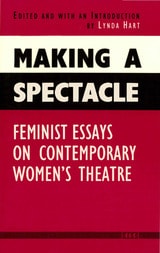
Making a Spectacle
Feminist Essays on Contemporary Women's TheatreEdited and with an Introduction by Lynda Hart
University of Michigan Press, 1988
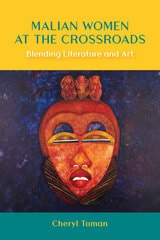
Malian Women at the Crossroads
Blending Literature and ArtCheryl Toman
Michigan State University Press, 2027
Mali’s history is defined by crossroads—geographic, cultural, and intellectual—linking to the Sahara and to long-standing trade routes. Francophone Malian women’s writing reflects this convergence, positioning literature as a site where diverse artistic and cultural traditions meet and evolve. In Malian Women at the Crossroads: Blending Literature and Art, writers such as Aoua Kéita, Aïcha Fofana, Adame Ba Konaré, Fatoumata Sidibé, Zakiyatou oualett Halatine, and Fadimata walett Oumar blur the boundaries between text and artistic practice, incorporating storytelling, visual arts, music, textile design, and other creative forms into their work. These interdisciplinary expressions both honor and reinterpret tradition, illuminating Mali’s cultural diversity while challenging divisions rooted in gender and ethnicity.
The voices of these writers denounce the conflict that has plagued Mali for over a decade and opt instead for showcasing creativity that preserves the memory of more promising times.
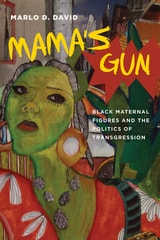
Mama's Gun
Black Maternal Figures and the Politics of TransgressionMarlo D. David
The Ohio State University Press, 2016
Taking inspiration from African American fiction, historical accounts of black life, Afrofuturism, and black popular culture in music and on screen, David turns her attention to Sapphire’s Push, Octavia Butler’s Dawn, and Suzan-Lori Parks’s Getting Mother’s Body as well as the performance art of Erykah Badu and the films of Tyler Perry. She draws out the implications of black maternal figures in these texts who balk at tradition and are far from “ideal.” David’s study shows how representations of blackness are deeply embedded in the neoliberal language of contemporary American politics and how black writers and performers resist such mainstream ideologies with their own transgressive black maternal figures.
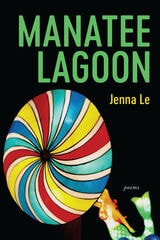
Manatee Lagoon
PoemsJenna Le
Acre Books, 2022
In Manatee Lagoon, sonnets, ghazals, pantoums, villanelles, and a “failed georgic” weave in contemporary subject matter, including social-media comment threads, Pap smears, eclipse glasses, and gun violence. A recurring motif throughout the collection, manatees become a symbol with meanings as wide-ranging as the book itself. Le aligns the genial but vulnerable sea cow with mermaids, neurologists, the month of November, harmful political speech, and even a family photo at the titular lagoon.
In these poems, Le also reflects on the experience of being the daughter of Vietnamese refugees in today’s sometimes tense and hostile America. The morning after the 2016 election, as three women of color wait for the bus, one says, “In this new world, we must protect each other.”
Manatee Lagoon is a treasury of voices, bringing together the personal and the persona, with poems dedicated to Kate Spade, John Ashbery, and Uruguayan poet Delmira Agustini. With this book, Le establishes herself as a talented transcriber of the human condition—and as one of the finest writers of formal verse today.
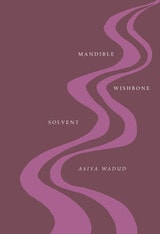
Mandible Wishbone Solvent
Asiya Wadud
University of Chicago Press, 2024
The poetry of Mandible Wishbone Solvent is situated in the space of bridges, fragmentary overlays, spectral reach, and the desire to keep reaching. Asiya Wadud’s poems engage in this act, not to stake a claim or to fasten themselves, but to hold fragments together in order to offer possibilities for connection and extension. Throughout the collection lies an acknowledgment that any hold will drift, meander, and find new paths, with each separation making space for new entanglements. Drawing on a keen interest in tactility and ekphrasis, Wadud mines the repetition and extension that comes with any fractured state of existence and considers the nature of a residual and roving we.
Following this selection of lyrical, ekphrastic, fragmented poems, the book concludes with two prose pieces that dwell on the concepts of “isthmus” and “drift,” respectively, which offer further grounds for contemplation and provide a frame for the poems.
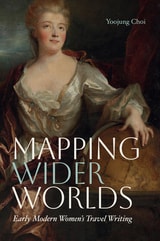
Mapping Wider Worlds
Early Modern Women's Travel WritingYoojung Choi
University of Delaware Press, 2027
Mapping Wider Worlds uncovers how early professional women writers in Britain invented a genre of women’s travel fiction in an era of increased mobility and exploration. As marketplace authorship began to take shape, writers such as Delarivier Manley, Mary Davys, Penelope Aubin, and Eliza Haywood turned to this genre to challenge the link between women’s travel and promiscuity, positioning travel instead as a site of knowledge production and self-discovery. In this book, Yoojung Choi reveals how these women authors not only reshaped cultural attitudes toward women’s mobility, but also redefined professional authorship in the late seventeenth and early eighteenth centuries, preceding and paving the way for travel literature by Lady Mary Wortley Montagu, Hester Piozzi, and Mary Wollstonecraft.

Margaret Atwood
Vision and FormsEdited by Kathryn Van Spanckeren and Jan Garden Castro. Foreword by Margaret Atwood
Southern Illinois University Press, 1988
A prolific writer and versatile social critic, Canadian novelist and poet Margaret Atwood has recently published Bluebeard’s Egg (short stories), Interlunar (poetry), and The Handmaid’s Tale a critically acclaimed best-selling novel.
This international collection of essays evaluates the complete body of her work—both the acclaimed fiction and the innovative poetry. The critics represented here—American, Australian, and Canadian—address Atwood’s handling of such themes as feminism, ecology, the gothic novel, and the political relationship between Canada and the United States.
The essays on Atwood’s novels introduce the general reader to her development as a writer, as she matures from a basically subjective, poetic vision, seen in Surfacing and The Edible Woman, to an increasingly engaged, political stance, exemplified by The Handmaid’s Tale. Other essays examine Atwood’s poetry, from her transformation of the Homeric model to her criticisms of the United States’ relationship with Canada. The last two critical essays offer a unique view of Atwood through an investigation of her use of the concept of shamanism and through a presentation of eight of her vivid watercolors.
The volume ends with Atwood presenting her own views in an interview with Jan Garden Castro and in a conversation between Atwood and students at the University of Tampa, Florida.

Margaret Fuller and Her Circles
Brigitte Bailey
University of New Hampshire Press, 2013
Marianne Moore, Elizabeth Bishop, and May Swenson
The Feminist Poetics of Self-RestraintKirstin Hotelling Zona
University of Michigan Press, 2002
In recent years critical studies of Bishop and Moore have flourished, a large percentage of them devoted to explorations of sexuality and gender. A gap is growing, however, between feminist repossessions of Moore and Bishop and recent readings of their antiessentialist poetics. On the one hand, these poets are appearing more frequently in the feminist canon, but the price of this inclusion is usually the suppression of their strategies of self-restraint. While Zona questions the poetic privileging of self-expression, she establishes contiguity between feminist poetry and developments in American poetry at large. In doing so she asserts the centrality of feminist poetry within discussions of contemporary American poetry, thereby challenging the common perception of feminist poetry as an "alternative" (which often means auxiliary) genre.
Kirstin Hotelling Zona is Assistant Professor of Poetry and Poetics, Illinois State University.
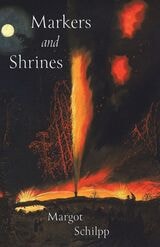
Markers and Shrines
Margot Schilpp
Carnegie Mellon University Press, 2025
In Markers and Shrines, Margot Schilpp traces the moments that define us—the losses that strip away our former selves and the resilience that emerges in their wake. These poems illuminate the way the past etches itself onto the future, displaying how experience, no matter how painful, strengthens and redefines us.
With lyrical precision and a musician’s ear for language, Schilpp crafts a world where memory lingers and meaning deepens. Her unembellished eloquence and eye for striking detail turn the everyday into something enlightening, reminding us that even in loss, there is beauty. Markers and Shrines is a reflection on survival and the unseen forces that shape who we become.
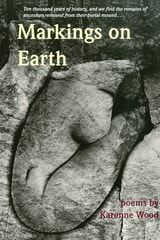
Markings on Earth
Karenne Wood
University of Arizona Press, 2001
“Ten thousand years of history, and we find the remains
of ancestors removed from their burial mound . . . “
Impressions of the past, markings on earth, are part of the world of Karenne Wood. A member of the Monacan tribe of Virginia, she writes with insight and grace on topics that both reflect and extend her Native heritage.
Markings on Earth is a cyclical work that explores the many dimensions of human experience, from our interaction with the environment to personal relationships. In these pages we relive the arrival of John Smith in America and visit the burial mounds of the Monacan people, experience the flight of the great blue heron and witness the dance of the spider. We also share the personal journey of one individual who seeks to overcome her sense of alienation from her people and her past.
Wood’s palette is not only Nature but human nature as well. She writes pointedly about shameful episodes of American history, such as the devastation of Appalachia by mining companies and the “disappearance” of Indian peoples. She also addresses forms of everyday violence known to many of us, such as alcoholism and sexual abuse. Wood conveys an acceptance of history and personal trauma, but she finds redemption in a return to tradition and a perception of the world’s natural grace.
Through these elegantly crafted words, we come to know that Native writers need not be limited to categorical roles determined by their heritage. Markings on Earth displays a fidelity to human experience, evoking that experience through poems honed to perfection. It is an affirmation of survival, a work that suggests one person’s life cannot be separated from the larger story of its community, its rootedness in history, and its timeless connections to the world.
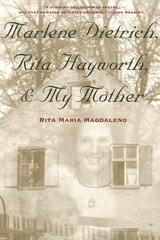
Marlene Dietrich, Rita Hayworth, & My Mother
Rita Maria Magdaleno
University of Arizona Press, 2003
Rita Magdaleno was born near Dachau shortly after World War II to a German mother and a Mexican American GI. Her family moved to Arizona in 1947, and Rita was raised with her father's traditions—but she remains at heart a child of two cultures.
This poetic memoir, recalling Magdaleno's return to the land of her birth, is an intertwining of personal and public history, bridging continents and cultures in search of family secrets. Her poems recall a mother "Marlene Dietrich pretty, / her smoky voice / & those wide Aryan / eyes that promised / never to lie," a war bride who named her child after a Hollywood movie star even before casting eyes on America. They also offer a new, intimate view of the war—and of today's reunified Germany—and show that the consequences of events played out half a century ago continue to resonate with the children of that era.
Magdaleno navigates currents of emotion that would drown less capable poets. With patience, courage, and abiding love, she draws on memories of mother and motherland to show us that healing can come in many forms.
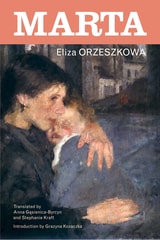
Marta
A NovelEliza Orzeszkowa
Ohio University Press, 2018
Eliza Orzeszkowa was a trailblazing Polish novelist who, alongside Leo Tolstoy and Henryk Sienkiewicz, was a finalist for the 1905 Nobel Prize in Literature. Of her many works of social realism, Marta (1873) is among the best known, but until now it has not been available in English. Easily a peer of The Awakening and A Doll’s House, the novel was well ahead of the English literature of its time in attacking the ways the labor market failed women.
Suddenly widowed, the previously middle-class Marta Świcka is left penniless and launched into a grim battle for her survival and that of her small daughter. As she applies for job after job in Warsaw—portrayed here as an every-city, an unforgiving commercial landscape that could be any European metropolis of the time—she is told time after time that only men will be hired, that men need jobs because they are fathers and heads of families.
Marta burns with Orzeszkowa’s feminist conviction that sexism was not just an annoyance but a threat to the survival of women and children. It anticipated the need for social safety nets whose existence we take for granted today, and could easily read as an indictment of current efforts to dismantle those very programs. Tightly plotted and exquisitely translated by Anna Gąsienica-Byrcyn and Stephanie Kraft, Marta resonates beyond its Polish setting to find its place in women’s studies, labor history, and among other works of nineteenth-century literature and literature of social change.
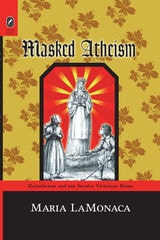
Masked Atheism
Catholicism and the Secular Victorian HomeMaria LaMonaca
The Ohio State University Press, 2008
Why did the Victorians hate and fear Roman Catholics so much? This question has long preoccupied literary and cultural scholars alike. Masked Atheism: Catholicism and the Secular Victorian Home by Maria LaMonaca begins with the assumption that anti-Catholicism reveals far more about the Victorians than simple theological disagreements or religious prejudice. An analysis of anti-Catholicism exposes a host of anxieties, contradictions, and controversies dividing Great Britain, the world’s most powerful nation by the mid-nineteenth century.
Noting that Catholicism was frequently caricatured by the Victorians as “masked atheism”—that is, heathenism and paganism masquerading as legitimate Christianity—LaMonaca’s study suggests that much anti-Catholic rhetoric in Victorian England was fueled by fears of encroaching secularism and anxieties about the disappearance of God in the modern world. For both male and female writers, Catholicism became a synonym for larger, “ungodly” forces threatening traditional ways of life: industrialization, rising standards of living, and religious skepticism.
LaMonaca situates texts by Charlotte Brontë, George Eliot, Christina Rossetti, Elizabeth Barrett Browning, Michael Field, and others against a rich background of discourses about the growing visibility of Anglo and Roman Catholicism in Victorian England. In so doing, she demonstrates the influence of both pro- and anti-Catholic sentiment on constructs of Victorian domesticity, and explores how writers appropriated elements of Catholicism to voice anxieties about the growing secularization of the domestic sphere: a bold challenge to sentimental notions of the home as a “sacred” space. Masked Atheism will contribute a fresh perspective to an ongoing conversation about the significance of Catholicism in Victorian literature and culture.
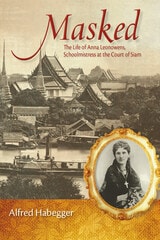
Masked
The Life of Anna Leonowens, Schoolmistress at the Court of SiamAlfred Habegger
University of Wisconsin Press, 2014
But who was Leonowens and why did her story take hold? Although it has been known for some time that she was of Anglo-Indian parentage and that her tales about the Siamese court are unreliable, not until now, with the publication of Masked, has there been a deeply researched account of her extraordinary life. Alfred Habegger, an award-winning biographer, draws on the archives of five continents and recent Thai-language scholarship to disclose the complex person behind the mask and the troubling facts behind the myth. He also ponders the curious fit between Leonowens’s compelling fabrications and the New World’s innocent dreams—in particular the dream that democracy can be spread through quick and easy interventions.
Exploring the full historic complexity of what it once meant to pass as white, Masked pays close attention to Leonowens’s midlevel origins in British India, her education at a Bombay charity school for Eurasian children, her material and social milieu in Australia and Singapore, the stresses she endured in Bangkok as a working widow, the latent melancholy that often afflicted her, the problematic aspects of her self-invention, and the welcome she found in America, where a circle of elite New England abolitionists who knew nothing about Southeast Asia gave her their uncritical support. Her embellished story would again capture America’s imagination as World War II ended and a newly interventionist United States looked toward Asia.
Best Books for General Audiences, selected by the American Association of School Librarians
Best Regional Special Interest Boosk, selected by the Public Library Reviewers
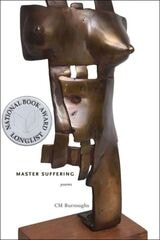
Master Suffering
CM Burroughs
Tupelo Press, 2021

Maternal Body and Voice in Toni Morrison, Bobbie Ann Mason, and Lee Smith
Paula Gallant Eckard
University of Missouri Press, 2002
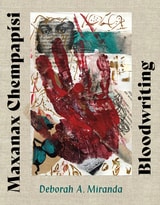
Maxanax Chempapísi / Bloodwriting
Deborah A. Miranda
University of Arizona Press, 2027
In Maxanax Chempapísi / Bloodwriting lyric poems exploring Esselen words and concepts traverse a supporting cast of prose poems about contemporary life as a queer, Indigenous recovering academic. Deborah A. Miranda witnesses the lives of women who are lovers, mothers, daughters, sisters, and grandmothers caught in a chain of ongoing apocalypse that stretches from the colonization of North America to the current Anthropocene.
These poems are small but potent ceremonies that center relationship as medicinal. They speak of the ugliness of genocide, substance abuse, environmental destruction, and homophobia with searing fury. They linger on the sacred powers found within a river—“A web of fireflies weaving constellations in the alder’s branches”—or the wonder of “The first woman / who stole my heart / rose up / from the earth / like a creation story.” Throughout this collection, images weave connections between women’s bodies and the moon, bodies and earth, bodies and constellations that surround us. Esselen, Miranda’s Indigenous language, acts as a bridge that translates some of these ancient struggles and insights into contemporary images.
This collection resists the separation of the body, the spirit, and the sacred. It seeks a reunion of true relationship in the midst of chaos and uncertainty. Miranda balances praise for the burning—but still beautiful and holy—world and grief for the loss of beings and places that cannot be recovered.
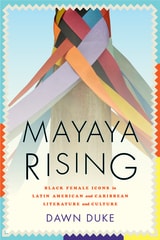
Mayaya Rising
Black Female Icons in Latin American and Caribbean Literature and CultureDawn Duke
Bucknell University Press, 2023
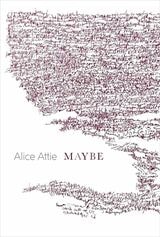
Maybe
Alice Attie
Seagull Books, 2026
The poems in Maybe form a tapestry of voices that slip from visibility to invisibility, illusion to disillusion, the conceivable to the inconceivable. Alice Attie writes of boundaries loosening, of transformations and transfigurations born of the unknown and the uncertain. Her poems suggest that this world will dissolve, and it will reappear as something other, something ineffable yet lodged in language, something fraught with an urgency that is both sublime and unbearable. Attie asks from what vantage point can the seer see, the writer write, the listener hear, learning ultimately that “for the length of my years to lengthen, I place the pebble on my tongue and rearrange the boundaries”?
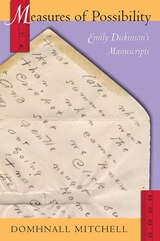
Measures of Possibility
Emily Dickinson's ManuscriptsDomhnall Mitchell
University of Massachusetts Press, 2005
In Measures of Possibility, Domhnall Mitchell sets out to test the hypothesis of Dickinson's textual radicalism, and its consequences for readers, students, and teachers, by looking closely at features such as spacing, the physical direction of the writing, and letter-shapes in handwritten lyric and epistolary texts. Through systematic contextualization and cross-referencing, Mitchell provides the reader with a critical apparatus by which to measure the extent to which contemporary approaches to Dickinson's autograph procedures can reasonably be formulated as corresponding to the poet's own purposes.
Medbh McGuckian
Borbála Faragó
Bucknell University Press, 2025
Published by Bucknell University Press. Distributed worldwide by Rutgers University Press.
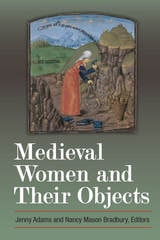
Medieval Women and Their Objects
Jenny Adams and Nancy Mason Bradbury, editors
University of Michigan Press, 2016
The opening section looks at how medieval authors imagined fictional and legendary women using particular objects in ways that reinforce or challenge gender roles. These women bring objects into the orbit of gender identity, employing and relating to them in a literal sense, while also taking advantage of their symbolic meanings. The second section focuses on the use of texts both as objects in their own right and as mechanisms by which other objects are defined. The possessors of objects in these essays lived in the world, their lives documented by historical records, yet like their fictional and legendary counterparts, they too used objects for instrumental ends and with symbolic resonances. The final section considers the objectification of medieval women’s bodies as well as its limits. While this at times seems to allow for a trade in women, authorial attempts to give definitive shapes and boundaries to women’s bodies either complicate the gender boundaries they try to contain or reduce gender to an ideological abstraction. This volume contributes to the ongoing effort to calibrate female agency in the late Middle Ages, honoring the groundbreaking work of Carolyn P. Collette.
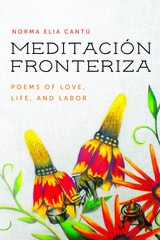
Meditación Fronteriza
Poems of Love, Life, and LaborNorma Elia Cantú
University of Arizona Press, 2019
The poems are a celebration of culture, tradition, and creativity that navigates themes of love, solidarity, and political transformation. Deeply personal yet warmly relatable, these poems flow from Spanish to English gracefully. With Gloria Anzaldúa’s foundational work as an inspiration, Meditación Fronteriza unveils unique images that provide nuance and depth to the narrative of the borderlands.
Poems addressed to talented and influential women such as Gwendolyn Brooks and Adrienne Rich, among others, pour gratitude and recognition into the collection. While many of the poems in Meditación Fronteriza are gentle and inviting, there are also moments that grieve for the state of the borderlands, calling for political resistance.
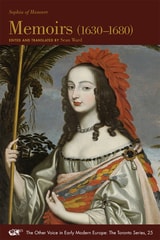
Memoirs (1630-1680)
Sophia of Hanover
Iter Press, 2013
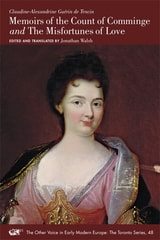
Memoirs of the Count of Comminge and The Misfortunes of Love
Claudine-Alexandrine Guérin de Tencin
Iter Press, 2016
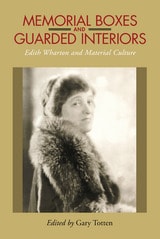
Memorial Boxes and Guarded Interiors
Edith Wharton and Material CultureGary Totten
University of Alabama Press, 2007
In Edith Wharton’s works, references to architecture, interior decoration, painting, sculpture, and fashion abound. As these essays demonstrate, art and objects are for Wharton evidence of cultural belief and reflect the values, assumptions, and customs of the burgeoning consumer culture in which she lived and about which she wrote. Furthermore, her meditations about issues of architecture, design, and decoration serve as important commentaries on her vision of the literary arts.
In The Decoration of Houses she notes that furniture and bric-à-brac are often crowded into a room in order to compensate for a "lack of architectural composition in the treatment of the walls," and that unless an ornamental object "adequately expresses an artistic conception" it is better removed from the room. These aesthetic standards apply equally to her construction of narratives and are evidence of a sensibility that counters typical understandings of Wharton as a novelist of manners and place her instead as an important figure in the development of American literary modernism.
Essays in this collection address issues such as parallels between her characters and the houses they occupy; dress as a metaphor for the flux of critical fashion; the marketing of Wharton's work to a growing female readership ; her relationship to mass culture industries such as advertising, theater, and cinema; the tableaux vivant both as set piece and as fictional strategy; the representation of female bodies as objets d’art; and her characters’ attempts at self-definition through the acquisition and consumption of material goods. All of Wharton’s major novels—The House of Mirth, The Fruit of the Tree, Ethan Frome, The Custom of the Country, Summer, The Age of Innocence, and Twilight Sleep—as well as her short stories, criticism, and essays are explored.
Gary Totten is Assistant Professor of English at North Dakota State University. His essays on Wharton and her contemporaries have appeared in American Indian Quarterly, American Literary Realism, College Literature, Dreiser Studies, and MELUS.
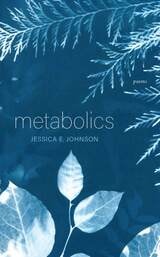
Metabolics
PoemsJessica E. Johnson
Acre Books, 2023
Metabolics, a book-length poem, borrows the movements of metabolic pathways to consider how nature accomplishes both balance and deep transformation. In visual figures and prose blocks that bridge the divide between poetry and nonfiction, Jessica E. Johnson employs scientific idioms to construct an allegory about a family in the Pacific Northwest. The region becomes a character in its own right, with cedars, moss, and heavy cloud knitting the mother, father, boy, and girl into their setting.
This far-reaching volume also serves as a study of the ecologies of contemporary parenting, with adults and children affected by “feeds” both on screen and off as their bodies metabolize food, the environment, and excess feelings such as rage. From climate change to kombucha to smartphones and curated produce, the smallest details of daily life in “Plasticland” catalyze a larger examination of selfhood: “Despite so many attempts to resolve this tension, sometimes you are you and also sometimes mother just as light can be both particle and wave.”
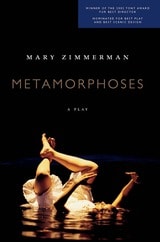
Metamorphoses
A PlayMary Zimmerman
Northwestern University Press, 2002
A beautiful and deeply humane reanimation of Ovid's myths
Called by Time the "theater event of the year," Mary Zimmerman's Metamorphoses brings Ovid's tales to stunning visual life. Set in and around a large pool of water onstage, Metamorphoses juxtaposes the ancient and the contemporary in both language and image to reflect the variety and persistence of narrative in the face of inevitable change. Nominated for three 2002 Tony Awards, including "Best Play," Metamorphoses earned Zimmerman a Tony for "Best Direction of a Play."
Michigan Salvage
The Fiction of Bonnie Jo CampbellLisa DuRose
Michigan State University Press, 2023
Midwife to the Queen of France
Diverse ObservationsLouise Bourgeois
Iter Press, 2017
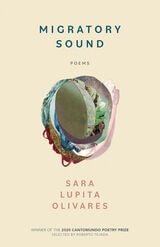
Migratory Sound
PoemsSara Lupita Olivares
University of Arkansas Press, 2020

Milk and Filth
Carmen Giménez Smith
University of Arizona Press, 2013
Adding to the Latina tradition, Carmen Giménez Smith, politically aware and feminist-oriented, focuses on general cultural references rather than a sentimental personal narrative. She speaks of sexual politics and family in a fierce, determined tone voracious in its opinions about freedom and responsibility.
The author engages in mythology and art history, musically wooing the reader with texture and voice. As she references such disparate cultural figures as filmmaker Lars Von Trier, Annie from the film Annie Get Your Gun, Nabokov’s Lolita, Facebook entries and Greek gods, they appear as part of the poet’s cultural critique.
Phrases such as “the caustic domain of urchins” and “the gelatin shiver of tea’s surface” take the poems from lyrical images to comic humor to angry, intense commentary. On writing about “downgrading into human,” she says, “Then what? Amorality, osteoporosis and not even a marble estuary for the ages.”
Giménez Smith’s poetic arsenal includes rapier-sharp wordplay mixed with humor, at times self-deprecating, at others an ironic comment on the postmodern world, all interwoven with imaginative language of unexpected force and surreal beauty. Revealing a long view of gender issues and civil rights, the author presents a clever, comic perspective. Her poems take the reader to unusual places as she uses rhythm, images, and emotion to reveal the narrator’s personality. Deftly blending a variety of tones and styles, Giménez Smith’s poems offer a daring and evocative look at deep cultural issues.
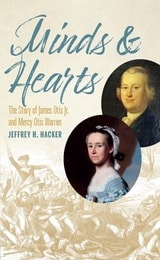
Minds and Hearts
The Story of James Otis Jr. and Mercy Otis WarrenJeffrey H. Hacker
University of Massachusetts Press, 2021
Minds and Hearts is the dual biography of these remarkable siblings, placing James and Mercy in the spotlight together for the first time, amid the rush of events, competing ideologies, and changing social conditions of eighteenth-century America. Jeffrey H. Hacker crafts a compelling narrative that focuses on the Otises' unique and dramatic relationship and traces their impact on the Revolutionary movement in Massachusetts. If the real American Revolution took place "in the minds and hearts of the people," as John Adams claimed, then the Otises were among the nation's true patriots.

Miracle Fruit
Aimee Nezhukumatathil
Tupelo Press, 2003
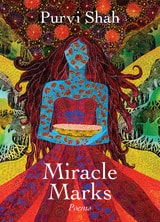
Miracle Marks
PoemsPurvi Shah
Northwestern University Press, 2019
In her second full-length poetry collection, Miracle Marks, activist Purvi Shah charts women’s status through pointed explorations of Hindu iconography and philosophy and powerful critiques of American racism. In these searing, revelatory poems, Shah reminds us that surviving birth as an infant girl and living as a woman is miraculous—as such, every girl is a miracle mark. And because education is often denied to girls, writing by women is a miracle.
In Miracle Marks, Shah probes belonging, devotion, and social inequity, delving into what it means to be a woman, and what it means to be. Through sound energy and white space, these poems chart multiple realities, including the miracles of women’s labors and survivals. This collection spurs dialogue across audiences and communities and lights a way for brown girls and women who relish in spirit, intellect, politics, and justice.
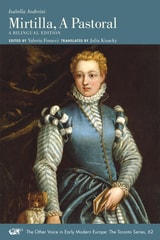
Mirtilla, A Pastoral
A Bilingual EditionIsabella Andreini
Iter Press, 2018
The Other Voice in Early Modern Europe - The Toronto Series: Volume 62
Misery Islands
January Gill O’Neil
CavanKerry Press, 2014
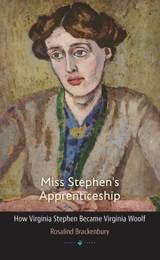
Miss Stephen's Apprenticeship
How Virginia Stephen Became Virginia WoolfRosalind Brackenbury
University of Iowa Press, 2018
During the years leading up to her marriage with Leonard Woolf in 1912, the year in which she finished The Voyage Out and sent it to be published by her cousin at Duckworth’s, the future Virginia Woolf was teaching herself how to be a writer. While her brothers were sent first to private schools, then to Cambridge to be educated, Virginia Stephen and her sister Vanessa were informally educated at home. With this background, how did she know she was a writer? What were her struggles? How did she teach herself? What made Miss Stephen into the author Virginia Woolf?
Miss Stephen’s Apprenticeship explores these questions, delving into Virginia Woolf ’s letters and diaries, seeking to understand how she covered the distance from the wistful “I only wish I could write,” to the almost casual statement, “the novels are finished.” These days, the trajectory of a writer very often starts with studying for an MFA. In Woolf ’s case, however, it’s instructive to ask: How did a great writer, who had no formal education, invent for herself the framework she needed for a writing life? How did she know what she had to learn? How did she make her own way?
Novelist Rosalind Brackenbury explores these questions and others, and in the process reveals what Virginia Woolf can give to young writers today.
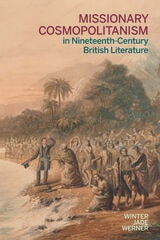
Missionary Cosmopolitanism in Nineteenth-Century British Literature
Winter Jade Werner
The Ohio State University Press, 2020
Missionary Cosmopolitanism identifies the nineteenth-century novel as thematically and formally attuned to the tension between missionaries’ cosmopolitan values and the moral impoverishment of their imperialist and expansionist practices. Werner’s chapters interact with canonical works such as Charlotte Brontë’s Jane Eyre and Charles Dickens’s Bleak House, along with lesser-known works by Robert Southey and Sydney Owenson. Ultimately, Missionary Cosmopolitanism demonstrates that nineteenth-century literature both illustrated and helped define missionary discourses regarding cosmopolitan ideas, showing how global evangelicalism continues to tap into the “new cosmopolitanisms” of today.
Modern Spanish Women as Agents of Change
Essays in Honor of Maryellen BiederSmith, Jennifer
Bucknell University Press, 2019
Published by Bucknell University Press. Distributed worldwide by Rutgers University Press.
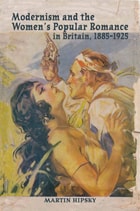
Modernism and the Women’s Popular Romance in Britain, 1885–1925
Martin Hipsky
Ohio University Press, 2011
Today’s mass-market romances have their precursors in late Victorian popular novels written by and for women. In Modernism and the Women’s Popular Romance Martin Hipsky scrutinizes some of the best-selling British fiction from the period 1885 to 1925, the era when romances, especially those by British women, were sold and read more widely than ever before or since.
Recent scholarship has explored the desires and anxieties addressed by both “low modern” and “high modernist” British culture in the decades straddling the turn of the twentieth century. In keeping with these new studies, Hipsky offers a nuanced portrait of an important phenomenon in the history of modern fiction. He puts popular romances by Mrs. Humphry Ward, Marie Corelli, the Baroness Orczy, Florence Barclay, Elinor Glyn, Victoria Cross, Ethel Dell, and E. M. Hull into direct relationship with the fiction of Virginia Woolf, Katherine Mansfield, James Joyce, and D. H. Lawrence, among other modernist greats.