Results by title
52 books match the query 'Women in motion pictures' and 3 start with m
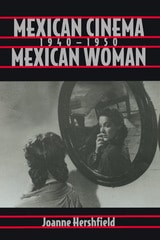
Mexican Cinema/Mexican Woman, 1940-1950
Joanne Hershfield
University of Arizona Press, 1996
The female image has been an ambiguous one in Mexican culture, and the place of women in Mexican cinema is no less tenuous--yielding in the films of Luis Buñuel and others a range of characterizations from virgin to whore, mother to femme fatale. Mexican Cinema/Mexican Woman, 1940-1950 examines a singular moment in the history of Mexican film to investigate the ways in which the cinematic figures of woman functioned to mediate narrative and social debates. The book raises new questions about the relations between woman and cinema. It will have broad appeal among students and scholars of film, feminist studies, and Latin American studies, as well as those interested in the popular culture of Mexico. Considering the historical and cultural representations of sexual difference as well as race and class, Hershfield closely examines the portrayal of women and gender identity in six films: María Candelaria (Emilio Fernández, 1943), Río Escondido (Emilio Fernández, 1947), Distinto amanecer (Julio Bracho, 1943), Salón México (Emilio Fernández, 1948), Doña Bárbara (Fernando de Fuentes, 1943), and Susana (Carne y demonio) (Luis Buñuel, 1950).
[more]
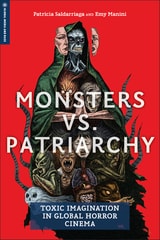
Monsters vs. Patriarchy
Toxic Imagination in Global Horror CinemaPatricia Saldarriaga
Rutgers University Press, 2025
Across the globe, the violent effects of patriarchy are manifest. Women, trans people, gender-nonconforming people, and the racialized Other are regularly subjected to physical danger, beginning with the denial of vitally important health care, and, in its most horrific form, rape, trafficking, and murder. Monsters vs. Patriarchy links these real-world horrors to the monstrification and dehumanization of people as expressed in contemporary global cinema. This monstrification has been achieved through a toxic imagination attributed to women, a trait that historically referred to the power of women to negatively affect others, including their own children in the womb, with only the use of their imagination. This process reflects the misogynist and racist world in which we live, where female bodies, people of color, and alternative identities represent a threat to patriarchal power.
Monsters vs. Patriarchy examines female monstrosity as it appears in horror films from around the world and considers specific political, scientific, and historical contexts to better understand how we construct and reconstruct monstrosity, using an intersectional approach to examine the imposition of gender and racial hierarchies that support national power structures. The authors contend that monstrous female cinematic subjects, including ghosts, witches, cannibals, and posthuman beings, are becoming empowered, using the tools of their monstrification to smash the colonial, white supremacist, and misogynist structures that created them.
Monsters vs. Patriarchy examines female monstrosity as it appears in horror films from around the world and considers specific political, scientific, and historical contexts to better understand how we construct and reconstruct monstrosity, using an intersectional approach to examine the imposition of gender and racial hierarchies that support national power structures. The authors contend that monstrous female cinematic subjects, including ghosts, witches, cannibals, and posthuman beings, are becoming empowered, using the tools of their monstrification to smash the colonial, white supremacist, and misogynist structures that created them.
[more]
Multiple Voices in Feminist Film Criticism
Diane Carson
University of Minnesota Press, 1993
[more]