139 books match the query 'World War, 1914-1918' and 5 start with m
cover of Maharajah of Bikaner: India

Maharajah of Bikaner

India

Hugh Purcell

Haus Publishing, 2010

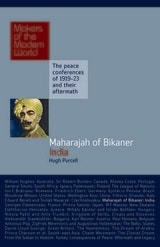
The story of the Indian soldiery in the Great War needs a new telling and one important chapter of it will be about the Maharajah of Bikaner: Dashing, autocratic and a formidable public speaker, Ganga Singh commanded his own camel corps called the Ganga Risala, fought on the Western Front and in Egypt, became the first Indian general in the British Indian army and persuaded the maharajas to unite into the Chamber of Princes. As a result of this and his war record he was invited by Lloyd George to attend the Imperial War Conference in 1917 and then the Versailles Peace Conference two years later, where he persuaded the other delegates to include India in the new League of Nations, quite an achievement as it was not an independent nation. Less successfully he tried to prevent the dismemberment of Turkey.
[more]
cover of Memorializing Pearl Harbor: Unfinished Histories and the Work of Remembrance

Memorializing Pearl Harbor

Unfinished Histories and the Work of Remembrance

Geoffrey M. White

Duke University Press, 2016
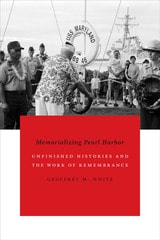
Memorializing Pearl Harbor examines the challenge of representing history at the site of the attack that brought America into World War II. Analyzing moments in which history is re-presented—in commemorative events, documentary films, museum design, and educational programming—Geoffrey M. White shows that the memorial to the Pearl Harbor bombing is not a fixed or singular institution. Rather, it has become a site in which many histories are performed, validated, and challenged. In addition to valorizing military service and sacrifice, the memorial has become a place where Japanese veterans have come to seek recognition and reconciliation, where Japanese Americans have sought to correct narratives of racial mistrust, and where Native Hawaiians have challenged their ongoing erasure from their own land. Drawing on extended ethnographic fieldwork, White maps these struggles onto larger controversies about public history, museum practices, and national memory.
[more]
cover of Messengers of Disaster: Raphael Lemkin, Jan Karski, and Twentieth-Century Genocides

Messengers of Disaster

Raphael Lemkin, Jan Karski, and Twentieth-Century Genocides

Annette Becker, Translated by Käthe Roth

University of Wisconsin Press, 2021

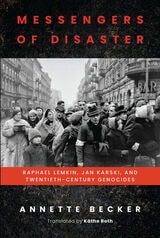
Leading up to World War II, two Polish men witnessed the targeted extermination of Jews under Adolf Hitler and the German Reich before the reality of the Holocaust was widely known. Raphael Lemkin, a Jewish lawyer who coined the term "genocide," and Jan Karski, a Catholic member of the Polish resistance, independently shared this knowledge with Winston Churchill and Franklin D. Roosevelt. Having heard false rumors of wartime atrocities before, the leaders met the messengers with disbelief and inaction, leading to the eventual murder of more than six million people.

Messengers of Disaster draws upon little-known texts from an array of archives, including the International Committee of the Red Cross in Geneva and the International Tracing Service in Bad Arolsen. Carrying the knowledge of disaster took a toll on Lemkin and Karski, but their work prepared the way for the United Nations to unanimously adopt the first human rights convention in 1948 and influenced the language we use to talk about genocide today. Annette Becker's detailed study of these two important figures illuminates how distortions of fact can lead people to deny knowledge of what is happening in front of their own eyes.
[more]
cover of Meuse-Argonne Diary: A Division Commander in World War I

Meuse-Argonne Diary

A Division Commander in World War I

William M. Wright & Edited & Intro by Robert H. Ferrell

University of Missouri Press, 2004

September 13, 1918

Got no sleep at all last night.

About two o'clock in the morning Col. Heintzelman, chief of staff of the corps, came out and he was much pleased with what the division had accomplished and with the way they had gone through. It was the division's first battle and it played a very important and creditable part. Certain things fell down. . . . The truth of the matter is the troops got away from the wire and it was impossible to keep the wire up through the tangle of barbed wire and woods. We captured 3,000 prisoners on our front alone and have lost 521.

November 1, 1918 Considerable heavy artillery fire all night. The preparation fire went down promptly at 3:30, it was very heavy. . . . The barrage went down promptly at 5:30. Troops jumped off. At 7:30 thirty prisoners reported from Le Dhuy Fme., taken by the 353rd and 354th infantries. I don't understand what the 353rd Infantry is doing in there, as it is out of the sector. At 7:00 a.m. there was a distinct lull in the artillery fire. . . . I told Hanson at 8:05 to move his troops forward to parallel 86 immediately. He stated that he would get them going about 8:30, but actually did not get them started until about eleven o'clock. I sent for him on arrival and told him to hurry his men up. Before Lee left I had ordered the divisional reserve to move forward with its advance element on the first objective to maintain their echelonment in depth. Smyser came in at one o'clock and I ordered the divisional machine guns to the front to take position about one-half kilometer east of Dhuy Fme. At the time the reserves were ordered forward. I ordered Hanson to take his P.C. to Dhuy Fme. . . . Hanson has just arrived. I do not understand why he is always so slow. He seems to be inordinately stupid.
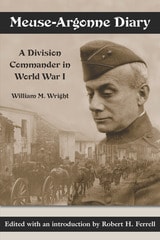
During America’s participation in World War I, 1917–1918, only a single commander of a division, William M. Wright, is known to have kept a diary. In it, General Wright relates his two-month experience at St. Mihiel and especially the Meuse-Argonne, the largest and most costly battle in American history. In the Meuse-Argonne, the Eighty-ninth Division, made up of 28,000 draftees from Missouri and Kansas and under Wright’s command, was one of the two American point divisions beginning November 1, 1918, when the U.S. First Army forced the German defenders back to the Meuse River and helped end World War I as the main German railway line for the entire Western Front came under American artillery fire. It was a great moment, and Wright was at the center of it. Robert Ferrell skillfully supplements the diary with his own narrative, making use of pertinent manuscripts, notably a memoir by one of Wright’s infantry regiment commanders.
The diary shows the exacting attention that was necessary to keep such a large, unwieldy mass of men in motion. It also shows how the work of the two infantry brigadiers and of the two supporting artillery brigades required the closest attention. Meuse-Argonne Diary, a unique account of, among other things, a singular moment in the Great War in which American troops ensured victory, will fascinate anyone interested in military history in general and World War I in particular.
[more]
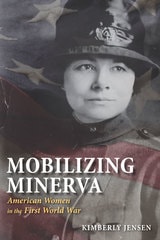
cover of Mobilizing Minerva: American Women in the First World War

Mobilizing Minerva

American Women in the First World War

Kimberly Jensen

University of Illinois Press, 2007

Mobilizing Minerva: American Women in the First World War analyzes the strategies of female physicians, nurses, and women-at-arms who linked military service with the opportunity to achieve professional and civic goals. Since women armed to defend the state during war could also protect themselves, Kimberly Jensen argues, Americans began to focus on women's relationship to violence--both its wielding against women and women's uses of it. Intense discussions of rape, methods of protecting women, and proper gender roles abound as Jensen draws from rich case studies to show how female thinkers and activists wove wartime choices into long-standing debates about woman suffrage, violence against women, gender-based discrimination, and economic parity. The war created new urgency in these debates, and Jensen forcefully presents the case of women participants and activists: women's involvement in the obligation of citizens to defend the state validated their right of full female citizenship.
[more]