Results by title
18284 books match the query 'United States' and 949 start with m
Migrant Returns
Manila, Development, and Transnational ConnectivityEric J. Pido
Duke University Press, 2017
Migrant Song
Politics and Process in Contemporary Chicano LiteratureBy Teresa McKenna
University of Texas Press, 1996
Migration and continuity have shaped both the Chicano people and their oral and written literature. In this pathfinding study of Chicano literature, Teresa McKenna specifically explores how these works arise out of social, political, and psychological conflict and how the development of Chicano literature is inextricably embedded in this fact.
McKenna begins by appraising the evolution of Chicano literature from oral forms—including the important role of the corrido in the development of Chicano poetry. In subsequent chapters she examines the works of Richard Rodriguez and Rolando Hinojosa. She also devotes a chapter to the development of the Chicana voice in Chicano literature. Her epilogue considers the parallel development of Chicano literary theory and discusses some possible directions for research.
In McKenna's own words, "I believe that the future of this literature, as that of all literatures by people of color in the United States, rests largely on its being effectively introduced into the curricula at all levels, as well as its entrance into the critical consciousness of literary theory." This book will be an important step in that process.
Migrants Who Care
West Africans Working and Building Lives in U.S. Health CareFumilayo Showers
Rutgers University Press, 2023
This book reveals the global, political, social, and economic factors that have facilitated the entry of West African women and men into the health care labor force (home and institutional care for older adults and individuals with physical and intellectual disabilities; and skilled nursing). It highlights these immigrants’ role as labor brokers who tap into their local ethnic and immigrant communities to channel co-ethnics to meet this labor demand. It illustrates how West African care workers understand their work across various occupational settings and segments in the health care industry. This book reveals the transformative processes migrants undergo as they become produced, repackaged, and deployed as health care workers after migration.
Ultimately, this book tells the very real and human story of an immigrant group surmounting tremendous obstacles to carve out a labor market niche in health care, providing some of the most essential and intimate aspects of care labor to the most vulnerable members of society.
Migrating Fictions
Gender, Race, and Citizenship in U.S. Internal DisplacementsAbigail G. H. Manzella
The Ohio State University Press, 2018
Winner, 2021 CCCC Outstanding Book Award
Migrating Fictions analyzes the role of race, gender, and citizenship in the major internal displacements of the 20th century in history and in narrative. Surveying the particular tactics employed by the United States during the Great Migration, the Dust Bowl, the Japanese American incarceration, and the migrant labor of the Southwest, Abigail G. H. Manzella reveals how the country’s past is imbued with governmentally (en)forced movements that diminished access to full citizenship rights for the laboring class, people of color, and women.
This work is the first book-length study to examine all of these movements together along with their literature, including Zora Neale Hurston’s Their Eyes Were Watching God, Sanora Babb’s Whose Names Are Unknown, Julie Otsuka’s When the Emperor Was Divine, Helena María Viramontes’s Under the Feet of Jesus, and Jesmyn Ward’s Salvage the Bones. Manzella shows how the United States’ history of spatial colonization within its own borders extends beyond isolated incidents into a pattern based on ideology about nation-building, citizenship, and labor. This book seeks to theorize a Thirdspace, an alternate location for social justice that acknowledges the precarity of the internally displaced person.
Migration and Mortality
Social Death, Dispossession, and Survival in the AmericasEdited by Jamie Longazel and Miranda Cady Hallett
Temple University Press, 2021
Death threatens migrants physically during perilous border crossings between Central and North America, but many also experience legal, social, and economic mortality. Rooted in histories of colonialism and conquest, exclusionary policies and practices deliberately take aim at racialized, dispossessed people in transit. Once in the new land, migrants endure a web of systems across every facet of their world—work, home, healthcare, culture, justice—that strips them of their personhood, denies them resources, and creates additional obstacles that deprive them of their ability to live fully.
As laws and policies create ripe conditions for the further extraction of money, resources, and labor power from the dispossessed, the contributors to this vibrant anthology, Migration and Mortality, examine restrictive immigration policies and the broader capitalist systems of exploitation and inequality while highlighting the power of migrants’ collective resistance and resilience.
The case studies in this timely collection explore border deaths, detention economies, asylum seeking, as well as the public health and mental health of migrants. Ultimately, these examples of oppression and survival contribute to understanding broader movements for life and justice in the Americas.
Migration and Residential Mobility in the United States
Larry Long
Russell Sage Foundation, 1988
Migration, Class and Transnational Identities
Croations in Australia and AmericaVal Colic-Pelsker
University of Illinois Press, 2007
Val Colic-Peisker harnesses concepts and theories from sociology, anthropology, and political science to compare the vastly different experiences of two Croatian immigrant cohorts in the city of Perth, Western Australia. The populations explored represent an earlier group of working-class migrants arriving from communist Yugoslavia from the 1950s to 1970s and a later group of urban professionals arriving in the 1980s and 1990s as 'independent' or skills-based migrants. This latter group integrated into professional ranks but also used their Australian experience as a stepping stone in becoming part of a highly mobile global professional middle class.
Employing a refined theoretical analysis, this rich ethnography challenges the domination of the ethnic perspective in migration studies and the idea of ethnic community itself. It emphasizes the importance of class, focusing on the intersection of class, ethnicity, and gender in the process of migration, migrant incorporation, and transnationalism. In theorizing the connection of the two migrant cohorts with their native Croatia, the study introduces concepts of "ethnic" and "cosmopolitan" transnationalism as two distinctive experiences mediated by class.
Migration, Mill Work, and Portuguese Communities in New England
Edited by Cristiana Bastos, Bela Feldman-Bianco, and Miguel Moniz
Tagus Press, 2024
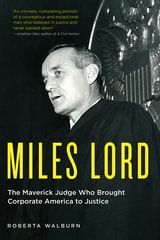
Miles Lord
The Maverick Judge Who Brought Corporate America to JusticeRoberta Walburn
University of Minnesota Press, 2017
The life of a crusading federal judge who stood up and fought for “the little guy”
This is the story of Miles Lord (1919–2016), who rose from humble beginnings on Minnesota’s Iron Range to become one of the most colorful and powerful judges in the country, described as “an unabashed Prairie populist” and “a live-wire slayer of corporate behemoths.” He cut a wide swath through history on his path to the bench: coming of age alongside a cadre of young Midwestern social-gospel progressives, including Hubert H. Humphrey, Eugene McCarthy, and Walter Mondale, in the days before they reached national fame; teaming with Bobby Kennedy as a hotshot prosecutor in pursuit of Jimmy Hoffa; and serving as the secret envoy between his friends Hubert and Eugene in their battle for the soul of the Democratic party in the historic 1968 presidential campaign. Later, after donning his black robe, he reshaped jurisprudence with precedent-breaking rulings—on issues ranging from women’s rights to consumer protection to education reform—and breaking trail when he ordered the shutdown of the Reserve Mining Company in northern Minnesota, which was spewing its waste into Lake Superior, in the most sensational trial of the early environmental era.
One of Judge Lord’s landmark cases—and interlaced as a centerpiece narrative of this book—involved the Dalkon Shield intrauterine device, which caused horrific infections in thousands of women, resulting in infertility and sometimes death. Author Roberta Walburn served as the judge’s law clerk during that litigation in 1983–84, and she provides a page-turning account (both an insider’s view and an in-depth chronicle) of what was called “one of the most disastrous episodes of American corporate misconduct.” In the end, more than 200,000 women received nearly $3 billion in compensation, and the Fortune 500 defendant was left in ruins. But Judge Lord was hauled up on judicial misconduct charges for his no-holds-barred actions that were certainly provocative but also stand as a timely reminder, even (or especially) today, of the challenges in balancing the scales of justice for a legal system that too often skews to the rich and powerful.
The author deftly weaves the Dalkon Shield drama into the larger story of the life of a one-of-a-kind man, crafting a sweeping and spirited true-life tale with not only her first-hand experiences as the judge’s law clerk but also with unrestricted access to the judge’s personal files. This is a rare and compelling portrait of a remarkable man and his place in both Minnesota and U.S. history.

Miles of Smiles, Years of Struggle
STORIES OF BLACK PULLMAN PORTERSJack Santino
University of Illinois Press, 1989
Jack Santino's interviews with retired porters provide extensive firsthand accounts of their work, the job inequities they faced, the formation of the Brotherhood of Sleeping Car Porters, and the aborted Pullman porter strike of 1928. Through the testimony of ran-and-file workers as well as key figures such as E. D. Nixon, the porter who initiated the Montgomery bus boycott and helped launch the career of Martin Luther King, Jr. and C.L. Dellums, the only surviving founding member of the BSCP, Miles of Smiles, Years of Struggle illuminates the Pullman porters' struggle for dignity.
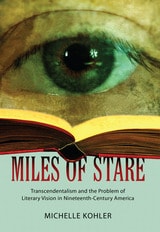
Miles of Stare
Transcendentalism and the Problem of Literary Vision in Nineteenth-Century AmericaMichelle Kohler
University of Alabama Press, 2014
The strangeness of nineteenth-century poetic vision is exemplified most famously by Emerson’s transparent eyeball. That disembodied, omniscient seer is able to shed its body and transcend sight paradoxically in order to see—not to create—poetic language “manifest” on the American landscape. In Miles of Stare, Michelle Kohler explores the question of why, given American transcendentalism’s anti-empiricism, the movement’s central trope becomes an eye purged of imagination. And why, furthermore, she asks, despite its insistent empiricism, is this notorious eye also so decidedly not an eye? What are the ethics of casting a boldly equivocal metaphor as the source of a national literature amidst a national landscape fraught with slavery, genocide, poverty, and war?
Miles of Stare explores these questions first by tracing the historical emergence of the metaphor of poetic vision as the transcendentalists assimilated European precedents and wrestled with America’s troubling rhetoric of manifest destiny and national identity. These questions are central to the work of many nineteenth-century authors writing in the wake of transcendentalism, and Kohler offers examples from the writings of Douglass, Hawthorne, Dickinson, Howells, and Jewett that form a cascade of new visual metaphors that address the irreconcilable contradictions within the transcendentalist metaphor and pursue their own efforts to produce an American literature. Douglass’s doomed witness to slavery, Hawthorne’s reluctantly omniscient narrator, and Dickinson’s empty “miles of Stare” variously skewer the authority of Emerson’s all-seeing poetic eyeball while attributing new authority to the limitations that mark their own literary gazes.
Tracing this metaphorical conflict across genres from the 1830s through the 1880s, Miles of Stare illuminates the divergent, contentious fates of American literary vision as nineteenth-century writers wrestle with the commanding conflation of vision and language that lies at the center of American transcendentalism—and at the core of American national identity.
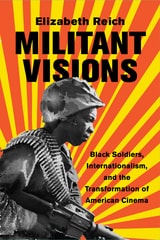
Militant Visions
Black Soldiers, Internationalism, and the Transformation of American CinemaReich, Elizabeth
Rutgers University Press, 2016
Offering a nuanced reading of a figure that was simultaneously conservative and radical, Reich considers how the cinematic black soldier lent a human face to ongoing debates about racial integration, black internationalism, and American militarism. Militant Visions thus not only presents a new history of how American cinema represented race, but also demonstrates how film images helped to make history, shaping the progress of the civil rights movement itself.
Militant Zionism in America
The Rise and Impact of the Jabotinsky Movement in the United States, 1926-1948Rafael Medoff
University of Alabama Press, 2006
This in-depth look at a controversial faction of American Zionism fills
a void in the story of American Zionism--and in the story of American Judaism.
This book recounts the fascinating and little-known story
of the militant American Zionists who lobbied Congress, rallied American
public opinion, and influenced British-American relations in their campaign
for Jewish statehood in the 1930s and 1940s. Although these activists have
been dismissed as fanatics who fragmented the American Zionist movement,
Rafael Medoff reveals that the faction--which included an Academy Award-winning
screenwriter and several future members of the Israeli parliament--was
more influential than has been previously acknowledged.
These militants stirred America's conscience by placing
controversial newspaper ads, lobbying conservative as well as liberal members
of Congress, and staging dramatic protest rallies. Through these tactics,
Medoff shows, they attracted a wave of support from an extraordinary cross-section
of leading Americans, including comedians Harpo Marx and Carl Reiner, actors
Vincent Price, Marlon Brando, and Jane Wyatt, musician Leonard Bernstein,
and rising young politicians Jacob Javits and Hubert Humphrey. Medoff also
describes the shadowy underground division that smuggled weapons to the
Holy Land in caskets, naming and interviewing for the first time members
of this gunrunning network.
Based on years of archival research and interviews and
written in a compelling style, Militant Zionism in America documents
events that reshaped the American Jewish community, influenced American
foreign policy, and contributed to one of the most extraordinary events
of modern history: the creation of the State of Israel.
Rafael Medoff is a Visiting Scholar at the State University of New York -- Purchase College.
Militarism, Imperialism, and Racial Accommodation
An Analysis and Interpretation of the Early Writings of Robert E. ParkStanford Lyman
University of Arkansas Press, 1992
1993 Mid-South Sociological Association Book Award
Robert E. Park has long been recognized as one of the most influential thinkers in early American sociology, yet virtually all of his works appearing before 1913 were published in popular magazines and were dismissed as nonsociological muckraking. In Militarism, Imperialism, and Racial Accommodation: An Analysis and Interpretation of the Early Writings of Robert E. Park, Stanford M. Lyman examines and reprints many of these little-known works, including Park’s essays on German military organization, his exposés of the atrocities committed by Belgium’s Leopold II in the Congo State, his studies of the black community in Winston-Salem, North Carolina, and of Booker T. Washington’s agricultural education program at Tuskegee, Alabama.
Lyman shows clearly that Park’s essays, written outside the academy, formulated a far more complex perspective on modern modes of evil than any proposed by his contemporaries, thereby influencing sociological debates for decades to come. By writing his essays on topical subjects and by publishing them for a public audience, Park dramatized his profound belief that the struggle to achieve racial accommodation and to establish a true and lasting democracy is a concern for all.

Militarized Currents
Toward a Decolonized Future in Asia and the PacificSetsu Shigematsu
University of Minnesota Press, 2010

Military Intervention after the Cold War
The Evolution of Theory and PracticeAndrea Kathryn Talentino
Ohio University Press, 2005
Military Intervention After the Cold War explores how and why this change took place, looking at how both ideas and actions changed in the post-Cold War period to make military intervention a tool of international security and a defining characteristic of the international system. Although it is often touted as a strategy to rebuild collapsed states, the examples of success are few and far between. Andrea Kathryn Talentino argues that standards of human rights and responsible governance have become part of the definition of international security. She addresses questions that are vital in the post-9/11 world, where weak and collapsed states are recognized as permissive and at times supportive environments for criminal actors.
The specter of terrorism has placed even greater emphasis on the need to understand why military intervention happens and how it could be more effective. With the news full of stories on intervention and nation-building, scholars, graduate and undergraduate students, and readers interested in understanding global interdependence will find Military Intervention After the Cold War an indispensable book.Andrea Kathryn Talentino is an assistant professor of international relations at Tulane University, New Orleans.The author of numerous articles on military intervention and post- conflict rebuilding, she is currently focusing on the link between nation-building and political violence.
Military Prisons of the Civil War
A Comparative StudyDavid L. Keller
Westholme Publishing, 2021
Over the course of the American Civil War, more than four hundred thousand prisoners were taken by the North and South combined—the largest number in any conflict up to that time, and nearly fifty-eight thousand of these men died while incarcerated or soon after being released. Neither side expected to take so many prisoners in the wake of battles and neither had any experience on how to deal with such large numbers. Prison camps were quickly established, and as the war progressed, reports of sickness, starvation, mistreatment by guards, and other horrors circulated in the press. After the war, recriminations were leveled on both sides, and much of the immediate ill-will between the North and South dealt with prisoners and their treatment.
In Military Prisons of the Civil War: A Comparative Analysis historic preservationist David L. Keller consulted official records, newspaper reports, first-person accounts from prisoners, and other primary source material in order to understand why imprisonment during the Civil War failed on both sides. His research identifies five factors shared among both Union and Confederate prisons that led to so many deaths, including the lack of a strategic plan on either side for handling prisoners, inadequate plans for holding prisoners for long periods of time, and poor selection and training of camp command and guards.
Military Realism
The Logic and Limits of Force and Innovation in the U.S. ArmyPeter Campbell
University of Missouri Press, 2024
In five case studies of U.S. Army doctrine, Campbell pits military realism against bureaucratic and cultural perspectives in three key areas—nuclear versus conventional warfare, preferences for offense versus defense, and COIN missions—and finds that the army has been more doctrinally flexible than those perspectives would predict. He demonstrates that decision makers, while vowing in the wake of Vietnam to avoid (COIN) missions, nonetheless found themselves adapting to the geopolitical realities of fighting “low intensity” conflicts. In essence, he demonstrates that pragmatism has won out over dogmatism. At a time when American policymakers remain similarly conflicted about future defense strategies, Campbell’s work will undoubtedly shape and guide the debate.

Milk Money
Cash, Cows, and the Death of the American Dairy FarmKirk Kardashian
Brandeis University Press, 2025
The dairy business is at the heart of the culture and economy of Vermont, just as it is in many other states. That fact meant little to Kirk Kardashian until he started taking his daughter to daycare at a dairy farm a few miles from his Vermont home. The farm had been owned by the same family for generations but struggled to make ends meet in a market where retail milk prices have held steady for decades while the prices paid to farmers have plummeted. Suddenly, the abstractions of economics and commodities markets were replaced by the flesh and blood of a farm family whom he greeted every day.
In the tradition of Michael Pollan and Eric Schlosser, Kardashian asks whether it is right that family farmers in America should toil so hard, produce a food so wholesome and so popular, and still lose money. His investigation uncovers the hidden forces behind dairy farm consolidation and explains why milk—a staple subject to both government oversight and industry collusion—has proven so tricky to stabilize, even as scores of small dairy farms close. This new edition brings the story up to date, as farmers grapple with an ever-changing landscape that includes shifting consumer preferences, immigration issues, climate change, and bird flu.
Milking in the Shadows
Migrants and Mobility in America’s DairylandKeller, Julie C
Rutgers University Press, 2019
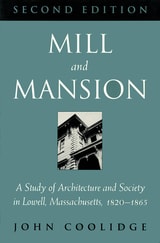
Mill and Mansion
A Study of Architecture and Society in Lowell, Massachusetts, 1820-1865John Coolidge
University of Massachusetts Press, 1993
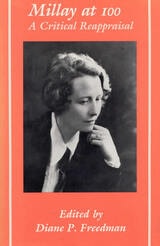
Millay At 100
A Critical ReappraisalDiane F. Freedman
Southern Illinois University Press, 1995
Though finding its occasion in the life of Millay— the centennial of the writer’ s birth— this volume refocuses attention on Millay’ s art by asking questions central to our present concerns: What in the varied body of Millay’ s work speaks to us most forcefully today? Which critical perspectives most illuminate her texts? How might those approaches be challenged, extended, or reoriented? In seeking the answers to such questions, the volume’ s contributors illuminate the means by which Millay’ s early success has been slighted and misunderstood and examine issues of personality, personae, critical stature, and formal experimentation in Millay’ s various genres: lyric poetry, the sonnet, verse drama, fiction, and the personal letter.
In 1920, following the publication of A Few Figs from Thistles, Millay was the "It girl" of American poetry. But by the late 1930s, her popularity waned as her critical reputation declined under the reign of high modernism and its critics. In fact, Millay, like others of her generation, had rejected modernist elitism in favor of public engagement, using her powerful public voice to plead for an end to the Sacco-Vanzetti trials as well as for U.S. entry into World War II. Condemned for both her politicizing and her political poetry, she was the first to admit that she and her poetry suffered in the service of public causes.
Grouped into four parts, these essays focus on Millay’ s relation to modernism, her revisionary perspectives on love, her treatment of time and of the female body, and her use of masquerade and impersonation in life and in art. Throughout, the essayists pose such questions as: Where is Millay’ s place in the literary histories of modern writing and in our hearts? How are we to value, interpret, and characterize the various forms and genres in which she wrote? What is the cultural work Millay achieves and reflects? How does she help us redefine modernism? What do Millay’ s great gifts enable us to see about genre, the social construction of gender, the definition of modernism, and the role of the poet?
Millay’ s considerable productivity, the range and virtues of her forms, and her experimentation clearly argue for a wide-ranging reappraisal of her work.
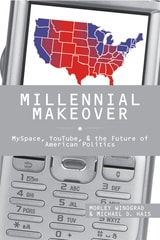
Millennial Makeover
MySpace, YouTube, and the Future of American PoliticsWinograd, Morley
Rutgers University Press, 2008
A 2008 New York Times Notable Book of the Year
It happens in America every four decades and it is about to happen again. America’s demand for change in the 2008 election will cause another of our country’s periodic political makeovers. This realignment, like all others before it, will result from the coming of age of a new generation of young Americans—the Millennial Generation—and the full emergence of the Internet-based communications technology that this generation uses so well. Beginning in 2008, almost everything about American politics and government will transform—voting patterns, the fortunes of the two political parties, the issues that engage the nation, and our government and its public policy.
Building on the seminal work of previous generational theorists,Morley Winograd and Michael D. Hais demonstrate and describe, for the first time, the two types of realignments—“idealist” and “civic”—that have alternated with one another throughout the nation’s history. Based on these patterns, Winograd and Hais predict that the next realignment will be very different from the last one that occurred in 1968. “Idealist” realignments, like the one put into motion forty years ago by the Baby Boomer Generation, produce, among other things, a political emphasis on divisive social issues and governmental gridlock. “Civic” realignments, like the one that is coming, and the one produced by the famous GI or “Greatest” Generation in the 1930s, by contrast, tend to produce societal unity, increased attention to and successful resolution of basic economic and foreign policy issues, and institution-building.
The authors detail the contours and causes of the country’s five previous political makeovers, before delving deeply into the generational and technological trends that will shape the next. The book’s final section forecasts the impact of the Millennial Makeover on the elections, issues, and public policies that will characterize America’s politics in the decades ahead.
For additional information go to:
Millennial Makeover website.
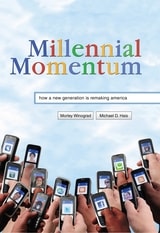
Millennial Momentum
How a New Generation Is Remaking AmericaWinograd, Morley
Rutgers University Press, 2011
About every eight decades, coincident with the most stressful and perilous events in U.S. history—the Revolutionary and Civil Wars and the Great Depression and World War II—a new, positive, accomplished, and group-oriented “civic generation” emerges to change the course of history and remake America. The Millennial Generation (born 1982–2003) is America’s newest civic generation.
In their 2008 book, Millennial Makeover, Morley Winograd and Michael D. Hais made a prescient argument that the Millennial Generation would change American politics for good. Later that year, a huge surge of participation from young voters helped to launch Barack Obama into the White House.
Now, in Millennial Momentum, Winograd and Hais investigate how the beliefs and practices of the Millennials are transforming other areas of American culture, from education to entertainment, from the workplace to the home, and from business to politics and government. The Millennials’ cooperative ethic and can-do spirit have only just begun to make their mark, and are likely to continue to reshape American values for decades to come.
Drawing from an impressive array of demographic data, popular texts, and personal interviews, the authors show how the ethnically diverse, socially tolerant, and technologically fluent Millennials can help guide the United States to retain its leadership of the world community and the global marketplace. They also illustrate why this generation’s unique blend of civic idealism and savvy pragmatism will enable us to overcome the internal culture wars and institutional malaise currently plaguing the country. Millennial Momentum offers a message of hope for a deeply divided nation.
Millennial Style
The Politics of Experiment in Contemporary African Diasporic CultureAliyyah I. Abdur-Rahman
Duke University Press, 2024
Millennials Killed the Video Star
MTV's Transition to Reality ProgrammingAmanda Ann Klein
Duke University Press, 2021
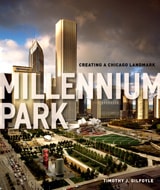
Millennium Park
Creating a Chicago LandmarkTimothy J. Gilfoyle
University of Chicago Press, 2006
Timothy Gilfoyle here offers a biography of this phenomenal undertaking, beginning before 1850 when the site of the park, the “city’s front yard,” was part of Lake Michigan. Gilfoyle studied the history of downtown; spent years with the planners, artists, and public officials behind Millennium Park; documented it at every stage of its construction; and traced the skeins of financing through municipal government, global corporations, private foundations, and wealthy civic leaders. The result is a thoroughly readable and lavishly illustrated testament to the park, the city, and all those attempting to think and act on a monumental scale. And underlying Gilfoyle’s history is also a revealing study of the globalization of art, the use of culture as an engine of economic expansion, and the nature of political and philanthropic power.
Born out of civic idealism, raised in political controversy, and maturing into a
symbol of the new Chicago, Millennium Park is truly a twenty-first-century
landmark, and it now has the history it deserves.
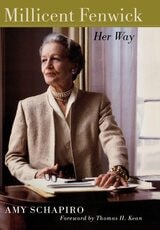
Millicent Fenwick
Her WaySchapiro, Amy
Rutgers University Press, 2003
Amy Schapiro has written the first biography of Millicent Fenwick, the popular and colorful New Jersey congresswoman. Affectionately remembered as the pipe-smoking grandmother who served as the model for Garry Trudeau’s Doonesbury character Lacey Davenport, Fenwick defied such simplistic expectations to become, in the words of Walter Cronkite, “the conscience of Congress.”
Born in 1910 into comfortable circumstances, Fenwick faced tragedy at an early age when her mother was lost in the sinking of the Lusitania. Following an upper-class childhood and a failed marriage, she began a fourteen-year career at Vogue magazine.
In the 1960s, Fenwick became involved in the civil rights movement and took part in local and state politics in New Jersey. Blessed with striking good looks and a sharp wit, she cut a glamorous figure, rising quickly through the ranks of the state Republican Party at a time when most of her peers were retiring. When this colorful, outspoken figure—one of only five New Jersey women ever elected to Congress— went to Washington in 1974 at age sixty-four, her victory was portrayed by the media as a “geriatric triumph.”
Schapiro’s extensive interviews with Fenwick’s son, Hugh, who granted her exclusive rights to Fenwick’s personal papers, oral histories, letters, and photographs, provide rare insight into the life and career of one of America’s most memorable politicians.
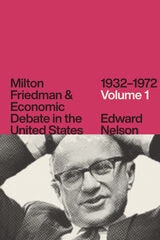
Milton Friedman and Economic Debate in the United States, 1932–1972, Volume 1
Edward Nelson
University of Chicago Press, 2020
This two-volume account provides a foundational introduction to Friedman’s role in several major economic debates that took place in the United States between 1932 and 1972. The first volume, which takes the story through 1960, covers the period in which Friedman began and developed his research on monetary policy. It traces Friedman’s thinking from his professional beginnings in the 1930s as a combative young microeconomist, to his wartime years on the staff of the US Treasury, and his emergence in the postwar period as a leading proponent of monetary policy. The second volume covers the years between 1960 and 1972— years that saw the publication of Friedman and Anna Schwartz’s Monetary History of the United States. The book also covers Friedman’s involvement in a number of debates in the 1960s and 1970s, on topics such as unemployment, inflation, consumer protection, and the environment.
As a fellow monetary economist, Nelson writes from a unique vantage point, drawing on both his own expertise in monetary analysis and his deep familiarity with Friedman’s writings. Using extensive documentation, the book weaves together Friedman’s research contributions and his engagement in public debate, providing an unparalleled analysis of Friedman’s views on the economic developments of his day.
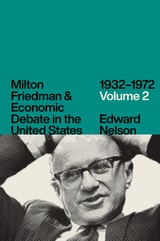
Milton Friedman and Economic Debate in the United States, 1932–1972, Volume 2
Edward Nelson
University of Chicago Press, 2020
This two-volume account provides a foundational introduction to Friedman’s role in several major economic debates that took place in the United States between 1932 and 1972. The first volume, which takes the story through 1960, covers the period in which Friedman began and developed his research on monetary policy. It traces Friedman’s thinking from his professional beginnings in the 1930s as a combative young microeconomist, to his wartime years on the staff of the US Treasury, and his emergence in the postwar period as a leading proponent of monetary policy. The second volume covers the years between 1960 and 1972— years that saw the publication of Friedman and Anna Schwartz’s Monetary History of the United States. The book also covers Friedman’s involvement in a number of debates in the 1960s and 1970s, on topics such as unemployment, inflation, consumer protection, and the environment.
As a fellow monetary economist, Nelson writes from a unique vantage point, drawing on both his own expertise in monetary analysis and his deep familiarity with Friedman’s writings. Using extensive documentation, the book weaves together Friedman’s research contributions and his engagement in public debate, providing an unparalleled analysis of Friedman’s views on the economic developments of his day.

Milton Friedman and Economic Debate in the United States, 1973–1976, Vol. 3
Edward Nelson
University of Chicago Press, 2027
The third installment in the definitive account of the famed economist's role in economic debate—and his lasting influence on economic policy.
Milton Friedman is widely recognized as one of the most significant contributors to economics in the modern age. Yet no previous study has distilled Friedman’s vast body of writings into an authoritative account of his research, his policy views, and his interventions in public debate. Through his sweeping series on the most influential economist of the second half of the twentieth century, Edward Nelson closes this gap: Milton Friedman and EconomicDebate in the United States is the defining narrative on the famed public intellectual—the first to grapple comprehensively with Friedman’s research output, economic framework, and legacy.
Volume 3 chronicles Friedman’s activities from 1973 to 1976, encompassing his final years at the University of Chicago and a period that saw his further ascension in national prominence. In the mid-1970s, economic news dominated American political discourse as the nation endured double-digit inflation and recession. It was during this time that Friedman’s views became a center of economic debate in both the research world and public debate, while his explanation for “stagflation” formed part of the critique of stabilization policy that would lead to his 1976 Nobel Prize. Nelson details the controversies that Friedman faced in the media—including his contrarian stances on inflation’s cure, the economic implications of oil price shocks, and the social responsibility of business—and how Friedman concluded that the world needed a “new Adam Smith” to press the case for free markets. Drawing upon a large body of documentary sources, interviews with dozens of the people closest to Friedman, and his own expertise in Friedman’s research area of monetary analysis, Nelson provides the definitive account of the formative (and uneven) events in Friedman’s foray into life as a public intellectual and how his research permanently shifted economic thinking.
Milton Friedman and Economic Debate in the United States, 1977–1979, Vol. 4
Edward Nelson
University of Chicago Press, 0
The fourth installment of the sweeping account of the most influential economist in modern times, focusing on his crossover into the public sphere.
Milton Friedman is widely recognized as one of the most significant contributors to economics in the modern age. Yet no previous study has distilled Friedman’s vast body of writings into an authoritative account of his research, his policy views, and his interventions in public debate. Through his sweeping series on the most influential economist of the second half of the twentieth century, Edward Nelson closes this gap: Milton Friedman and EconomicDebate in the United States is the defining narrative on the famed public intellectual—the first to grapple comprehensively with Friedman’s research output, economic framework, and legacy.
Volume 4 of Nelson’s intellectual and policy biography offers an exacting portrait of Friedman’s career following his departure from the University of Chicago. Spanning 1977 to 1979, Nelson’s narrative details Friedman’s move to California and his greater immersion in public policy, including his project with Rose Friedman and television professionals to create a TV series giving his viewpoint. Nelson details the successes and failures of Friedman’s years of extraordinary influence, including:
- His warnings about US inflation returning to double digits in 1979;
- The changes in professional thinking in the US economics profession and policymaking toward acceptance of Friedman's view that inflation is a monetary phenomenon;
- The rise of Paul Volcker to head of the Federal Reserve and his integration of monetarist ideas into US monetary policy;
- Friedman's proposal to phase in a zero-tariff arrangement in the United States;
- His role in the tax revolt of the 1970s—including his break with the emerging supply-side economics movement on the effects of tax cuts;
- The second oil-price shock and Friedman's critique of the Carter Administration's energy policy;
- The resilience after 1976 of Ronald Reagan's presidential ambitions and Friedman's 1979 endorsement of Reagan for president in the 1980 election.
Drawing upon a large body of documentary sources, interviews with dozens of the people closest to Friedman, and his own expertise in Friedman’s research area of monetary analysis, Nelson offers the definitive account of what proved to be pivotal years for Friedman and the field of economics.
Milwaukee Mayhem
Murder and Mystery in the Cream City's First CenturyMatthew J. Prigge
Wisconsin Historical Society Press, 2015
From murder and matchstick men to all-consuming fires, painted women, and Great Lakes disasters--and the wide-eyed public who could not help but gawk at it all--"Milwaukee Mayhem" uncovers the little-remembered and rarely told history of the underbelly of a Midwestern metropolis. "Milwaukee Mayhem" offers a new perspective on Milwaukee's early years, forgoing the major historical signposts found in traditional histories and focusing instead on the strange and brutal tales of mystery, vice, murder, and disaster that were born of the city's transformation from lakeside settlement to American metropolis. Author Matthew J. Prigge presents these stories as they were recounted to the public in the newspapers of the era, using the vivid and often grim language of the times to create an engaging and occasionally chilling narrative of a forgotten Milwaukee.
Through his thoughtful introduction, Prigge gives the work context, eschewing assumptions about "simpler times" and highlighting the mayhem that the growth and rise of a city can bring about. These stories are the orphans of Milwaukee's history, too unusual to register in broad historic narratives, too strange to qualify as nostalgia, but nevertheless essential to our understanding of this American city.
Milwaukee Through History
A Young Reader's Guide to the People and Events That Shaped a CityJames K. Nelsen
Wisconsin Historical Society Press, 2025
This richly illustrated book for middle grade and high school learners uses primary sources and archival photos to explore Milwaukee’s role in Wisconsin and US history. Milwaukee Through History highlights the city’s multiple transformations—from a resource-rich homeland of Ho-Chunk, Menominee, Ojibwe, Potawatomi, and other Native peoples to an immigrant hub to an industrial boomtown and, finally, to a vibrant tourist destination that continues to grapple with issues of poverty and inequality.
Readers will discover key people, places, events, and innovations that made Milwaukee—and national—history, including:
• Freedom seeker Joshua Glover
• Industrial giants like Harley Davidson & Allen Bradley
• Whitnall Park and the North Point Water Tower
• Labor movements and the fair housing marches
• Civil rights leader Vel Phillips
Author James K. Nelsen sheds new light on important events and milestones in history, including the American Revolution, the War of 1812, the Civil War, and the Great Migration. Written with middle and high school readers in mind, the book will appeal to people of all ages who are curious about Milwaukee’s history and culture. Milwaukee Through History is both an engaging supplement to Wisconsin and US history curricula and a great read for anyone seeking a deeper understanding of a diverse and dynamic city.
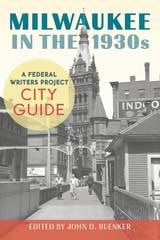
Milwaukee in the 1930s
A Federal Writers Project City GuideJohn D. Buenker
Wisconsin Historical Society Press, 2016
What would it be like to take an intensive tour of Milwaukee as it was during the late 1930s—at the confluence of the Great Depression, the New Deal, and the run-up to World War II? That is precisely what the participants in the Federal Writers Project did while researching their Guide to Milwaukee. The fruits of their labors were ready for publication by 1940, but for a number of reasons the finished product never saw the light of day—until now.
Fortunately, the manuscript has been carefully preserved in the Wisconsin Historical Society Archives
. Seventy-five years after the work’s completion, the Wisconsin Historical Society Press and historian John D. Buenker present this guide—now serving as a time machine, ready to transport readers back to the Milwaukee of the 1930s, neighborhood by neighborhood, building by building. Much more than a nostalgic snapshot, the book examines Milwaukee’s history from its earliest days to 1940.
Buenker’s thoughtful introduction provides historical context, detailing the FWP’s development of this guide, as well as Milwaukee’s political climate leading up to, and during, the 1930s. Next, essays on thirteen "areas," ranging from Civic Center to Bay View, delve deeper into the geography, economy, and culture of old Milwaukee’s neighborhoods, and simulated auto tours take readers to locales still familiar today, exploring the city’s most celebrated landmarks and institutions. With a calendar of annual events and a list of public services and institutions, plus dozens of photographs from the era, Milwaukee in the 1930s provides a unique record of a pre–World War II American city.
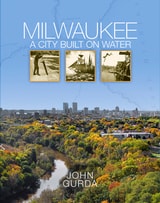
Milwaukee
A City Built on WaterJohn Gurda
Wisconsin Historical Society Press, 2026
The success and survival of Milwaukee lies in the rivers that meander through its streets and the great lake at its eastern boundary. The Indigenous peoples of the region recognized the value of an abundant, clean water supply for food and transportation. Generations of immigrants, entrepreneurs, innovators, and recreationists used the same waters to travel greater distances, power million-dollar industries, and even have a bit of fun.
In Milwaukee: A City Built on Water, celebrated historian John Gurda relates the history of the waters that gave Milwaukee life—and occasionally threatened the city through erosion, invasive species, and water-borne diseases. Telling tales of brewers, brickmakers, ecologists, and engineers, Gurda explores the city’s complicated connections with its most precious resource and greatest challenge. You’ll meet the generations of people, from a Potawatomi chief to fur traders and fishermen, who settled on the small spit of land known as Jones Island; learn how Milwaukee’s unique water composition creates its distinct cream-colored bricks; visit Wisconsin’s first waterparks; and see how city leaders transformed the Milwaukee River—once described as a “vast sewer” with an “odorous tide”—into today’s lively and lovely Riverwalk.
Now available in paperback, Milwaukee: A City Built on Water is the sweeping chronicle of a critical natural resource that has weathered heavy use and flagrant abuse to emerge as a focal point of both celebration and concern in the twenty-first century.

Mind-Bending Mysteries and Thrillers for Teens
A Programming and Readers' Advisory GuideAmy Alessio
American Library Association, 2014
Minding the South
John Shelton Reed
University of Missouri Press, 2003
You're in the American South now, a proud region with a distinctive history and culture. A place that echoes with names like Thomas Jefferson and Robert E. Lee, Scarlett O'Hara and Uncle Remus, Martin Luther King and William Faulkner, Billy Graham, Mahalia Jackson, Muhammad Ali, Elvis Presley. Home of the country blues and country music, bluegrass and Dixieland jazz, gospel music and rock and roll. Where menus offer both down-home biscuits and gravy and uptown shrimp and grits. Where churches preach against "cigarettes, whiskey, and wild, wild women" (all Southern products) and where American football is a religion.
For more than thirty years John Shelton Reed has been “minding” the South—watching over it, providing commentary upon it. He is the author or editor of thirteen books about the South, and despite his disclaimer regarding formal study of Southern history, Reed has read widely and in depth about the South. His primary focus is upon Southerners’ present-day culture and consciousness, but he knows that one must approach the South historically in order to understand the place and its people.

Minds and Hearts
The Story of James Otis Jr. and Mercy Otis WarrenJeffrey H. Hacker
University of Massachusetts Press, 2021
Minds and Hearts is the dual biography of these remarkable siblings, placing James and Mercy in the spotlight together for the first time, amid the rush of events, competing ideologies, and changing social conditions of eighteenth-century America. Jeffrey H. Hacker crafts a compelling narrative that focuses on the Otises' unique and dramatic relationship and traces their impact on the Revolutionary movement in Massachusetts. If the real American Revolution took place "in the minds and hearts of the people," as John Adams claimed, then the Otises were among the nation's true patriots.
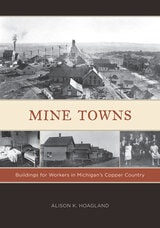
Mine Towns
Buildings for Workers in Michigan’s Copper CountryAlison K. Hoagland
University of Minnesota Press, 2010

Mineral Point
A HistoryGeorge Fiedler
Wisconsin Historical Society Press, 1973
Mining America
The Industry and the Environment, 1800-1980Duane A. Smith
University Press of Colorado, 1994
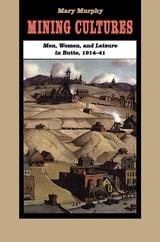
Mining Cultures
Men, Women, and Leisure in Butte, 1914-41Mary Murphy
University of Illinois Press, 1997
Butte, Montana, long deserved its reputation as a wide-open town. Mining Cultures shows how the fabled Montana city evolved from a male-dominated mining enclave to a community in which men and women participated on a more equal basis as leisure patterns changed and consumer culture grew. Mary Murphy looks at how women worked and spent their leisure time in a city dominated by the quintessential example of "men's work": mining. Bringing Butte to life, she adds in-depth research on church weeklies, high school yearbooks, holiday rituals, movie plots, and news of local fashion to archival material and interviews.
A richly illustrated jaunt through western history, Mining Cultures is the never-told chronicle of how women transformed the richest hill on earth.
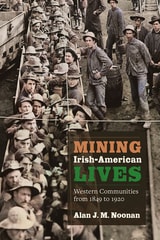
Mining Irish-American Lives
Western Communities from 1849 to 1920Alan J. M. Noonan
University Press of Colorado, 2022
Historian Alan J. M. Noonan uses a range of previously overlooked sources, including collections of emigrant letters, hospital logbooks, private detective reports, and internment records, to tell the stories of Irish men and women who emigrated to mining towns to search for opportunity. Noonan details the periods, the places, and the experiences over multiple generations in the late nineteenth and early twentieth centuries. He carefully examines their encounters with nativists, other ethnic groups, and mining companies to highlight the contested emergence of a hyphenated Irish-American identity.
Unearthing personal details along with the histories of different communities, the book investigates Irish immigrants and Irish-Americans through the prism of their own experiences, significantly enriching the history of the period.
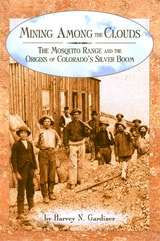
Mining among the Clouds
The Mosquito Range and the Origins of Colorado's Silver BoomHarvey N. Gardiner
University Press of Colorado, 2002
Mining in the Museum
Mineral Technology on Display in American HistoryEric C. Nystrom
University of Massachusetts Press, 2027
Examining 150 years of mining and mineral technology exhibits at the Smithsonian
Buried deep underground or cut into remote landscapes, mines are often dirty, dark, and dangerous places, located far from the everyday urban spaces that most Americans call home. Yet mining is foundational to the making of the United States, supplying the raw materials that built its infrastructure, powered its industries, and shaped its scientific institutions, even as the work itself has remained physically removed, technically complex, and culturally overlooked. Mining in the Museum reveals how Americans have encountered this vital industry not at the distant mine face, but in museum galleries. Tracing more than 150 years of mining and mineral technology exhibits at the Smithsonian Institution in Washington, DC, Eric C. Nystrom shows how curators transformed ore, instruments, models, and machinery into stories about progress, innovation, and national development, and how those interpretive choices shaped what the nation remembers—and forgets—about mining.
Using mining collections as a lens into institutional change, Nystrom offers a new history of the Smithsonian and its United States National Museum, examining how curators, administrators, and policymakers debated what museums were for, which kinds of knowledge they should produce, and what objects deserved display. He follows the shifting fortunes of mineral and mining exhibits across world’s fairs, scientific surveys, and changing exhibition philosophies, showing how display strategies evolved alongside professional science and public education. As mining’s place in the national imagination changed, so too did its presence in the federal museum, moving from a central scientific and technological showcase to a subject increasingly preserved by regional and local institutions closer to mining communities themselves. Grounded in extensive archival research, Mining in the Museum illuminates the evolving relationship among technology, public history, and the politics of display, demonstrating how museums help define which industries, and which kinds of work, become part of the American story.
Mining the Borderlands
Industry, Capital, and the Emergence of Engineers in the Southwest Territories, 1855-1910Sarah E. M. Grossman
University of Nevada Press, 2018
At the dawn of the twentieth century, the US-Mexico border was home to some of the largest and most technologically advanced industrial copper mines. This despite being geographically, culturally, and financially far-removed from traditional urban centers of power. Mining the Borderlands argues that this was only possible because of the emergence of mining engineers—a distinct technocratic class of professionals who connected capital, labor, and expertise.
Mining engineers moved easily between remote mining camps and the upscale parlors of east coast investors. Working as labor managers and technical experts, they were involved in the daily negotiations, which brought private US capital to the southwestern border. The success of the massive capital-intensive mining ventures in the region depended on their ability to construct different networks, serving as intermediaries to groups that rarely coincided.
Grossman argues that this didn’t just lead to bigger and more efficient mines, but served as part of the ongoing project of American territorial and economic expansion. By integrating the history of technical expertise into the history of the transnational mining industry, this in-depth look at borderlands mining explains how American economic hegemony was established in a border region peripheral to the federal governments of both Washington, D.C. and Mexico City.
Ministers of Reform
The Progressives' Achievement in American Civilization, 1889-1920Robert M. Crunden
University of Illinois Press, 1982
Minneapolis Madams
The Lost History of Prostitution on the RiverfrontPenny A. Petersen
University of Minnesota Press, 2013
Sex, money, and politics—no, it’s not a thriller novel. Minneapolis Madams is the surprising and riveting account of the Minneapolis red-light district and the powerful madams who ran it. Penny Petersen brings to life this nearly forgotten chapter of Minneapolis history, tracing the story of how these “houses of ill fame” rose to prominence in the late nineteenth century and then were finally shut down in the early twentieth century.
In their heyday Minneapolis brothels were not only open for business but constituted a substantial economic and political force in the city. Women of independent means, madams built custom bordellos to suit their tastes and exerted influence over leading figures and politicians. Petersen digs deep into city archives, period newspapers, and other primary sources to illuminate the Minneapolis sex trade and its opponents, bringing into focus the ideologies and economic concerns that shaped the lives of prostitutes, the men who used their services, and the social-purity reformers who sought to eradicate their trade altogether. Usually written off as deviants, madams were actually crucial components of a larger system of social control and regulation. These entrepreneurial women bought real estate, hired well-known architects and interior decorators to design their bordellos, and played an important part in the politics of the developing city.
Petersen argues that we cannot understand Minneapolis unless we can grasp the scope and significance of its sex trade. She also provides intriguing glimpses into racial interactions within the vice economy, investigating an African American madam who possibly married into one of the city’s most prestigious families. Fascinating and rigorously researched, Minneapolis Madams is a true detective story and a key resource for anyone interested in the history of women, sexuality, and urban life in Minneapolis.
Minneapolis Teamsters Strike of 1934
Philip Korth
Michigan State University Press, 1995
The 1934 Minneapolis Teamsters Strike proved to be a pivotal event in twentieth-century American labor history. The Minneapolis Teamsters challenged the muscle of big business, as well as the authority of local, state, and federal government, and in the process they changed the very nature of labor relations in the United States. In The Minneapolis Teamsters Strike of 1934, Philip Korth's description of events surrounding this landmark labor action are filtered through the recollections of the people who were there. Korth blends historical record with the words of actual participants to draw a thorough and compelling portrait of a labor strike and its consequences. Philip Korth's study illustrates the organizational strategies that made the Minneapolis strike a success, as well as how opposition and public perception defined emerging labor relations practices and public policy. At the same time, the author provides an in-depth examination of the conflict through interviews with witnesses and participants in this pivotal event in labor history.