Results by title
12 books match the query 'Start'
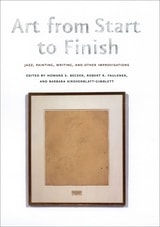
Art from Start to Finish
Jazz, Painting, Writing, and Other ImprovisationsEdited by Howard S. Becker, Robert R. Faulkner, and Barbara Kirshenblatt-Gimblett
University of Chicago Press, 2006
Art from Start to Finish gathers a unique group of contributors from the worlds of sociology, musicology, literature, and communications—many of them practicing artists in their own right—to discuss how artists from jazz musicians to painters work: how they coordinate their efforts, how they think, how they start, and, of course, how they finish their productions.
Specialists in the arts have much to say about the works themselves, which are often neglected by scholarsi n other fields. Art from Start to Finish takes a different tack by exploring the creative process itself and its social component. Any reader who makes art or has an interest in it will value this book.
But Can I Start a Sentence with "But"?
Advice from the Chicago Style Q&AThe University of Chicago Press Editorial Staff
University of Chicago Press, 2016
A. The idiom is “happy medium,” but I like the image of commuters taking refuge from road rage on the happy median.
Q. How do I write a title of a song in the body of the work (caps, bold, underline, italics, etc.)? Example: The Zombies’ “She’s Not There” looped in his head.
A. Noooo! Now that song is looping in my head (“but it’s too late to say you’re sorry . . .”). Use quotation marks. Thanks a lot.
Every month, tens of thousands of self-declared word nerds converge upon a single site: The Chicago Manual of Style Online's Q&A. There the Manual’s editors open the mailbag and tackle readers’ questions on topics ranging from abbreviation to word division to how to reform that coworker who still insists on two spaces between sentences. Champions of common sense, the editors offer smart, direct, and occasionally tongue-in-cheek responses that have guided writers and settled arguments for more than fifteen years.
But Can I Start a Sentence with “But”? brings together the best of the Chicago Style Q&A. Curated from years of entries, it features some of the most popular—and hotly debated—rulings and also recovers old favorites long buried in the archives.
Questions touch on myriad matters of editorial style—capitalization, punctuation, alphabetizing, special characters—as well as grammar, usage, and beyond (“How do I spell out the sound of a scream?”). A foreword by Carol Fisher Saller, the Q&A’s longtime editor, takes readers through the history of the Q&A and addresses its reputation for mischief. (“It’s not that we set out to be cheeky,” she writes.)
Taken together, the questions and answers offer insights into some of the most common issues that face anyone who works with words. They’re also a comforting reminder that even the best writer or editor needs a little help—and humor—sometimes.
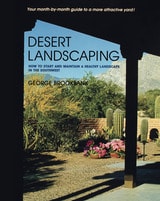
Desert Landscaping
How to Start and Maintain a Healthy Landscape in the SouthwestGeorge Brookbank
University of Arizona Press, 1992
CONTENTS
Part 1 - How to Start and Maintain a Desert Landscape
1. Desert Conditions: How They Are "Different"
2. Plants Are Like People: They're Not Alike
3. Use Arid-Land Plants to Save Water
4. How to Irrigate in the Desert
5. How to Design and Install a Drip Irrigation System
6. Soils and Their Improvement I: How to Plant in the Desert
7. Soils and Their Improvement II: How to Use Fertilizers
8. What to Do When Things Go Wrong: A Troubleshooter's Guide
9. How to Avoid—and Repair—Frost Damage
10. How to Control "Weeds"
11. Palo Verde Borer Beetle: What to Do
12. How to Avoid Texas Root Rot
13. When You Move Into an Empty House
14. What to Do About Roots in Drains
15. How to Dig Up Plants and Move Them
16. How to Have Flower Bed Color All Year
17. Landscape Gardening with Containers
18. Starting Wildflowers
19. Starting a Lawn
20. Making and Keeping a Good Hedge
21. Pruning Trees and Shrubs
22. Palm Tree Care
23. Caring for Saguaros, Ocotillos, Avages, and Prickly Pears
24. Roses in the Desert: Hard Work and Some Disappointments
25. Landscaping with Citrus
26. Swimming Pools: Plants, Play, and Water-Saving
27. Landscape Maintenance While You're Away
28. Condominiums: Common Grounds, Common Problems
Part 2 - A Month-by-Month Maintenance Guide
Finished from the Start and Other Plays
Juan Radrigan
Northwestern University Press, 2007
This collection of plays comes from one of Chile’s finest voices of the voiceless: Juan Radrigán. A history marked by personal and political hardship has equipped Radrigán to tell the stories of those his nation left behind. Seven years old when his father abandoned his family, he was forced to work from an early age. As an adult, he worked as a manual laborer during a very dark time for Chile: the demise of Salvador Allende and the rise of General Augusto Pinochet. In a time of torture, exile, and political “disappearances,” his plays stood as quietly powerful anti-regime statements that mourned the country’s loss. Translator Ana Elena Puga’s introduction places Radrigán’s work in its historical and cultural context and provides ample background for the six pieces.
The first work, Testimonies to the Deaths of Sabina, features a fruit seller who may lose her livelihood after she is accused of some mysterious infraction; but she doesn’t know what she has done—if she has truly done anything. The Beasts tells the story of three sisters living in the wilderness who, fearing they have been completely abandoned, devise a means of ultimate escape. Funeral Drums for Lambs and Wolves comes in three parts: Isabel Banished in Isabel, a monologue of a woman left to go mad alone; Without Apparent Motive, a monologue by a murderer who laments the spread of violence; and the dialogue The Guest, a confrontational piece that speaks directly to the spectators, implicating them in their silent, passive tolerance of Pinochet. The title play, Radrigán’s 1981 masterpiece, speaks directly to the specter of the many “disappeared” victims of the military regime.

How to Start a Farm Stop
A Pattern Language for Local Food SystemsKathryn Barr
Michigan Publishing Services, 2023

Start a Revolution
Stop Acting Like a LibraryBen Bizzle
American Library Association, 2014
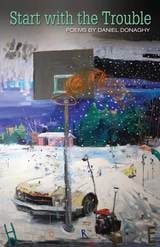
Start with the Trouble
PoemsDaniel Donaghy
University of Arkansas Press, 2009

Technomodern Poetics
The American Literary Avant-Garde at the Start of the Information AgeTodd F. Tietchen
University of Iowa Press, 2018
After the second World War, the term “technology” came to signify both the anxieties of possible annihilation in a rapidly changing world and the exhilaration of accelerating cultural change. Technomodern Poetics examines how some of the most well-known writers of the era described the tensions between technical, literary, and media cultures at the dawn of the Digital Age. Poets and writers such as Allen Ginsberg, Charles Olson, Jack Kerouac, and Frank O’Hara, among others, anthologized in Donald Allen’s iconic The New American Poetry, 1945–1960, provided a canon of work that has proven increasingly relevant to our technological present. Elaborating on the theories of contemporaneous technologists such as Norbert Wiener, Claude Shannon, J. C. R. Licklider, and a host of noteworthy others, these artists express the anxieties and avant-garde impulses they wrestled with as they came to terms with a complex array of issues raised by the dawning of the nuclear age, computer-based automation, and the expansive reach of electronic media. As author Todd Tietchen reveals, even as these writers were generating novel forms and concerns, they often continued to question whether such technological changes were inherently progressive or destructive.
With an undeniable timeliness, Tietchen’s book is sure to appeal to courses in modern English literature and American studies, as well as among fans of Beat writers and early Cold War culture.
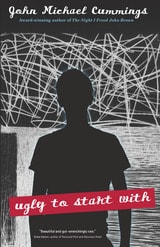
Ugly to Start With
John Michael Cummings
West Virginia University Press, 2011
Jason Stevens is growing up in picturesque, historic Harpers Ferry, West Virginia in the 1970s. Back when the roads are smaller, the cars slower, the people more colorful, and Washington, D.C. is way across the mountains—a winding sixty-five miles away.
Jason dreams of going to art school in the city, but he must first survive his teenage years. He witnesses a street artist from Italy charm his mother from the backseat of the family car. He stands up to an abusive husband—and then feels sorry for the jerk. He puts up with his father’s hard-skulled backwoods ways, his grandfather’s showy younger wife, and the fist-throwing schoolmates and eccentric mountain characters that make up Harpers Ferry—all topped off by a basement art project with a girl from the poor side of town.
Ugly to Start With punctuates the exuberant highs, bewildering midpoints, and painful lows of growing up, and affirms that adolescent dreams and desires are often fulfilled in surprising ways.
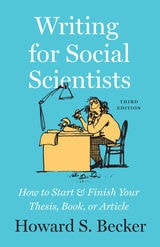
Writing for Social Scientists, Third Edition
How to Start and Finish Your Thesis, Book, or ArticleHoward S. Becker
University of Chicago Press, 2020
This is not a book about sociological writing. Instead, Becker applies his sociologist’s eye to some of the common problems all academic writers face, including trying to get it right the first time, failing, and therefore not writing at all; getting caught up in the trappings of “proper” academic writing; writing to impress rather than communicate with readers; and struggling with the when and how of citations. He then offers concrete advice, based on his own experiences and those of his students and colleagues, for overcoming these obstacles and gaining confidence as a writer.
While the underlying challenges of writing have remained the same since the book first appeared, the context in which academic writers work has changed dramatically, thanks to rapid changes in technology and ever greater institutional pressures. This new edition has been updated throughout to reflect these changes, offering a new generation of scholars and students encouragement to write about society or any other scholarly topic clearly and persuasively.
As Becker writes in the new preface, “Nothing prepared me for the steady stream of mail from readers who found the book helpful. Not just helpful. Several told me the book had saved their lives; less a testimony to the book as therapy than a reflection of the seriousness of the trouble writing failure could get people into.” As academics are being called on to write more often, in more formats, the experienced, rational advice in Writing for Social Scientists will be an important resource for any writer’s shelf.
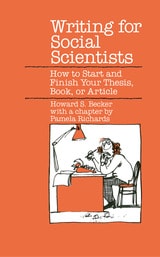
Writing for Social Scientists
How to Start and Finish Your Thesis, Book, or ArticleHoward S. Becker
University of Chicago Press, 1986
Both the means and the reasons for writing a thesis or article or book are socially structured by the organization of graduate study, the requirements for publication, and the conditions for promotion, and the pressures arising from these situations create the writing style so often lampooned and lamented. Drawing on his thirty-five years' experience as a researcher, writer, and teacher, Becker exposes the foibles of the academic profession to the light of sociological analysis and gentle humor. He also offers eminently useful suggestions for ways to make social scientists better and more productive writers. Among the topics discussed are how to overcome the paralyzing fears of chaos and ridicule that lead to writer's block; how to rewrite and revise, again and again; how to adopt a persona compatible with lucid prose; how to deal with that academic bugaboo, "the literature." There is also a chapter by Pamela Richards on the personal and professional risks involved in scholarly writing.
In recounting his own trials and errors Becker offers his readers not a model to be slavishly imitated but an example to inspire. Throughout, his focus is on the elusive work habits that contribute to good writing, not the more easily learned rules of grammar and punctuation. Although his examples are drawn from sociological literature, his conclusions apply to all fields of social science, and indeed to all areas of scholarly endeavor. The message is clear: you don't have to write like a social scientist to be one.
Writing for Social Scientists
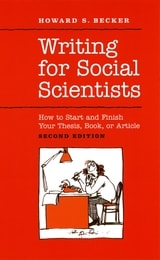
How to Start and Finish Your Thesis, Book, or Article: Second EditionHoward S. Becker
University of Chicago Press, 2007
Sociologist Howard S. Becker has written the classic book on how to conquer these pressures and simply write. First published nearly twenty years ago, Writing for Social Scientists has become a lifesaver for writers in all fields, from beginning students to published authors. Becker’s message is clear: in order to learn how to write, take a deep breath and then begin writing. Revise. Repeat.
It is not always an easy process, as Becker wryly relates. Decades of teaching, researching, and writing have given him plenty of material, and Becker neatly exposes the foibles of academia and its “publish or perish” atmosphere. Wordiness, the passive voice, inserting a “the way in which” when a simple “how” will do—all these mechanisms are a part of the social structure of academic writing. By shrugging off such impediments—or at the very least, putting them aside for a few hours—we can reform our work habits and start writing lucidly without worrying about grades, peer approval, or the “literature.”
In this new edition, Becker takes account of major changes in the computer tools available to writers today, and also substantially expands his analysis of how academic institutions create problems for them. As competition in academia grows increasingly heated, Writing for Social Scientists will provide solace to a new generation of frazzled, would-be writers.