Results by title
18284 books match the query 'United States' and 949 start with m
More Peoples of Las Vegas
One City, Many FacesJerry L Simich
University of Nevada Press, 2010
The remarkable economic growth of Las Vegas between 1980 and 2007 created a population boom and a major increase in the ethnic and religious diversity of the city. Today, over 21 percent of the city’s population is foreign born, and over 30 percent speak a language other than English at home. The local court system offers interpreters in 82 languages, and in 2005/2006, for example, more than 11,000 people, originating from 138 countries, were naturalized there as American citizens.More Peoples of Las Vegas extends the survey of this city’s cosmopolitan population begun in The Peoples of Las Vegas (University of Nevada Press, 2005). As in the previous book, this volume includes well-established groups like the Irish and Germans, and recently arrived groups like the Ethiopians and Guatemalans. Essays describe the history of each group in Las Vegas and the roles they play in the life and economy of the city. The essays also explore the influence of modern telecommunications and accessible air travel, showing how these factors allow newcomers to create transnational identities and maintain ties with families and culture back home. They also examine the role of local institutions—including clubs, religious organizations, shops, restaurants, and newspapers and other media—in helping immigrants maintain their ethnic and religious identities and in disseminating national and even regional cultures of origin.More Peoples of Las Vegas adds to our awareness of the rich and varied ethnic and religious character of Las Vegans. In a broader context, it offers thoughtful perspectives on the impact of globalization on a major American city and on the realities of immigrant life in the twenty-first century.
More Philadelphia Murals and the Stories They Tell
Jane Golden
Temple University Press, 2006
More Secure, Less Free?
Antiterrorism Policy & Civil Liberties after September 11Mark Sidel
University of Michigan Press, 2010
Unlike earlier books published shortly after the September 11 attacks that focus on the Patriot Act, More Secure, Less Free? covers the Patriot Act but goes well beyond, analyzing Total Information Awareness, Terrorist Information and Prevention System (TIPS), Computer Assisted Passenger Prescreening System II (CAPPS II), and a number of other "second wave" antiterror initiatives.
It's also the first book of its kind to go beyond federal measures to explain the devolution of antiterror policies to the states, and now to the military as well. Author Mark Sidel discusses the continuing debates on antiterror law at the state level, with a focus on the important states of New York, California, and Michigan, and explains how the military-through an informant program known as "Eagle Eyes"-is now taking a direct hand in domestic antiterror efforts.
The volume also discusses and analyzes crucially important aspects of American antiterror policy that have been largely ignored in other volumes and discusses the effects of antiterror policy on the American academic world and the American nonprofit sector, for example. And it provides the first comparative perspectives on U.S. antiterror policy yet published in an American volume, discussing antiterror initiatives in Great Britain, Australia, and India and contrasting those to the American experience.
More Secure, Less Free? is important and essential reading for anyone interested in an analytical perspective on American antiterror policy since September 11 that goes well beyond the Patriot Act.
Mark Sidel is Associate Professor of Law at the University of Iowa and a research scholar at the University's Obermann Center for Advanced Studies.
More Speech, Not Less
Communications Law in the Information AgeMark Sableman. Foreword by Paul Simon
Southern Illinois University Press, 1997
On a daily basis we are confronted with "more speech, not less"—more news reports, more television channels, more publications, more electronic communications. Communications laws have expanded in response to the proliferation of communications, and these laws affect everyone.
Communications lawyer Mark Sableman uses recent case studies, practical examples, and plain language to describe and analyze the broad spectrum of modern communications laws and policies. In these essays, Sableman helps communications professionals as well as informed citizens understand the law.
The constitutional foundation for the information age is settled: radical solutions on either side have been rejected. Neither First Amendment absolutism nor untrammeled content-based censorship will rule in America. But within the remaining middle area, many key policy choices are being made by courts and policy makers. Intricate webs of legal do’s and don’ts, practical pitfalls, and effective safe harbors are being developed across the broad spectrum of communications law.
In this guide to existing law, developing trends, and critical policy determinations, Sableman discusses privacy, Internet communications and policy, censorship, libel and slander, copyright and intellectual property, advertising, broadcasting, and journalistic confidentiality. Through actual cases and practical examples, he examines and explains both the existing rules for communications professionals and the developing policies that deserve the attention and scrutiny of informed citizens. Sableman approaches these subjects as a practicing lawyer experienced in both business and media communications.
The phrase "more speech, not less" describes not only the growing cacophony of the information age, but also one approach to legal policy—Justice Louis D. Brandeis’s preference for "more speech, not enforced silence" in all but the most extreme situations. Drawing from his strong advocacy of free speech, Sableman hopes to stimulate informed debate among all who are concerned about the power of information and the magic of words and images.

More Storytime Action!
American Library Association, 2009
More Storytime Magic
Kathy MacMillan
American Library Association, 2016
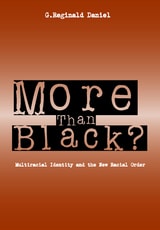
More Than Black
Multiracial Identity & New Racial OrderG. Reginald Daniel
Temple University Press, 2001
Tracing the centuries-long evolution of Eurocentrism, a concept geared to protecting white racial purity and social privilege, Daniel shows how race has been constructed and regulated in the United States. The so-called one-drop rule (i.e., hypodescent) obligated individuals to identify as black or white, in effect erasing mixed-race individuals from the social landscape. For most of our history, many mixed-race individuals of African American descent have attempted to acquire the socioeconomic benefits of being white by forming separate enclaves or "passing." By the 1990s, however, interracial marriages became increasingly common, and multiracial individuals became increasingly political, demanding institutional changes that would recognize the reality of multiple racial backgrounds and challenging white racial privilege.
More Than Black? regards the crumbling of the old racial order as an opportunity for substantially more than an improvement in U.S. race relations; it offers no less than a radical transformation of the nation's racial consciousness and the practice of democracy.
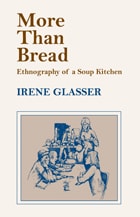
More Than Bread
Ethnography of a Soup KitchenIrene Glasser
University of Alabama Press, 2010
A powerful ethnographic portrait of hunger, dignity, and community in America.
In More than Bread: Ethnography of a Soup Kitchen, sociologist Irene Glasser presents a compelling and deeply human exploration of poverty, hunger, and community through the lens of an American soup kitchen. Drawing on immersive ethnographic research, Glasser moves beyond stereotypes and statistics to examine the daily experiences of individuals who depend on emergency food assistance, as well as the volunteers and staff who work to meet their needs.
Through firsthand observations and personal narratives, the book reveals the complex social relationships, challenges, and acts of resilience that unfold within this vital community institution. Glasser explores how issues such as homelessness, unemployment, inequality, mental health, and social isolation intersect in the lives of those seeking assistance, while also highlighting the dignity and humanity of people often overlooked in public discussions of poverty.
More than Bread invites readers to consider broader questions about social responsibility, public policy, and the effectiveness of charitable responses to human need. A valuable resource for understanding the realities of food insecurity in America, this book offers an informative and compassionate perspective on one of society's most pressing challenges. It is an essential read for students, scholars, social workers, policymakers, nonprofit professionals, and anyone interested in poverty, homelessness, and social justice.
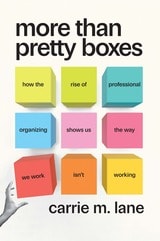
More Than Pretty Boxes
How the Rise of Professional Organizing Shows Us the Way We Work Isn’t WorkingCarrie M. Lane
University of Chicago Press, 2024
For a widely dreaded, often mundane task, organizing one’s possessions has taken a surprising hold on our cultural imagination. Today, those with the means can hire professionals to help sort and declutter their homes. In More Than Pretty Boxes, Carrie M. Lane introduces us to this world of professional organizers and offers new insight into the domains of work and home, which are forever entangled—especially for women.
The female-dominated organizing profession didn’t have a name until the 1980s, but it is now the subject of countless reality shows, podcasts, and magazines. Lane draws on interviews with organizers, including many of the field’s founders, to trace the profession’s history and uncover its enduring appeal to those seeking meaningful, flexible, self-directed work. Taking readers behind the scenes of real-life organizing sessions, More Than Pretty Boxes details the strategies organizers use to help people part with their belongings, and it also explores the intimate, empathetic relationships that can form between clients and organizers.
But perhaps most importantly, More Than Pretty Boxes helps us think through an interconnected set of questions around neoliberal work arrangements, overconsumption, emotional connection, and the deeply gendered nature of paid and unpaid work. Ultimately, Lane situates organizing at the center of contemporary conversations around how work isn’t working anymore and makes a case for organizing’s radical potential to push back against the overwhelming demands of work and the home, too often placed on women’s shoulders. Organizers aren’t the sole answer to this crisis, but their work can help us better understand both the nature of the problem and the sorts of solace, support, and solutions that might help ease it.

More Than Science and Sputnik
The National Defense Education Act of 1958Wayne J. Urban
University of Alabama Press, 2010
Sparked by dramatic Soviet achievements, particularly in nuclear technology and the development of the Sputnik space orbiter, the United States responded in the late 1950s with an extraordinary federal investment in education. Designed to overcome a perceived national failure to produce enough qualified scientists, engineers, and mathematicians to compete with the Communist bloc, the effort resulted in the National Defense Education Act of 1958 (NDEA). Representative Carl Elliott and Senator Lister Hill both from Alabama, and then Assistant Secretary of Health, Education, and Welfare, Elliot Richardson were the prime movers in shaping of this landmark legislation.
More than Science and Sputnik analyzes primary documents of the three leaders to describe the political process that established the NDEA. The book illustrates what the assumptions of the key players were, and why they believed the act was needed.
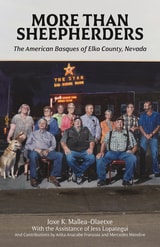
More Than Sheepherders
The American Basques of Elko County, NevadaJoxe K. Mallea-Olaetxe
University of Nevada Press, 2025
Joxe K. Mallea-Olaetxe presents a modern study focused on the post-1970s, when the retired Basque sheepherders and their families became the dominant Americanized minority in the area. During this time, the Fourth of July National Basque Festival began to attract thousands of visitors from as far away as Europe to the small Nevada community and brought to light the vibrant customs of these Nevadans.
This book explores the American Basques’ present-day place in the West, bolstered by the collaborative efforts of four contributors, including two women—all who have been residents of Elko. The writers offer firsthand knowledge of their heritage through numerous vignettes, and these deeply personal perspectives will entice readers into Mallea-Olaetxe’s singular and entertaining historical account.

More Than Words
A Memoir of a Writing LifeJerry Apps
Wisconsin Historical Society Press, 2022
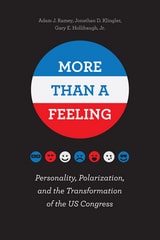
More Than a Feeling
Personality, Polarization, and the Transformation of the US CongressAdam J. Ramey, Jonathan D. Klingler, and Gary E. Hollibaugh Jr.
University of Chicago Press, 2017
With More Than a Feeling, Adam J. Ramey, Jonathan D. Klingler, and Gary E. Hollibaugh, Jr. have developed an innovative framework incorporating what are known as the Big Five dimensions of personality—openness to experience, conscientiousness, extraversion, agreeableness, and neuroticism—to improve our understanding of political behavior among members of Congress. To determine how strongly individuals display these traits, the authors identified correlates across a wealth of data, including speeches, campaign contributions and expenditures, committee involvement, willingness to filibuster, and even Twitter feeds. They then show how we might expect to see the influence of these traits across all aspects of Congress members’ political behavior—from the type and quantity of legislation they sponsor and their style of communication to whether they decide to run again or seek a higher office. They also argue convincingly that the types of personalities that have come to dominate Capitol Hill in recent years may be contributing to a lot of the gridlock and frustration plaguing the American political system.
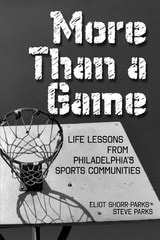
More Than a Game
Life Lessons from Philadelphia's Sports CommunityEliot Shorr-Parks
Temple University Press, 2012
Anyone who has sat at the "Vet," watched a pick-up game, or played catch in the yard, knows that sports is more than a game in Philadelphia—it's a commitment to hard work, a belief in community values, and a tradition of never giving up.
Told through the personal experiences of professional athletes, community leaders, and everyday players, More Than a Game captures how sports build character and communities with each hit of the ball, catch of a touchdown pass, or dunk of the basketball.
Among those featured are Carlos Ruiz, Chris Pronger, Sonny Hill, Angelo Cataldi, Leonard Weaver, Rita Sloan Green, Ruben Amaro, Jr., Joe Banner, Alyson Goodner, Gary Cobb, Jim Ellis, Mayor Michael Nutter, Nicholas Bradley, Governor Edward Rendell, and Rami Ibrahim.
The perfect gift for the aspiring athlete, the community coach, or the supportive parent.

More or Less Afraid of Nearly Everything
Homeland Security, Borders, and Disasters in the Twenty-First CenturyBenjamin Rohrbaugh
University of Michigan Press, 2020
Throughout the twentieth century, the United States did not experience national security domestically; it defended its borders by conducting military, foreign policy, and intelligence operations internationally, and then separated these activities from domestic law enforcement with bright legal lines. In the twenty-first century, U.S. national security no longer occurs exclusively outside of the nation. The U.S. government is beginning to respond to this change, and the establishment of the Department of Homeland Security is merely the first step in an organizational and strategic realignment that will be a long, difficult, and mistake-filled process. More or Less Afraid of Nearly Everything is an accessible and engaging guide to homeland security, particularly migration and border security, that makes innovative arguments about the American government and keeping citizens safe, and provides practical solutions to real-world problems.
More than Lore
Reminiscences of Marion TalbotMarion Talbot
University of Chicago Press, 2015
Originally published in 1936, More than Lore is a unique firsthand account of the early days of the university, capturing the excitement and travails of life on an academic frontier. Talbot shares gossip from the faculty lounge, relays student antics in the dorms, and tells stories from the living rooms of Hyde Park. It’s also a fascinating look at life as an early twentieth-century college woman, with scandals over improper party invitations and underground sororities, petitions calling for more female professors, and campaigns to have students be known as “university women” instead of “college girls.” With Talbot as our guide, we reenter a lost world where simply to be a woman was to be a pioneer and where the foundations of the modern undergrad experience were being established.
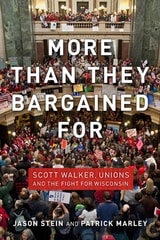
More than They Bargained For
Scott Walker, Unions, and the Fight for WisconsinJason Stein and Patrick Marley
University of Wisconsin Press, 2013
“Stein and Marley deliver an impressively objective account of the struggle, ably describing the objectives and tactics of each side in a confident and engaging style.”—Kirkus Reviews
“Stein and Marley deliver a swashbuckling tale of Wisconsin's Republican Governor Scott Walker's election and tumultuous first year in office. . . . Instead of an expected dry read, the authors' lively, economical prose, supplemented by snippets of social media reporting in real time, place readers in the crowded Capitol building stairwells, or in the midst of Wisconsin's largest sustained demonstration since Vietnam protests rocked the University of Wisconsin campus.”—Publishers Weekly
“This book is a political thriller, an activists’ handbook (for the Left on how to organize mass protests, and for the Right on how to effectively fight public employee unions), and a work of investigative journalism all rolled into one. Social scientists, political junkies, and anyone interested in public affairs will devour it.”—Library Journal
“Not only have Stein and Marley organized this mass of material into a coherent whole, but they also write well, ensuring that even the drier parts of their narrative are clear as well as fair. Their book provides plenty of ammunition for both sides. But it also offers something far better: the basis for an adult conversation about what actually happened.”—Milwaukee Journal Sentinel
“This timely account covers the ethics investigations, public demonstrations, runaway legislators, recalls, and physical confrontation between two state Supreme Court justices. . . . This book is written in a concise, unbiased manner and includes complete details. In a greater sense, it explores the drastic polarization endemic in American society today.”—Choice
“A testament to the information-gathering powers of good beat reporters. In Bob Woodward style, they reconstruct the backroom meetings that ushered Gov. Scott Walker’s Act 10 legislation through the protester-crammed halls of the Wisconsin State Capitol.”—Milwaukee Magazine
“Stein and Marley have managed to produce a very readable, well-researched, and thoroughly interesting narrative without any notable bias—a major accomplishment.”—Wisconsin People & Ideas Magazine
More than a Farmer's Wife
Voices of American Farm Women, 1910-1960Amy Mattson Lauters
University of Missouri Press, 2009

Morgan Park
Duluth, U.S. Steel, and the Forging of a Company TownArnold R. Alanen
University of Minnesota Press, 2008
From 1915 to 1971 the large U.S. Steel plant was a major part of Duluth’s landscape and life. Just as important was Morgan Park—an innovatively planned and close-knit community constructed for the plant’s employees and their families. In this new book Arnold R. Alanen brings to life Morgan Park, the formerly company-controlled town that now stands as a city neighborhood, and the U.S. Steel plant for which it was built.
Planned by renowned landscape architects, architects, and engineers, and provided with schools, churches, and recreational and medical services by U.S. Steel, Morgan Park is an iconic example—like Lowell, Massachusetts, and Pullman, Illinois—of a twentieth-century company town, as well as a window into northeastern Minnesota’s industrial roots.
Starting with the intense political debates that preceded U.S. Steel’s decision to build a plant in Duluth, Morgan Park follows the town and its residents through the boom years to the closing of the outmoded facility—an event that foreshadowed industrial shutdowns elsewhere in the United States—and up to today, as current residents work to preserve the community’s historic character.
Through compelling archival and contemporary photographs and vibrant stories of a community built of concrete and strong as steel, Alanen shows the impact both the plant and Morgan Park have had on life in Duluth.
Arnold R. Alanen is professor of landscape architecture at the University of Wisconsin–Madison. His previous books include Main Street Ready-Made: The New Deal Community of Greendale, Wisconsin and Preserving Cultural Landscapes in America.
Morkan's Quarry
A NovelSteve Yates
Moon City Press, 2010
Mormon Battalion
United States Army of the West, 1846-1848Norma Baldwin Ricketts
Utah State University Press, 1997

Mormon Enigma
Emma Hale SmithLinda King Newell and Valeen Tippetts Avery
University of Illinois Press, 1994
Winner of the Evans Biography Award, the Mormon History Association Best Book Award, and the John Whitmer Association (RLDS) Best Book Award.
Mormon Enigma is the bestselling biography of Emma Hale Smith, wife of the Mormon prophet Joseph Smith. It was Joseph Smith who announced that an angel of the Lord had commanded him to introduce a 'new order of marriage.' And it was Emma Hale Smith who confronted the practice of polygamy head on.
As the authors note in their introduction, "Early leaders in Utah castigated Emma from their pulpits for opposing Brigham Young and the practice of polygamy, and for lending support to the Reorganization. As these attitudes filtered down through the years, Emma was virtually written out of official Utah histories. In this biography, we have attempted to reconstruct the full story of this remarkable and much misunderstood woman's experiences.
Mormon Envoy
The Diplomatic Legacy of Dr. John Milton BernhiselBruce W. Worthen
University of Illinois Press, 2023
Having risen from a Pennsylvania backcountry upbringing to become a respected member of the upper class, Bernhisel possessed a personal history that allowed him to reach common ground with politicians and other outsiders. He negotiated for Joseph Smith’s life and, after the Church’s relocation to the Utah Territory, took on the task of rehabilitating the public image of the Latter-day Saints. Brigham Young’s defiance of the government undermined Bernhisel’s work, but their close if sometimes turbulent relationship ultimately allowed Bernhisel to make peace with Washington, secure a presidential pardon for Young, and put Utah and the Latter-day Saints on the road to formally joining the United States.
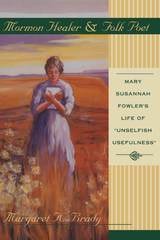
Mormon Healer Folk Poet
Mary Susannah Fowler's Life of 'Unselfish Usefulness'Margaret Brady
Utah State University Press, 2000
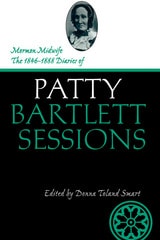
Mormon Midwife
edited by Donna Toland Smart
Utah State University Press, 1999

Mormon Passage of George D. Watt
First British Convert, Scribe for ZionRonald G. Watt
Utah State University Press, 2009
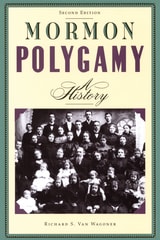
Mormon Polygamy
A HistoryRichard S. Van Wagoner
Signature Books, 1989
What emerges is a portrait that neither discounts nor exaggerates the historical evidence. He presents polygamy in context, neither condemning nor defending, while relevant contemporary accounts are treated sympathetically but interpreted critically. No period of Mormon history is emphasized over another. The result is a systematic view that is unavailable in studies of isolated periods or in the repetitions of folklore that only disguise the reality of what polygamy was.
Scattered throughout the western United States today are an estimated 30,000 fundamentalist Mormons who still live “the principle.” They, too, are a part of Joseph Smith’s legacy and are included in this study.
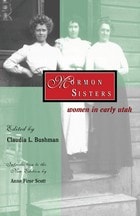
Mormon Sisters
Women In Early UtahClaudia Bushman
Utah State University Press, 1997
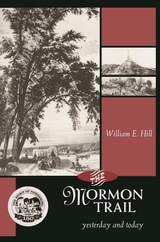
Mormon Trail
Yesterday and TodayWilliam E. Hill
Utah State University Press, 1996
Back in print, this essential reference for readers interested in the Mormon Trail is part history, part resource book, part guide and photographic essay. Driven from their home in Nauvoo, Illinois, Mormons led by Brigham Young began in 1846 to journey west to an expected haven in the Great Salt Lake Valley. The first party arrived there in July 1847. Thousands of members and converts later followed the Mormon Trail, which for much of its way traced the route of the Oregon Trail, although it generally stayed across the Platte River from the more-traveled way. It was thus, until the railroad's arrival in 1869, one of the West's most important and heavily used roads.
Although the Mormons' experience was in most ways similar to that of other emigrants, the religious motivations, tight organization, and family groups of the Mormons gave their migration a distinct character. William E. Hill introduces the Mormons, their eventful early history, and the characteristics of the migration west. His book also includes a chronology of trail-related events, excerpts from diaries and guidebooks, songs, historical maps, over 200 then-and-now illustrations, descriptions of major museums and displays on the trail, and recommendations for further reading.
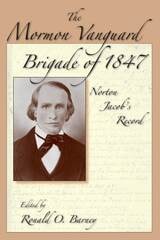
Mormon Vanguard Brigade Of 1847
Norton Jacob's Recordedited by Ronald O. Barney
Utah State University Press, 2005
Mormon Women at the Crossroads
Global Narratives and the Power of ConnectednessCaroline Kline
University of Illinois Press, 2022
Winner of the Mormon History Association Best International Book Award
The Church of Jesus Christ of Latter-day Saints continues to contend with longstanding tensions surrounding gender and race. Yet women of color in the United States and across the Global South adopt and adapt the faith to their contexts, many sharing the high level of satisfaction expressed by Latter-day Saints in general. Caroline Kline explores the ways Latter-day Saint women of color in Mexico, Botswana, and the United States navigate gender norms, but also how their moral priorities and actions challenge Western feminist assumptions. Kline analyzes these traditional religious women through non-oppressive connectedness, a worldview that blends elements of female empowerment and liberation with a broader focus on fostering positive and productive relationships in different realms. Even as members of a patriarchal institution, the women feel a sense of liberation that empowers them to work against oppression and against alienation from both God and other human beings.
Vivid and groundbreaking, Mormon Women at the Crossroads merges interviews with theory to offer a rare discussion of Latter-day Saint women from a global perspective.
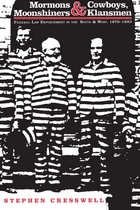
Mormons and Cowboys, Moonshiners and Klansman
Federal Law Enforcement in the South and West, 1870-1893Stephen Cresswell
University of Alabama Press, 1991
A critical study of the expansion of federal law enforcement across the post-Civil War American South and frontier West.
In the decades immediately following the Civil War, the United States expanded rapidly. As the nation grew, so too did federal law, moving into areas of citizens’ lives previously regulated by local custom and state and territorial statutes.
Drawing on contemporary accounts and the letters that flowed between the Washington office of the Justice Department and its attorneys and marshals throughout the states and territories, Cresswell uses a case-study approach to explore the enforcement of federal law in four regions. In northern Mississippi, the rights of freedmen to vote clashed with established rules of relations between blacks and whites. In Utah Territory, Mormon polygamy and economic dominance challenged the aspirations of non-Mormon settlers. In eastern Tennessee, desperate poverty lent enchantment to the easy money of moonshining. In Arizona Territory, frontier greed and violence threatened the lives of people and the chances of early admission to the Union of states.
Mormons and Cowboys, Moonshiners and Klansmen moves beyond these local case studies to illuminate larger questions, including the evolution of the American criminal justice system, the relationship of the South and the West to the rest of the nation, the workings of the 19th-century American bureaucracy, and conflict of the local, state, and federal governments.
Out of the efforts of these early federal marshals came the modern federal justice system, with its firm policy guidelines, its Federal Bureau of Investigation, and its broader powers over the country as a whole.
Mormons, Musical Theater, and Belonging in America
Jake Johnson
University of Illinois Press, 2019
Morocco Bound
Disorienting America's Maghreb, from Casablanca to the Marrakech ExpressBrian T. Edwards
Duke University Press, 2005
Edwards reads a broad range of texts to recuperate the disorienting possibilities for rethinking American empire. Examining work by William Burroughs, Jane Bowles, Ernie Pyle, A. J. Liebling, Jane Kramer, Alfred Hitchcock, Clifford Geertz, James Michener, Ornette Coleman, General George S. Patton, and others, he puts American texts in conversation with an archive of Maghrebi responses. Whether considering Warner Brothers’ marketing of the movie Casablanca in 1942, journalistic representations of Tangier as a city of excess and queerness, Paul Bowles’s collaboration with the Moroccan artist Mohammed Mrabet, the hippie communities in and around Marrakech in the 1960s and early 1970s, or the writings of young American anthropologists working nearby at the same time, Edwards illuminates the circulation of American texts, their relationship to Maghrebi history, and the ways they might be read so as to reimagine the role of American culture in the world.

Mortal Kombat
Games of DeathDavid Church
University of Michigan Press, 2022
This book traces Mortal Kombat’s history as an American product inspired by both Japanese video games and Chinese martial-arts cinema, its successes and struggles in adapting to new market trends, and the ongoing influence of its secret-strewn narrative world. After outlining the specific elements of gameplay that differentiated Mortal Kombat from its competitors in the coin-op market, David Church examines the various martial-arts films that inspired its Orientalist imagery, helping explain its stereotypical uses of race and gender. He also posits the games as a cultural landmark from a moment when public policy attempted to intervene in both the remediation of cinematic aesthetics within interactive digital games and in the transition of public gaming spaces into the domestic sphere. Finally, the book explores how the franchise attempted to conquer other forms of media in the 1990s, lost ground to a new generation of 3D games in the 2000s, and has successfully rebooted itself in the 2010s to reclaim its legacy.
Moses and the Monster and Miss Anne
Carole C. Marks
University of Illinois Press, 2008
All three women lived for a time in close proximity on the Eastern Shore of Maryland, an isolated region that thrived on tobacco and then lost it, procured slaves and then lost them, and produced strong-minded women and then condemned them. Though they never actually met, and their backgrounds and beliefs differed drastically, these women's lives converged through their active experiences of the conflict over slavery in Maryland and beyond, the uncertainties of economic transformation, the struggles in the legal foundation of slavery and, most of all, the growing dispute in gender relations in America.
Throughout this book, Carole C. Marks gleans historical fact and sociological insight from the persistent myths and exaggerations that color the women's legacies, and she investigates the common roots and motivations of three remarkable figures who bucked the era's expectations for women. She also considers how each woman's public identity reflected changing ideas of domesticity and the public sphere, spirituality, and legal rights and limitations. Cannon, Carroll, and Tubman, each in her own way, passionately fought for the future of Maryland and the United States, and from these unique vantage points, Moses and the Monster and Miss Anne portrays the intersecting and conflicting forces of race, economics, and gender that threatened to rend a nation apart.
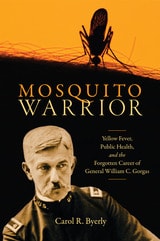
Mosquito Warrior
Yellow Fever, Public Health, and the Forgotten Career of General William C. GorgasCarol R. Byerly
University of Alabama Press, 2024
A compelling biography of General William C. Gorgas, the US Army doctor's campaign against mosquito-borne disease reshaped public health, military medicine, and U. S. power on the world stage.
Mosquito Warrior tells the engrossing story of General William C. Gorgas (1854–1920), the once-renowned pioneer in tropical disease research and public health. His fascinating life illuminates vast transformations in the United States, including the end of the Civil War and the industrialization of the US military and economy, the emergence of germ theory and the modernization of the public health system, and the rise of the United States as a world power.
A scion of Confederate elites, Gorgas came of age amidst war and disease and the politics of racial segregation. He followed his father into military service as an army medical officer, treating troops on America’s western frontier posts. During the US occupation of Cuba, Gorgas applied Walter Reed’s research on the theory of mosquito-borne disease transmission, ending centuries of yellow fever in Havana through the eradication of the deadly Aedes aegypti mosquito. Applying similar strategies on the isthmus of Panama against yellow fever and malaria, Gorgas enabled the completion of the Panama Canal, then the largest engineering project in the world. Hailed a hero, he pursued his fight against mosquito-borne disease throughout the tropics, expanding American interests as he went. Appointed as US Army surgeon general on the eve of World War I, Gorgas resumed work modernizing the army health care system, strengthening US medical and military authority on the world stage.
Celebrated in life, Gorgas’s reputation fell victim to competing political interests and jealousies after his death, a cautionary tale about historical memory and the politics of science and personality. Carol R. Byerly’s balanced and contemporary examination of Gorgas illuminates his complex legacy in medicine and public health, military history, and American ambitions at the dawn of US global ascendency.

Most of the Stars
An American SongPietro Federico
St. Augustine's Press, 2024
In Most of the Stars the linguistic power of the Italian literary tradition and the contemporary vernacular combine to articulate an idiosyncratic understanding of the New World—the breadth of its cities, its towns, its frontiers and interiors. Federico’s deeply spiritual understanding of our own American personalities and histories offers us a gift of beautiful objectivity. Students of poetry, linguistics, and cultural anthropology will be grateful to Federico and Poch for the wonder offered in this bilingual collection.
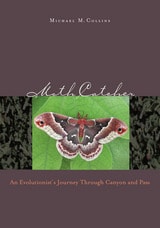
Moth Catcher
An Evolutionist's Journey Through Canyon And PassMichael M. Collins
University of Nevada Press, 2007
The memoir of a scientist and the wild silk moths he studies
Biologist Michael Collins has been studying wild silk moths since he was a boy. This family — which includes the largest and most colorful of the North American moths — led Collins into a long career as a scientist, and has provided him with significant insights into the process by which new species evolve. Moth Catcher is Collins’s engaging account of his development as a scientist and of his groundbreaking research. The canyon and pass environments of the American West offer a setting in which, since the last Ice Age, organisms have adapted to new surroundings and where many have formed new species. Collins has discovered in the Sierra Nevada that geneticists call a “hybrid zone” where two species interbreed. This hybrid zone is unusual because both sexes are fertile, unlike lab-bred hybrids between the same silk moth species. Collins explains how such hybrid populations serve as laboratories in nature where the process of speciation can be observed and studied. This book offers a fascinating view into the work of a field scientist and the ways that evolution continues to operate around us. Collins’s colorful accounts of his fieldwork will delight any reader who loves the outdoors and is captivated by the diversity and interrelations of the life forms found there. And his passion for his research and the fragile, exquisite creatures that he studies will inspire a new appreciation of the wonders of the natural world and the myriad life forms that occupy it.
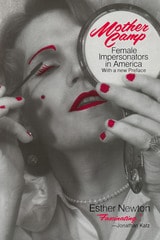
Mother Camp
Female Impersonators in AmericaEsther Newton
University of Chicago Press, 1979
"Newton's fascinating book shows how study of the extraordinary can brilliantly illuminate the ordinary—that social-sexual division of personality, appearance, and activity we usually take for granted."—Jonathan Katz, author of Gay American History
"A trenchant statement of the social force and arbitrary nature of gender roles."—Martin S. Weinberg, Contemporary Sociology
Mother Earth and Uncle Sam
How Pollution and Hollow Government Hurt Our KidsBy Rena I. Steinzor
University of Texas Press, 2007
In this compelling study, Rena Steinzor highlights the ways in which the government, over the past twenty years, has failed to protect children from harm caused by toxic chemicals. She believes these failures—under-funding, excessive and misguided use of cost/benefit analysis, distortion of science, and devolution of regulatory authority—have produced a situation in which harm that could be reduced or eliminated instead persists.
Steinzor states that, as a society, we are neglecting our children's health to an extent that we would find unthinkable as individual parents, primarily due to the erosion of the government's role in protecting public health and the environment. At this pace, she asserts, our children will inherit a planet under grave threat. We can arrest these developments if a critical mass of Americans become convinced that these problems are urgent and the solutions are near at hand.
By focusing on three specific case studies—mercury contamination through the human food chain, perchlorate (rocket fuel) in drinking water, and the effects of ozone (smog) on children playing outdoors—Steinzor creates an analysis grounded in law, economics, and science to prove her assertions about the existing dysfunctional system.
Steinzor then recommends a concise and realistic series of reforms that could reverse these detrimental trends and serve as a blueprint for restoring effective governmental intervention. She argues that these recommendations offer enough material to guide government officials and advocacy groups toward prompt implementation, for the sake of America's—and the world's—future generations.
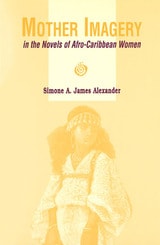
Mother Imagery in the Novels of Afro-Caribbean Women
Simone A. James Alexander
University of Missouri Press, 2000
Focusing on specific texts by Jamaica Kincaid, Maryse Condé, and Paule Marshall, this fascinating study explores the intricate trichotomous relationship between the mother (biological or surrogate), the motherlands Africa and the Caribbean, and the mothercountry represented by England, France, and/or North America. The mother-daughter relationships in the works discussed address the complex, conflicting notions of motherhood that exist within this trichotomy. Although mothering is usually socialized as a welcoming, nurturing notion, Alexander argues that alongside this nurturing notion there exists much conflict. Specifically, she argues that the mother-daughter relationship, plagued with ambivalence, is often further conflicted by colonialism or colonial intervention from the "other," the colonial mothercountry.
Mother Imagery in the Novels of Afro-Caribbean Women offers an overview of Caribbean women's writings from the 1990s, focusing on the personal relationships these three authors have had with their mothers and/or motherlands to highlight links, despite social, cultural, geographical, and political differences, among Afro-Caribbean women and their writings. Alexander traces acts of resistance, which facilitate the (re)writing/righting of the literary canon and the conception of a "newly created genre" and a "womanist" tradition through fictional narratives with autobiographical components.
Exploring the complex and ambiguous mother-daughter relationship, she examines the connection between the mother and the mother's land. In addition, Alexander addresses the ways in which the absence of a mother can send an individual on a desperate quest for selfhood and a home space. This quest forces and forges the creation of an imagined homeland and the re-validation of "old ways and cultures" preserved by the mother. Creating such an imagined homeland enables the individual to acquire "wholeness," which permits a spiritual return to the motherland, Africa via the Caribbean. This spiritual return or homecoming, through the living and practicing of the old culture, makes possible the acceptance and celebration of the mother's land.
Alexander concludes that the mothers created by these authors are the source of diasporic connections and continuities. Writing/righting black women's histories as Kincaid, Condé, and Marshall have done provides a clearing, a space, a mother's land, for black women. Mother Imagery in the Novels of Afro-Caribbean Women will be of great interest to all teachers and students of women's studies, African American studies, Caribbean literature, and diasporic literatures.
Mother-Work
Women, Child Welfare, and the State, 1890-1930Molly Ladd-Taylor
University of Illinois Press, 1994
Early in the twentieth century, maternal and child welfare evolved from a private family responsibility into a matter of national policy. Molly Ladd-Taylor explores both the private and public aspects of child-rearing, using the relationship between them to cast new light on the histories of motherhood, the welfare state, and women's activism in the United States.
Ladd-Taylor argues that mother-work, "women's unpaid work of reproduction and caregiving," motivated women's public activism and "maternalist" ideology. Mothering experiences led women to become active in the development of public health, education, and welfare services. In turn, the advent of these services altered mothering in many ways, including the reduction of the infant mortality rate.

Motherhood in Bondage
Foreword by Margaret MarshMargaret Sanger
The Ohio State University Press, 2000
In Motherhood in Bondage, first published in 1928, Sanger reproduced letters written to her from women and sometimes men from all over the country, in both urban and rural areas, who were seeking advice on reproductive matters and marital relations, but mostly imploring her to help them find ways to avoid more pregnancies. The letters are grouped by theme into sixteen chapters, and Sanger wrote an introduction to each chapter. With clear relevance to the current post-Roe moment, these pleas to Sanger for advice on avoiding unwanted pregnancy dramatically detail the desperation for reproductive agency when birth control was unknown, withheld, or otherwise inaccessible.
In her foreword for this edition, Margaret Marsh describes the controversies surrounding these letters and places them in their historical context.
Mothering Without A Compass
White Mother’s Love, Black Son’s CourageBecky Thompson
University of Minnesota Press, 2000
A lively meditation on creating a multiracial family.
In 1997, Becky Thompson began parenting nine-year-old Adrian at the request of his mother, and her life changed forever. Mothering without a Compass is the moving story of her first year as the white lesbian "sudden-mother" of an African American boy. From the everyday yet sometimes overwhelming tasks of finding Adrian a school and debating the significance of action figures, to unexpected discussions about who pays whom at the sperm bank, to the more complicated matters of racism, sexuality, nontraditional families, open adoption, love, and loss, Thompson gives us an absorbing and often humorous account of her attempt at antiracist, multicultural parenting.
Mothering without a Compass highlights a range of issues and experiences: Thompson’s desire to be a good mother while holding on to her sense of self; her growing, detailed knowledge of the ways in which racism affects people’s feelings about themselves and the world around them; her increasing appreciation of the inner life of a child; her realization that mothering forces her to confront her own vulnerabilities and past losses. The book opens with Adrian’s arrival and ends with a visit from Adrian’s biological mother, during which she and Thompson search for ways to respect each other as parents across racial, religious, and cultural divides.Mothering without a Compass relates a lesbian parent’s struggle to help her child grow up and describes the complexities facing children who have more than one family. This candid, personal story shows that it is through everyday life that questions about race, class, gender, and sexuality are often played out. It is a necessary book for all parents-for anyone concerned with the challenge of raising justice-minded children in a complicated world.
Mothering by Degrees
Single Mothers and the Pursuit of Postsecondary EducationDuquaine-Watson, Jillian M.
Rutgers University Press, 2017
In Mothering by Degrees, Jillian Duquaine-Watson shows how single mothers pursuing college degrees must navigate a difficult course as they attempt to reconcile their identities as single moms, college students, and in many cases, employees. They also negotiate a balance between what they think a good mother should be, and what society is telling them, and how that affects their choices to go to college, and whether to stay in college or not.
The first book length study to focus on the lives and experiences of single mothers who are college students, Mothering by Degrees points out how these women are influenced by dominant American ideologies of motherhood, and the institutional parameters of the schools they attend, and argues for increased attention to the specific ways in which the choices, challenges, and opportunities available to mothers are shaped within their specific environments, as well as the ways in which mothers help shape those environments...

Mothering in the Time of Coronavirus
Amy Lutz, Sujung (Crystal) Lee, and Baurzhan Bokayev
University of Massachusetts Press, 2025
When stay-at-home orders during the COVID-19 pandemic erased the division between home and school, many parents in the United States were suddenly expected to become their children’s teachers. Despite this new arrangement, older gender norms largely remained in place, and these extra child rearing responsibilities fell disproportionately on mothers. Mothering in the Time of Coronavirus explores how they juggled working, supervising at-home learning, and protecting their children’s emotional and physical health during the outbreak.
Focusing on both remote and essential workers in central New York, Amy Lutz, Sujung (Crystal) Lee, and Baurzhan Bokayev argue that the pandemic transformed an already intensive style of contemporary American child rearing, in which mothers are expected to be constantly available to meet their children’s needs even when they are working outside the home, into extremely intensive mothering. The authors investigate the consequences of this shift, and how it is influenced by issues such as class and race. They also bring attention to how and why current public policies are not conducive to the de-intensification of motherhood. Locating their study within larger intersections of gender, family, and education, they contend that to fully appreciate the broader social consequences of COVID-19, we must understand the experiences of mothers.
Mothering through Precarity
Women's Work and Digital MediaJulie A. Wilson and Emily Chivers Yochim
Duke University Press, 2017
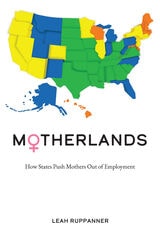
Motherlands
How States Push Mothers Out of EmploymentLeah Ruppanner
Temple University Press, 2020
In the absence of federal legislation, each state in the United States has its own policies regarding family leave, job protection for women and childcare. No wonder working mothers encounter such a significant disparity when it comes to childcare resources in America! Whereas conservative states like Nebraska offer affordable, readily available, and high quality childcare, progressive states that advocate for women’s economic and political power, like California, have expensive childcare, shorter school days, and mothers who are more likely to work part-time or drop out of the labor market altogether to be available for their children.
In Motherlands, Leah Ruppanner cogently argues that states should look to each other to fill their policy voids. She provides suggestions and solutions for policy makers interested in supporting working families. Whether a woman lives in a state with stronger childcare or gender empowerment regimes, at stake is mothers’ financial dependence on their partners.
Ruppanner advocates for reducing the institutional barriers mothers face when re-entering the workforce. As a result, women would have greater autonomy in making employment decisions following childbirth.
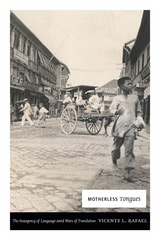
Motherless Tongues
The Insurgency of Language amid Wars of TranslationVicente L. Rafael
Duke University Press, 2016