Results by title
28167 books match the query 'History' and 1583 start with m
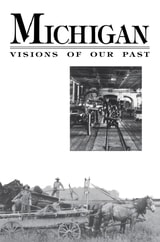
Michigan Visions of Our Past
Richard J. Hathaway
Michigan State University Press, 1989
Throughout the history of michigan, many problems occur and recur: satisfying a diverse population, economic booms and busts, business and labor conflicts, religion in public education, environmental concerns.
A number of writers collaborated to bring such themes to light in 18 illuminating essays. The collection provides a tool for the teacher, a sourse for the scholar, and a pleasurable trip through Michigan history. Michigan: Visions of Our Past, also provides a challenge; a challenge to citizens to understand the past, and apply its lessons to the future of Michigan.

Michigan's Capitol
Construction and RestorationWilliam Seale
University of Michigan Press, 1995
Michigan's Capitol: Construction and Restoration is the history of a great American landmark, one among fifty statehouses. Construction of Michigan's State Capitol began in 1871, six years after the close of the Civil War, and was brought to completion less than a decade later. It has survived for more than a century to become the object of one of America's most authentic restorations. This volume allows the reader to chronicle the building and restoration of Michigan's Capitol through words and magnificent color and black-and-white photographs. An archive of treasured historical images, beginning with a group scene at the time the cornerstone was placed, is also included alongside original architectural drawings and sketches.
Michigan's Capitol: Construction and Restoration is not only the history of a great vision realized, but a celebration of the rediscovery and revival of that vision in the 1980s and 1990s culminating in one of the most comprehensive restorations ever carried out on an American building. The author, William Seale, a part of the restoration team for Michigan's Capitol from the start, has written extensively about many American buildings, including the White House.
Written in a lively, narrative style accessible to readers of all ages, Michigan's Capitol: Construction and Restoration is an especially useful introduction to the art of building as well as the politics of public building.
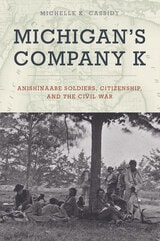
Michigan's Company K
Anishinaabe Soldiers, Citizenship, and the Civil WarMichelle K Cassidy
Michigan State University Press, 2023
Michigan's Con-Con 11
Women and State Constitution-making in 1961Lynn Liberato
Michigan State University Press, 2025
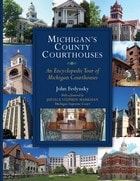
Michigan's County Courthouses
John Fedynsky
University of Michigan Press, 2011
John Fedynsky documents in narrative and photos every county courthouse of Michigan's eighty-three counties, as well as the Michigan Hall of Justice. These buildings are symbols: physically they stand, but figuratively they speak. They embody the purposes for which they were created: law, order, justice, and the promise of a better tomorrow.
Fedynsky tells the story of each building. For Michigan, the typical evolution begins in the cabin, tavern, or hotel of a prominent local settler and progresses through incarnations of simple log or wooden clapboard, and then opulent stone or brick, before the structure arrives in modern and utilitarian form. But there are myriad exceptions to this rule, and they add to the diversity of Michigan's county courthouses.
In Fedynsky's descriptions, verifiable facts and local lore weave together in dramatic tales of outrageous crime, courtroom intrigue, backroom dealing, jury determination, and judicial prerogative. Released jail inmates assist with evacuating and extinguishing a courthouse fire, residents during a natural disaster seek and find physical refuge behind the sure walls of the courthouse, and vigilant legions of homebound defenders are stationed in wartime throughout the courthouse towers scanning the skies for signs of foreign aircraft.
Then there are the homey touches that emphasize the "house" half of Michigan's courthouses: local folks dropping off plants in the courthouse atrium to use it as a winter greenhouse, cows grazing on the public square, county fairs in or near the courthouse, and locally made artwork hanging in public hallways. The courthouses bear within their walls a richness of soul endowed by the good people who make each one special.
Cover design by Heidi Dailey
Cover photos: John Fedynsky

Michigan's State Forests
A Century of StewardshipWilliam B. Botti
Michigan State University Press, 2006
It has been said that Michigan’s nineteenth century white pine stands were the finest the world has ever seen. Dense, parklike stands, more than 150 feet tall, covered vast areas northward from the Bay City– Muskegon line. The sheer quantity of timber lured many adventurous entrepreneurs and enterprising farmers to Michigan. Lumber became a mainstay of Michigan’s economy as logging interests and railroad entrepreneurs became adept at harvesting, transporting, and processing pine logs. Many considered the pine to be practically limitless.
In October of 1871, the first indication of a troubled future occurred when Michigan settlers experienced fires unlike any they had ever seen. Following two months of serious drought, and fed by hundreds of small fires set by land-clearing operations, much of northern Lower Michigan erupted in flames; dry winds fanned the many small fires into one unbelievable conflagration that swept entirely across the Lower Peninsula, from Lake Michigan to Lake Huron. Many towns were reduced to ashes, among them Holland, Glen Haven, Huron City, Sand Beach, White Rock, and Forestville. Navigation was interrupted on Lake Huron and as far downriver as Detroit because of the heavy smoke. More than 200 people lost their lives.
Michigan’s State Forests recounts how an abandoned, cutover, and often burned wilderness has been converted once again into highly productive and protected public lands. For more than 100 years, these lands have been preserved, managed and developed to form one of Michigan’s great assets, not only for economic development but also as enhancements to our quality of life.
Michigan
A History of Explorers, Entrepreneurs, and Everyday PeopleRoger L. Rosentreter
University of Michigan Press, 2013
The history of Michigan is a fascinating story of breathtaking geography enriched by an abundant water supply, of bold fur traders and missionaries who developed settlements that grew into major cities, of ingenious entrepreneurs who established thriving industries, and of celebrated cultural icons like the Motown sound. It is also the story of the exploitation of Native Americans, racial discord that resulted in a devastating riot, and ongoing tensions between employers and unions. Michigan: A History of Explorers, Entrepreneurs, and Everyday People recounts this colorful past and the significant role the state has played in shaping the United States. Well-researched and engagingly written, the book spans from Michigan’s geologic formation to important 21st-century developments in a concise but detailed chronicle that will appeal to general readers, scholars, and students interested in Michigan’s past, present, and future.
Michigan’s War
The Civil War in DocumentsJohn W. Quist
Ohio University Press, 2018
When it came to the Civil War, Michiganians never spoke with one voice. At the beginning of the conflict, family farms defined the southern Lower Peninsula, while a sparsely settled frontier characterized the state’s north. Although differing strategies for economic development initially divided Michigan’s settlers, by the 1850s Michiganians’ attention increasingly focused on slavery, race, and the future of the national union. They exchanged charges of treason and political opportunism while wrestling with the meanings of secession, the national union, emancipation, citizenship, race, and their changing economy. Their actions launched transformations in their communities, their state, and their nation in ways that Americans still struggle to understand.
Building upon the current scholarship of the Civil War, the Midwest, and Michigan’s role in the national experience, Michigan’s War is a documentary history of the Civil War era as told by the state’s residents and observers in private letters, reminiscences, newspapers, and other contemporary sources. Clear annotations and thoughtful editing allow teachers and students to delve into the political, social, and military context of the war, making it ideal for classroom use.
Michoacán and Eden
Vasco de Quiroga and the Evangelization of Western MexicoBy Bernardino Verástique
University of Texas Press, 2000
Don Vasco de Quiroga (1470-1565) was the first bishop of Michoacán in Western Mexico. Driven by the desire to convert the native Purhépecha-Chichimec peoples to a purified form of Christianity, free of the corruptions of European Catholicism, he sought to establish New World Edens in Michoacán by congregating the people into pueblo-hospital communities, where mendicant friars could more easily teach them the fundamental beliefs of Christianity and the values of Spanish culture.
In this broadly synthetic study, Bernardino Verástique explores Vasco de Quiroga's evangelizing project in its full cultural and historical context. He begins by recreating the complex and not wholly incompatible worldviews of the Purhépecha and the Spaniards at the time of their first encounter in 1521. With Quiroga as a focal point, Verástique then traces the uneasy process of assimilation and resistance that occurred on both sides as the Spaniards established political and religious dominance in Michoacán. He describes the syncretisms, or fusions, between Christianity and indigenous beliefs and practices that arose among the Purhépecha and relates these to similar developments in other regions of Mexico.
Written especially for students and general readers, this book demonstrates how cultural and geographical environments influence religious experience, while it adds to our understanding of the process of indigenous appropriation of Christian theological concepts in the New World.
Mickey Mouse History and Other Essays on American Memory
Michael Wallace
Temple University Press, 1996
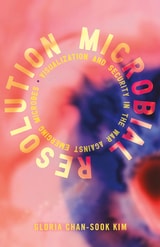
Microbial Resolution
Visualization and Security in the War against Emerging MicrobesGloria Chan-Sook Kim
University of Minnesota Press, 2024
An interdisciplinary study charting the war against microbial futures leads to a new theory of contemporary vision and visuality
In 1989, a group of U.S. government scientists met to discuss some surprising findings: new diseases were appearing around the world, and viruses that they thought long vanquished were resurfacing. Their appearance heralded a future perpetually threatened by unforeseeable biological risks, sparking a new concept of disease: the “emerging microbe.” With the Cold War nearing its end, American scientists and security experts turned to confront this new “enemy,” redirecting national security against its risky horizons. In order to be fought, emerging microbes first needed to be made perceptible; but how could something immaterial, unknowable, and ever mutating be coaxed into visibility, knowability, and operability?
Microbial Resolution charts the U.S.-led war on the emerging microbe to show how their uncertain futures were transformed into objects of global science and security. Moving beyond familiar accounts that link scientific knowledge production to optical practices of visualizing the invisible, Gloria Chan-Sook Kim develops a theory of “microbial resolution” to analyze the complex problematic that arises when dealing with these entities: what can be seen when there is nothing to see? Through a syncretic analysis of data mining, animal-tracking technologies, media networks, computer-modeled futures, and global ecologies and infrastructures, she shows how a visual impasse—the impossibility of seeing microbial futures—forms the basis for new modes of perceiving, knowing, and governing in the present.
Timely and thought provoking, Microbial Resolution opens up the rich paradoxes, irreconcilabilities, and failures inherent in this project and demonstrates how these tensions profoundly animate twenty-first-century epistemologies, aesthetics, affects, and ecologies.
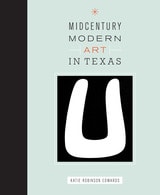
Midcentury Modern Art in Texas
By Katie Robinson Edwards
University of Texas Press, 2014
Winner, Award of Merit for Non-Fiction, The Philosophical Society of Texas, 2015
Before Abstract Expressionism of New York City was canonized as American postwar modernism, the United States was filled with localized manifestations of modern art. One such place where considerable modernist activity occurred was Texas, where artists absorbed and interpreted the latest, most radical formal lessons from Mexico, the East Coast, and Europe, while still responding to the state’s dramatic history and geography. This barely known chapter in the story of American art is the focus of Midcentury Modern Art in Texas.
Presenting new research and artwork that has never before been published, Katie Robinson Edwards examines the contributions of many modernist painters and sculptors in Texas, with an emphasis on the era’s most abstract and compelling artists. Edwards looks first at the Dallas Nine and the 1936 Texas Centennial, which offered local artists a chance to take stock of who they were and where they stood within the national artistic setting. She then traces the modernist impulse through various manifestations, including the foundations of early Texas modernism in Houston; early practitioners of abstraction and non-objectivity; the Fort Worth Circle; artists at the University of Texas at Austin; Houston artists in the 1950s; sculpture in and around an influential Fort Worth studio; and, to see how some Texas artists fared on a national scale, the Museum of Modern Art’s “Americans” exhibitions.
The first full-length treatment of abstract art in Texas during this vital and canon-defining period, Midcentury Modern Art in Texas gives these artists their due place in American art, while also valuing the quality of Texan-ness that subtly undergirds much of their production.
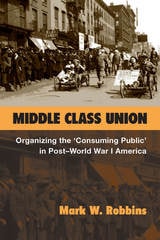
Middle Class Union
Organizing the ‘Consuming Public’ in Post-World War I AmericaMark W. Robbins
University of Michigan Press, 2017
Combining social history with interdisciplinary approaches to the study of consumption and symbolic space, Middle Class Union illustrates how acts of consumption, representations of the middle class in literary, journalistic, and artistic discourses, and ground-level organizing combined to enable white-collar activists to establish themselves as both the middle class and the backbone of the nation. This book contributes to labor history by examining the nexus of class and consumption to show how many white-collar workers drew on their consumer identity to express an anti-labor politics, later facilitating the struggles of unions throughout the post–World War I years. It also contributes to political history by emphasizing how these middle-class activists laid important groundwork for both 1920s business conservatism and New Deal liberalism. They exerted their political influence well before the post–World War II period, when a self-interested and powerful middle-class consumer identity is more widely acknowledged to have taken hold.
Middle English Dictionary
A.1Robert E. Lewis, Editor-in-Chief
University of Michigan Press, 1956
Middle English Dictionary
A.2Robert E. Lewis, Editor-in-Chief
University of Michigan Press, 1956

Middle English Dictionary
A.3Robert E. Lewis, Editor-in-Chief
University of Michigan Press, 1956
Middle English Dictionary
A.4Robert E. Lewis, Editor-in-Chief
University of Michigan Press, 1957
Middle English Dictionary
B.1Robert E. Lewis, Editor-in-Chief
University of Michigan Press, 1957

Middle English Dictionary
B.2Robert E. Lewis, Editor-in-Chief
University of Michigan Press, 1957
Middle English Dictionary
B.3Robert E. Lewis, Editor-in-Chief
University of Michigan Press, 1957
Middle English Dictionary
B.4Robert E. Lewis, Editor-in-Chief
University of Michigan Press, 1958
Middle English Dictionary
B.5Robert E. Lewis, Editor-in-Chief
University of Michigan Press, 1958

Middle English Dictionary
C.1Robert E. Lewis, Editor-in-Chief
University of Michigan Press, 1959
Middle English Dictionary
C.2Robert E. Lewis, Editor-in-Chief
University of Michigan Press, 1959
Middle English Dictionary
C.3Robert E. Lewis, Editor-in-Chief
University of Michigan Press, 1959
Middle English Dictionary
C.4Robert E. Lewis, Editor-in-Chief
University of Michigan Press, 1960
Middle English Dictionary
C.5Robert E. Lewis, Editor-in-Chief
University of Michigan Press, 1960
Middle English Dictionary
C.6Robert E. Lewis, Editor-in-Chief
University of Michigan Press, 1960
Middle English Dictionary
D.1Robert E. Lewis, Editor-in-Chief
University of Michigan Press, 1961
Middle English Dictionary
D.2Robert E. Lewis, Editor-in-Chief
University of Michigan Press, 1961
Middle English Dictionary
D.3Robert E. Lewis, Editor-in-Chief
University of Michigan Press, 1961
Middle English Dictionary
D.4Robert E. Lewis, Editor-in-Chief
University of Michigan Press, 1962
Middle English Dictionary
D.5Robert E. Lewis, Editor-in-Chief
University of Michigan Press, 1962
Middle English Dictionary
E.1Robert E. Lewis, Editor-in-Chief
University of Michigan Press, 1952
Middle English Dictionary
E.2Robert E. Lewis, Editor-in-Chief
University of Michigan Press, 1953
Middle English Dictionary
E.3Robert E. Lewis, Editor-in-Chief
University of Michigan Press, 1953
Middle English Dictionary
F.1Robert E. Lewis, Editor-in-Chief
University of Michigan Press, 1953
Middle English Dictionary
F.2Robert E. Lewis, Editor-in-Chief
University of Michigan Press, 1954
Middle English Dictionary
F.3Robert E. Lewis, Editor-in-Chief
University of Michigan Press, 1954
Middle English Dictionary
F.4Robert E. Lewis, Editor-in-Chief
University of Michigan Press, 1954
Middle English Dictionary
G.1Robert E. Lewis, Editor-in-Chief
University of Michigan Press, 1963
Middle English Dictionary
G.2Robert E. Lewis, Editor-in-Chief
University of Michigan Press, 1963
Middle English Dictionary
G.3Robert E. Lewis, Editor-in-Chief
University of Michigan Press, 1964
Middle English Dictionary
H.1Robert E. Lewis, Editor-in-Chief
University of Michigan Press, 1966
Middle English Dictionary
H.2Robert E. Lewis, Editor-in-Chief
University of Michigan Press, 1966
Middle English Dictionary
H.3Robert E. Lewis, Editor-in-Chief
University of Michigan Press, 1966
Middle English Dictionary
H.4Robert E. Lewis, Editor-in-Chief
University of Michigan Press, 1966
Middle English Dictionary
H.5Robert E. Lewis, Editor-in-Chief
University of Michigan Press, 1967
Middle English Dictionary
I.1Robert E. Lewis, Editor-in-Chief
University of Michigan Press, 1968
Middle English Dictionary
I.2Robert E. Lewis, Editor-in-Chief
University of Michigan Press, 1968