1272 books match the query 'Asia' and 79 start with m
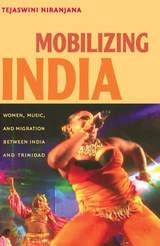
cover of Mobilizing India: Women, Music, and Migration between India and Trinidad

Mobilizing India

Women, Music, and Migration between India and Trinidad

Tejaswini Niranjana

Duke University Press, 2006

Descendants of indentured laborers brought from India to the Caribbean between 1845 and 1917 comprise more than forty percent of Trinidad’s population today. While many Indo-Trinidadians identify themselves as Indian, what “Indian” signifies—about nationalism, gender, culture, caste, race, and religion—in the Caribbean is different from what it means on the subcontinent. Yet the ways that “Indianness” is conceived of and performed in India and in Trinidad have historically been, and remain, intimately related. Offering an innovative analysis of how ideas of Indian identity negotiated within the Indian diaspora in Trinidad affect cultural identities “back home,” Tejaswini Niranjana models a necessary project: comparative research across the global South, scholarship that decenters the “first world” West as the referent against which postcolonial subjects understand themselves and are understood by others.

Niranjana draws on nineteenth-century travel narratives, anthropological and historical studies of Trinidad, Hindi film music, and the lyrics, performance, and reception of chutney-soca and calypso songs to argue that perceptions of Indian female sexuality in Trinidad have long been central to the formation and disruption of dominant narratives of nationhood, modernity, and normative sexuality in India. She illuminates debates in India about “the woman question” as they played out in the early-twentieth-century campaign against indentured servitude in the tropics. In so doing, she reveals India’s disavowal of the indentured woman—viewed as morally depraved by her forced labor in Trinidad—as central to its own anticolonial struggle. Turning to the present, Niranjana looks to Trinidad’s most dynamic site of cultural negotiation: popular music. She describes how contested ideas of Indian femininity are staged by contemporary Trinidadian musicians—male and female, of both Indian and African descent—in genres ranging from new hybrids like chutney-soca to the older but still vibrant music of Afro-Caribbean calypso.
[more]
cover of Model-Minority Imperialism

Model-Minority Imperialism

Victor Bascara

University of Minnesota Press, 2006
At the beginning of the twentieth century, soon after the conclusion of the Spanish-American War, the United States was an imperialistic nation, maintaining (often with the assistance of military force) a far-flung and growing empire. After a long period of collective national amnesia regarding American colonialism, in the Philippines and elsewhere, scholars have resurrected the power of “empire” as a way of revealing American history and culture. Focusing on the terms of Asian American assimilation and the rise of the model-minority myth, Victor Bascara examines the resurgence of empire as a tool for acknowledging—and understanding—the legacy of American imperialism. Model-Minority Imperialism links geopolitical dramas of twentieth-century empire building with domestic controversies of U.S. racial order by examining the cultural politics of Asian Americans as they are revealed in fiction, film, and theatrical productions. Tracing U.S. economic and political hegemony back to the beginning of the twentieth century through works by Jessica Hagedorn, R. Zamora Linmark, and Sui Sin Far; discourses of race, economics, and empire found in the speeches of William McKinley and William Jennings Bryan; as well as L. Frank Baum’s The Wonderful Wizard of Oz and other texts, Bascara’s innovative readings uncover the repressed story of U.S. imperialism and unearth the demand that the present empire reckon with its past. Bascara deploys the analytical approaches of both postcolonial studies and Asian American studies, two fields that developed in parallel but have only begun to converge, to reveal how the vocabulary of empire reasserted itself through some of the very people who inspired the U.S imperialist mission.Victor Bascara is assistant professor of English and Asian American studies at the University of Wisconsin, Madison.
[more]
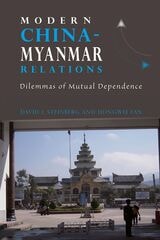
cover of Modern China-Myanmar Relations: Dilemmas of Mutual Dependence

Modern China-Myanmar Relations

Dilemmas of Mutual Dependence

David I. Steinberg and Hongwei Fan

National University of Singapore Press, 2012
This volume examines the changing relations between China and Burma/Myanmar since Burmese independence in 1948 and the formation of the People's Republic of China in 1949. Drawing on hitherto unavailable Chinese sources, it documents the negotiations and settlement of outstanding issues such as the border demarcation, the Chinese Nationalist forces in Burma, the status of the overseas Chinese residents, and the Burma Communist Party. The study documents the Sino-Burmese riots of 1967, the improvement of relations, culminating in the close bilateral association since 1988-89. It analyses in detail Myanmar's changing role in Chinese strategy, concentrating on trade and investment relations, oil, gas, hydroelectric power, natural resources and improved transportation. It outlines military cooperation, narcotics control, and migration while emphasizing Indian and ASEAN concerns and responses. The volume outlines a set of policy dilemmas facing the central and provincial Chinese authorities, the Myanmar government and Burmese ethnic minorities, while analysing dilemmas for the United States, India, ASEAN and Japan in responding to the changed interdependent Sino-Burmese relationship.
[more]
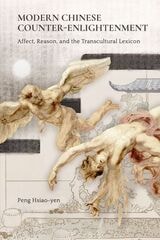
cover of Modern Chinese Counter-Enlightenment: Affect, Reason, and the Transcultural Lexicon

Modern Chinese Counter-Enlightenment

Affect, Reason, and the Transcultural Lexicon

Peng Hsiao-yen

Hong Kong University Press, 2023

An examination of the Counter-Enlightenment movement in China.

In Modern Chinese Counter-Enlightenment, Peng Hsiao-yen argues that a trend of Counter-Enlightenment had grown from the late Qing to the May Fourth era in the 1910s to the 1920s and continued to the 1940s. She demonstrates how Counter-Enlightenment was manifested with case studies such as Lu Xun’s writings in the late 1900s, the Aesthetic Education movement from the 1910s to 1920s, and the Science and Lifeview debate in the 1920s. During the period, the life philosophy movement, highlighting the epistemic debate on affect and reason, is connected with its counterparts in Germany, France, and Japan. The movement had a widespread and long-term impact on Chinese philosophy and literature. Using the transcultural lexicon as methodology, this book traces how the German term Lebensanschauung (life view), a key concept in Rudolf Eucken’s life philosophy, constituted a global tide of Counter-Enlightenment that influenced the thought of leading Chinese intellectuals in the Republican era. Peng contends that Chinese intellectuals’ transcultural connections with others in the philosophical pursuit of knowledge triggered China’s self-transformation. She successfully reconstructs the missing link in the Chinese theater of the worldwide dialectic of Enlightenment and Counter-Enlightenment.
 
[more]
cover of Modern Chinese Literary and Cultural Studies in the Age of Theory: Reimagining a Field

Modern Chinese Literary and Cultural Studies in the Age of Theory

Reimagining a Field

Rey Chow, ed.

Duke University Press, 2000

These groundbreaking essays use critical theory to reflect on issues pertaining to modern Chinese literature and culture and, in the process, transform the definition and conceptualization of the field of modern Chinese studies itself. The wide range of topics addressed by this international group of scholars includes twentieth-century literature produced in Taiwan, Hong Kong, and mainland China; film, art, history, popular culture, and literary and cultural criticism; as well as the geographies of migration and diaspora.

One of the volume’s provocative suggestions is that the old model of area studies—an offshoot of U.S. Cold War strategy that found its anchorage in higher education—is no longer feasible for the diverse and multifaceted experiences that are articulated under the rubric of “Chineseness.” As Rey Chow argues in her introduction, the notion of a monolithic Chineseness bound ultimately to mainland China is, in itself, highly problematic because it recognizes neither the material realities of ethnic minorities within China nor those of populations in places such as Tibet, Taiwan, and post–British Hong Kong. Above all, this book demonstrates that, as the terms of a chauvinistic sinocentrism become obsolete, the critical use of theory—particularly by younger China scholars whose enthusiasm for critical theory coincides with changes in China’s political economy in recent years—will enable the emergence of fresh connections and insights that may have been at odds with previous interpretive convention.
Originally published as a special issue of the journal boundary 2, this collection includes two new essays and an afterword by Paul Bové that places its arguments in the context of contemporary cultural politics. It will have far-reaching implications for the study of modern China and will be of interest to scholars of theory and culture in general.

Contributors. Stanley K. Abe, Ien Ang, Chris Berry, Paul Bové, Sung-cheng Yvonne Chang, Rey Chow, Dorothy Ko, Charles Laughlin, Leung Ping-kwan, Kwai-cheung Lo, Christopher Lupke, David Der-wei Wang, Michelle Yeh

[more]
cover of Modern Cows and Bovine Transformations: The Remaking of India's Cattle, 1790-1950

Modern Cows and Bovine Transformations

The Remaking of India's Cattle, 1790-1950

David Arnold

University of Chicago Press, 0

Examines how India’s cattle underwent profound changes during the years of British colonial rule.

Drawing on extensive, untapped archives, Modern Cowsand Bovine Transformations illustrates the radical remaking of India’s cattle against the backdrop of colonial policies, environmental change, and anticolonial politics. Historian David Arnold examines the history of cows in India from 1790 to 1950, focusing on science, technology, and medicine to provide a secular account of imperial animal husbandry.

Doing justice to the wide variety of Indian cattle breeds, Arnold unpacks “bovine technology” and its subaltern linkages, covering topics such as the role of cattle in agriculture and the military; haulage and transport; breeding strategies; bacteriology and nutrition science, and India’s milk revolution. He also examines the dispersal of Indian cattle around the globe and the role that colonial policies played in spreading knowledge of Indian cattle breeds and facilitating their export. Finally, he addresses the “cattle crisis” brought on by famines, droughts, and disease, and disputes between colonial rulers and Hindu nationalists. He concludes with the impact of World War II and Partition on bovine populations, illustrating the consequences for independent India’s attempts to restore the milk supply and rebuild cattle breeds while also respecting the Hindu cow protection agenda. In the end, Arnold argues, the history of cattle in India provides us with a new way of understanding the power of the colonial state, its ambitions to transform India, its appropriation of the Indian subcontinent’s resources, and the myriad contradictions of its policies.
[more]
cover of Modern Japanese Cuisine: Food, Power and National Identity

Modern Japanese Cuisine

Food, Power and National Identity

Katarzyna J. Cwiertka

Reaktion Books, 2015

Over the past two decades, the popularity of Japanese food in the West has increased immeasurably—a major contribution to the evolution of Western eating habits. But Japanese cuisine itself has changed significantly since pre-modern times, and the food we eat at trendy Japanese restaurants, from tempura to sashimi, is vastly different from earlier Japanese fare. Modern Japanese Cuisine examines the origins of Japanese food from the late nineteenth century to unabashedly adulterated American favorites like today’s California roll.

Katarzyna J. Cwiertka demonstrates that key shifts in the Japanese diet were, in many cases, a consequence of modern imperialism. Exploring reforms in military catering and home cooking, wartime food management and the rise of urban gastronomy, Cwiertka shows how Japan’s numerous regional cuisines were eventually replaced by a set of foods and practices with which the majority of Japanese today ardently identify.

The result of over a decade of research, Modern Japanese Cuisine is a fascinating look at the historical roots of some of the world’s best cooking and will provide appetizing reading for scholars of Japanese culture and foodies alike.
[more]
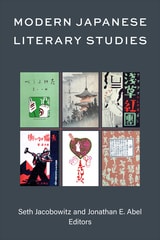
cover of Modern Japanese Literary Studies

Modern Japanese Literary Studies

Seth Jacobowitz and Jonathan E. Abel, Editors

University of Michigan Press, 2026
Explores new directions in modern Japanese literature
[more]
cover of Modern Jungles: A Hmong Refugee's Childhood Story of Survival

Modern Jungles

A Hmong Refugee's Childhood Story of Survival

Pao Lor

Wisconsin Historical Society Press, 2023

As a five-year-old boy, Pao Lor joined thousands of Hmong who fled for their lives through the jungles of Laos in the aftermath of war. After a difficult and perilous journey that neither of his parents survived, he reached the safety of Thailand, but the young refugee boy’s challenges were only just beginning.

Born in a small farming village, Pao was destined to be a Hmong clan leader, wedding negotiator, or shaman. But the course of his life changed dramatically in the 1970s, when the Hmong faced persecution for their role in helping US forces fighting communism in the region. After more than two years in Thai refugee camps, Pao and his surviving family members boarded the belly of an “iron eagle” bound for the United States, where he pictured a new life of comfort and happiness. Instead, Pao found himself navigating a frightening and unfamiliar world, adjusting to a string of new schools and living situations while struggling to fulfill the hopes his parents had once held for his future. Now in Modern Jungles, Pao Lor shares his inspiring coming-of-age tale about perseverance, grit, and hope. 

Included are discussion questions for use by book clubs, in classrooms, or around the dinner table.
[more]
cover of Modern Jungles: A Hmong Refugee’s Childhood Story of Survival

Modern Jungles

A Hmong Refugee’s Childhood Story of Survival

Pao Lor

Wisconsin Historical Society Press, 2021

As a five-year-old boy, Pao Lor joined thousands of Hmong who fled for their lives through the jungles of Laos in the aftermath of war. After a difficult and perilous journey that neither of his parents survived, he reached the safety of Thailand, but the young refugee boy’s challenges were only just beginning.

Born in a small farming village, Pao was destined to be a Hmong clan leader, wedding negotiator, or shaman. But the course of his life changed dramatically in the 1970s, when the Hmong faced persecution for their role in helping US forces fighting communism in the region. After more than two years in Thai refugee camps, Pao and his surviving family members boarded the belly of an “iron eagle” bound for the United States, where he pictured a new life of comfort and happiness. Instead, Pao found himself navigating a frightening and unfamiliar world, adjusting to a string of new schools and living situations while struggling to fulfill the hopes his parents had once held for his future. Now in Modern Jungles, Pao Lor shares his inspiring coming-of-age tale about perseverance, grit, and hope. 

Included are discussion questions for use by book clubs, in classrooms, or around the dinner table.
[more]
cover of Modern Noise, Fluid Genres: Popular Music in Indonesia, 1997–2001

Modern Noise, Fluid Genres

Popular Music in Indonesia, 1997–2001

Jeremy Wallach

University of Wisconsin Press, 2008
What happens to “local” sound when globalization exposes musicians and audiences to cultural influences from around the world? Jeremy Wallach explores this question as it plays out in the eclectic, evolving world of Indonesian music after the fall of the repressive Soeharto regime. Against the backdrop of Indonesia’s chaotic and momentous transition to democracy, Wallach takes us to recording studios, music stores, concert venues, university campuses, video shoots, and urban neighborhoods.
Integrating ground-level ethnographic research with insights drawn from contemporary cultural theory, he shows that access to globally circulating music and technologies has neither extinguished nor homogenized local music-making in Indonesia. Instead, it has provided young Indonesians with creative possibilities for exploring their identity in a diverse nation undergoing dramatic changes in an increasingly interconnected world. Ultimately, he finds, the unofficial, multicultural nationalism of Indonesian popular music provides a viable alternative to the religious, ethnic, regional, and class-based extremism that continues to threaten unity and democracy in that country.
[more]
cover of Monetary Authorities: Capitalism and Decolonization in the American Colonial Philippines

Monetary Authorities

Capitalism and Decolonization in the American Colonial Philippines

Allan E. S. Lumba

Duke University Press, 2022
In Monetary Authorities Allan E. S. Lumba explores how the United States used monetary policy and banking systems to justify racial and class hierarchies, enforce capitalist exploitation, and counter movements for decolonization in the American colonial Philippines. Lumba shows that colonial economic experts justified American imperial authority by claiming that Filipinos did not possess the racial capacities to properly manage money. Financial independence, then, became a key metric of racial capitalism by which Filipinos had to prove their ability to self-govern. At the same time, the colonial state used its monetary authority to police the economic activities of colonized subjects and to curb movements for decolonization. It later offered a conditional form of decolonization that left the Philippines reliant on U.S. financial institutions. By showing how imperial governance was entwined with the racialization and regulation of monetary systems in the Philippines, Lumba illuminates a key mechanism through which the United States securitized the imperial world order.
[more]
cover of Monumental Matters: The Power, Subjectivity, and Space of India's Mughal Architecture

Monumental Matters

The Power, Subjectivity, and Space of India's Mughal Architecture

Santhi Kavuri-Bauer

Duke University Press, 2011

Built in the sixteenth and seventeenth centuries, India’s Mughal monuments—including majestic forts, mosques, palaces, and tombs, such as the Taj Mahal—are world renowned for their grandeur and association with the Mughals, the powerful Islamic empire that once ruled most of the subcontinent. In Monumental Matters, Santhi Kavuri-Bauer focuses on the prominent role of Mughal architecture in the construction and contestation of the Indian national landscape.

She examines the representation and eventual preservation of the monuments, from their disrepair in the colonial past to their present status as protected heritage sites. Drawing on theories of power, subjectivity, and space, Kavuri-Bauer’s interdisciplinary analysis encompasses Urdu poetry, British landscape painting, imperial archaeological surveys, Indian Muslim identity, and British tourism, as well as postcolonial nation building, World Heritage designations, and conservation mandates. Since Independence, the state has attempted to construct a narrative of Mughal monuments as symbols of a unified, secular nation. Yet modern-day sectarian violence at these sites continues to suggest that India’s Mughal monuments remain the transformative spaces—of social ordering, identity formation, and national reinvention—that they have been for centuries.
[more]
cover of Moral Politics in the Philippines: Inequality, Democracy and the Urban Poor

Moral Politics in the Philippines

Inequality, Democracy and the Urban Poor

Wataru Kusaka

National University of Singapore Press, 2017
Moral Politics in the Philippines offers an in-depth examination of the political participation and discourse of the urban poor in Manila. After the ousting of Ferdinando Marcos in 1986, society in the Philippines fractured along socioeconomic lines. The educated middle class began to recognize themselves as moral citizens and political participants while condemning the poor as immoral “masses” who earn money illegally and support corrupt leaders. Conversely, the poor believe themselves to be morally upright and criticize the rich as arrogant oppressors. Wataru Kusaka looks at the dangers of this moralization of politics during the last several decades, and he analyzes the damaging effects it has had on democracy by excluding much of society and marginalizing the interests of those most in need of resources.
 
 
[more]
cover of Mormonisms in Asia: Stories of Global Faith and Local Lives

Mormonisms in Asia

Stories of Global Faith and Local Lives

Edited by Melissa Wei-Tsing Inouye and Laurie F. Maffly-Kipp

University of Illinois Press, 2026

Mormonism is often described as the quintessentially American religion, one that is highly centralized around its leadership and demographic presence in Utah. But given a dramatic increase in non-U.S. membership since 1960 in both the Church of Jesus Christ of Latter-day Saints and the Community of Christ, new questions about these movements come to the fore: How are these Restoration traditions lived and experienced in other parts of the world? How do church members outside the United States understand their relationship to a sacralized American past and an administrative hierarchy in Salt Lake City? And how has the relatively recent explosion of membership outside of the United States begun to shift the faith’s institutional, political, and cultural dynamics within those traditions? Most importantly, how do church members from different localities and cultures relate to each other, forming a global community? Or do they?

This volume focuses on Asia, a region that includes more than half the world's population, but where Restoration traditions specifically and Christianity broadly are minority faiths. It uses a combination of focused case studies and theoretical analysis to highlight broader trends and themes that those studies suggest about the meaning of a globalized faith in the twenty-first century. The first section of this book lays out ways of thinking about Mormonism’s global presence in terms of the nation-state, and the essays explore where and how Restoration traditions as institutional actors have made their way into new political and social contexts. The second section studies the tensions created by the encounters of LDS norms with preexisting cultural and political values in local settings. These essays burrow more deeply into political and religious realities and explore the variations in Mormon cultural assumptions about politics and society, as well as the relationship between local congregants and the Mormon administrative center. The final section presents fine-grained
studies that focus attention on one of the central features of LDS lived religion: the role of gender and the family in the religious community. In each case, divine dictates necessarily bump up against traditional societal norms that converts must navigate.

Contributors: John-Charles Duffy, Stacilee Ford, Taunalyn Ford, Conan Grames, David J. Howlett, Melissa Wei-Tsing Inouye, Keisha Lai, Laurie Maffly-Kipp, Matthew Martinich, Meagan Rainock, Shinji Takagi, Pierre Vendassi
[more]
cover of Motherless Tongues: The Insurgency of Language amid Wars of Translation

Motherless Tongues

The Insurgency of Language amid Wars of Translation

Vicente L. Rafael

Duke University Press, 2016

In Motherless Tongues, Vicente L. Rafael examines the vexed relationship between language and history gleaned from the workings of translation in the Philippines, the United States, and beyond. Moving across a range of colonial and postcolonial settings, he demonstrates translation's agency in the making and understanding of events. These include nationalist efforts to vernacularize politics, U.S. projects to weaponize languages in wartime, and autobiographical attempts by area studies scholars to translate the otherness of their lives amid the Cold War. In all cases, translation is at war with itself, generating divergent effects. It deploys as well as distorts American English in counterinsurgency and colonial education, for example, just as it re-articulates European notions of sovereignty among Filipino revolutionaries in the nineteenth century and spurs the circulation of text messages in a civilian-driven coup in the twenty-first. Along the way, Rafael delineates the untranslatable that inheres in every act of translation, asking about the politics and ethics of uneven linguistic and semiotic exchanges. Mapping those moments where translation and historical imagination give rise to one another, Motherless Tongues shows how translation, in unleashing the insurgency of language, simultaneously sustains and subverts regimes of knowledge and relations of power. 


[more]
cover of Mountain Witches: Yamauba

Mountain Witches

Yamauba

Noriko T. Reider

Utah State University Press, 2021

Mountain Witches is a comprehensive guide to the complex figure of yamauba—female yōkai often translated as mountain witches, who are commonly described as tall, enigmatic women with long hair, piercing eyes, and large mouths that open from ear to ear and who live in the mountains—and the evolution of their roles and significance in Japanese culture and society from the premodern era to the present. In recent years yamauba have attracted much attention among scholars of women’s literature as women unconstrained by conformative norms or social expectations, but this is the first book to demonstrate how these figures contribute to folklore, Japanese studies, cultural studies, and gender studies.
 
Situating the yamauba within the construct of yōkai and archetypes, Noriko T. Reider investigates the yamauba attributes through the examination of narratives including folktales, literary works, legends, modern fiction, manga, and anime. She traces the lineage of a yamauba image from the seventh-century text Kojiki to the streets of Shibuya, Tokyo, and explores its emergence as well as its various, often conflicting, characteristics. Reider also examines the adaptation and re-creation of the prototype in diverse media such as modern fiction, film, manga, anime, and fashion in relation to the changing status of women in Japanese society.
 
Offering a comprehensive overview of the development of the yamauba as a literary and mythic trope, Mountain Witches is a study of an archetype that endures in Japanese media and folklore. It will be valuable to students, scholars, and the general reader interested in folklore, Japanese literature, demonology, history, anthropology, cultural studies, gender studies, and the visual and performing arts.
 
[more]
cover of Mourning the Nation: Indian Cinema in the Wake of Partition

Mourning the Nation

Indian Cinema in the Wake of Partition

Bhaskar Sarkar

Duke University Press, 2009

What remains of the “national” when the nation unravels at the birth of the independent state? The political truncation of India at the end of British colonial rule in 1947 led to a social cataclysm in which roughly one million people died and ten to twelve million were displaced. Combining film studies, trauma theory, and South Asian cultural history, Bhaskar Sarkar follows the shifting traces of this event in Indian cinema over the next six decades. He argues that Partition remains a wound in the collective psyche of South Asia and that its representation on screen enables forms of historical engagement that are largely opaque to standard historiography.

Sarkar tracks the initial reticence to engage with the trauma of 1947 and the subsequent emergence of a strong Partition discourse, revealing both the silence and the eventual “return of the repressed” as strands of one complex process. Connecting the relative silence of the early decades after Partition to a project of postcolonial nation-building and to trauma’s disjunctive temporal structure, Sarkar develops an allegorical reading of the silence as a form of mourning. He relates the proliferation of explicit Partition narratives in films made since the mid-1980s to disillusionment with post-independence achievements, and he discusses how current cinematic memorializations of 1947 are influenced by economic liberalization and the rise of a Hindu-chauvinist nationalism. Traversing Hindi and Bengali commercial cinema, art cinema, and television, Sarkar provides a history of Indian cinema that interrogates the national (a central category organizing cinema studies) and participates in a wider process of mourning the modernist promises of the nation form.
[more]
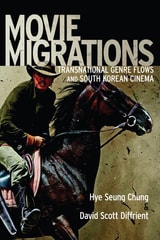
cover of Movie Migrations: Transnational Genre Flows and South Korean Cinema

Movie Migrations

Transnational Genre Flows and South Korean Cinema

Hye Seung Chung and David Scott Diffrient

Rutgers University Press, 2015
As the two billion YouTube views for “Gangnam Style” would indicate, South Korean popular culture has begun to enjoy new prominence on the global stage. Yet, as this timely new study reveals, the nation’s film industry has long been a hub for transnational exchange, producing movies that put a unique spin on familiar genres, while influencing world cinema from Hollywood to Bollywood. 
 
Movie Migrations is not only an introduction to one of the world’s most vibrant national cinemas, but also a provocative call to reimagine the very concepts of “national cinemas” and “film genre.” Challenging traditional critical assumptions that place Hollywood at the center of genre production, Hye Seung Chung and David Scott Diffrient bring South Korean cinema to the forefront of recent and ongoing debates about globalization and transnationalism. In each chapter they track a different way that South Korean filmmakers have adapted material from foreign sources, resulting in everything from the Manchurian Western to The Host’s reinvention of the Godzilla mythos. 
 
Spanning a wide range of genres, the book introduces readers to classics from the 1950s and 1960s Golden Age of South Korean cinema, while offering fresh perspectives on recent favorites like Oldboy and Thirst. Perfect not only for fans of Korean film, but for anyone curious about media in an era of globalization, Movie Migrations will give readers a new appreciation for the creative act of cross-cultural adaptation. 
 

[more]
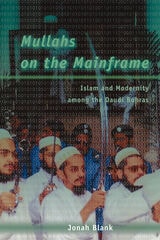
cover of Mullahs on the Mainframe: Islam and Modernity among the Daudi Bohras

Mullahs on the Mainframe

Islam and Modernity among the Daudi Bohras

Jonah Blank

University of Chicago Press, 2001

In Jonah Blank's important, myth-shattering book, the West gets its first look at the Daudi Bohras, a unique Muslim denomination who have found the core of their religious beliefs largely compatible with modern ideology. Combining orthodox Muslim prayer, dress, and practice with secular education, relative gender equality, and Internet use, this community serves as a surprising reminder that the central values of "modernity" are hardly limited to the West.
[more]
cover of Musical Journeys in Sumatra

Musical Journeys in Sumatra

Margaret Kartomi

University of Illinois Press, 2012

Although Sumatra is the sixth largest island in the world and home to an estimated 44 million Indonesians, its musical arts and cultures have not been the subject of a book-length study until now. Documenting and explaining the ethnographic, cultural, and historical contexts of Sumatra's performing arts, Musical Journeys in Sumatra also traces the changes in their style, content, and reception from the early 1970s onward.

Having dedicated almost forty years of scholarship to exploring the rich and varied music of Sumatran provinces, Margaret Kartomi provides a fascinating ethnographic record of vanishing musical genres, traditions, and practices that have become deeply compromised by the pressures of urbanization, rural poverty, and government policy. This deeply informed collection showcases the complex diversity of Indonesian music and includes field observations from six different provinces: Aceh, North Sumatra, Riau, West Sumatra, South Sumatra, and Bangka-Belitung. Featuring photographs and original drawings from Kartomi's field observations of instruments and performances, Musical Journeys in Sumatra provides a comprehensive musical introduction to this neglected, very large island, with its hundreds of ethno-linguistic-musical groups.
[more]
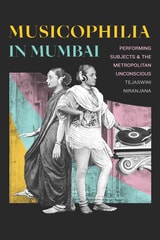
cover of Musicophilia in Mumbai: Performing Subjects and the Metropolitan Unconscious

Musicophilia in Mumbai

Performing Subjects and the Metropolitan Unconscious

Tejaswini Niranjana

Duke University Press, 2020
In Musicophilia in Mumbai Tejaswini Niranjana traces the place of Hindustani classical music in Mumbai throughout the long twentieth century as the city moved from being a seat of British colonial power to a vibrant postcolonial metropolis. Drawing on historical archives, newspapers, oral histories, and interviews with musicians, critics, students, and instrument makers as well as her own personal experiences as a student of Hindustani classical music, Niranjana shows how the widespread love of music throughout the city created a culture of collective listening that brought together people of diverse social and linguistic backgrounds. This culture produced modern subjects Niranjana calls musicophiliacs, whose subjectivity was grounded in a social rather than an individualistic context. By attending concerts, learning instruments, and performing at home and in various urban environments, musicophiliacs embodied forms of modernity that were distinct from those found in the West. In tracing the relationship between musical practices and the formation of the social subject, Niranjana opens up new ways to think about urbanity, subjectivity, culture, and multiple modernities.
[more]
cover of Muslim Becoming: Aspiration and Skepticism in Pakistan

Muslim Becoming

Aspiration and Skepticism in Pakistan

Naveeda Khan

Duke University Press, 2012
In Muslim Becoming, Naveeda Khan challenges the claim that Pakistan's relation to Islam is fragmented and problematic. Offering a radically different interpretation, Khan contends that Pakistan inherited an aspirational, always-becoming Islam, one with an open future and a tendency toward experimentation. For the individual, this aspirational tendency manifests in a continual striving to be a better Muslim. It is grounded in the thought of Muhammad Iqbal (1877–1938), the poet, philosopher, and politician considered the spiritual founder of Pakistan. Khan finds that Iqbal provided the philosophical basis for recasting Islam as an open religion with possible futures as yet unrealized, which he did in part through his engagement with the French philosopher Henri Bergson. Drawing on ethnographic research in the neighborhoods and mosques of Lahore and on readings of theological polemics, legal history, and Urdu literature, Khan points to striving throughout Pakistani society: in prayers and theological debates and in the building of mosques, readings of the Qur'an, and the undertaking of religious pilgrimages. At the same time, she emphasizes the streak of skepticism toward the practices of others that accompanies aspiration. She asks us to consider what is involved in affirming aspiration while acknowledging its capacity for violence.
[more]
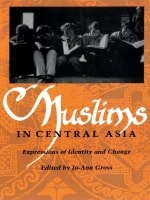
cover of Muslims in Central Asia: Expressions of Identity and Change

Muslims in Central Asia

Expressions of Identity and Change

Jo-Ann Gross, ed.

Duke University Press, 1992

Central Asia is distinctive in its role as a frontier region in which a unique diversity of cultural, religious, and political traditions exist. This collection of essays by expert scholars in a range of disciplines focuses on the formation of ethnic, religious, and national identities in Muslim societies of Central Asia, thus furthering our general understanding of the history and culture of this significant region.
This study includes several geopolitical regions—Chinese Central Asia, Soviet Central Asia, Afghanistan, Transoxiana and Khurasan—and covers historical periods from the fifteenth century to the present. Drawing on scholarship in anthropology, religion, history, literature, and language studies, Muslims in Central Asia argues for an interdisciplinary, inter-regional dialog in the development of new approaches to understanding the Muslim societies in Central Asia. The authors creatively examine the social construction of identities as expressed through literature, Islamic discourse, historical texts, ethnic labels, and genealogies, and explore how such identities are formed, changed, and adopted through time.

Contributors. Hamid Algar, Muriel Atkin, Walter Feldman, Dru C. Gladney, Edward J. Lazzerini, Beatrice Forbes Manz, Christopher Murphy, Oliver Roy, Isenbike Togan
[more]
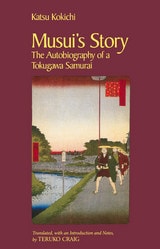
cover of Musui's Story: The Autobiography of a Tokugawa Samurai

Musui's Story

The Autobiography of a Tokugawa Samurai

Kokichi Katsu; Translated by Teruko Craig

University of Arizona Press, 1988

A series of picaresque adventures set against the backdrop of a Japan still closed off from the rest of the world, Musui's Story recounts the escapades of samurai Katsu Kokichi. As it depicts Katsu stealing, brawling, indulging in the pleasure quarters, and getting the better of authorities, it also provides a refreshing perspective on Japanese society, customs, economy, and human relationships.

From childhood, Katsu was given to mischief. He ran away from home, once at thirteen, making his way as a beggar on the great trunk road between Edo and Kyoto, and again at twenty, posing as the emissary of a feudal lord. He eventually married and had children but never obtained official preferment and was forced to supplement a meager stipend by dealing in swords, selling protection to shopkeepers, and generally using his muscle and wits.

Katsu's descriptions of loyalty and kindness, greed and deception, vanity and superstition offer an intimate view of daily life in nineteenth-century Japan unavailable in standard history books. Musui's Story will delight not only students of Japan's past but also general readers who will be entranced by Katsu's candor and boundless zest for life.
[more]
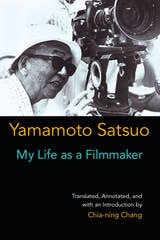
cover of My Life as a Filmmaker

My Life as a Filmmaker

Yamamoto Satsuo; Translated, Annotated, and with an Introduction by Chia-ning Chang

University of Michigan Press, 2017

In his posthumous autobiography, Watakushi no eiga jinsei (1984), Yamamoto reflects on his career and legacy: beginning in the prewar days as an assistant director in a well-established film company under the master Naruse Mikio, to his wide-ranging experiences as a filmmaker, including his participation in the tumultuous Toho Labor Upheaval soon after Japan’s defeat in World War II and his struggles as an independent filmmaker in the 1950s and 1960s before returning to work within the mainstream industry.  In the process, he established himself as one of the most prominent and socially engaged film artists in postwar Japan.  Imbued with vibrant social realism and astute political commentary, his filmic genres ranged widely from melodramas, period films from the Tokugawa era, samurai action jidaigeki, social satires, and antiwar films. Providing serious insights into and trenchant critique of the moral corruption in Japanese politics, academe, industry, and society, Yamamoto at the same time produced highly successful films that offered drama and entertainment for Japanese and international moviegoers.  His considerable artistic distinction, strong social and political consciousness, and filmic versatility have earned him a unique and distinguished position among Japan’s world-class film directors.
 
In addition to detailed annotations of the autobiography, translator Chia-ning Chang offers a comprehensive introduction to the career and the significance of Yamamoto and his works in the context of Japanese film history.  It contextualizes Yamamoto’s life and works in the historical and cultural zeitgeist of prewar, wartime, and postwar Japan before scrutinizing the unique qualities of his narrative voice and social conscience as a film artist.
[more]
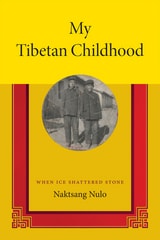
cover of My Tibetan Childhood: When Ice Shattered Stone

My Tibetan Childhood

When Ice Shattered Stone

Natksang Nulo

Duke University Press, 2014

In My Tibetan Chldhood, Naktsang Nulo recalls his life in Tibet's Amdo region during the 1950s. From the perspective of himself at age ten, he describes his upbringing as a nomad on Tibet's eastern plateau. He depicts pilgrimages to monasteries, including a 1500-mile horseback expedition his family made to and from Lhasa. A year or so later, they attempted that same journey as they fled from advancing Chinese troops. Naktsang's father joined and was killed in the little-known 1958 Amdo rebellion against the Chinese People’s Liberation Army, the armed branch of the Chinese Communist Party. During the next year, the author and his brother were imprisoned in a camp where, after the onset of famine, very few children survived.

The real significance of this episodic narrative is the way it shows, through the eyes of a child, the suppressed histories of China's invasion of Tibet. The author's matter-of-fact accounts cast the atrocities that he relays in stark relief. Remarkably, Naktsang lived to tell his tale. His book was published in 2007 in China, where it was a bestseller before the Chinese government banned it in 2010. It is the most reprinted modern Tibetan literary work. This translation makes a fascinating if painful period of modern Tibetan history accessible in English.
[more]
cover of Mysore Modern: Rethinking the Region under Princely Rule

Mysore Modern

Rethinking the Region under Princely Rule

Janaki Nair

University of Minnesota Press, 2011

Mysore Modern reconceptualizes modernity in India using the history of the Princely State of Mysore. In this forcefully argued work, Janaki Nair critiques earlier notions of the native states of India as spaces that were either defined entirely by the dominant narratives of colonial/national modernity or were relatively untouched by them.

Grounded in political history, and deriving insights from a wide range of visual, social, and legal texts and issues, Mysore Modern reperiodizes the modern by connecting these apparently discrepant registers to build up a case for a specifically regional, “monarchical modern” moment in Indian history. Nair examines mural and portraiture traditions, as well as forms of memorialization and nationalization of art and architectural practices. The volume also considers bureaucratic efforts centered on the use of law and development as instruments of modernity.

As Nair demonstrates, the resolution of struggles about the significance of the past in the present, the control of women’s sexuality and labor, and the role of the bureaucracy in Mysore reveal the imperatives of taking the region as the inaugural site for writing a history of Indian modernity.

[more]
cover of Myth and History in the Historiography of Early Burma: Paradigms, Primary Sources, and Prejudices

Myth and History in the Historiography of Early Burma

Paradigms, Primary Sources, and Prejudices

Michael A. Aung-Thwin

Ohio University Press, 1998

After careful re-reading and analysis of original Old Burmese and other primary sources, the author discovered that four out of the five events considered to be the most important in the history of early Burma, and believed to have been historically accurate, are actually late-nineteenth and twentieth-century inventions of colonial historians caught in their own intellectual and political world.

Only one of these is a genuine indigenous Burmese myth, but it too has been embellished by modern historians.

The author discusses each of these five myths and concludes with an assessment of the current situation in Burma in the context of the new myths springing up today, thereby bringing the thirteenth century into the twentieth.

[more]