Results by title
1832 books match the query 'Essays' and 67 start with m

Mountain Dialogues
Frank Waters
Ohio University Press, 1999
“Mysticism is peculiar to the mountainbred,” Frank Waters once told an interviewer for Psychology Today. And in Mountain Dialogues, available for the first time in paperback, the mountainbred Waters proves it true. Ranging over such diverse subjects as silence, spirits, time, change, and the sacred mountains of the world, Waters sounds again and again the radiant, mystic theme of man’s inherent wholeness and his oneness with the cosmos.
Writing in Western American Literature, Charles L. Adams said, “In Mountain Dialogues, we see Frank Waters acknowledging his sources—major influences on a great American thinker and writer. Waters weaves together threads of these influences, adds his own thought, and presents us with a truly cosmic overview. This overview is thoroughly that of an American ‘Westerner’; it also is one that merits international consideration.”
And as the Bloomsbury Review wrote: “Mountain Dialogues is more than just a collection of personal essays. It is an ‘evolutionist’s handbook’ for the sons and daughters of the new West, a guide for those who would transcend the limitations of Western civilization.”

Mountains Of Memory
A Fire Lookout'S LifeDon Scheese
University of Iowa Press, 2001
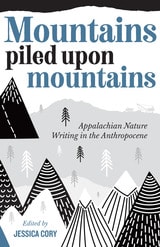
Mountains Piled upon Mountains
Appalachian Nature Writing in the AnthropoceneJessica Cory
West Virginia University Press, 2019
Mountains Piled upon Mountains features nearly fifty writers from across Appalachia sharing their place-based fiction, literary nonfiction, and poetry. Moving beyond the tradition of transcendental nature writing, much of the work collected here engages current issues facing the region and the planet (such as hydraulic fracturing, water contamination, mountaintop removal, and deforestation), and provides readers with insights on the human-nature relationship in an era of rapid environmental change.
This book includes a mix of new and recent creative work by established and emerging authors. The contributors write about experiences from northern Georgia to upstate New York, invite parallels between a watershed in West Virginia and one in North Carolina, and often emphasize connections between Appalachia and more distant locations. In the pages of Mountains Piled upon Mountains are celebration, mourning, confusion, loneliness, admiration, and other emotions and experiences rooted in place but transcending Appalachia’s boundaries.
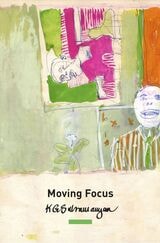
Moving Focus
Essays on Indian ArtK. G. Subramanyan
Seagull Books, 2024
Written between the early 1960s and the mid-1970s, the articles and lectures collected in Moving Focus reflect on some of the major concerns of the practicing artist and scholar of modern Indian art: tradition and modernism, the question of the image, and the use of art criticism. The collection also includes essays on the work of Rabindranath Tagore, Abanindranath Tagore, Binodebehari Mukherjee, Ramkinker Baij, and Amrita Sher-Gil. Together, they deal with the focal changes taking place in the contemporary art situation—a period of great significance in terms of cultural development, just about a decade and a half after India’s hard-won Independence—and seek to put them in perspective. The analytical essays of K. G. Subramanyan, one of India's most celebrated artists, remain as relevant and useful today as they were when this collection first appeared decades ago, and are perfectly suited to introducing the non-specialist to Indian modernism and its global concerns.
Subramanyan played a pivotal role in shaping India’s artistic identity after Independence. Mani-da, as he was fondly called, seamlessly blended elements of modernism with folk expression in his works, spanning paintings, murals, sculptures, prints, set designs, and toys. Beyond his visual artistry, his writings have laid a solid foundation for understanding the demands of art on the individual. In the year of his centenary, Seagull is proud to publish his writings in special new editions.

Murder and Its Consequences
Essays on Capital Punishment in AmericaLeigh B Bienen
Northwestern University Press, 2010
The essays in Murder and Its Consequences span several periods in the history of capital punishment in America and the professional career of Leigh Bienen, a leading researcher on the death penalty. “A Good Murder” describes the subtle relationship between high-profile murders and the death penalty, while “The Proportionality Review of Capital Cases” places the well-known study of proportionality in New Jersey within a nationwide context.
“Anomalies” suggests that the arcane protocols written for lethal injection have little to do with insuring humane executions, but rather are concerned with protecting the sensibilities of witnesses and the liability of corrections officials. Other essays address the groundbreaking developments surrounding the death penalty in Illinois, and take a retrospective look at the evolution of her own and the country’s thinking about this complex, divisive topic.
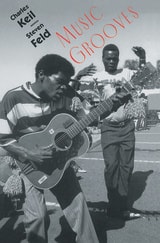
Music Grooves
Essays and DialoguesCharles Keil and Steven Feld
University of Chicago Press, 1994
Music Grooves ranges from jazz, blues, polka, soul, rock, world beat, rap, karaoke, and other familiar genres to major scholarly debates in music theory, ethnomusicology, and popular culture studies. The authors develop and create links between the fields of ethnomusicology and popular culture studies and relate the contents of musics from America, Greece, Cuba, Africa, and Papua New Guinea to artists as diverse as James Brown, Aretha Franklin, L'il Wally Jagiello, Bo Diddley, Walt Solek, Madonna, Paul Simon, Miles Davis, Thelonious Monk, and Billie Holiday.
Keil and Feld offer a fascinating view of the shaping of central ideas and terms in ethnomusicology such as "engendered feeling," "interpretive moves," "participatory discrepancies," "iconicity of style," "people's music," "schizophonia," and "lift-up-over sounding." From Keil's critique of Leonard Meyer's musicological approach to Feld's recent work on world beat, this volume covers an array of vital issues in media studies, musicology and ethnomusicology, popular culture, anthropology, and sociology. It will interest anyone concerned with the nature and meaning of music in the modern world.
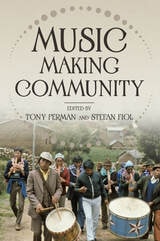
Music Making Community
Edited by Tony Perman and Stefan Fiol
University of Illinois Press, 2024
Making music offers enormous possibilities--and faces significant limitations--in its power to generate belonging and advance social justice. Tony Perman and Stefan Fiol edit essays focused on the forms of interplay between music-making and community-making as mutually creative processes. Contributors in the first section look at cases where music arrived in settings with little or no sense of community and formed social bonds that lasted beyond its departure. In the sections that follow, the essayists turn to stable communities that used musical forms to address social needs and both forged new social groups and, in some cases, splintered established communities. By centering the value of difference in productive feedback dynamics of music and community while asserting the need for mutual moral indebtedness, they foreground music’s potential to transform community for the better.
Contributors: Stephen Blum, Joanna Bosse, Sylvia Bruinders, Donna A. Buchanan, Rick Deja, Veit Erlmann, Stefan Fiol, Eduardo Herrera, David A. McDonald, Tony Perman, Thomas Solomon, and Ioannis Tsekouras
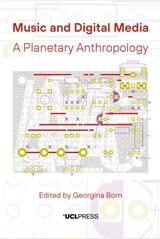
Music and Digital Media
A Planetary AnthropologyEdited by Georgina Born
University College London, 2022
Offering a radically new theoretical framework for understanding digital media through music, this volume redresses anthropology’s frequent oversight of music as a topic of study. By positioning music as an expansive subject for digital anthropology, Georgina Born demonstrates how the field can build interdisciplinary links to music and sound studies, digital media studies, and science and technology studies. Music and Digital Media includes five original ethnographies spanning pop, folk, and crossover musical genres throughout Kenya, Argentina, India, Canada, and the UK. A further three chapters engage experimentally with the platforms of music-making and distribution, presenting pioneering ethnographies of an extra-legal peer-to-peer site and the streaming platform Spotify, a series of prominent internet-mediated music genres, and the first ethnography of a global software package, the interactive music platform Max MSP.

Music in Black American Life, 1600-1945
A University of Illinois Press AnthologyCompiled by Laurie Matheson. Introduction by Sandra Jean Graham
University of Illinois Press, 2022
Eclectic and essential, Music in Black American Life, 1600–1945 offers specialists and students alike a gateway to the history and impact of Black music in the United States.
Contributors: R. Reid Badger, Rae Linda Brown, Samuel A. Floyd Jr., Sandra Jean Graham, Jeffrey Magee, Robert M. Marovich, Harriet Ottenheimer, Eileen Southern, Katrina Dyonne Thompson, Stephen Wade, and Charles Wolfe

Music in Black American Life, 1945-2020
A University of Illinois Press AnthologyCompiled by Laurie Matheson. Introduction by Tammy L. Kernodle
University of Illinois Press, 2022
Part sourcebook and part survey of historic music scholarship, Music in Black American Life, 1945–2020 collects groundbreaking work that redefines our view of Black music and its place in American music history.
Contributors: Nelson George, Wayne Everett Goins, Claudrena N. Harold, Eileen M. Hayes, Loren Kajikawa, Robin D. G. Kelley, Tammy L. Kernodle, Cheryl L. Keyes, Gwendolyn Pough, Bernice Johnson Reagon, Mark Tucker, and Sherrie Tucker
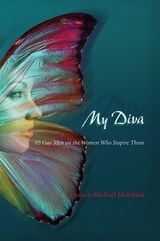
My Diva
65 Gay Men on the Women Who Inspire ThemEdited by Michael Montlack
University of Wisconsin Press, 2009
These witty and poignant short essays explore reasons for diva-worship as diverse as the writers themselves. My Diva offers both depth and glamour as it pays tribute with joy, intelligence, and fierce, fierce love.

My Father's House
On Will Barnet's PaintingThomas Dumm
Duke University Press, 2014
Dumm first became acquainted with Barnet and his paintings in 2008. Given his scholarly focus on the lives of ordinary people, he was immediately attracted to the artist's work. When they met, Dumm and Barnet began a friendship and dialogue that lasted until the painter's death in 2012, at the age of 101. This book reflects the many discussions the two had concerning the series of paintings, Barnet's family, his early life in Beverly, and his eighty-year career as a prominent New York artist. Reading the almost gothic paintings in conversation with the writers and thinkers key to both his and Barnet's thinking—Emerson, Spinoza, Dickinson, Benjamin, Cavell, Nietzsche, Melville—Dumm's haunting meditations evoke broader reflections on family, mortality, the uncanny, and the loss that comes with remembrance.
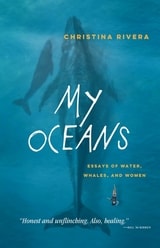
My Oceans
Essays of Water, Whales, and WomenChristina Rivera
Northwestern University Press, 2025
In a swell of sea-linked essays, Christina Rivera explores the kinship between marine animals, humans, and Earth’s blue womb. Rivera’s investigative questions begin with the toxic burden of her body and spiral out—to a grieving orca, a hunted manta ray, a pregnant sea turtle, a spawning salmon, an “endling” porpoise, and the “mother culture” of sperm whales—as she redefines what it means to mother and defend a collective future.
Braiding memoir with embodied climate science, Rivera challenges that it’s not anthropomorphism to feel deep connection to nonhuman species and proposes that gathering in collective grief is essential amid the sixth mass extinction. For ecofeminists, fans of Rachel Carson and Terry Tempest Williams—and for anyone who feels themself disintegrate in the presence of the sea—My Oceans offers a timely and wondrous descent into the deep waters of interconnection in which we swim.
My Poetics
Maureen N. McLane
University of Chicago Press, 2024
In My Poetics, Maureen N. McLane writes as a poet, critic, theorist, and scholar—but above all as an impassioned reader. Written in an innovative, conversable style, McLane’s essays illuminate her own poetics and suggest more generally all that poetics can encompass. Ranging widely from romantic-era odes and hymns to anonymous ballads to haikus and haibuns to modernist and contemporary poetries in English, My Poetics explores poems as speculative instruments and as ways of registering our very sense of being alive. McLane pursues a number of open questions: How do poems generate modes for thinking? How does rhyme help us measure out thought? What is the relation of poetry to its surroundings, and how do specific poems activate that relation?
If, as Wallace Stevens wrote, “poetry is the scholar’s art,” My Poetics flies under a slightly different banner: study and criticism are also the poet’s art. Punctuated with McLane’s poems and drawing variously on Hannah Arendt, Percy Bysshe Shelley, Roland Barthes, Bruno Latour, and other writers and poets, My Poetics is a formally as well as intellectually adventurous work. Its artful arrangement of readings and divagations shows us a way to be with poems and poetics.
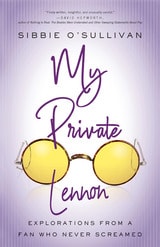
My Private Lennon
Explorations from a Fan Who Never ScreamedSibbie O'Sullivan
The Ohio State University Press, 2020
My Private Lennon charts the author’s realization that the Beatles, especially John Lennon, were a crucial force in her development. A radical departure from other books written by Beatles fans, My Private Lennon invites its readers to consider subjects not usually found in works about Lennon and the band, such as the constraints of memory, the male body, grief, the female breast, race, cultural issues, and the importance of privacy in our over-mediated world. In pieces that engage cultural issues and historical contexts, My Private Lennon creates a witty and provocative intimacy with readers who value the power of art to change one’s life and who love John Lennon and the Beatles.

My Race Is My Gender
Portraits of Nonbinary People of ColorStephanie Hsu
Rutgers University Press, 2024
Genderqueer and nonbinary people of color often experience increased marginalization, belonging to an ethnic group that seldom recognizes their gender identity and a queer community that subscribes to white norms. Yet for this very reason, they have a lot to teach about how racial, sexual, and gender identities intersect. Their experiences of challenging social boundaries demonstrate how queer communities can become more inclusive and how the recognition of nonbinary genders can be an anti-racist practice.
My Race is My Gender is the first anthology by nonbinary writers of color to include photography and visual portraits, centering their everyday experiences of negotiating intersectional identities. While informed by queer theory and critical race theory, the authors share their personal stories in accessible language. Bringing together Black, Indigenous, Latine, and Asian perspectives, its six contributors present an intergenerational look at what it means to belong to marginalized queer communities in the U.S. and feel solidarity with a global majority at the same time. They also provide useful insights into how genderqueer and nonbinary activism can both energize and be fueled by such racial justice movements as Black Lives Matter.

Myth and Southern History, Volume 1
The Old SouthEdited by Patrick Gerster and Nicholas Cords
University of Illinois Press, 1989