Results by title
3745 books match the query 'Europe' and 307 start with m
Marvelous Possessions
The Wonder of the New WorldStephen Greenblatt
University of Chicago Press, 2017
Marx and the French Revolution
François Furet
University of Chicago Press, 1988
With his early critique of Hegel, Marx started moving toward his fundamental thesis: that the state is a product of civil society and that the French Revolution was the triumph of bourgeois society. Furet's interpretation follows the evolution of this idea and examines the dilemmas it created for Marx as he considered all the faces the new state assumed over the course of the Revolution: the Jacobin Terror following the constitutional monarchy, Bonaparte's dictatorship following the parliamentary republic.
The problem of reconciling his theory with the reality of the Revolution's various manifestations is one of the major difficulties Marx contended with throughout his work. The hesitation, the remorse, and the contradictions of the resulting analyses offer a glimpse of a great thinker struggling with the constraints of his own system. Marx never did elaborate a theory of an autonomous state, but he never stopped wrestling with the challenge to his doctrine posed by late eighteenth-century France, whose changing conditions and successive regimes prompted some of his most intriguing and, until now, unexplored thought.
Marxism and the Interpretation of Culture
Edited by Cary Nelson and Lawrence Grossberg
University of Illinois Press, 1988
Mary Magdalene and Her Sister Martha
An Edition and Translation of the Medieval Welsh LivesJane Cartwright
Catholic University of America Press, 2013
Mary Wroth
The Countess of Montgomery's Urania (Abridged)Edited by Mary Ellen Lamb
Arizona Center for Medieval and Renaissance Studies, 2000
Masculine Figures
Fashioning Men and the Novel in Nineteenth-Century SpainNicholas Wolters
Vanderbilt University Press, 2022
Fictional masculinity performs a symbolic role in representing and negotiating the contradictions male novelists often encountered in their attempts to professionalize not only as writers, but also as businessmen, professors, lawyers, and politicians. Through specific and recurring figures like the student, the priest, the businessman, and the heir, male novelists portray and represent an increasingly middle-class world at odds with the values and virtues it inherited from an imperial Spanish past, and those it imported from more industrialized nations like England and France. The visual culture of the time and place marks the material turn in middle-class masculinity and sets the stage for discussions of race and sexuality.

Masculine Singular
French New Wave CinemaGeneviève Sellier
Duke University Press, 2008
Sellier draws on sociological surveys, box office data, and popular magazines of the period, as well as analyses of specific New Wave films. She examines the development of the New Wave movement, its sociocultural and economic context, and the popular and critical reception of such well-known films as Jules et Jim and Hiroshima mon amour. In light of the filmmakers’ focus on gender relations, Sellier reflects on the careers of New Wave’s iconic female stars, including Jeanne Moreau and Brigitte Bardot. Sellier’s thorough exploration of early New Wave cinema culminates in her contention that its principal legacy—the triumph of a certain kind of cinephilic discourse and of an “auteur theory” recognizing the director as artist—came at a steep price: creativity was reduced to a formalist game, and affirmation of New Wave cinema’s modernity was accompanied by an association of creativity with masculinity.
Masculinity and Danger on the Eighteenth-Century Grand Tour
Sarah Goldsmith
University of London Press, 2020
Goldsmith demonstrates that the Grand Tour was a means of constructing Britain’s next generation of leaders. Influenced by aristocratic concepts of honor and inspired by military-style leadership, elite society viewed experiences of danger and hardship as powerfully transformative and therefore as central to constructing masculinity. Scaling mountains, volcanoes, and glaciers, and even encountering war and disease, Grand Tourists willingly tackled a variety of perils. Through her study of these dangers, Goldsmith offers a bold revision of eighteenth-century elite masculine culture and the critical role the Grand Tour played within it.
Masses and Man
Nationalist and Fascist Perceptions of RealityGeorge L. Mosse
University of Wisconsin Press, 2024
Masses and Man comprises three parts. The first lays out a cultural history of nationalism, essentially the first of its kind, emphasizing the importance of sacred expressions like myths, symbols, and rituals as appropriated in a political context. The second zeroes in on fascism’s most dramatic irruptions in European history in the rise of Italian Fascism and the Nazi Party in Germany, elucidating these as not just political movements but also cultural and even aesthetic ones. The third part considers nationalism and fascism from the particular standpoint of German Jews.
Taken in full, the volume offers an eloquent summation of Mosse’s groundbreaking insights into European nationalism, fascism, and Jewish history in the twentieth century. A new critical introduction by Enzo Traverso helpfully situates Mosse’s work in context and exposes the many ways in which Masses and Man, first published in 1980, remains relevant today.
Mastering the Niger
James MacQueen's African Geography and the Struggle over Atlantic SlaveryDavid Lambert
University of Chicago Press, 2013

Masterpieces of History
The Peaceful End of the Cold War in Europe, 1989The National Security Archive Savranskaya
Central European University Press, 2010
Materials and Expertise in Early Modern Europe
Between Market and LaboratoryEdited by Ursula Klein and E. C. Spary
University of Chicago Press, 2010
It is often assumed that natural philosophy was the forerunner of early modern natural sciences. But where did these sciences’ systematic observation and experimentation get their starts? In Materials and Expertise in Early Modern Europe, the laboratories, workshops, and marketplaces emerge as arenas where hands-on experience united with higher learning. In an age when chemistry, mineralogy, geology, and botany intersected with mining, metallurgy, pharmacy, and gardening, materials were objects that crossed disciplines.
Here, the contributors tell the stories of metals, clay, gunpowder, pigments, and foods, and thereby demonstrate the innovative practices of technical experts, the development of the consumer market, and the formation of the observational and experimental sciences in the early modern period. Materials and Expertise in Early Modern Europe showcases a broad variety of forms of knowledge, from ineffable bodily skills and technical competence to articulated know-how and connoisseurship, from methods of measuring, data gathering, and classification to analytical and theoretical knowledge. By exploring the hybrid expertise involved in the making, consumption, and promotion of various materials, and the fluid boundaries they traversed, the book offers an original perspective on important issues in the history of science, medicine, and technology.
Materials of the Mind
Phrenology, Race, and the Global History of Science, 1815-1920James Poskett
University of Chicago Press, 2019
Phrenology was the most popular mental science of the Victorian age. From American senators to Indian social reformers, this new mental science found supporters around the globe. Materials of the Mind tells the story of how phrenology changed the world—and how the world changed phrenology.
This is a story of skulls from the Arctic, plaster casts from Haiti, books from Bengal, and letters from the Pacific. Drawing on far-flung museum and archival collections, and addressing sources in six different languages, Materials of the Mind is an impressively innovative account of science in the nineteenth century as part of global history. It shows how the circulation of material culture underpinned the emergence of a new materialist philosophy of the mind, while also demonstrating how a global approach to history can help us reassess issues such as race, technology, and politics today.

May '68
Donald M. Reid and Daniel J. Sherman, special issue editors
Duke University Press, 2018
Contributors: Ludivine Bantigny, Françoise Blum, Tony Côme, Boris Gobille, Bethany Keenan, Salar Mohandesi, Donald Reid, Sandrine Sanos, Daniel Sherman

May '68 and Its Afterlives
Kristin Ross
University of Chicago Press, 2002
Kristin Ross shows how the current official memory of May '68 came to serve a political agenda antithetical to the movement's aspirations. She examines the roles played by sociologists, repentant ex-student leaders, and the mainstream media in giving what was a political event a predominantly cultural and ethical meaning. Recovering the political language of May '68 through the tracts, pamphlets, and documentary film footage of the era, Ross reveals how the original movement, concerned above all with the question of equality, gained a new and counterfeit history, one that erased police violence and the deaths of participants, removed workers from the picture, and eliminated all traces of anti-Americanism, anti-imperialism, and the influences of Algeria and Vietnam. May '68 and Its Afterlives is especially timely given the rise of a new mass political movement opposing global capitalism, from labor strikes and anti-McDonald's protests in France to the demonstrations against the World Trade Organization in Seattle.
Measuring the New World
Enlightenment Science and South AmericaNeil Safier
University of Chicago Press, 2008
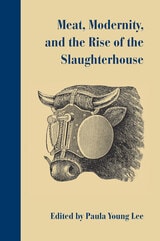
Meat, Modernity, and the Rise of the Slaughterhouse
Paula Young Lee
University of New Hampshire Press, 2008
Contributors include: Dorothee Brantz, Kyri Claflin, Jared Day, Roger Horowitz, Lindgren Johnson, Ian MacLachlan, Christopher Otter, Dominic Pacyga, Richard Perren, Jeffrey Pilcher, and Sydney Watts.
Meddling in Middle Europe
Britain and the 'Lands Between' 1919-1925Miklos Lojkó
Central European University Press, 2006
Media Amnesia
Rewriting the Economic CrisisLaura Basu
Pluto Press, 2018
Media Constrained by Context
International Assistance and Democratic Media Transition in the Western BalkansKristina Irion
Central European University Press, 2018

Media Freedom and Pluralism
Media Policy Challenges in the Enlarged EuropeBeata Klimkiewicz
Central European University Press, 2010

Media and Identity in Contemporary Europe
Consequences of global convergenceRichard Collins
Intellect Books, 1995
Because technological change in broadcasting has enabled us to open up media markets, the shape of media and of society has become more internationally-oriented. Indeed, modern international media has bought into question the very legitimacy of national communities and ideologies. And this is a phenomenon whose greatest impact has been in Europe.
These studies address the future of public service broadcasting and the power of national regulators to shape trans-national media relationships. The author takes an empirical approach to analysis of these issues, exploring media and communication studies very much as a social science.
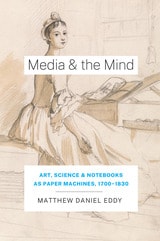
Media and the Mind
Art, Science, and Notebooks as Paper Machines, 1700-1830Matthew Daniel Eddy
University of Chicago Press, 2022
We often think of reason as a fixed entity, as a definitive body of facts that do not change over time. But during the Enlightenment, reason also was seen as a process, as a set of skills enacted on a daily basis. How, why, and where were these skills learned? Concentrating on Scottish students living during the long eighteenth century, this book argues that notebooks were paper machines and that notekeeping was a capability-building exercise that enabled young notekeepers to mobilize everyday handwritten and printed forms of material and visual media in a way that empowered them to judge and enact the enlightened principles they encountered in the classroom. Covering a rich selection of material ranging from simple scribbles to intricate watercolor diagrams, the book reinterprets John Locke’s comparison of the mind to a blank piece of paper, the tabula rasa. Although one of the most recognizable metaphors of the British Enlightenment, scholars seldom consider why it was so successful for those who used it. Each chapter uses one core notekeeping skill to reveal the fascinating world of material culture that enabled students in the arts, sciences, and humanities to transform the tabula rasa metaphor into a dynamic cognitive model. Starting in the home, moving to schools, and ending with universities, the book reconstructs the relationship between media and the mind from the bottom up. It reveals that the cognitive skills required to make and use notebooks were not simply aids to reason; rather, they were part of reason itself.
Media in Europe Today
Edited by Josef Trappel, Werner A. Meier, Leen d’Haenens, Jeanette Steemers, and Barbara Thomass for the Euromedia Research Group
Intellect Books, 2011
Media in Europe Today provides a comprehensive overview of European media in its current state of transformation. Through a focus on specific European media sectors, it assesses the impact of new technologies across industries and addresses a wide range of practices, strategies, and challenges facing European media today. The Euromedia Research Group has more than twenty years of experience in the observation of trends affecting media today, and this book marks the strong continuation of that long tradition.
Media, Monarchy and Power
Neil Blain and Hugh O'Donnell
Intellect Books, 2013

Media, Nationalism and European Identities
Karol Jakubowicz
Central European University Press, 2011

Mediating Culture in the Seventeenth-Century German Novel
Eberhard Werner Happel, 1647-1690Gerhild Scholz Williams
University of Michigan Press, 2014
Happel primarily lived and worked in the vigorous port city of Hamburg, which was a “media center” in terms of the access it offered to a wide library of books in public and private collections. Hamburg’s port status meant it buzzed with news and information, and Happel drew on this flow of data in his novels. His books deal with many topics of current interest—national identity formation, gender and sexualities, Western European encounters with neighbors to the East, confrontations with non-European and non-Western powers and cultures—and they feature multiple media, including news reports, news collections, and travel writings. As a result, Happel’s use of contemporary source material in his novels feeds our current interest in the impact of the production of knowledge on seventeenth-century narrative. Mediating Culture in the Seventeenth-Century German Novel explores the narrative wealth and multiversity of Happel’s work, examines Happel’s novels as illustrative of seventeenth-century novel writing in Germany, and investigates the synergistic relationship in Happel’s writings between the booming print media industry and the evolution of the German novel.
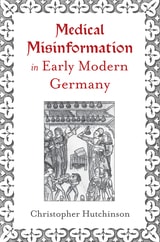
Medical Misinformation in Early Modern Germany
Christopher Hutchinson
University of Delaware Press, 2026
Medical Misinformation in Early Modern Germany examines how doctors, writers, and printers in sixteenth-century Germany responded to the rapid expansion of print and its implications for medical knowledge. The spread of printed texts generated widespread suspicion about print’s reliability as a conduit of information and led writers to reflect on questions of audience, vernacularity, and medical authority in their responses to disease. The book investigates literary texts alongside popular vernacular medical pamphlets on the major epidemic diseases of the period––plague, syphilis, and the English sweating sickness––to reveal a widespread concern with the impact of printed texts on public health. During the 1529 outbreak of the English sweating sickness, this concern culminated in writers’ use of a “rhetoric of virality,” explicitly comparing the circulation of texts to the spread of disease, as they confronted the parallel contagions of disease and information.
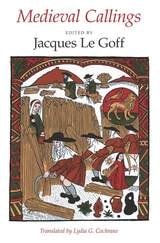
Medieval Callings
Edited by Jacques Le Goff
University of Chicago Press, 1990
The contributors focus on attitudes of medieval men and women toward their own society. Through a variety of techniques, from a reading of the Song of Roland to a reading of administrative records, they identify characteristic viewpoints of members of the fighting class, the clergy, and the peasantry. Along with vivid descriptions of what life was like for warrior knights, monks, high churchmen, criminals, lepers, shepherds, and prostitutes, this innovative approach offers a valuable new perspective on the complex social dynamics of feudal Europe.
"Very useful discussions of texts, both learned and literary."—Christopher Dyer, Times Literary Supplement
Contributors: Mariateresa Fumagalli Beonio Brocchieri, Franco Cardini, Enrico Castelnuovo, Giovanni Cherubini, Bronislaw Geremek, Aron Ja. Gurevich, Christiane Klapisch-Zuber, Jacques Le Goff, Giovanni Miccoli, Jacques Rossiaud, and André Vauchez.
Medieval Church Law and the Origins of the Western Legal Tradition
A Tribute to Kenneth PenningtonWolfgang P. Müller
Catholic University of America Press, 2006
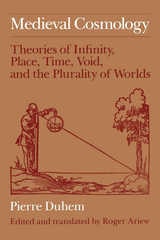
Medieval Cosmology
Theories of Infinity, Place, Time, Void, and the Plurality of WorldsPierre Duhem
University of Chicago Press, 1987
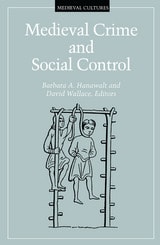
Medieval Crime and Social Control
Barbara A. Hanawalt
University of Minnesota Press, 1998
Uses historical and literary insights to consider crime and punishment in the Middle Ages.
Crime is a matter of interpretation, and never was this truer than in the Middle Ages, when societies faced with new ideas and pressures were continually forced to rethink what a crime was-and what was a crime. This collection undertakes a thorough exploration of shifting definitions of crime and changing attitudes toward social control in medieval Europe.
These essays-by leading specialists in European history and literature-reveal how various forces in medieval society interacted and competed in interpreting and influencing mechanisms for social control. They also demonstrate how well the different methods of history and literature combine to illuminate these developments.The essays show how the play with boundaries between legitimate and illegitimate actions took place not only in laws and courts, but also in the writing of social commentators such as John Fortescue and Jean Gerson, in the works of authors such as William Langland and Geoffrey Chaucer, and in popular literature such as sagas and romances. Drawing on a wide range of historical and literary sources-legal treatises, court cases, statutes, poems, romances, and comic tales-the contributors consider topics including fear of crime, rape and violence against women, revenge and condemnations of crime, learned dispute about crime and social control, and legal and political struggles over hunting rights. Their work shows how medieval society also defined its boundaries in contested spaces such as taverns and forests and in the different rules applying to the behavior and treatment of men and women.Contributors: Christopher Cannon, Oxford U; Elizabeth Fowler, Yale U; Louise O. Fradenburg, U of California, Santa Barbara; Claude Gauvard, Sorbonne; James H. Landman, U of North Texas; William Perry Marvin, Colorado State U; William Ian Miller, U of Michigan; Louise Mirrer, CUNY; Walter Prevenier, U of Ghent.ISBN 0-8166-3168-9 Cloth $49.95xxISBN 0-8166-3169-7 Paper $19.95x268 pages 5 7/8 x 9 JanuaryMedieval Cultures Series, volume 16Translation inquiries: University of Minnesota Press
Medieval Identity Machines
Jeffrey J. Cohen
University of Minnesota Press, 2003
A provocative new approach to medieval culture
In Medieval Identity Machines, Jeffrey J. Cohen examines the messiness, permeability, and perversity of medieval bodies, arguing that human identity always exceeds the limits of the flesh. Combining critical theory with a rigorous reading of medieval texts, Cohen asks if the category “human” isn’t too small to contain the multiplicity of identities. As such, this book is the first to argue for a “posthuman” Middle Ages and to make extensive use of the philosophical writings of Gilles Deleuze to rethink the medieval.
Among the topics that Cohen covers are the passionate bond between men and horses in chivalric training; the interrelation of demons, celibacy, and colonialism in an Anglo-Saxon saint’s life; Lancelot’s masochism as envisioned by Chrétien de Troyes; the voice of thunder echoing from Margery Kempe; and the fantasies that sustained some dominant conceptions of race. This tour of identity—in all its fragility and diffusion—illustrates the centrality of the Middle Ages to theory as it enhances our understanding of self, embodiment, and temporality in the medieval world.
Medieval Islam
A Study in Cultural OrientationGustave E. von Grunebaum
University of Chicago Press, 1946
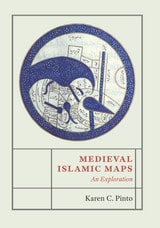
Medieval Islamic Maps
An ExplorationKaren C. Pinto
University of Chicago Press, 2016
Pinto focuses on the distinct tradition of maps known collectively as the Book of Roads and Kingdoms (Kitab al-Masalik wa al-Mamalik, or KMMS), examining them from three distinct angles—iconography, context, and patronage. She untangles the history of the KMMS maps, traces their inception and evolution, and analyzes them to reveal the identities of their creators, painters, and patrons, as well as the vivid realities of the social and physical world they depicted. In doing so, Pinto develops innovative techniques for approaching the visual record of Islamic history, explores how medieval Muslims perceived themselves and their world, and brings Middle Eastern maps into the forefront of the study of the history of cartography.
Medieval Jerusalem
Forging an Islamic City in Spaces Sacred to Christians and JewsJacob Lassner
University of Michigan Press, 2017
Examining Muslim historiography and religious lore in light of Jewish traditions about the city, Jacob Lassner points out how these reworked Jewish traditions and the imposing monumental Islamic architecture of the city were meant to demonstrate that Islam had superseded Judaism and Christianity as the religion for all monotheists. He interrogates the literary sources of medieval Islamic historiography and their modern interpreters as if they were witnesses in a court of law, and applies the same method for the arguments about the monuments of the city’s material culture, including the great archaeological discoveries along the south wall of the ancient Temple Mount.
This book will be of interest to a broad range of readers given the significance of the city in the current politics of the Near East. It will in part serve as a corrective to narratives of Jerusalem’s past that are currently popular for scholarly and political reasons.
Medieval Londoners
essays to mark the eightieth birthday of Caroline M. BarronEdited by Christian Steer and Elizabeth New
University of London Press, 2019
Medieval Manuscripts from Würzburg in the Bodleian Library
A Descriptive CatalogueDaniela Mairhofer
Bodleian Library Publishing, 2015
Presenting detailed descriptions of more than fifty of manuscripts, Medieval Manuscripts from Würzburg in the Bodleian Library, Oxford provides an authoritative catalog, including many important early copies of the manuscripts of church fathers during the Carolingian period. Daniela Mairhofer examines each from both a textual and paleographic point of view, paying careful attention to the provenance of the manuscript, as well as to physical characteristics like decoration and binding. Entries are accompanied by copious color plates.

Medieval Merchants and Money
Essays in Honour of James L. BoltonEdited by Matthew Davies
University of London Press, 2016
Medieval Misogyny and the Invention of Western Romantic Love
R. Howard Bloch
University of Chicago Press, 1991
Through analyses of a broad range of patristic and medieval texts, Bloch explores the Christian construction of gender in which the flesh is feminized, the feminine is aestheticized, and aesthetics are condemned in theological terms. Tracing the underlying theme of virginity from the Church Fathers to the courtly poets, Bloch establishes the continuity between early Christian antifeminism and the idealization of woman that emerged in the twelfth and thirteenth centuries. In conclusion he explains the likely social, economic, and legal causes for the seeming inversion of the terms of misogyny into those of an idealizing tradition of love that exists alongside its earlier avatar until the current era.
This startling study will be of great value to students of medieval literature as well as to historians of culture and gender.
Medieval Practices Of Space
Barbara A. Hanawalt
University of Minnesota Press, 2000
Interprets space and place in the medieval era.
Interprets space and place in the medieval era.
A glance at medieval maps tells us that cartographers of the Middle Ages divided space differently than we do today. In the great mappae mundi, for instance, Jerusalem takes center stage, with an image of the crucified Christ separating one place from another. The architects of medieval cathedrals manipulated space to clarify the roles and status of all who entered. Even in the most everyday context, space was allotted according to gender and class and was freighted with infinitely subtle meanings. The contributors to this volume cross disciplinary and theoretical boundaries to read the words, metaphors, images, signs, poetic illusions, and identities with which medieval men and women used space and place to add meaning to the world.Contributors: Kathleen Biddick, U of Notre Dame; Charles Burroughs, SUNY, Binghamton; Michael Camille, U of Chicago; Tom Conley, Harvard U; Donnalee Dox, U of Arizona; Jody Enders, U of California, Santa Barbara; Valerie K. J. Flint, U of Hull, UK; Andrzej Piotrowski, U of Minnesota; Daniel Lord Smail, Fordham U.Barbara A. Hanawalt is King George III Professor of British History at Ohio State University. Michal Kobialka is associate professor of theatre at University of Minnesota.
Medieval Scandinavia
From Conversion to Reformation, circa 800-1500Birgit Sawyer
University of Minnesota Press, 1993
Medieval Sovereignty
Marsilius of Padua and Bartolous of SaxoferratoFrancesco Maiolo
Eburon Academic Publishers, 2007
Medieval Views of the Cosmos
E. Edson and E. Savage-Smith
Bodleian Library Publishing, 2004
In the medieval world system—inherited by Christians and Muslims from the Greeks and Romans, and modified by their own religious tenets—spheres bearing the planets and stars wheeled around the earth, and at every level there was a moral lesson for humanity and a satisfying metaphor for the nature of God. The authors of this volume explain how the medieval view of the universe was harmonious on theological and practical levels, providing answers to the most puzzling of questions.
Medieval Views of the Cosmos is an engaging and beautifully illustrated introduction to a world where every moment was a theater of human drama directed by the hand of God.
Medieval Wellness
From Beauty to BloodlettingLarisa Grollemond
J. Paul Getty Trust, The, 0
Dispelling myths of a dirty, superstitious Middle Ages, this entertaining volume explores medieval approaches to health and wellness.
Often maligned as an era of darkness and superstition, the Middle Ages in Europe have been stereotyped as lacking standards for basic hygiene, or, at the very least, for having a laughably simplistic approach to self-care and medicine. With wit and expert analysis, medievalist Larisa Grollemond explores everyday practices and beliefs of medieval life. She uncovers a world as nuanced and self-aware as our own while playfully connecting traditions from the Middle Ages to modern wellness culture.
- Challenges misconceptions of medieval Europe with engaging, evidence-based insights into hygiene and healthcare practices.
- Answers popular questions about daily life, including bathing, cosmetics, contraception, and the realities of medieval medical treatments.
- Features over 130 illustrations of illuminated manuscripts, medieval artifacts, and other art works that bring the past vividly to life.
- Connects medieval wellness practices to contemporary self-care trends, offering surprising parallels and fresh perspective.
If you think the Middle Ages were primitive and unsophisticated, this book will change your mind. With Medieval Wellness, you’ll discover a world of care, curiosity, and complexity that will feel familiar to your own.
Medieval Women and Their Objects
Jenny Adams and Nancy Mason Bradbury, editors
University of Michigan Press, 2016
The opening section looks at how medieval authors imagined fictional and legendary women using particular objects in ways that reinforce or challenge gender roles. These women bring objects into the orbit of gender identity, employing and relating to them in a literal sense, while also taking advantage of their symbolic meanings. The second section focuses on the use of texts both as objects in their own right and as mechanisms by which other objects are defined. The possessors of objects in these essays lived in the world, their lives documented by historical records, yet like their fictional and legendary counterparts, they too used objects for instrumental ends and with symbolic resonances. The final section considers the objectification of medieval women’s bodies as well as its limits. While this at times seems to allow for a trade in women, authorial attempts to give definitive shapes and boundaries to women’s bodies either complicate the gender boundaries they try to contain or reduce gender to an ideological abstraction. This volume contributes to the ongoing effort to calibrate female agency in the late Middle Ages, honoring the groundbreaking work of Carolyn P. Collette.
Medieval Worlds
Barbarians, Heretics and Artists in the Middle AgesArno Borst
University of Chicago Press, 1992
Clearly interested in the forms of medieval behavior which gave rise to the seeds of modern society, Borst focuses on three in particular that gave momentum to medieval religious, social, and intellectual movements: the barbaric, heretical, and artistic. Borst concludes by reflecting on his own life as a scholar and draws out lessons for us from the turbulence of the Middle Ages.
Medieval and Early Renaissance Medicine
An Introduction to Knowledge and PracticeNancy G. Siraisi
University of Chicago Press, 1990
Medievalism, Popular Culture and Politics in Metal Music
The Case of Hispanic Epic ThemesAmaranta Saguar García
Intellect Books, 2026
Challenging the common view of metal music as just a form of Western pop culture, this innovative book draws attention to medievalizing epicism, a distinctive strand within metal that evokes the medieval and the epic in both aesthetics and sensibility. While often shaped by fantasy literature, cinema, and more recently, video games, this fascination with the medieval has deeper roots in nationalist ideologies. Through a rich exploration of Spain and Portugal’s transitions after their period of authoritarian rule, this book reveals how medievalizing epicism plays a key role in shaping nationalist and ethnocentric discourses, fascist narratives, and official efforts to foster patriotic sentiment, and how metal bands confront these origins.
Drawing on an impressive breadth of scholarship and a deep knowledge of metal music culture, Amaranta Saguar García skillfully weaves together diverse reference points without losing focus or clarity. This book invites both scholars and music fans to reflect more broadly on how metal music imagines and reuses medieval heritage.
Meditations on the Incarnation, Passion, and Death of Jesus Christ
Catharina Regina von Greiffenberg
University of Chicago Press, 2009
Read by Protestants and Catholics alike, Catharina Regina von Greiffenberg (1633–94) was the foremost German woman poet and writer in the seventeenth-century German-speaking world. Privileged by her social station and education, she published a large body of religious writings under her own name to a reception unequaled by any other German woman during her lifetime. But once the popularity of devotional writings as a genre waned, Catharina’s works went largely unread until scholars devoted renewed attention to them in the twentieth century.
For this volume, Lynne Tatlock translates for the first time into English three of the thirty-six meditations, restoring Catharina to her rightful place in print. These meditations foreground women in the life of Jesus Christ—including accounts of women at the Incarnation and the Tomb—and in Scripture in general. Tatlock’s selections give the modern reader a sense of the structure and nature of Catharina’s devotional writings, highlighting the alternative they offer to the male-centered view of early modern literary and cultural production during her day, and redefining the role of women in Christian history.