Results by title
3785 books match the query 'Poetry' and 149 start with m
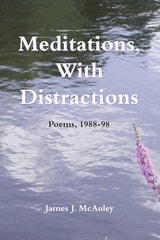
Meditations, With Distractions
Poems, 1988-1998James McAuley
University of Arkansas Press, 2001
At the center of James McAuley’s new collection—the work of over a decade since his previous book, Coming & Going, New & Selected—is the sequence, “God’s Pattern,” meditations on the Stations of the Cross, an old devotional form of pilgrimage or “pattern” still practiced in rural parishes of the poet’s native country, Ireland. Theme and treatment vary throughout the collection, from somber reflection on the fate of a drunk in a cheap hotel room, “Cantata for the Feast of St. Anonymous,” to the scathing Celtic-style satire, “The Gingriad.” McAuley is well regarded for his experiments with traditional forms and rhythms: examples included are blank-verse narratives and elegies, a Haiku sequence, sonnets, a variation on the topographical poetry of the seventeenth century, even a carmen figurata.
Meditations, With Distractions has the qualities that all good poetry should possess: depth, erudition, accessibility, a joy in the practice of language. Combine these qualities with McAuley’s humanity and humor, and the result is a collection that readers will come to enjoy and appreciate more and more with each successive reading.
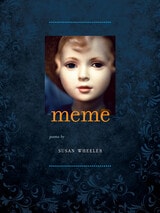
Meme
Susan Wheeler
University of Iowa Press, 2012
Wheeler reconstructs her mother’s voice—down to its cynicism and its mid twentieth-century midwestern vernacular—in “The Maud Poems,” a voice that takes a more aggressive, vituperative turn in “The Devil—or—The Introjects.” In the book’s third long sequence, a generational inheritance feeds cultural transmission in “The Split.” A set of variations on losses and break-ups—wildly, darkly funny throughout and, in places, devastatingly sad—“The Split” brings Wheeler’s lauded inventiveness, wit, and insight to the profound loss of love. One read, and the meme “Should I stay or should I go?” will be altered in your head forever.
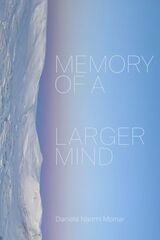
Memory of a Larger Mind
Daniela Naomi Molnar
Omnidawn, 2026
Poems written outdoors, in the presence of disappearing glaciers—a book of memory, grief, and transformation.
In her new poetry collection, Memory of a Larger Mind, Daniela Naomi Molnar sifts through memory and layered loss—planetary, cultural, familial, and personal—asking how we withstand and how we transform. These are plein air poems, written outdoors in the presence of disappearing glaciers and composed with shifting light, wind, sound, and scent: elegies and love songs, celebrations and laments. Braiding the slow death of glaciers with her grandmother's survival of the Holocaust, the book holds ecological and ancestral loss in a single frame. Alive to our current moment while keeping one foot in geologic time, Molnar exposes genocide and ecocide as expressions of the same logic, the same movement: ice to water to light, grief to love to joy to grief.
Memory of a Larger Mind is part of a larger interdisciplinary project that gathers pigments, language, and memory from “sacrifice zones”—glaciated landscapes, former concentration and incarceration camps, desecrated sacred sites—and transforms them into poems, paintings, and films. The result is work in which all bodies are understood as dynamic, part of a world in which difficult pasts might open toward more peaceful futures, and in which grief, handled with care, might shift to love.
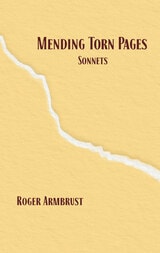
Mending Torn Pages
SonnetsRoger Armbrust
Parkhurst Brothers, Inc., 2021
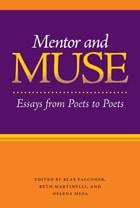
Mentor and Muse
Essays from Poets to PoetsEdited by Blas Falconer, Beth Martinelli, and Helena Mesa
Southern Illinois University Press, 2010
In Mentor and Muse, a collection of twenty-nine insightful essays by some of today’s leading poetic minds, editors Blas Falconer, Beth Martinelli, and Helena Mesa have brought together an illuminating anthology that draws upon both established and emerging poets to create a one-of-a-kind resource and unlock the secrets of writing and revising poetry.
Gathered here are numerous experts eager to share their wisdom with other writers. Each author examines in detail a particular poetic element, shedding new light on the endless possibilities of poetic forms. Addressed within are such topics as the fluid possibilities of imagery in poetry; the duality of myth and the personal, and the power of one to unlock the other; the surprising versatility of traditional poetic forms; and the pleasure of collaboration with other poets. Also explored in depth are the formative roles of cultural identity and expectations, and their effect on composition; advice on how to develop one’s personal poetic style and approach; the importance of setting in reading and meaning; and the value of indirection in the lyric poem. Challenges to conventional concepts of beauty are examined through Shakespeare’s sonnets, and the ghost of Longfellow is called upon to guide students through the rewards and roadblocks of writing popular poetry. Poetic persona is demystified through Newton’s law of gravity, while the countless permutations of punctuation are revealed with analysis of e. e. cummings and W. S. Merwin.
The essays include the full text of the poems discussed, and detailed, relevant writing exercises that allow students the opportunity to directly implement the strategies they have learned. While many advanced topics such as authenticity, discordant music, and prosody are covered, this highly readable volume is as user-friendly as it is informative. Offering a variety of aesthetics and approaches to tackling the issues of composition, Mentor and Muse takes poets beyond the simple stages of poetic terms and strategies. These authorsinvite students to explore more advanced concepts, enabling them to draw on the traditions of the past while at the same time forging their own creative paths into the future.
Chosen as one of the "Best Books for Writers" by Poets & Writers magazine
Mercy Mercy Me
Elena Georgiou
University of Wisconsin Press, 2003

Mercy Seat
Bruce Smith
University of Chicago Press, 1994

Meridian
Kathleen Jesme
Tupelo Press, 2012
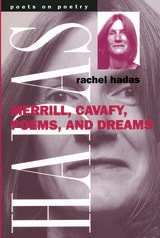
Merrill, Cavafy, Poems, and Dreams
Rachel Hadas
University of Michigan Press, 2000
The second half of the book combines explorations of various corners and horizons of the poetry scene, including neglected American poets and Hadas's thoughts on her own poetics and career. "Two Letters from New York" and "Tangled Web Sites" take bemused looks at literary or cultural landscapes. Hadas also looks inward: to dreams and dreamwork, to her dead mother's address book, to the emblematic drilling of a well in a country house. The range of selections includes essays, interviews, memoir, criticism, and a few of Hadas's own poems.
Rachel Hadas is the author of eleven books of poetry, essays, and translations. Her most recent book is Halfway Down the Hall: New and Selected Poems. She has received a Guggenheim Fellowship in Poetry and an American Academy-Institute of Arts and Letters Award in Literature, and is a member of the American Academy of Arts and Sciences. She is Professor of English at the Newark campus of Rutgers University.
Mesmerizingly Sadly Beautiful
Matthew Lippman
Four Way Books, 2020
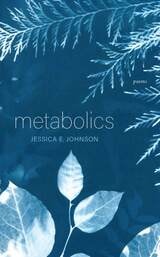
Metabolics
PoemsJessica E. Johnson
Acre Books, 2023
Metabolics, a book-length poem, borrows the movements of metabolic pathways to consider how nature accomplishes both balance and deep transformation. In visual figures and prose blocks that bridge the divide between poetry and nonfiction, Jessica E. Johnson employs scientific idioms to construct an allegory about a family in the Pacific Northwest. The region becomes a character in its own right, with cedars, moss, and heavy cloud knitting the mother, father, boy, and girl into their setting.
This far-reaching volume also serves as a study of the ecologies of contemporary parenting, with adults and children affected by “feeds” both on screen and off as their bodies metabolize food, the environment, and excess feelings such as rage. From climate change to kombucha to smartphones and curated produce, the smallest details of daily life in “Plasticland” catalyze a larger examination of selfhood: “Despite so many attempts to resolve this tension, sometimes you are you and also sometimes mother just as light can be both particle and wave.”
Meter Matters
Verse Cultures of the Long Nineteenth CenturyJason David Hall
Ohio University Press, 2011
Across the nineteenth century, meter mattered—in more ways and to more people than we might well appreciate today. For the period’s poets, metrical matters were a source of inspiration and often vehement debate. And the many readers, teachers, and pupils encountered meter and related topics in both institutional and popular forms.
The ten essays in Meter Matters showcase the range of metrical practice of poets from Wordsworth and Byron to Hopkins, Swinburne, and Tennyson; at the same time, the contributors bring into focus some of the metrical theorizing that shaped poetic thinking and responses to it throughout the nineteenth century. Paying close attention to the historical contours of Romantic and Victorian meters, as well as to the minute workings of the verse line, Meter Matters presents a fresh perspective on a subject that figured significantly in the century’s literature, and in its culture.
Meter in English
A Critical EngagementDavid Baker
University of Arkansas Press, 1997
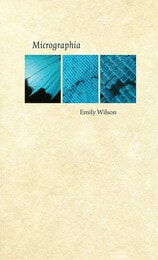
Micrographia
Emily Wilson
University of Iowa Press, 2009
Eight years after her revelatory first book, Emily Wilson deepens her focus and extends her vision in new poems of striking intelligence and originality. Venturing into landscapes both interior and exterior, Micrographia explores what Wilson calls “the complex rigged wildness” of geographical, emotional, and verbal states, a territory located “somewhere in that / enjambment within / a cave within the brain.” Following in the tradition of such poets as Dickinson, Bishop, and Ammons, Wilson’s work regards the mind as “enmeshed” with the natural world, always “at the hinge of going over.” Her way of speaking is as precisely calibrated and as restless as her way of seeing, and the terrain of Micrographia rises from a rich and unpredictable encounter with poetic language and form. At the same time, the voice of these poems is never less than urgent, “coming clear by the foment / moving through it.”
Wilson’s eye travels the troubled boundaries between visible and invisible worlds, ranging from coastal Nova Scotia to the Andean highlands to Brooklyn’s industrial Gowanus Canal to the poet’s own backyard. Steeped in tradition but spoken in tones that are utterly distinctive, these intricate poems enter into the microscopic, micrographic spaces between words and things, between thinking and being.
Midflight
David Corcoran
Four Way Books, 2022
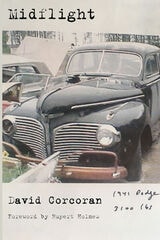
A posthumous collection, Midflight collects the poems written by beloved science editor and journalist David Corcoran in the latter part of his life. Idling in a space between the pastoral and the ordinary, Corcoran’s lyrical world maps the sublime mundanity of nature while exploring memory, dreams, and consciousness itself. Corcoran’s lines abound with figures living and long deceased, with the dead walking onstage as if they never left. Describing the accident that killed his father when he was a toddler in “Here,” Corcoran writes, “the door [opens] in midflight / and [pitches] him out.” In “Last Questions,” he asks, “Are you my brother or / a mockingbird?” While these haunting, vivid poems have an aching prescience, imbued as they are with the awareness of human ephemerality, the gift they proffer, to the writer and the reader at once, is the sense of finding oneself midflight, in midair, betwixt sky and ground, in the free fall of being—going and going and never gone.
Midland
PoemsKwame Dawes
Ohio University Press, 2000
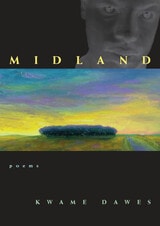
The winning manuscript of the fourth annual Hollis Summers Poetry Prize is also the exciting American debut by a poet who has already established himself as an important international poetic voice. Midland, the seventh collection by Kwame Dawes, draws deeply on the poet’s travels and experiences in Africa, the Caribbean, England, and the American South. Marked equally by a lushness of imagery, an urgency of tone, and a muscular rhythm, Midland, in the words of the final judge, Eavan Boland, is “a powerful testament of the complexity, pain, and enrichment of inheritance…It is a compelling meditation on what is given and taken away in the acts of generation and influence. Of a father’s example and his oppression. There are different places throughout the book. They come willfully in and out of the poems: Jamaica. London. Africa. America. But all the places become one place in the central theme and undersong here: which is displacement…The achievement of this book is a beautifully crafted voice which follows the painful and vivid theme of homelessness in and out of the mysteries of loss and belonging.”
Midland is the work of a keen and transcendent intellect, a collection of poems that speaks to the landscape from inside, from an emotional and experiential place of risk and commitment.
Midsummer Night's Toast
PoemsMamie Morgan
Ohio University Press, 2026
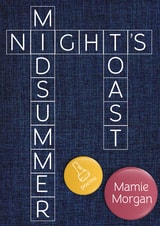
Midsummer Night’s Toast is a collection that answers to no one, a freedom we learn the speaker has finally afforded herself after a half-life spent under the glaring light of tradition, fear, of men, of institutions. She’s answered to her parents, to students, to academia, shame, to the workshop model, to various earlier versions of herself and is ready—in short—to have a good time. The invite list for this particular party belongs entirely to her: friends, street names, Kelly Ripa inside a crossword puzzle, bounced checks, hurricanes and Marilyn Hacker, frat boys and birds, bridal shops, Chaucer, the pictures her husband draws, King Arthur, Adrienne Rich. She’s sad for sure, and angry, but she’s also fierce as fire. At times these poems feel hurried, because they are. The landscape of this book feels like that penultimate moment in When Harry Met Sally when Billy Crystal says, “When you realize you want to spend the rest of your life with somebody, you want the rest of your life to start as soon as possible.” Mamie Morgan is reenacting a half-life of pain utilizing a kaleidoscope she’s crafted from discarded paper, felt, cheap gemstones, crayons worn to nubs, and mixtapes. Lots of mixtapes.
Midwhistle
Dante Di Stefano
University of Wisconsin Press, 2023
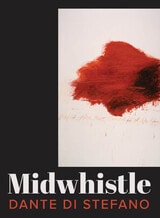
Di Stefano travels through a controlled stream of consciousness as he examines the weights of joy and grief. Bearing witness to the world, Midwhistle unfolds and refolds upon itself, touching on Hiroshima, Bergen-Belsen, Charlottesville, the sacoglossan sea slug, Darwin's Arch, and much more. Stylistically formal, the poem soars and dips, lightly and deftly finding the light in nighttime meditations, as the poet considers “our Unyet son, lemon-sized, / amniotic cosmonaut,” while imagining Heyen at his own age, “the thin black necktie of your / apprenticeship had not been / taken off yet.”
In these examinations we find the poet himself, faced always with a “blinking / cursor,” seeking in the words and lives of other poets what it really means to write poetry. Midwhistle, in its meandering self-reflection and loving expansiveness, is a celebration of the act of poetic creation itself.
your beloved.
—Excerpt from “xxiii. (interlude: prayer for Gaza)”
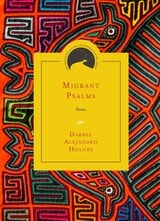
Migrant Psalms
PoemsDarrel Alejandro Holnes
Northwestern University Press, 2021
Migrant Psalms gives us a rare look inside a Panamanian experience of migration, describing the harsh realities of mothers, children, and teens who entered the United States—or tried to do so. Holnes’s poems find the universal through specificity; their exploration of expatriation, assimilation, and naturalization transcends the author’s personal experience to speak to what it means to be “other” anywhere.
The collection begins with “Kyrie,” a coming‑to‑America chronicle that spans three years in Texas, modeled after the liturgical Christian prayer Kyrie Eleison (Lord, have mercy). Other poems experiment with macaronic language and form to parallel shifts in the speaker’s status from immigrant to citizen, ending with “The 21st Century Poem,” which probes what’s “real” in today’s New York City. Through the speaker’s quest to become an American, this collection asks: Who are we becoming as individuals, as a society, as a nation, as a world? And is faith enough to enact change? Or is it just the first step?
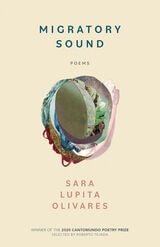
Migratory Sound
PoemsSara Lupita Olivares
University of Arkansas Press, 2020
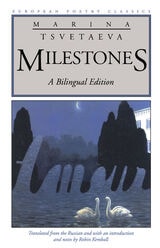
Milestones
A Bilingual EditionMarina Tsvetaeva, translated from the Russian by Robin Kemball
Northwestern University Press, 2003
Milestones lays out a sensual feast of moods, themes, styles, and rhythms—all the ingredients that would in time reveal Tsvetaeva as one of the most daring and original poets of her time.

Milk and Filth
Carmen Giménez Smith
University of Arizona Press, 2013
Adding to the Latina tradition, Carmen Giménez Smith, politically aware and feminist-oriented, focuses on general cultural references rather than a sentimental personal narrative. She speaks of sexual politics and family in a fierce, determined tone voracious in its opinions about freedom and responsibility.
The author engages in mythology and art history, musically wooing the reader with texture and voice. As she references such disparate cultural figures as filmmaker Lars Von Trier, Annie from the film Annie Get Your Gun, Nabokov’s Lolita, Facebook entries and Greek gods, they appear as part of the poet’s cultural critique.
Phrases such as “the caustic domain of urchins” and “the gelatin shiver of tea’s surface” take the poems from lyrical images to comic humor to angry, intense commentary. On writing about “downgrading into human,” she says, “Then what? Amorality, osteoporosis and not even a marble estuary for the ages.”
Giménez Smith’s poetic arsenal includes rapier-sharp wordplay mixed with humor, at times self-deprecating, at others an ironic comment on the postmodern world, all interwoven with imaginative language of unexpected force and surreal beauty. Revealing a long view of gender issues and civil rights, the author presents a clever, comic perspective. Her poems take the reader to unusual places as she uses rhythm, images, and emotion to reveal the narrator’s personality. Deftly blending a variety of tones and styles, Giménez Smith’s poems offer a daring and evocative look at deep cultural issues.
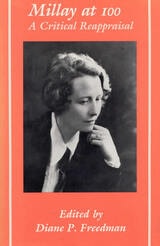
Millay At 100
A Critical ReappraisalDiane F. Freedman
Southern Illinois University Press, 1995
Though finding its occasion in the life of Millay— the centennial of the writer’ s birth— this volume refocuses attention on Millay’ s art by asking questions central to our present concerns: What in the varied body of Millay’ s work speaks to us most forcefully today? Which critical perspectives most illuminate her texts? How might those approaches be challenged, extended, or reoriented? In seeking the answers to such questions, the volume’ s contributors illuminate the means by which Millay’ s early success has been slighted and misunderstood and examine issues of personality, personae, critical stature, and formal experimentation in Millay’ s various genres: lyric poetry, the sonnet, verse drama, fiction, and the personal letter.
In 1920, following the publication of A Few Figs from Thistles, Millay was the "It girl" of American poetry. But by the late 1930s, her popularity waned as her critical reputation declined under the reign of high modernism and its critics. In fact, Millay, like others of her generation, had rejected modernist elitism in favor of public engagement, using her powerful public voice to plead for an end to the Sacco-Vanzetti trials as well as for U.S. entry into World War II. Condemned for both her politicizing and her political poetry, she was the first to admit that she and her poetry suffered in the service of public causes.
Grouped into four parts, these essays focus on Millay’ s relation to modernism, her revisionary perspectives on love, her treatment of time and of the female body, and her use of masquerade and impersonation in life and in art. Throughout, the essayists pose such questions as: Where is Millay’ s place in the literary histories of modern writing and in our hearts? How are we to value, interpret, and characterize the various forms and genres in which she wrote? What is the cultural work Millay achieves and reflects? How does she help us redefine modernism? What do Millay’ s great gifts enable us to see about genre, the social construction of gender, the definition of modernism, and the role of the poet?
Millay’ s considerable productivity, the range and virtues of her forms, and her experimentation clearly argue for a wide-ranging reappraisal of her work.
Millennial Teeth
Dan Albergotti
Southern Illinois University Press, 2014
Both bleak and bewildering, Millennial Teeth, the visceral new collection by poet Dan Albergotti, maps a contradictory journey filled with longing and dread, cynicism and hope. A heady mix of traditional forms and more experimental verse, Albergotti’s volume lures readers inexorably into the poet’s obsessions with mystery, doubt, ephemerality, and silence.
The poetry in Millennial Teeth will feel both refreshingly new and strangely familiar to Albergotti’s audience. Some poems pay direct tribute to such literary luminaries as Wallace Stevens and Philip Larkin, while others give nods to icons of pop culture, from Radiohead to Roman Polanski. The narrator muses on the resurrection of Christina the Astonishing, the works of Coleridge, and the mindless duties of minor players in Shakespeare’s Hamlet.
Yet these familiar faces are not our friends; they are juxtaposed with the heartbreaking apocalypses, both natural and man-made, that have plagued the world since the first plane flew into the World Trade Center. A reluctant witness to such events, the narrator of these poems attempts to navigate his own personal crises, including the mental illness and dementia of loved ones and the inability to connect with others, from the darkness of a personal orbit far from the sun. As he vehemently rejects the notions of religious succor, immortality, and the passive acceptance of fate, he simultaneously yearns to be proven wrong. Yet despite his trials, Albergotti’s narrator maintains a gallows humor and wry insight that balance his despair.
A riveting exploration of the all-too-human struggle between faith and doubt, skepticism and obsession, Millennial Teeth has both heart and bite in plenty.
Millions of Suns
On Writing and LifeSharon Fagan McDermott and M. C. Benner Dixon
University of Michigan Press, 2023
With decades of combined teaching experience, McDermott and Benner Dixon share practical craft-of-writing advice with the reader, including over fifty engaging writing prompts to spark the creative process. These prompts guide readers toward the freedom and joy that comes with finding one’s authentic voice. Embracing both the painful and the playful, Millions of Suns is an ideal text for classrooms, professional development, or daily writing practice. Through humor, lyricism, and poignancy, the fundamental message of the book remains the same for newcomers and career authors, whether they write poetry, fiction, non-fiction, or memoir. Let Millions of Suns open a door for you into your creative work, inviting imagination, memory, and inspiration into your writing life.
Milton's Epic Voice
The Narrator in Paradise LostAnne Ferry
University of Chicago Press, 1983
Milton's Modernities
Poetry, Philosophy, and History from the Seventeenth Century to the PresentEdited by Feisal G. Mohamed and Patrick Fadely
Northwestern University Press, 2017
Bristling with insights on Milton’s major works, Milton’s Modernities offers fresh perspectives on the thinkers central to our theorizations of modernity: from Lucretius and Spinoza, Hegel and Kant, to Benjamin and Deleuze. At the volume's core is an embrace of the possibilities unleashed by current trends in philosophy, variously styled as the return to ethics, or metaphysics, or religion. These make all the more visible Milton’s dialogues with later modernity, dialogues that promise to generate much critical discussion in early modern studies and beyond.
Such approaches necessarily challenge many prevailing assumptions that have guided recent Milton criticism—assumptions about context and periodization, for instance. In this way, Milton’s Modernities powerfully broadens the historical archive beyond the materiality of events and things, incorporating as well intellectual currents, hybrids, and insights.
Minding the Sun
Robert Pack
University of Chicago Press, 1996
The opening section marks a return for Pack to the musical sensuality of the lyric. These short lyrics are uniquely his: the sequence begins in Vermont and concludes in the Andromeda galaxy, providing an opportunity to hold in mind the nurturing sun of our solar system.
The poems of the collection's middle section, written in the flowing narrative and meditative mode familiar to Pack's many admirers, take up the themes of human sexuality and consciousness. And the final section, replete with puns and paradoxes, shows Pack at his most playful as he muses on art, technology, romantic and marital desire, and the stubborn longing for transcendence. The poet concludes the volume with a sobering plea, "The Trees Will Die," to heed the sun's example, to cherish and protect our planet and all its living things.
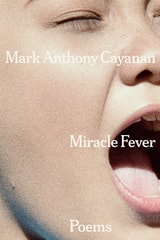
Miracle Fever
PoemsMark Anthony Cayanan
Northwestern University Press, 2027
Poetically delving into the spectacle and incredulity of a real-life religious controversy
In the early 1990s, a small town in the Philippines became the epicenter of religious controversy when a teenager claimed to be visited by the Virgin Mary. News of these visions, broadcast over national media, would prompt over a million to flock to the town, hoping to catch a glimpse of the teenager and witness inexplicable events: a statue of the Virgin weeping blood, the sun dancing and throbbing into various fantastic colors, or a bevy of doves appearing overhead during Mass.
Miracle Fever, chronicling the life of this town, is a poetry sequence revolving around these apparitions. Documentary in its scrutiny and distortion of real-life events, novelistic in its plot trajectory, and lyric in its imagistic intensity, Miracle Fever offers a fabulist model of reality, built through poems delivered in the form of dramaticules, timelines, and photo captions. These fugitive presences, bearing out and unsettling the complex ethics of representation that the sequence cleaves to, foreground the element of spectacle surrounding the apparitions and bring new light to the ever-shifting antecedents bound by shared history.
Miracle Fruit
Aimee Nezhukumatathil
Tupelo Press, 2003
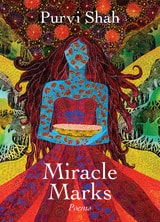
Miracle Marks
PoemsPurvi Shah
Northwestern University Press, 2019
In her second full-length poetry collection, Miracle Marks, activist Purvi Shah charts women’s status through pointed explorations of Hindu iconography and philosophy and powerful critiques of American racism. In these searing, revelatory poems, Shah reminds us that surviving birth as an infant girl and living as a woman is miraculous—as such, every girl is a miracle mark. And because education is often denied to girls, writing by women is a miracle.
In Miracle Marks, Shah probes belonging, devotion, and social inequity, delving into what it means to be a woman, and what it means to be. Through sound energy and white space, these poems chart multiple realities, including the miracles of women’s labors and survivals. This collection spurs dialogue across audiences and communities and lights a way for brown girls and women who relish in spirit, intellect, politics, and justice.
Miraculous Simplicity
Essays on R.S. ThomasWilliam V. Davis
University of Arkansas Press, 1993
In the autobiographical essay, Thomas reveals his passion for his homeland and his ever-present hunger for spiritual and natural exploration:
those rocks, I certainly was reminded of the transience of human existence,
and my own in particular. As Pindar put it: “A dream about a
shadow is man.” I began to ponder more the being and nature of God
and his relation to the late twentieth-century situation, which science and
technology had created in the western world. Where did the ancient
world of rock and ocean fit into an environment in which nuclear physics
and the computer were playing an increasingly prominent part? . . .
Misery Islands
January Gill O’Neil
CavanKerry Press, 2014
Misery Prefigured
J. Allyn Rosser
Southern Illinois University Press, 2001
In her second collection of poems, J. Allyn Rosser explores the human condition in all its gloriously valiant pathos. Misery Prefigured dwells on our continual reinventions of self and world and the restless dynamic that vibrates between them.Whether contemplating a failed marriage, a visit from God, or a pearl dropped into a bottle of Prell shampoo, Rosser's wry yet impassioned eye looks hard for a habitable and abiding truth. Alternating between deadpan and dead serious, these poems are often darkly funny, exposing the contradictions inherent in every desire. Misery Prefigured is fueled by a cocky, unsentimental determination to make some consolatory sense of what passes for reality.
Miss Carrie
A NovelJudson N. Hout
Parkhurst Brothers, Inc., 2013
“Set in Arkansas during World War II, Hout’s touching story of an orphaned boy's relationship with the inhabitant of a small town's "haunted house” will keep you guessing, right up to the satisfying ending. Another endearing novel from Judson Hout."
--Cindy Ward, Dallas, Texas
Missing Measures
Modern Poetry and the Revolt Against MeterTimothy Steele
University of Arkansas Press, 1990
By the close of the nineteenth century, many poets had abandoned rhyme and meter in favor of “free verse.” Nearly one hundred years later, a growing number of younger poets are reclaiming traditional conventions of prosody by composing rhymed and measured poetry.
Missing Measures is the first full articulation of the aesthetics of this new movement. Timothy Steele, one of the best of those poets who are sometimes called the “New Formalists,” treats his subject against a backdrop of the long history of ideas about poetry, formulated first by the ancients and re-examined and re-interpreted by subsequent writers.
Steele offers a new perspective on the wholesale departure from tradition proclaimed in modernist critical justifications. A rare marriage of clear writing, careful scholarship, and bold thinking, Missing Measures provides a vital new movement with a critical manifesto.
Mistaking Each Other for Ghosts
Lawrence Raab
Tupelo Press, 2015

Mister Martini
Richard Carr
University of North Texas Press, 2008
Mixed Company
Alan Shapiro
University of Chicago Press, 1996
"What draws us into Alan Shapiro's Mixed Company is not a conspicuous felicity or any sort of bravura, but the quiet, undaunted way he goes after the truth of human feeling and motive. . . . The poems grope and conjecture, looking for understanding . . . but whatever may remain unsolved and insoluble, the poems are full of astonishing insights, a rare articulateness, and what another age called 'knowledge of the human heart.'" —Richard Wilbur

Modern Swedish Prose in Translation
Karl Erik Lagerlof, Editor
University of Minnesota Press, 1979
Modern Swedish Prose in Translation was first published in 1979. Minnesota Archive Editions uses digital technology to make long-unavailable books once again accessible, and are published unaltered from the original University of Minnesota Press editions.
These excerpts from Swedish prose works - mostly novels - reflect major shifts in mood and style in the 25 years since 1950. Editor Karl Erik Lagerlof traces cultural and political developments in Sweden from the post-World War II era, when writers felt themselves in a world devoid of political meaning and rejected realism as a literary mode, down to the intensely political years of the Vietnam era. The selections in this anthology range from the anti-ideological works of the postwar years to recent documentary methods influenced by Marxism, structuralism, and a renewed political consciousness.
Modernism the Morning After
Bob Perelman
University of Alabama Press, 2017
Modernism the Morning After is a superb, lively, engaging series of essays and talks, dating from 1995 to 2016, by the eminent scholar, critic, and poet Bob Perelman. Throughout his career, Perelman has focused on the persistence of modernist ambition in poetry, with all of its admirable articulations and tragicomic short-circuits. Poetry, it turns out, is not simply “news that stays news,” as Ezra Pound postulated. Instead, as Perelman demonstrates, poetry often gropes toward whatever news can be found in the broader contexts of public speech—the cultural commons, the almost-real or much-too-real language of people and our hyperactive media.
Working in a variety of modes from the poetic to the dramatic to the conversational, and ranging across an expansive historical register from Dickinson, Whitman, and Dunbar in the nineteenth century to Kenneth Goldsmith and Stephen Colbert in the twenty-first, Perelman’s readings are unfailingly illuminating and, in many cases, his witty expositions take us strikingly close to the original intent of the text concerned.
Perelman also places intermittent, yet artful, pressure on some basic questions about the very nature of poetry. What does the transcription of poems tell us about them? How do hoaxes like the Ern Malley affair compel us to reconsider fundamental assumptions about what constitutes “authentic” poetry? How does the bathetic register relate to tones and idiom in recent poetic production? In Modernism the Morning After, Perelman writes as a poet, teacher, and critic, addressing a broad audience of readers and writers without choosing between them, inviting all to consider along with him modernism’s future through a dynamic consideration of its past.
Modernity
Clarence Major
Tupelo Press, 2027
From the barbershop to the railroad track, from the museum to the waiting room, this collection invites us to see through the eyes of one of the greatest living American poets.
In Modernity, Clarence Major brings his painter's eye and poet's precision to the ordinary landscapes of contemporary life, transforming everyday encounters into moments of revelation. Moving effortlessly among museums, city streets, family memory, dreams, travel, and ritual, these quietly luminous poems discover beauty, humor, melancholy, and resilience in the fleeting textures of modern experience. Animated by keen observation and philosophical wit, Modernity reflects on art, aging, love, race, memory, and the passage of time without sacrificing the immediacy of lived perception. The result is a deeply humane collection from one of America's most distinguished literary voices, celebrating the extraordinary that persists within the ordinary.
Modes of Viewing in Hellenistic Poetry and Art
And ArtGraham Zanker
University of Wisconsin Press, 2003
Taking a fresh look at the poetry and visual art of the Hellenistic age, from the death of Alexander the Great in 323 B.C. to the Romans’ defeat of Cleopatra in 30 B.C., Graham Zanker makes enlightening discoveries about the assumptions and conventions of Hellenistic poets and artists and their audiences.
Zanker’s exciting new interpretations closely compare poetry and art for the light each sheds on the other. He finds, for example, an exuberant expansion of subject matter in the Hellenistic periods in both literature and art, as styles and iconographic traditions reserved for grander concepts in earlier eras were applied to themes, motifs, and subjects that were emphatically less grand.
Moling in Meditation
A Psalter for an Early Irish MonkPaul Murray
St. Augustine's Press, 2021
Jeremy Driscoll, O.S.B. Abbot of Mount Angel Abbey
Paul Murray’s poetry is always a miracle of compression and economy without ever seeming sparse or austere. These luminous meditative pieces have the richness that comes from an intent focus on the everyday and the material as carrying immeasurable grace.
Rowan Williams, Former Archbishop of Canterbury
The present work contains poems and meditations voiced by Paul Murray for Moling, an Irish monk and poet of the 7th century. In the Irish tradition, Moling is the figure who most resembles St Francis of Assisi. He is a man, a saint, whose presence resists linear history, who yet walks toward us in wonder and myth. In Moling in Meditation, the poems, though quiet in their form and expression, represent nevertheless a fresh and, at times, bold exploration of states of soul and psyche which, in almost every age, accompany the spiritual journey.
Money and Modernity
Pound, Williams, and the Spirit of JeffersonAlec Marsh
University of Alabama Press, 1998
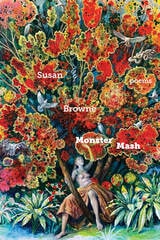
Monster Mash
Susan Browne
Four Way Books, 2025
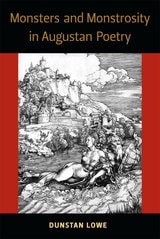
Monsters and Monstrosity in Augustan Poetry
Dunstan Lowe
University of Michigan Press, 2015
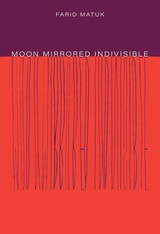
Moon Mirrored Indivisible
Farid Matuk
University of Chicago Press, 2025
An inheritor of lineages marked by colonial and gendered violence, Farid Matuk approaches the musical capacities of verse not as mere excitation or decoration, but as forms that reclaim pleasure and presence. Entering the sonic constellations of Moon Mirrored Indivisible, the reader finds relief from nesting layers of containment that systems of power impose on our bodies and imaginations. In this hall of historical mirrors, fictions of identity are refracted, reflected, and multiplied into a vast field of possibilities. Matuk’s meditations on place and power offer experiments in self-understanding, moving through expansive conversations between a lyric “I” and others, including poets, the speaker’s partner, ancestors, and the reader, and creating spaces for strange intimacy. Each of the book’s four sections of poems builds on the other to ask how we might form a collective—a people—not founded in orthodoxies of originality but in the mutual work of mirroring one another.
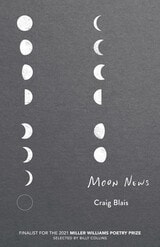
Moon News
Craig Blais
University of Arkansas Press, 2021
Finalist, 2022 Housatonic Book Awards
Craig Blais’s Moon News, a finalist for the 2021 Miller Williams Poetry Prize, deploys the sonnet form to treat subjects as diverse as Gregor Samsa, SpongeBob SquarePants, and the cosmos. Here the form’s capaciousness is engaged to full effect. Blais, who turned to the sonnet as a method for focusing on the present in the early days of his recovery from alcoholism, confronts personal demons, loss, and the possibility for healing. These aren’t your grandmother’s sonnets—though you might find her pea soup recipe or sex tape in this remarkable second collection.
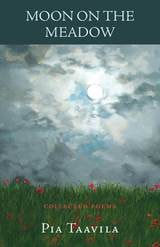
Moon on the Meadow
Collected PoemsPia Taavila-Borsheim
Gallaudet University Press, 2008
As a child of deaf adults (CODA), Pia Taavila first learned to communicate when her deaf father fingerspelled the names of toys in her crib and her mother showed her the signs for objects in picture books. From this primary visual orientation, in combination with her own innate sense of imagery, Taavila crafted the lush verse featured in Moon on the Meadow: Collected Poems.
Taavila uses the graphic power of her poetry to evoke emotions about all aspects of existence — love, loss of love, family, death, and desire — feelings elicited through a lens attuned to the simple beauty of the natural. Most of the poems in Moon on the Meadow have been published at least once in established journals, testimony to the broad appeal of her passionate outlook on life. Yet, Taavila believes that her experiences as a CODA are essential to her ability to write at all. She never strays far from her home, her family, and the comforts they bring her through her art:
At a wedding, a flautist’s
languid notes lilt on the air.
My mother, who cannot hear,
leans forward, attentive
to the dip and sway of his body.
She signs to me:
It sounds like butterflies